

LVLUP Health uses real technologies, BPC-Arginine and SNAC, but their >90% bioavailability claim has no human clinical trial support. Honest teardown.
LVLUP Health is one of the most technically sophisticated oral peptide brands on the market right now, and that's a genuine compliment worth starting with. Before we get into the specifics, it's worth reading this alongside our breakdown of evidence-based peptide protocols. Most oral peptide companies sell plain capsules with no serious thought given to what happens between your mouth and your blood. LVLUP uses real absorption technologies: BPC-157 in arginate salt form and SNAC (salcaprozate sodium, the absorption enhancer found in Rybelsus, Novo Nordisk's FDA-approved oral diabetes medication). This content is published for research purposes only.
The full picture is more complicated. Their technology is real, their bioavailability claims (how much of what you swallow actually reaches your bloodstream) are extraordinary, and the human clinical evidence to back those specific numbers doesn't currently exist.
Key Takeaways
- LVLUP Health uses real absorption technologies, BPC-157 arginate salt and SNAC, and is genuinely more sophisticated than most oral peptide supplement brands. That's honest credit, not a softened critique.
- The >90% oral bioavailability claim for BPC-arginate traces to a 2014 patent by the original research group, not a published peer-reviewed human pharmacokinetic trial. A patent is a hypothesis about what's possible, not a confirmed outcome.
- SNAC is real technology with FDA-validated clinical use in Rybelsus. But LVLUP's description of how it works (paracellular transport) differs from SNAC's validated mechanism (transcellular, gastric absorption). The distinction matters for evaluating what their capsule can realistically do.
- The current ceiling for commercial oral peptide bioavailability, set by pharmaceutical-grade Rybelsus with Novo Nordisk's full engineering behind it, is 0.8 percent (Overgaard et al. 2021, PMID 33969456). LVLUP's implied claims exceed this by orders of magnitude, without published human trial data.
- LVLUP products contain real, tested ingredients and are not selling counterfeit material. The honest gap is between what's in the capsule and what the gut allows through: a gap that arginate and SNAC narrow, but the current evidence doesn't confirm they eliminate.
- Sublingual delivery removes the gut from the equation rather than optimising within it. It's a different category of solution, not an incremental one.
Want to see what a gut-bypass delivery approach looks like in practice? Explore the RESTORE Protocol →
This content is published for research purposes only and does not constitute medical advice. It is not intended to diagnose, treat, cure, or prevent any disease. Anyone considering a peptide research protocol should consult a qualified clinician before beginning.
What Is LVLUP Health?
LVLUP Health was founded in Australia in 2020 by Kyal Van Der Leest, a nutritionist and naturopath. Products are formulated and manufactured in California, and every batch goes through third-party testing, a quality baseline many supplement brands skip entirely. They sell direct-to-consumer and through clinics and health stores worldwide.
Their product range centres on peptides:
- Wolverine, BPC-157 Arginate + TB4 Fragments + PEA + SNAC ($219.99 for 30 servings)
- BPC-ARG Double Strength, BPC-arginate with pH buffering ($169.99)
- Ultimate GI Repair, BPC-157 combined with zinc carnosine, larazotide acetate, and KPV tripeptide
- Re-Generate, BPC-157 arginate-centered recovery formula
Van Der Leest has built a genuine following in biohacker and functional medicine circles, and the brand has real practitioners stocking it. This isn't a fly-by-night operation selling mislabelled powder in a capsule.
The BPC-Arginine Claim: Real Chemistry, Thin Evidence
LVLUP's central differentiator is this: standard BPC-157 in acetate form has poor oral bioavailability, less than 3% by their own framing. BPC-157 in arginate (arginine salt) form, they claim, achieves greater than 90%. If true, that's a roughly 30-fold improvement from a capsule you swallow.
The chemical logic is at least plausible. Arginine salt forms of peptides can improve stability in acidic environments, and research suggests structural modifications to peptides can meaningfully improve their gastrointestinal survival, which is why pharmaceutical companies pursue them actively (Renukuntla et al. 2013, Int J Pharm, PMC3680128). The theoretical case: wrapping BPC-157's 15-amino-acid chain in an arginine salt shields it from gastric acid, keeps more of the structure intact through the stomach, and improves solubility downstream.
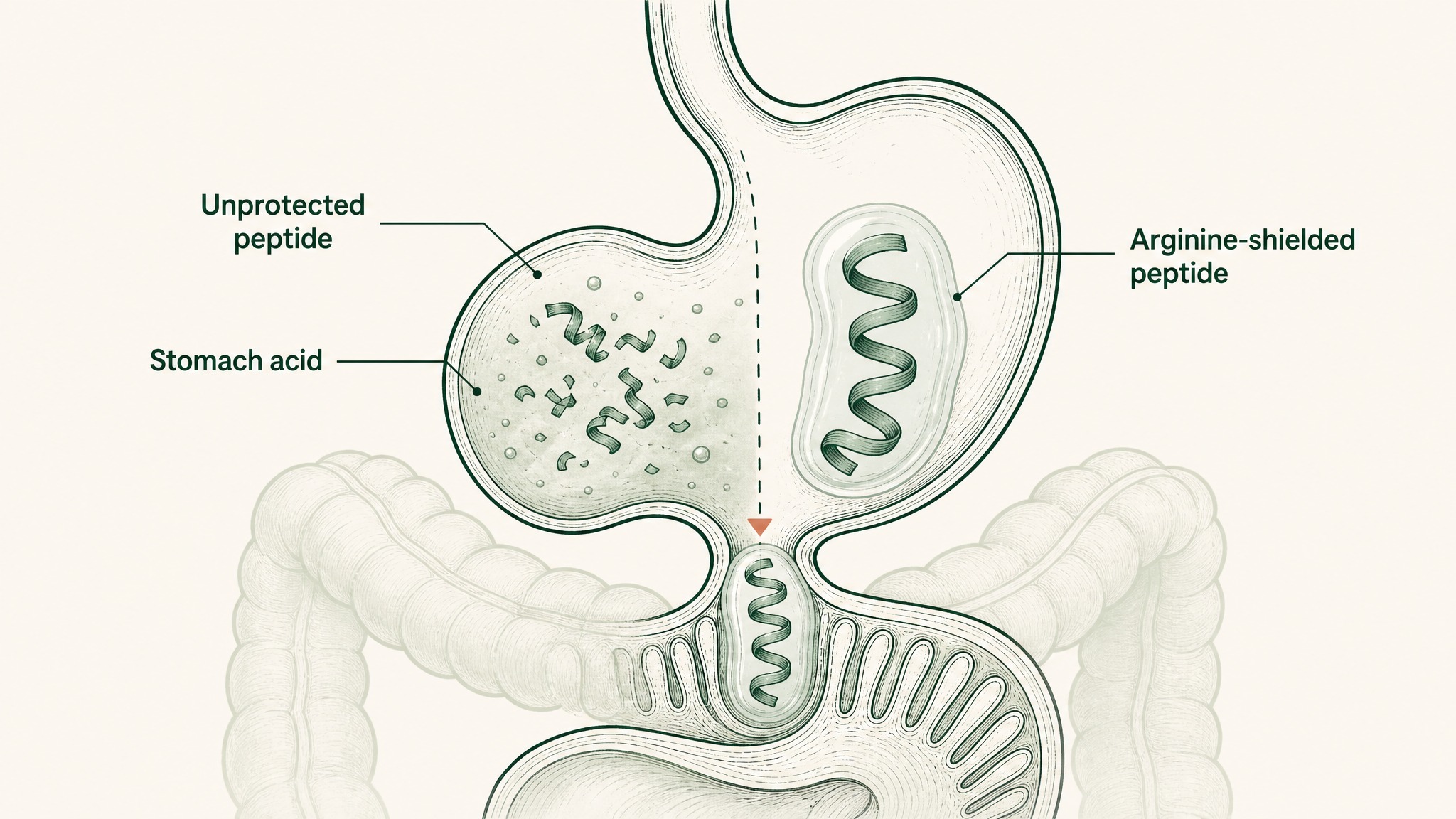
How an arginine salt coating might protect BPC-157 from stomach acid during digestion.
Here's where the story gets complicated:
The evidence trail for the >90% claim:
- The figure originates from a 2014 patent filed by the original BPC-157 research group in Slovenia
- Patents describe what compounds can theoretically do under optimised lab conditions, not what they do in humans buying capsules from a website
- No published, peer-reviewed human pharmacokinetic study has independently confirmed this number for any BPC-arginate formulation
That third point is the whole issue. No dietary supplement has demonstrated greater-than-90% oral peptide bioavailability in a peer-reviewed human clinical trial. That figure would exceed many injectable preparations and represent a genuine scientific breakthrough worthy of a major pharmaceutical publication. The absence of that publication is meaningful.
SNAC: The Technology Behind Rybelsus, and What LVLUP's Version Actually Does
Salcaprozate sodium, SNAC, is the absorption enhancer Novo Nordisk uses in Rybelsus, the FDA-approved oral form of semaglutide (the GLP-1 compound also sold as Ozempic). It's not a marketing term; it's a real, clinically validated compound with FDA regulatory history. LVLUP includes SNAC in Wolverine, citing it as the mechanism getting BPC-157 and TB4 Fragments across the gut wall.
The problem is how they describe it. LVLUP's ingredient page classifies SNAC as working via "paracellular transport," meaning it allegedly opens gaps between intestinal cells to let peptides through. But SNAC's validated mechanism in Rybelsus is different: it works transcellularly (through cells, not between them), creating a localised pH rise in the stomach that allows semaglutide to absorb through the stomach wall before it reaches the small intestine's enzymatic environment. That's a precise mechanism Novo Nordisk developed specifically for semaglutide over years of pharmaceutical engineering. The paracellular story is a different compound's mechanism entirely.
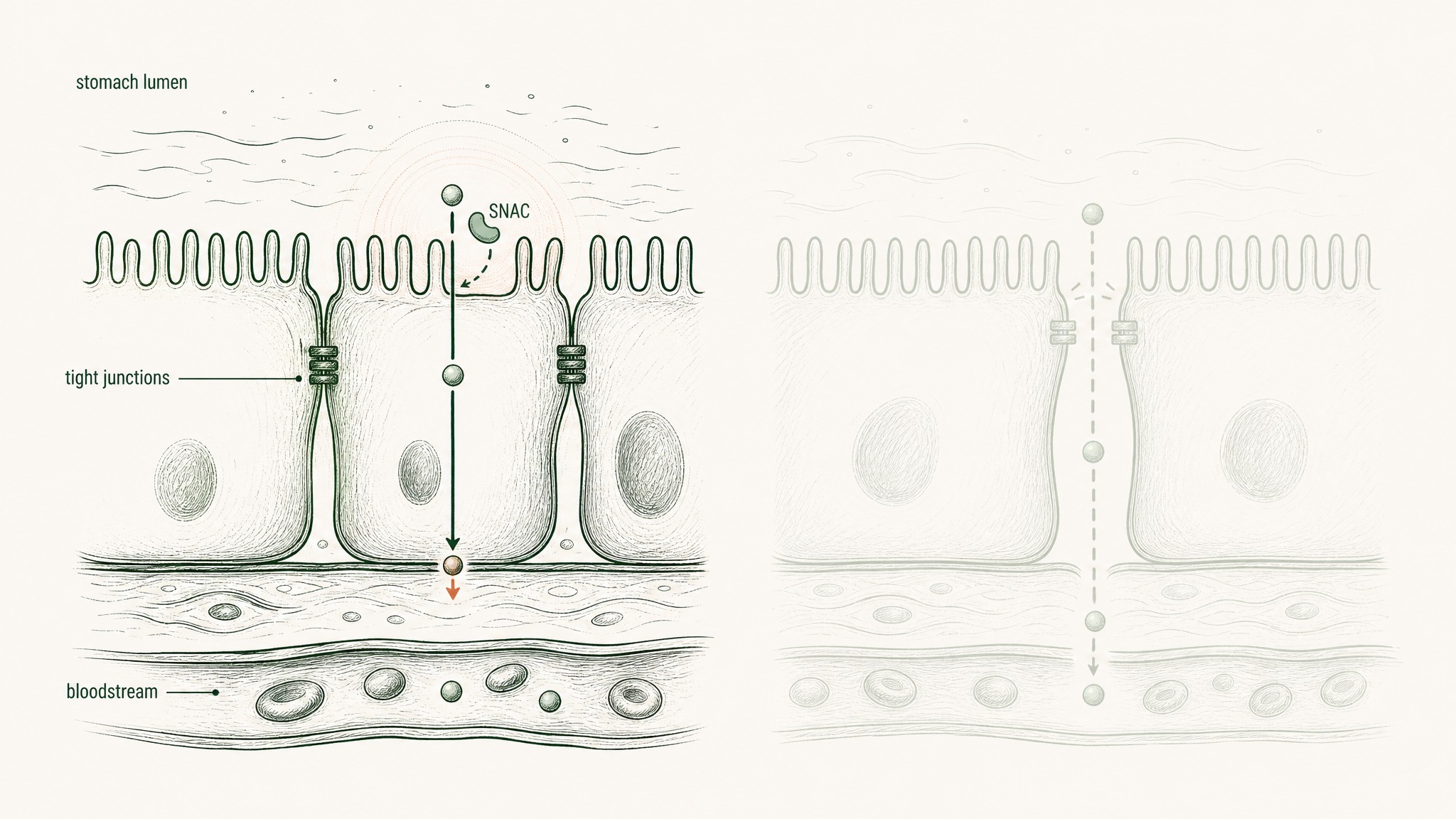
SNAC works through stomach cells, not between intestinal cells a difference that matters for peptide delivery.
SNAC isn't a universal peptide unlock. It's a chemistry engineered for one molecule in one pharmaceutical formulation under tightly controlled conditions.
Under those engineered conditions, SNAC co-formulated with semaglutide, fasted, with no more than 120ml of water, absolute oral bioavailability reached 0.8 percent (Overgaard et al. 2021, Clin Pharmacokinet, PMID 33969456). That's the current pharmaceutical ceiling for commercial oral peptide delivery. The evidence for SNAC specifically enhancing BPC-157 absorption in LVLUP's formulation rests, by their own disclosure, on "preclinical models", animal studies, not human trials.
Users report the gap between preclinical and real-world human outcomes in peptide research is often substantial, and SNAC + BPC-arginate sits firmly on the preclinical side of that line right now.
What's Actually Inside the Products
Ingredient transparency is one area where LVLUP earns genuine marks. Their labels are clear, dosages are disclosed, and there are no proprietary blends hiding what's inside.
Wolverine ($219.99, 30 servings), full breakdown:
- BPC-157 as Arginine Salt, the core peptide in the more acid-stable form
- TB4 Fragments (Ac-SDKP and Ac-LKKTETQ), thymosin beta-4 derived sequences studied in wound repair research
- PEA (palmitoylethanolamide), a fatty acid amide studied for inflammatory signalling
- SNAC (salcaprozate sodium), the absorption enhancer
- Cissus Quadrangularis, a botanical with some research backing for joint and connective tissue support
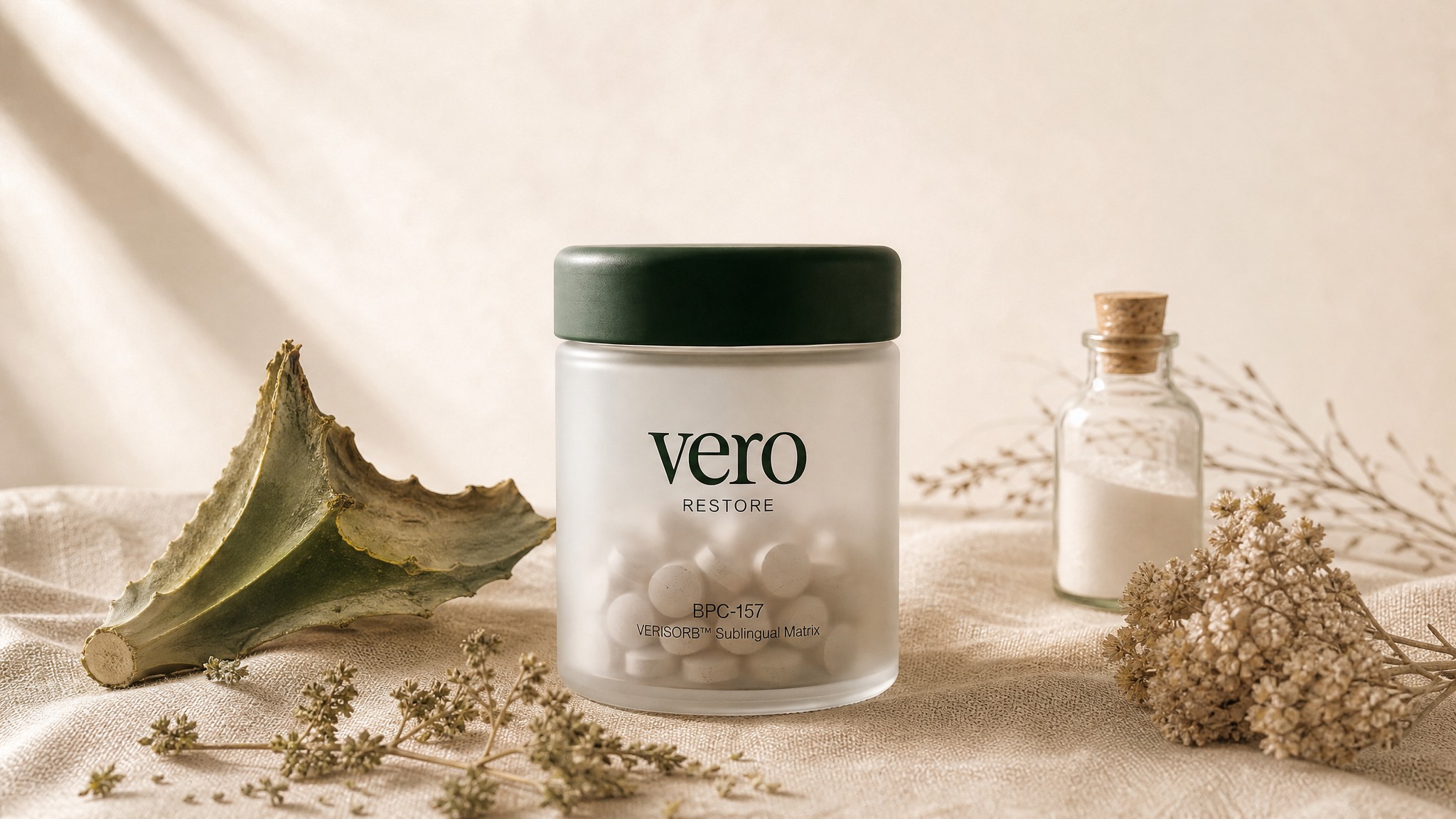
RESTORE's core ingredients: BPC-157, TB4 fragments, and absorption enhancers in one capsule.
BPC-ARG Double Strength ($169.99, 30 servings) is leaner: BPC-arginate, sodium bicarbonate for pH buffering, and sodium hyaluronate. You're paying for a compound whose real-world human bioavailability in that specific formulation, has never been measured in a published study.
Products are manufactured in California under GMP conditions with third-party certificates of analysis on each batch. The question isn't what's in the capsule. It's what percentage exits the gut intact and enters your bloodstream.
The Core Problem: You're Still Running the Gauntlet
Think of your gastrointestinal tract as a five-stage security checkpoint specifically designed to dismantle protein structures. Peptides are protein structures, and the gut doesn't make exceptions:
- Gastric acid (pH 1.5–3.5): your stomach runs at roughly battery-acid strength and produces pepsin, an enzyme whose entire function is cutting peptide bonds
- Brush-border peptidases: the intestinal lining is dense with enzymes continuing the dismantling, processing peptide fragments down to individual amino acids
- The epithelial barrier: a continuous cell layer with both physical and enzymatic resistance to anything attempting to cross
- Tight junctions: protein structures sealing the gaps between intestinal cells, blocking most larger molecules from slipping through
- Hepatic first-pass: everything absorbed from your gut travels to your liver before the rest of your body sees it, and hepatic enzymes take a final cut
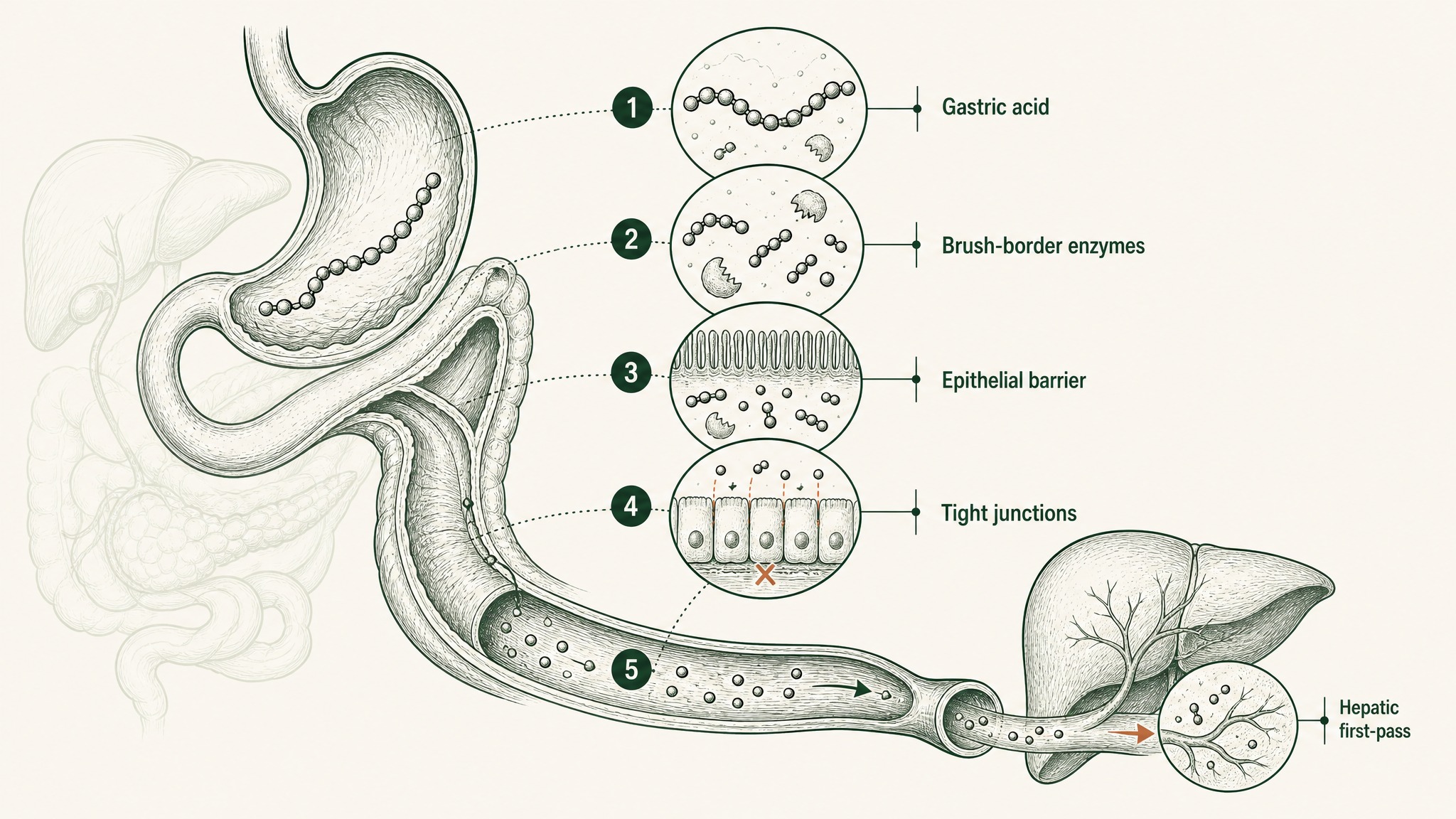
Five sequential barriers in your gut systematically break down oral peptides before they reach your bloodstream.
Research documents oral peptide delivery as facing enzymatic degradation, poor membrane permeability, and first-pass hepatic metabolism as sequential obstacles, each one working on whatever the previous stage left (Verma et al. 2021, Drug Dev Res, PMID 33988872). The arginate salt addresses one fraction of the first checkpoint. SNAC, even taking LVLUP's description of the mechanism at face value, addresses one fraction of the intestinal barrier.
The gauntlet still runs five stages. The compounding effect of each one multiplying the losses of the last is exactly what drives oral peptide bioavailability below 1–2 percent for unmodified compounds.
The intestinal transporter that actually accepts intact peptides, PepT1, only handles di-peptides and tri-peptides: chains of exactly two or three amino acids (Freeman 2015, World J Gastrointest Pharmacol Ther, PMC4419090). BPC-157 is 15 amino acids long. It wasn't built for this system, and optimising around it can only go so far.
Where LVLUP Gets Credit, and Where It Runs Out
Members experience a wide range with oral peptide products, and LVLUP sits at the more credible end of that category. Worth being precise about what that credit actually covers.
What LVLUP is genuinely doing right:
- Using arginate salt form, more stable chemistry in acidic environments than the standard acetate form
- Third-party batch testing with documented certificates you can actually verify
- Transparent ingredient lists with disclosed dosages, no proprietary blends obscuring what's inside
- Research-oriented framing that stays out of therapeutic territory
Where the credibility gets complicated:
- The >90% oral bioavailability figure comes from a patent, not a peer-reviewed human pharmacokinetic trial
- Their SNAC mechanism description (paracellular) differs from SNAC's validated mechanism (transcellular, gastric absorption) in the only clinical context where SNAC has been tested in humans
- No published pharmacokinetic data exists for LVLUP's specific formulations in human subjects
- At $169–$219 per month, the cost commitment is premium for unvalidated systemic delivery efficiency
None of this makes LVLUP fraudulent in the standard sense. The more accurate framing is: they're selling aspirational science. The chemistry is real and the direction is credible. The gap is between a promising 2014 patent and a confirmed outcome in a human bloodstream, and that gap currently runs through territory with no published peer-reviewed evidence to cross it.
There's one context where their oral approach makes more sense on its own terms: gut-focused products. Compounds like BPC-157 working locally in the intestinal lining don't need high systemic blood concentrations to have effects within the gut itself. Research suggests local gut action doesn't carry the same absorption burden as systemic delivery. Ultimate GI Repair, with its intestinal-barrier-supporting stack, is a more defensible product in this respect than Wolverine, which is marketed for systemic recovery.
Why Bypassing the Gut Is a Different Category
The question LVLUP's formulation approach doesn't address: why optimise performance inside a system built to eliminate peptides, when you can bypass it entirely?
Sublingual delivery routes compounds across the mucosal tissue under your tongue. The anatomy is what makes it structurally different from anything going through the gut. The sublingual epithelium is thinner, far less enzymatic, and more permeable than the gastrointestinal lining, and compounds absorbed there drain directly into systemic circulation, bypassing your stomach, intestinal enzymes, and your liver's first-pass filter altogether (Zhang, Zhang & Streisand 2002, Clin Pharmacokinet, PMID 12126458). Every stage in the gut's five-checkpoint destruction sequence becomes irrelevant.
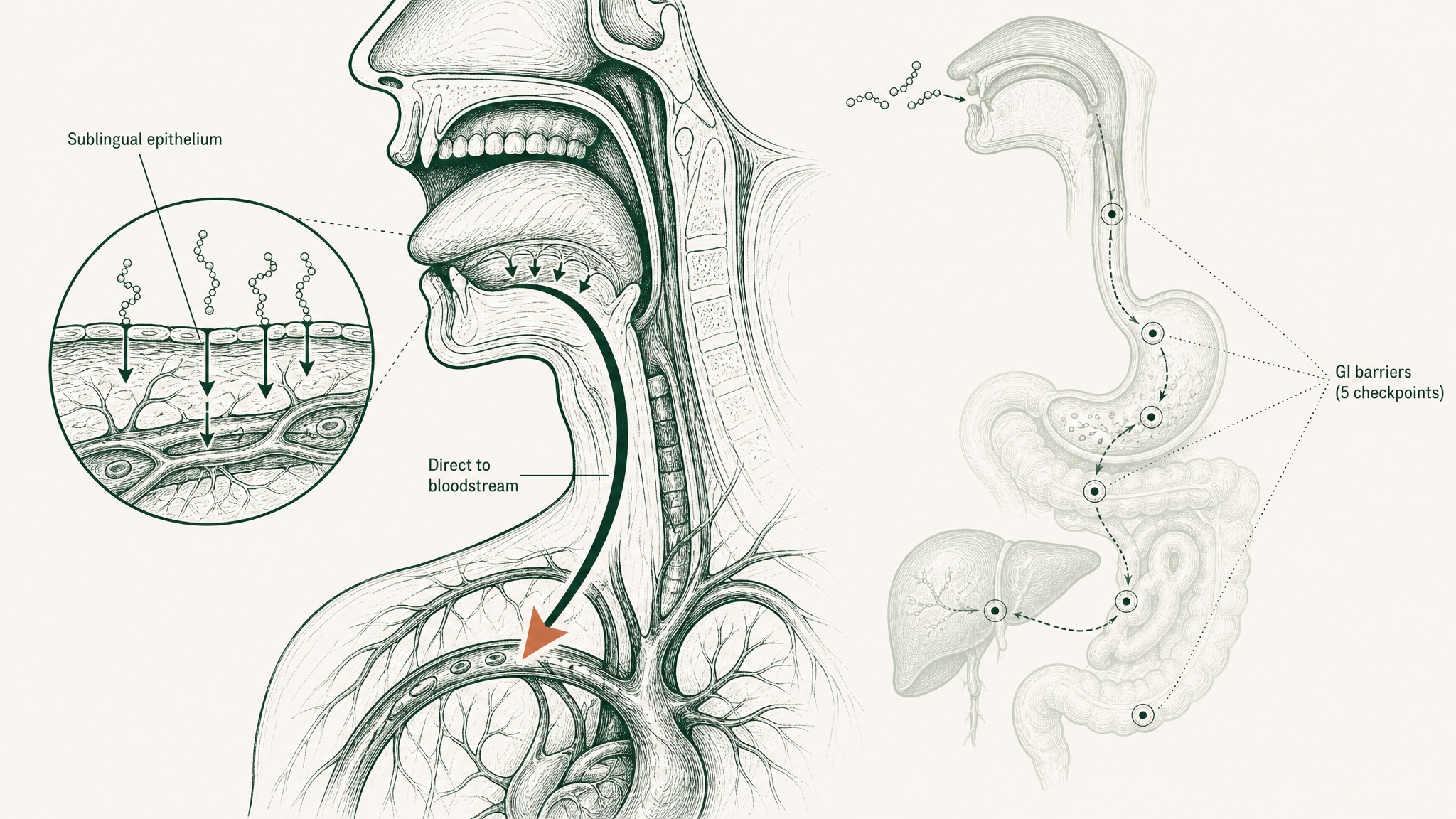
Sublingual delivery bypasses stomach acid, intestinal enzymes, and liver filtration that destroy oral peptides.
That's not an incremental improvement over LVLUP's approach. That's a different architecture entirely.
Research suggests sublingual formulations still require specific engineering, an unformulated peptide placed under the tongue doesn't automatically absorb through the mucosal barrier. But one engineered mucosal barrier is a fundamentally different problem from five sequential gut barriers in a system whose job is protein elimination. VERO's VERISORB platform is built around this route: mucoadhesive polymers that hold the compound against the mucosal surface, permeation chemistry matched to peptide characteristics, and vehicle formulation specific to sublingual absorption mechanics.
The LVLUP approach is working hard to reduce damage through a gauntlet. The sublingual approach removes the gauntlet.
Frequently Asked Questions
What is BPC-157 arginate and how does it differ from standard BPC-157?
BPC-157 arginate is BPC-157 in arginine salt form, a structural modification intended to improve stability in the acidic environment of the stomach compared to the standard acetate form. Research suggests arginine salt forms of peptides can better survive gastric acid, which degrades standard peptide formulations before they reach the intestine. The modification addresses a real chemical problem, though peer-reviewed human pharmacokinetic data confirming the degree of improvement in humans remains unpublished for any commercial formulation.
Is LVLUP Health's greater-than-90% bioavailability claim supported by clinical evidence?
The greater-than-90% oral bioavailability figure traces to a 2014 patent filed by the original BPC-157 research group in Slovenia, not a peer-reviewed human clinical trial. Patents describe theoretical performance under optimised laboratory conditions, not confirmed outcomes in human subjects consuming commercial capsules. No published pharmacokinetic study has independently validated this number for any BPC-arginate supplement formulation.
How does SNAC work, and does it improve peptide absorption in supplements?
SNAC (salcaprozate sodium) is the absorption enhancer used in Rybelsus, the FDA-approved oral semaglutide tablet, where its validated mechanism is transcellular: it creates a localised pH rise in the stomach that allows the co-formulated compound to absorb through the stomach wall before intestinal enzymes degrade it. LVLUP describes SNAC working via paracellular transport, which is a different mechanism from what Novo Nordisk's clinical data confirmed. Research on SNAC specifically enhancing BPC-157 absorption in supplement formulations currently rests on preclinical animal models, not published human pharmacokinetic studies.
What is the current ceiling for oral peptide bioavailability in clinical evidence?
The highest oral bioavailability achieved for a commercial peptide product in published clinical data is approximately 0.8 percent, set by Novo Nordisk's Rybelsus under tightly controlled fasting conditions with no more than 120ml of water (Overgaard et al. 2021, PMID 33969456). This result required years of pharmaceutical engineering specific to one molecule. Research suggests unmodified oral peptides, without specialised formulation, typically achieve below 1 to 2 percent systemic absorption due to the compounding effect of multiple gastrointestinal barriers.
Who is LVLUP Health best suited for?
Users report LVLUP products may be most relevant for gut-focused applications, where local action within the intestinal lining does not require high systemic blood concentrations to have a local effect. Their Ultimate GI Repair product, designed around intestinal barrier support, presents a more defensible case for local gut activity than products marketed for systemic recovery. Users seeking systemic peptide effects face the unresolved question of what fraction of an oral dose survives the full gastrointestinal tract and reaches the bloodstream intact.
How does sublingual delivery compare to oral capsule delivery for peptides?
Sublingual delivery routes compounds across the mucosal tissue under the tongue, which is thinner and more permeable than the gastrointestinal lining and contains far fewer proteolytic enzymes. Compounds absorbed sublingually drain directly into systemic circulation, bypassing the stomach, intestinal enzymes, and hepatic first-pass metabolism that collectively reduce oral bioavailability. Research suggests sublingual formulations still require specific engineering to improve mucosal permeability, but the challenge is one barrier rather than the five sequential barriers in the gastrointestinal tract.
Is LVLUP Health a reputable brand?
LVLUP Health manufactures under GMP conditions in California and publishes third-party certificates of analysis for each batch, a quality standard many supplement brands do not meet. Their ingredient labels are transparent, with disclosed dosages and no proprietary blends obscuring what is inside. The brand's credibility gap is not in ingredient quality or manufacturing standards: it is in the distance between their bioavailability claims and the published human clinical evidence currently available to support those claims.
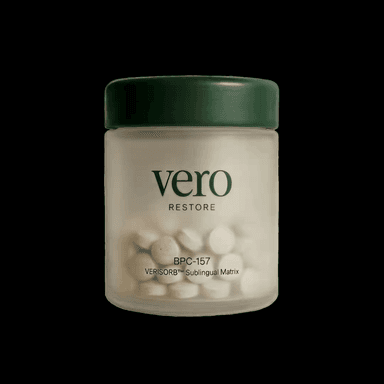
RESTORE™
BPC-157Engineered around 0.5mg BPC-157 (arginate salt). Accelerates deep tissue and joint recovery
Clinical Context
Important Notice: VERO protocols are nutritional and systemic optimisation formats. They are not intended to diagnose, treat, cure, or prevent any medical condition. These statements have not been evaluated by the Food and Drug Administration.