
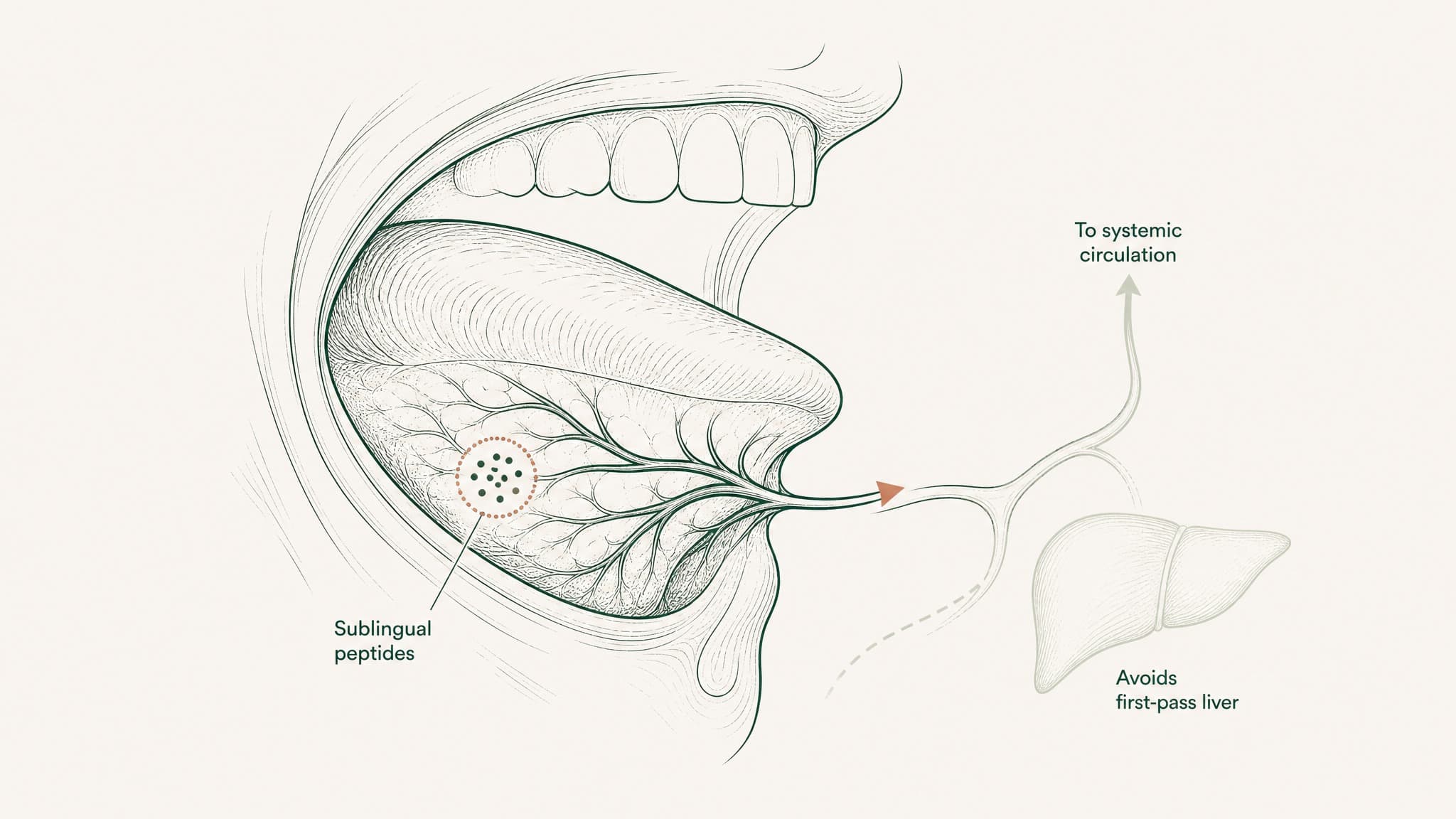
VERISORB™ is the sublingual delivery matrix behind every VERO protocol — engineered to get a peptide from under your tongue into your bloodstream without a needle. Here's what it actually solves, and what the formulation research behind it shows.
Here's the plain-English version: VERISORB™ is the delivery matrix that gets a peptide from under your tongue into your bloodstream, no needle involved. It's the engine behind every dose in the RESTORE Protocol, and it exists to fix one very specific problem: your digestive system is built to tear apart the exact kind of molecule a peptide is. This article is published for research purposes only, and it walks through what VERISORB actually does, and why a bare drop under your tongue can't do the same job on its own.
Swallow a peptide in a capsule and you've entered a race against your own gut. Stomach acid, digestive enzymes, and your liver each take a turn at destroying it before anything reaches your blood. Sublingual delivery — absorbing a compound through the tissue under your tongue — skips that entire gauntlet, but only if the formulation is actually built to make that happen.
Key Takeaways
- Oral peptide capsules lose most of their dose to stomach acid, enzymes, and liver processing. Research puts what survives at roughly 1 to 2 percent (Renukuntla et al. 2013).
- Sublingual absorption drains straight into blood vessels under your tongue, skipping your gut and liver entirely (Zhang et al. 2002).
- An unformulated sublingual drop mostly gets swallowed before it can absorb — you swallow by reflex every 30 to 60 seconds, whether you notice it or not.
- VERISORB is a three-part engineered matrix, not just a route: it anchors the compound in place, helps it cross the membrane, and shields it from enzymes during that window.
- Formulated sublingual delivery has real numbers behind it. Engineered nanoparticle insulin has reached 24.1 percent bioavailability relative to injection in animal research (Patil & Devarajan 2016).
This content is published for research and educational purposes only. It is not intended to diagnose, treat, cure, or prevent any disease, and it does not constitute medical advice. Readers should consult a qualified healthcare professional before making decisions about their own health. Statements on this page have not been evaluated by the FDA. VERO's peptide products are supplied for research purposes only.
Why Your Gut Is the Wrong Door for a Peptide
Think of your gut as a four-stage security checkpoint, and a peptide — a short chain of amino acids your body uses to carry signals — as exactly the kind of thing that checkpoint is built to flag and take apart. Your stomach runs on acid corrosive enough to break down food, backed by pepsin, an enzyme whose entire job is cutting protein structures into pieces. Whatever survives that still has to get past your intestinal wall and your liver before your bloodstream ever sees it.
A peptide has to clear four separate barriers before it reaches your blood, and each one is built to stop exactly that.
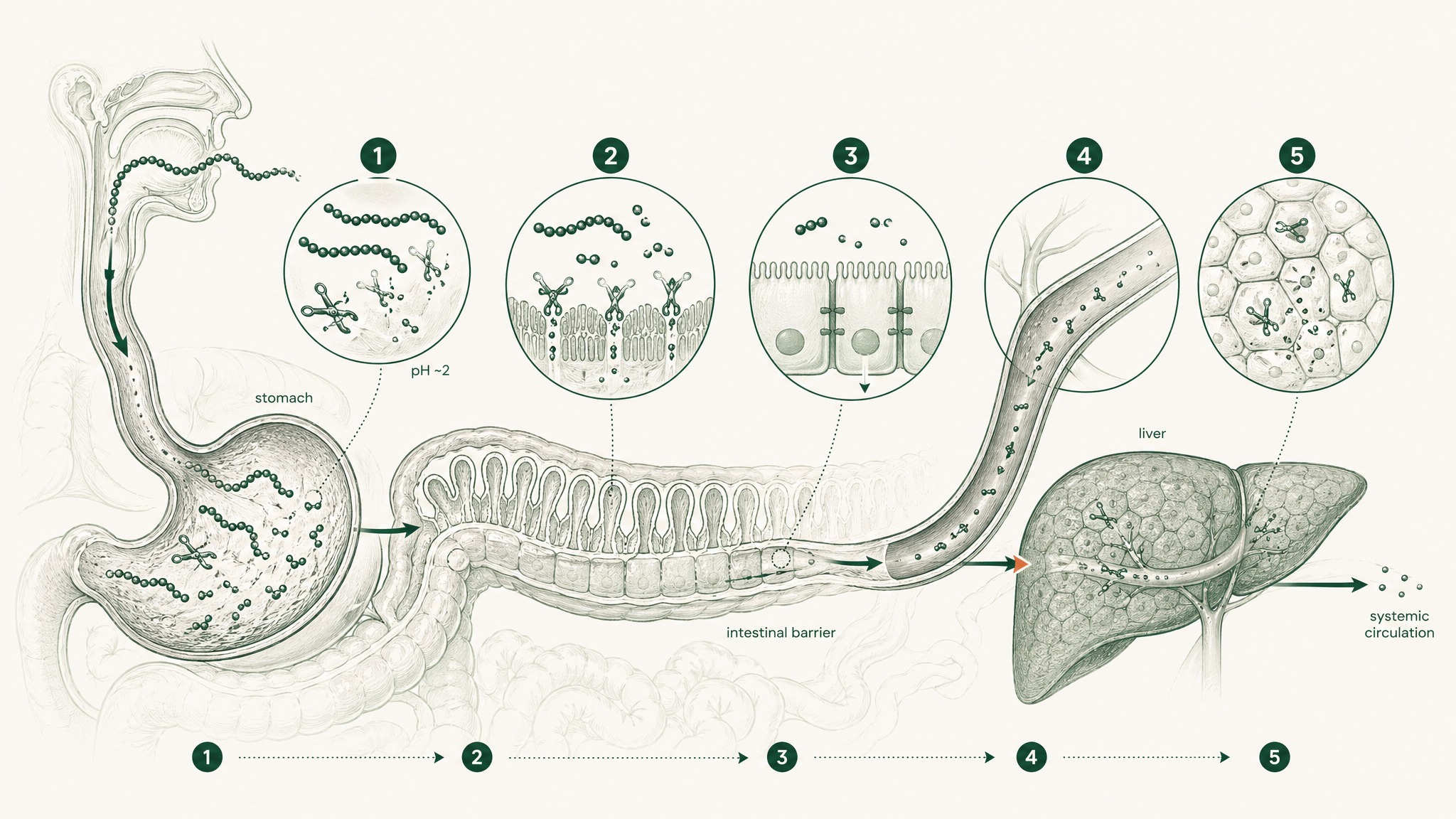
A peptide faces four barriers in your gut before reaching your blood.
- Stomach acid and pepsin — the first checkpoint, breaks peptide bonds directly
- Intestinal brush-border enzymes — a second wave that keeps the breakdown going
- The intestinal wall — most large molecules simply can't cross it
- Your liver — processes anything absorbed before the rest of your body sees it
There's also a narrow doorway called PepT1, the one active transporter your gut has for peptides, and it only lets through di-peptides and tri-peptides — chains of two or three amino acids (Freeman 2015). Most research peptides are longer than that, so the door is effectively closed before the acid and enzymes even finish their work.
Research puts the surviving fraction of an oral peptide dose at under 1 to 2 percent by the time all four stages are done (Renukuntla et al. 2013; Verma et al. 2021).
That gap isn't a formulation failure specific to cheap supplements, either. Even oral semaglutide — a pharmaceutical product built with a specific absorption-enhancing carrier and years of dedicated engineering — tops out at 0.8 percent bioavailability under its recommended dosing conditions (Overgaard et al. 2021). If that's the ceiling for a molecule with a pharmaceutical company's resources behind it, a plain capsule never had a chance.
The Bypass Lane: How Sublingual Delivery Skips the Gut Entirely
The tissue under your tongue isn't like your gut at all. It's thin, it's permeable, and it sits directly on top of a dense bed of small blood vessels — picture a bypass lane that skips every checkpoint at once instead of queuing through them one by one.
Skip the gut and skip the liver, and you skip most of what destroys a peptide in the first place.
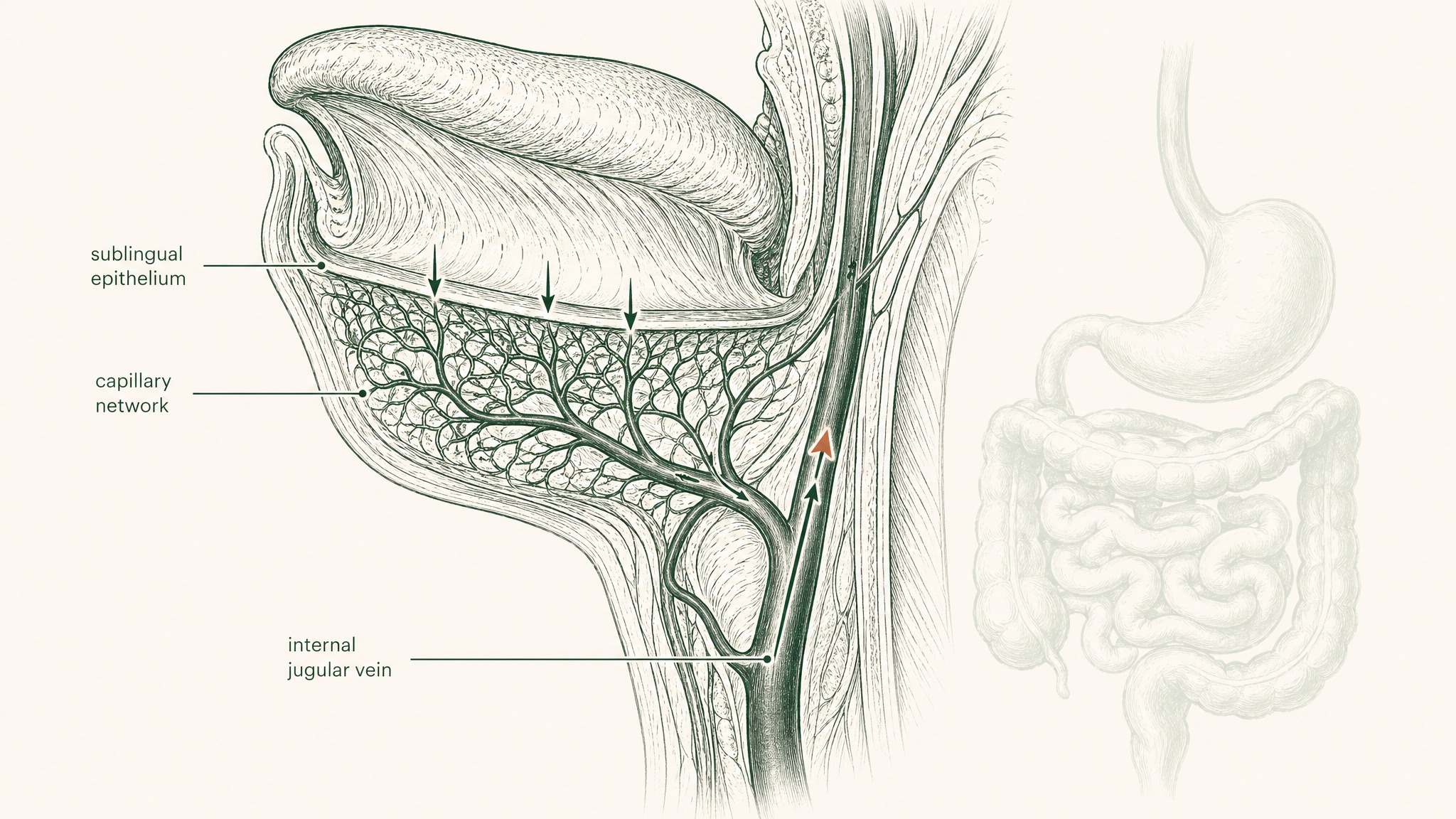
Sublingual tissue drains directly into the bloodstream, bypassing the gut and liver entirely.
When a compound absorbs through that tissue, it drains into veins that lead straight to general circulation. There's no detour through the intestines and no detour through the liver (Zhang et al. 2002).
Research on oral transmucosal delivery describes the identical mechanism: absorption that reaches the bloodstream while bypassing hepatic first-pass metabolism, the liver's habit of processing a compound before your body gets to use it (Lam et al. 2014).
An injectable dose gets a version of the same shortcut by depositing a compound straight into tissue under the skin, which is part of why injections remain a common reference point in peptide research. Sublingual delivery is chasing that same shortcut without a needle. But getting the route right doesn't automatically mean the compound crosses into your blood — that's a separate problem, and it's the one most sublingual products get wrong.
Why a Bare Drop Under Your Tongue Still Doesn't Work
Here's the part most "just hold it under your tongue" products don't mention: putting something under your tongue doesn't mean your body absorbs it there. Your mouth is a busy hallway, not a quiet room — saliva is constantly washing through it, and you swallow involuntarily every 30 to 60 seconds whether you're thinking about it or not.
An unformulated peptide dropped under your tongue, with nothing holding it in place and nothing helping it cross the membrane, gets swallowed before it has a real chance to absorb. At that point you've taken an oral supplement by a slower, less pleasant route. It lands back in your gut anyway, right where the destruction sequence started.
Unformulated peptides under the tongue get washed away by saliva and swallowed before absorption can occur.
- No polymer to hold it in place — washed away by saliva within seconds
- No permeation enhancer — even what stays put may not cross the membrane
- No protective matrix — salivary enzymes start breaking it down on contact
Foundational research on oral mucosal drug delivery found that the molecules naturally suited to buccal and sublingual absorption tend to share three traits: low molecular weight, high potency, and a long biological half-life (Harris & Robinson 1992). Most research peptides don't check all three boxes on their own. They need formulation help to get across, and that's the gap VERISORB's matrix is built to close.
The Three Jobs VERISORB's Matrix Has to Do
VERISORB is a formulated matrix, not a drop, and it exists specifically to solve the three things that make sublingual delivery fail without it.
- Contact time — staying on the tissue long enough to absorb
- Membrane crossing — actually getting through the tissue into your blood
- Enzyme protection — surviving salivary breakdown during that window
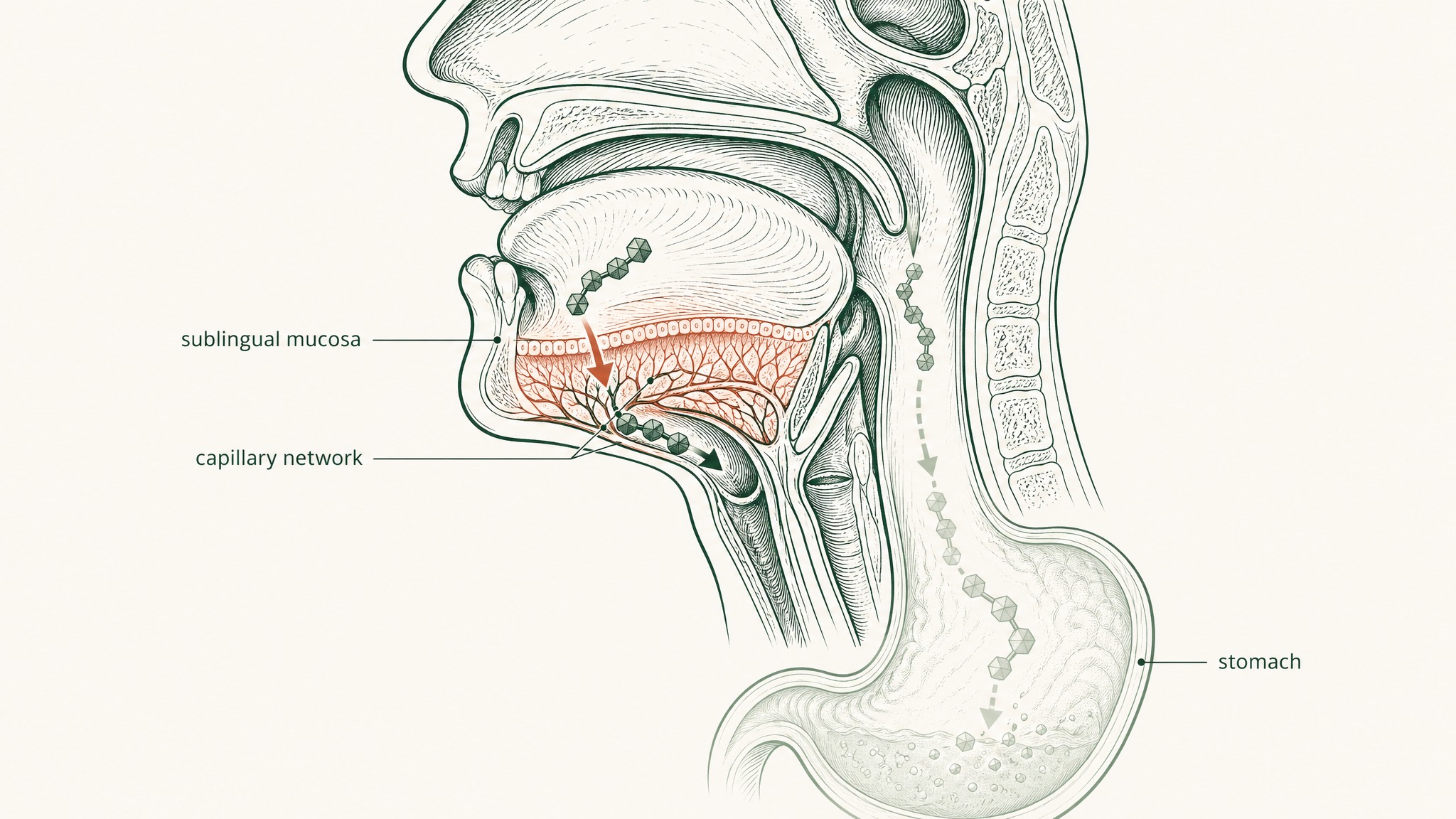
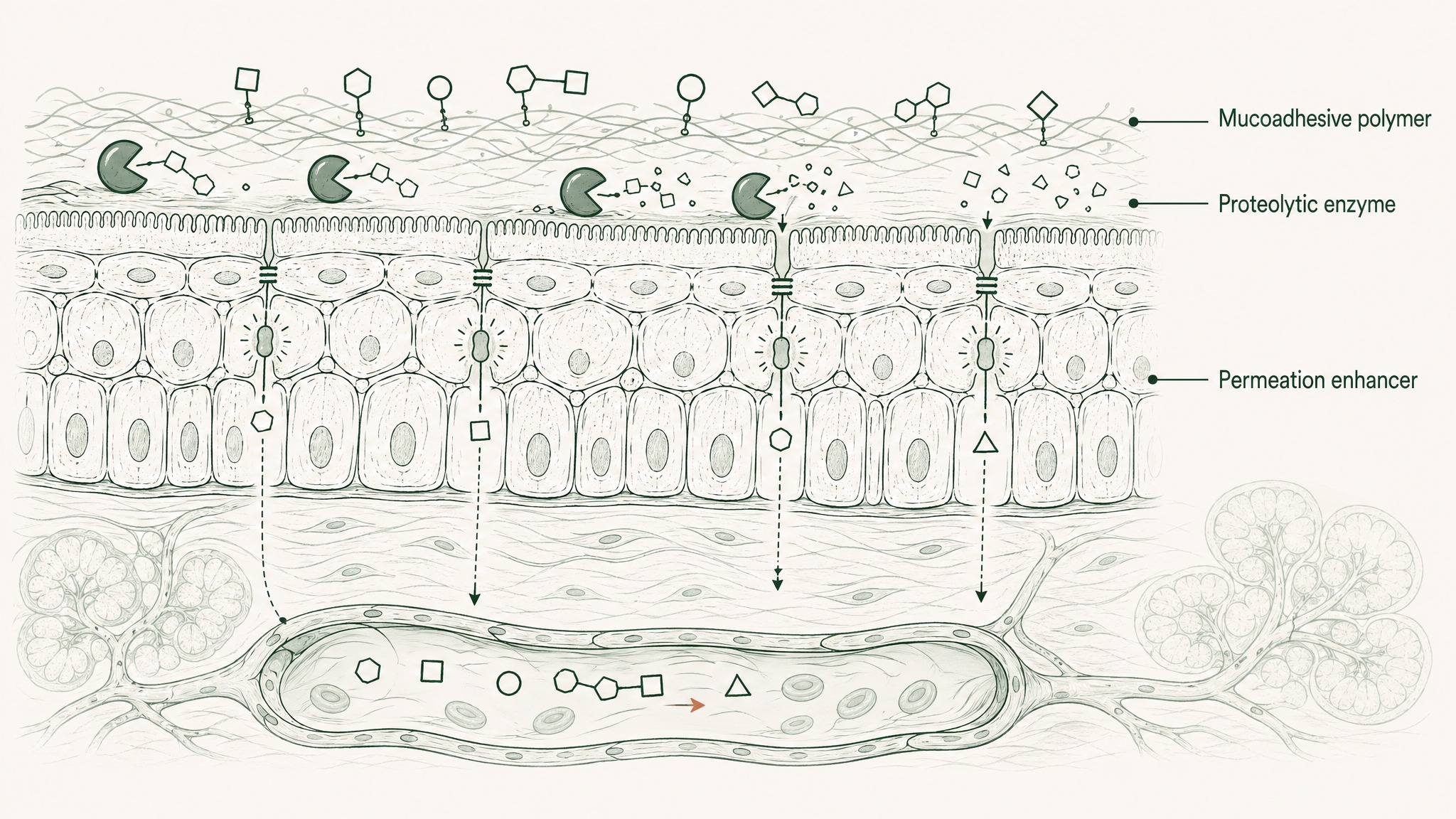
How VERISORB's matrix anchors peptides, opens the membrane barrier, and shields them from saliva enzymes.
Skip any one of those three, and the whole route falls apart.
Job One: Staying Put
Absorption can't happen if a compound isn't in contact with the tissue long enough, and an unformulated drop only gets a few seconds before saliva clears it. Mucoadhesive polymers — ingredients that stick to mucosal tissue and resist being washed away — work like an anchor, holding a compound against the tissue instead of letting it float off.
Formulation research on sublingual delivery has tested this directly. A mucoadhesive polymer film carrying glutathione — used here purely as a research example of the anchoring approach, not an ingredient in VERO's own formula — stayed attached to sublingual tissue long enough for absorption to occur, instead of washing away first (Chen, Bunt & Wen 2015). That's the difference an anchor makes.
Job Two: Getting Through the Membrane
Staying in place doesn't automatically mean crossing into your blood — those are two separate jobs. The tissue under your tongue is lipid-rich, meaning it's essentially oily at a molecular level, and most peptides are hydrophilic, meaning they're water-loving and don't naturally dissolve through an oily barrier. It's the same reason a water droplet won't pass through a layer of oil on its own.
Permeation enhancers are formulation ingredients that temporarily loosen that barrier, giving a water-loving peptide a way through. A 2026 formulation review names permeation enhancers, alongside mucoadhesive polymers and multilayer film architectures, among the core strategies for getting a peptide across the sublingual membrane (Karki et al. 2026).
Job Three: Surviving Intact
Your saliva carries its own protein-cutting enzymes — a smaller-scale version of the ones in your gut. That means a peptide sitting under your tongue can be trying to absorb and getting broken down at the same time.
The same 2026 review identifies salivary enzyme activity, alongside washout and the membrane barrier itself, as one of the three core obstacles to sublingual peptide delivery (Karki et al. 2026). VERISORB's matrix is built to slow that breakdown during the absorption window — protecting the dose long enough to do its job, not just long enough to survive being swallowed.
What the Research Shows When the Engineering Is Done Right
The case for formulated sublingual delivery comes with real bioavailability numbers attached, and they're worth putting side by side.
- <2% — what an unformulated oral peptide capsule typically manages (Renukuntla et al. 2013)
- 0.8% — oral semaglutide, a pharmaceutical product with a dedicated absorption carrier, under recommended dosing conditions (Overgaard et al. 2021)
- 24.1% — sublingual insulin nanoparticles versus subcutaneous injection, in a diabetic rat model (Patil & Devarajan 2016)
- 22–150 kDa — the size range of proteins shown to absorb sublingually with the right delivery peptides, in mice, with no measured toxicity (Wu et al. 2024)
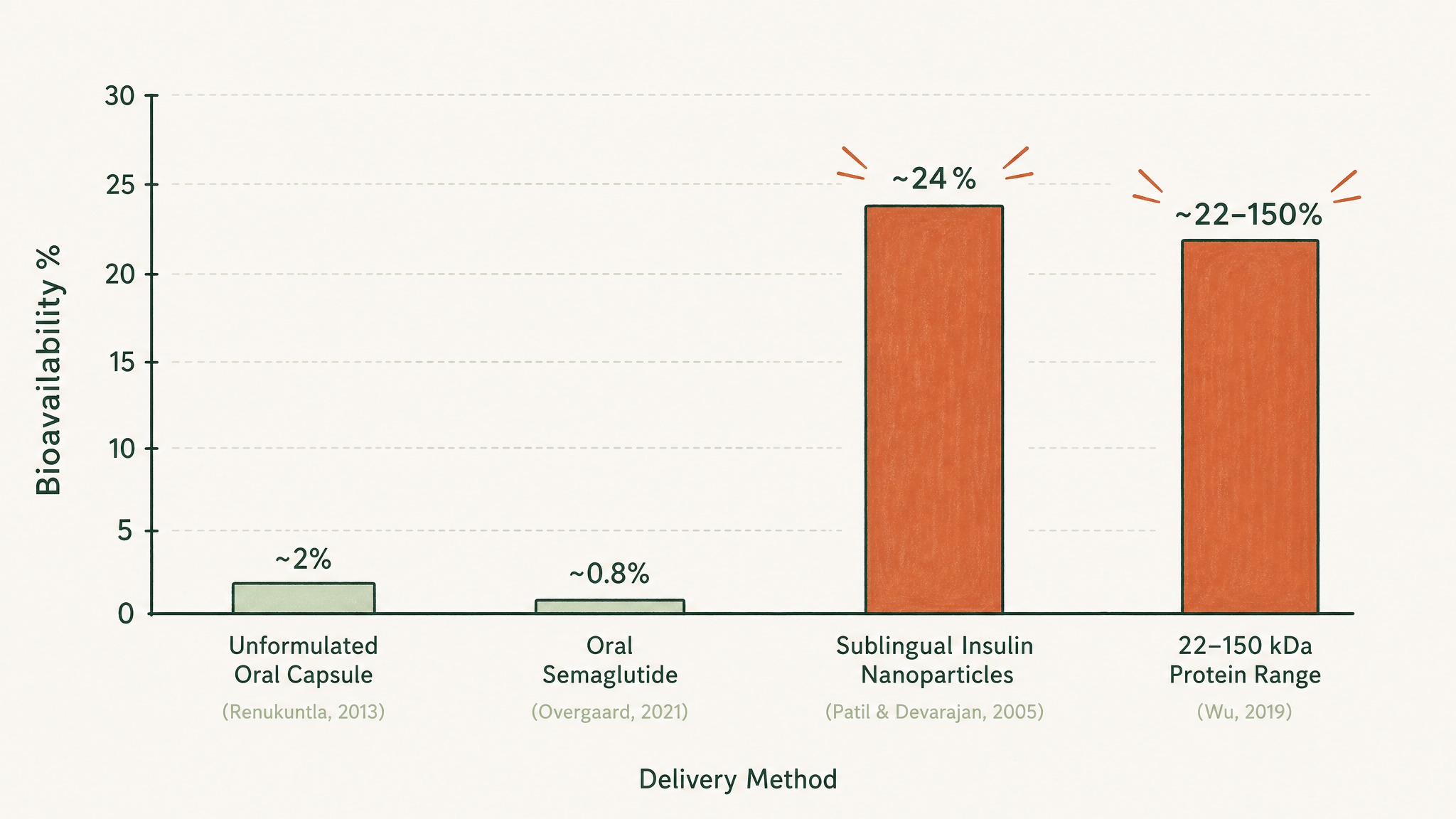
Sublingual delivery achieves 24% bioavailability versus under 2% for unformulated oral peptides.
Compare 24 percent to under 2 percent, and it's clear the formulation is doing most of the heavy lifting — the route alone only gets you partway there.
Newer research has pushed this further by testing much larger molecules. A 2024 study paired therapeutic proteins — up to 150 kilodaltons, a size range that includes molecules the weight of a full antibody — with specially designed delivery peptides and achieved sublingual absorption in mice, with effects comparable to a subcutaneous injection and no measurable toxicity observed in the animals tested (Wu et al. 2024). Research suggests the ceiling on what can absorb sublingually is more a formulation question than a fixed biological limit.
How VERISORB Runs Across VERO's Protocols
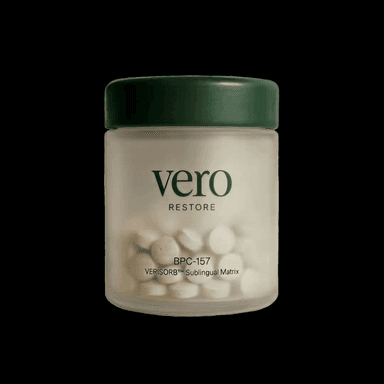
The same VERISORB engine runs underneath every VERO protocol, tuned to each compound's own size and chemistry. RESTORE routes BPC-157 through VERISORB's full three-part system — mucoadhesive matrix, permeation enhancers, and enzyme protection — sized for that specific peptide.
- RESTORE → BPC-157
- LEGACY → NAD+
- CLARITY → Dihexa
- RADIANCE → GHK-Cu
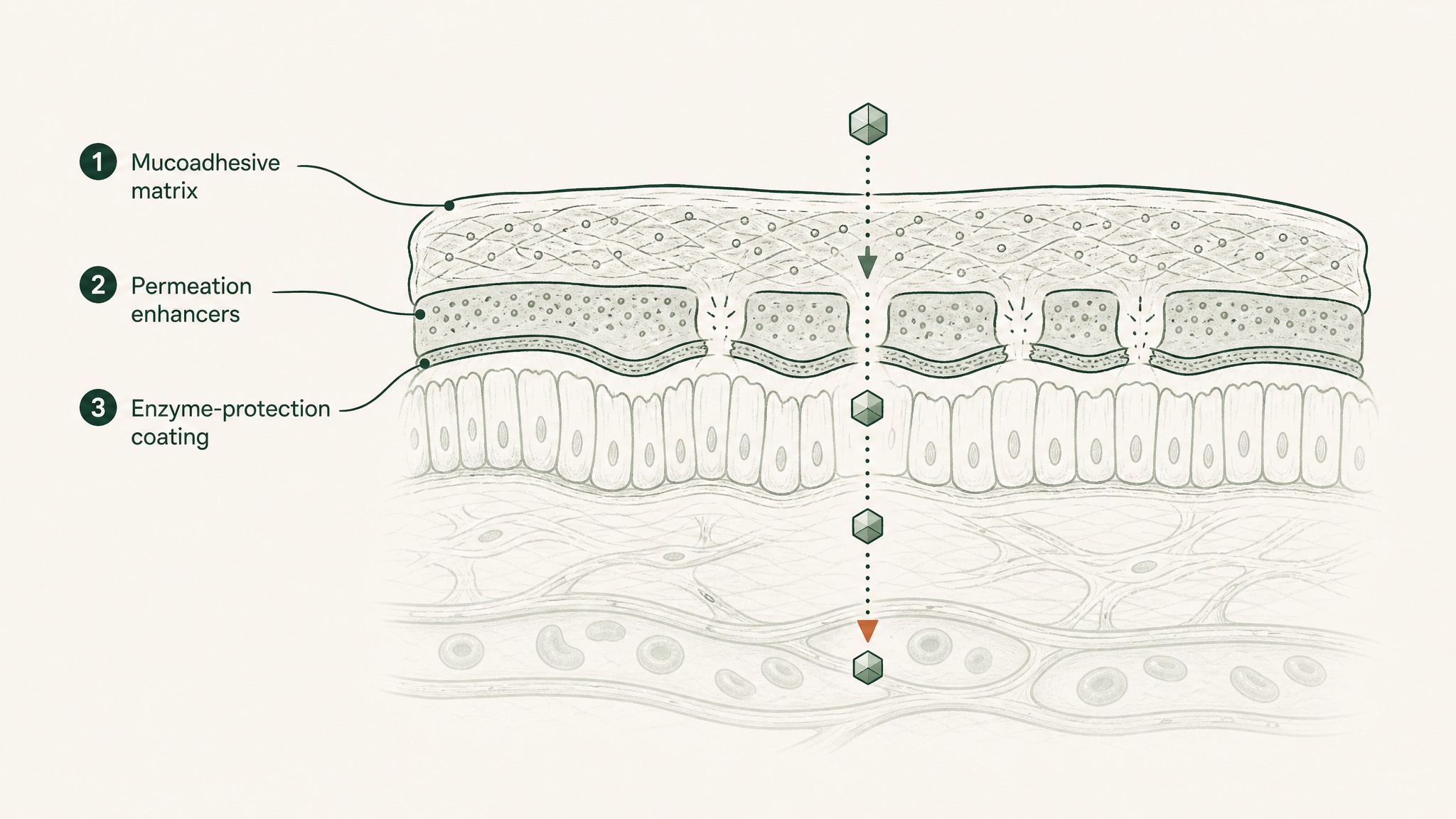
How VERISORB's three-part system guides peptides across the sublingual membrane into the bloodstream.
The same underlying engineering carries across all four. GHK-Cu is a small copper-binding peptide that presents the identical membrane-crossing challenge described above — hydrophilic, and not naturally suited to crossing an oily membrane on its own. The compound changes; the three engineering jobs don't.
Users report that not having to inject something changes what's actually sustainable across weeks or months of a research protocol. Consistency matters as much as the delivery route itself.
Members experience the format difference directly — a tablet held for about a minute, instead of a needle. Formulation is what actually decides whether a dose you'll stick with is also a dose that reaches your blood.
Common Questions About VERISORB and Sublingual Peptides
How long do you need to hold a VERISORB tablet under your tongue?
Formulation research on mucoadhesive sublingual delivery generally points to a hold time of one to two minutes — long enough for the polymer matrix to adhere to the tissue and for absorption to begin. Swallowing earlier shortens that window before it's finished. VERO's product documentation includes the specific hold time for each protocol.
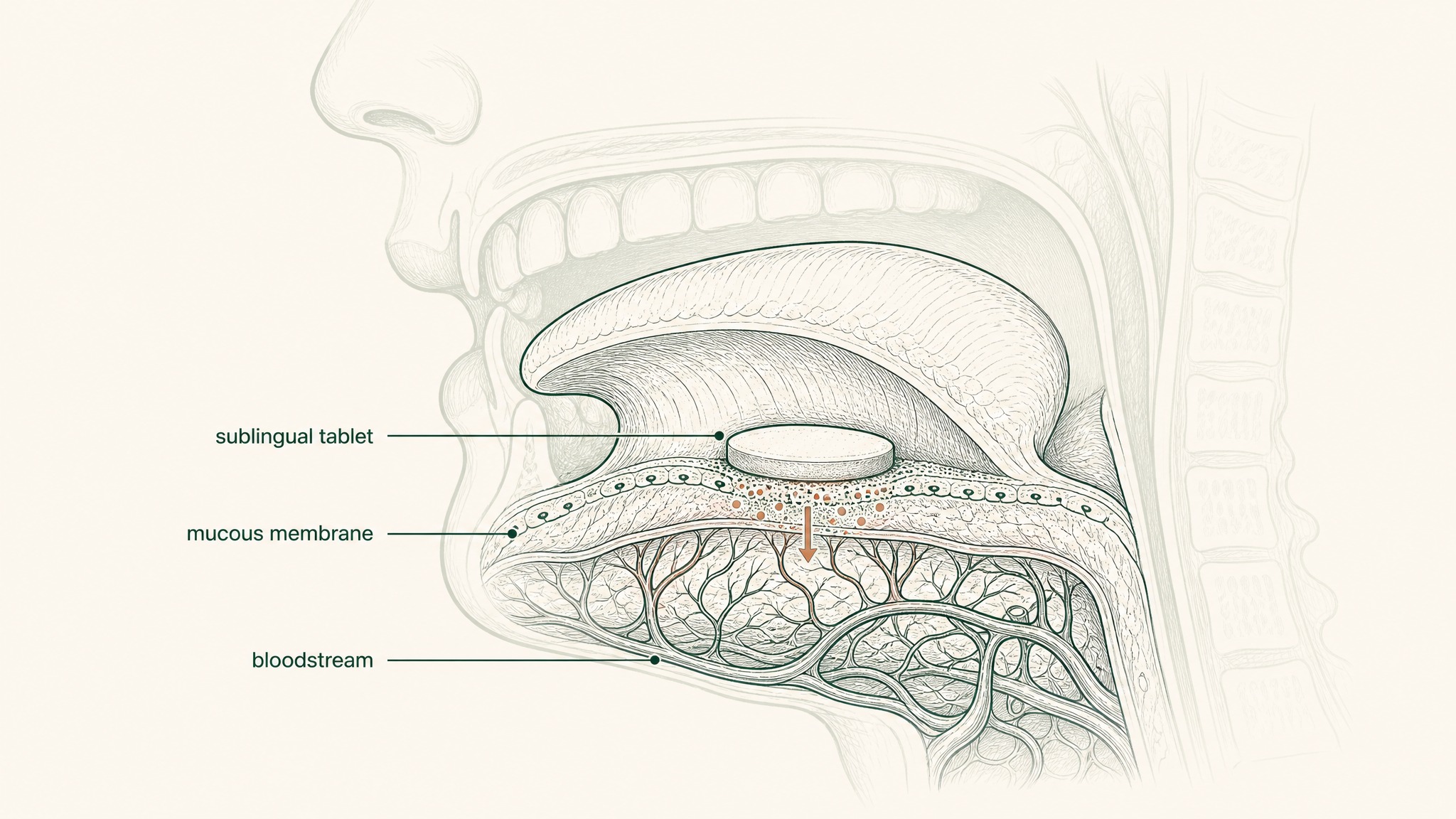
A sublingual tablet adheres to tissue under your tongue and peptides begin crossing into nearby blood vessels.
Is sublingual delivery as effective as an injection?
Subcutaneous injection is a common benchmark in peptide research because it bypasses the gut entirely by depositing a dose directly under the skin. Formulated sublingual delivery chases that same outcome — reaching the bloodstream without going through your gut — and animal research on engineered sublingual insulin has reached roughly 24 percent of injectable bioavailability (Patil & Devarajan 2016). That figure is specific to one compound and one formulation, so it isn't a universal conversion rate.
Why doesn't just holding a peptide under your tongue work on its own?
Because your mouth doesn't hold still. You swallow every 30 to 60 seconds by reflex, and saliva constantly clears the sublingual space, leaving an unformulated compound only a few seconds of real contact time. Molecules naturally suited to buccal or sublingual absorption tend to share low molecular weight, high potency, and a long half-life (Harris & Robinson 1992), and most research peptides don't have all three without formulation help.
What size peptides can absorb sublingually?
Bigger than most people assume. A 2024 study paired therapeutic proteins as large as 150 kilodaltons with delivery peptides and achieved sublingual absorption in mice, with results comparable to a subcutaneous injection (Wu et al. 2024). The limiting factor comes down to whether the formulation solves the contact-time, membrane-crossing, and enzyme-protection problems described above.
Does sublingual delivery work faster than swallowing a capsule?
Generally, yes — a compound absorbed sublingually reaches your bloodstream directly instead of working through your entire digestive tract first (Zhang et al. 2002). Exact onset time depends on the specific formulation and the individual, and most of the comparative data here comes from animal and lab research rather than large-scale human studies.
Sources & Further Reading
- Renukuntla, J., Vadlapudi, A.D., Patel, A., Boddu, S.H., Mitra, A.K. (2013). Oral bioavailability strategies for peptides and proteins: a formulation review. International Journal of Pharmaceutics.
- Verma, S., Goand, U.K., Husain, A., Katekar, R.A., Garg, R., Gayen, J.R. (2021). Oral peptide and protein drug delivery: challenges and bioavailability strategies. Drug Development Research.
- Zhang, H., Zhang, J., Streisand, J.B. (2002). Oral mucosal drug delivery: a clinical pharmacokinetics review. Clinical Pharmacokinetics.
- Lam, J.K.W., Xu, Y., Worsley, A., Wong, I.C.K. (2014). Oral transmucosal drug delivery, a pediatric formulation review. Advanced Drug Delivery Reviews.
- Harris, D., Robinson, J.R. (1992). Drug delivery via the mucous membranes of the oral cavity, a formulation review. Journal of Pharmaceutical Sciences.
- Chen, G., Bunt, C., Wen, J. (2015). Mucoadhesive polymer film as a sublingual glutathione carrier system. Journal of Pharmacy and Pharmacology.
- Karki, S., Malhotra, S., Ijaz, M., O'Cearbhaill, E.D., Nielsen, L.H., Brayden, D.J. (2026). Oromucosal films for peptide delivery: formulation strategies using permeation enhancers and polymers, a review. Drug Delivery and Translational Research.
- Patil, N.H., Devarajan, P.V. (2016). Insulin-loaded alginic acid nanoparticles for sublingual delivery, a bioavailability study. Drug Delivery.
- Wu, J., Jones, N., Hohenwarter, L., Zhao, F., Chan, V., Tan, Z., Carlaw, T., Morin, T., Li, J., Kaur, T., Andrew, L.J., Ross, C.J.D., Hedtrich, S., Li, S.D. (2024). Systemic protein delivery via novel sublingual delivery peptides. Journal of Controlled Release.
- Freeman, H.J. (2015). Clinical relevance of intestinal peptide uptake, a PepT1 transporter review. World Journal of Gastrointestinal Pharmacology and Therapeutics.
- Overgaard, R.V., Navarria, A., Ingwersen, S.H., Bækdal, T.A., Kildemoes, R.J. (2021). Clinical pharmacokinetics of oral semaglutide, an analysis of clinical pharmacology trial data. Clinical Pharmacokinetics.
VERISORB™ is the delivery platform behind every VERO protocol. See the full protocol lineup →
RESTORE™
BPC-157Engineered around 0.5mg BPC-157 (arginate salt). Accelerates deep tissue and joint recovery
Clinical Context
Important Notice: VERO protocols are nutritional and systemic optimisation formats. They are not intended to diagnose, treat, cure, or prevent any medical condition. These statements have not been evaluated by the Food and Drug Administration.