

When you take your NAD supplement matters almost as much as which one you pick. What the research suggests about morning, fasted, sublingual, and split dosing.
If you have already picked an NAD plus supplement, the next honest question is when to take it, and timing is worth treating as carefully as the rest of your dosing protocols. Most labels say something vague like "with or without food, any time of day," which is convenient marketing but not what the research actually points to. This guide is for research purposes only, and it covers what the human trials and the circadian biology suggest about getting more out of the same bottle just by changing the clock.
The short version:
- Most controlled trials dose NAD precursors in the morning, fasted, before noon.
- Your body's own NAD+ rhythm peaks early in the day, which is the biological reason behind that choice.
- Late evening dosing has been linked in some user reports to sleep disruption, especially with NMN.
- Sublingual delivery removes the food-interaction question, because nothing has to survive your gut.
- For most healthy adults, one daily dose with breakfast is a sensible default, and split dosing is the exception, not the rule.
Key Takeaways
- Time of day matters because your NAD+ pool follows a circadian rhythm, and most trials dose in the morning.
- Fasted, on waking, before coffee, is the trial-supported convention for oral NMN and NR.
- Evening dosing has been linked to lighter sleep and vivid dreams in a subset of users, especially with NMN.
- Sublingual delivery removes the food-interaction question because the molecule bypasses the gut entirely.
- Once-daily morning dosing beats split dosing for most healthy adults; split protocols belong to specific high-demand cases.
- Pair with TMG, resveratrol, or a B-complex in the same morning window. Space iron, calcium, and fish-oil capsules by at least two hours.
- Plan in months, not days. Two to four weeks for blood NAD+ to climb, six to twelve weeks for subjective changes.
Does the time of day really matter for an NAD supplement?
Yes, more than the labels admit. Your NAD+ levels are not flat across the day. They follow a circadian rhythm, the same internal clock that runs your sleep, your hunger, and your cortisol curve.
Here is the simple version: NAD+ in your tissues rises in the early waking hours and falls overnight, tracking the activity of your sirtuins (a family of repair proteins) and the BMAL1/CLOCK gene network (your master body clock). When you dose a precursor in line with that rising tide, you're topping up a fuel supply at the moment your cells are gearing up to use it.
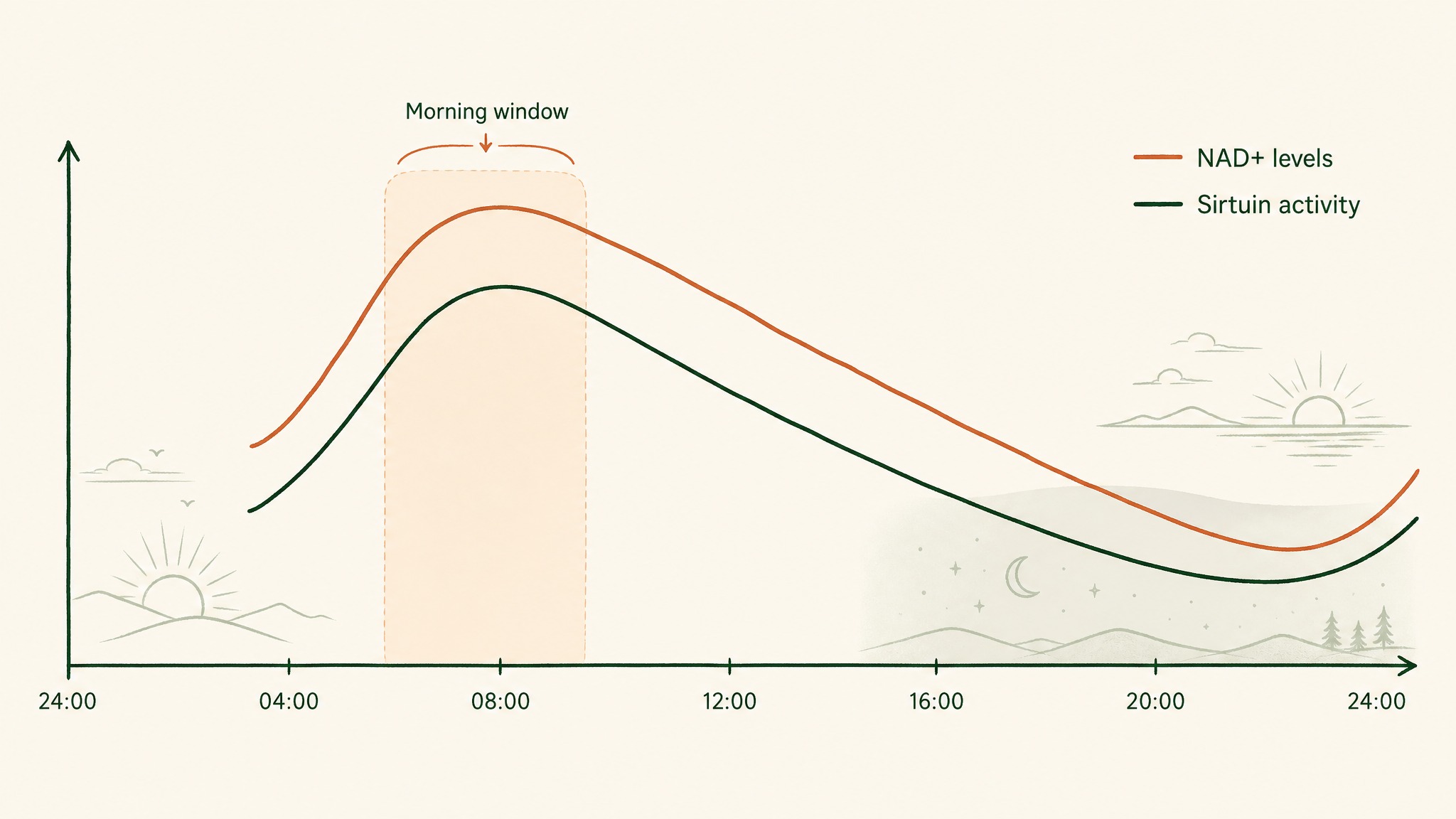
NAD+ levels rise with daylight and peak in early morning, matching when your repair proteins are most active.
That doesn't mean dosing at the "wrong" time wastes the capsule. It means the published evidence is much stronger for the morning window, simply because that is when nearly every controlled trial has tested it.
A few practical anchors to keep in mind:
- Most published NR and NMN trials dose in the morning, often fasted (Conze et al., 2019; Yoshino et al., 2021).
- Your sirtuins, the enzymes that burn NAD+, ramp up with daylight and food intake.
- Splitting a dose into late evening has not been shown to outperform a single morning dose in published comparisons.
The clock matters because your biology has one. Working with it is the cheapest optimisation you can run.
Why is morning the most studied window?
The morning bias in NAD research isn't arbitrary. It mirrors how your body's own NAD+ cycle works, and how the molecule pairs with daily metabolism.
Think of NAD+ as the cellular fuel your engine runs on between meals and during exercise. Your liver, your muscles, and your brain all draw on it most heavily during the active phase of the day. The 2018 NR trial in healthy middle-aged adults, the one that first showed a clean, dose-dependent NAD+ rise in human blood, used a once-daily morning dose for six weeks (Martens et al., 2018).
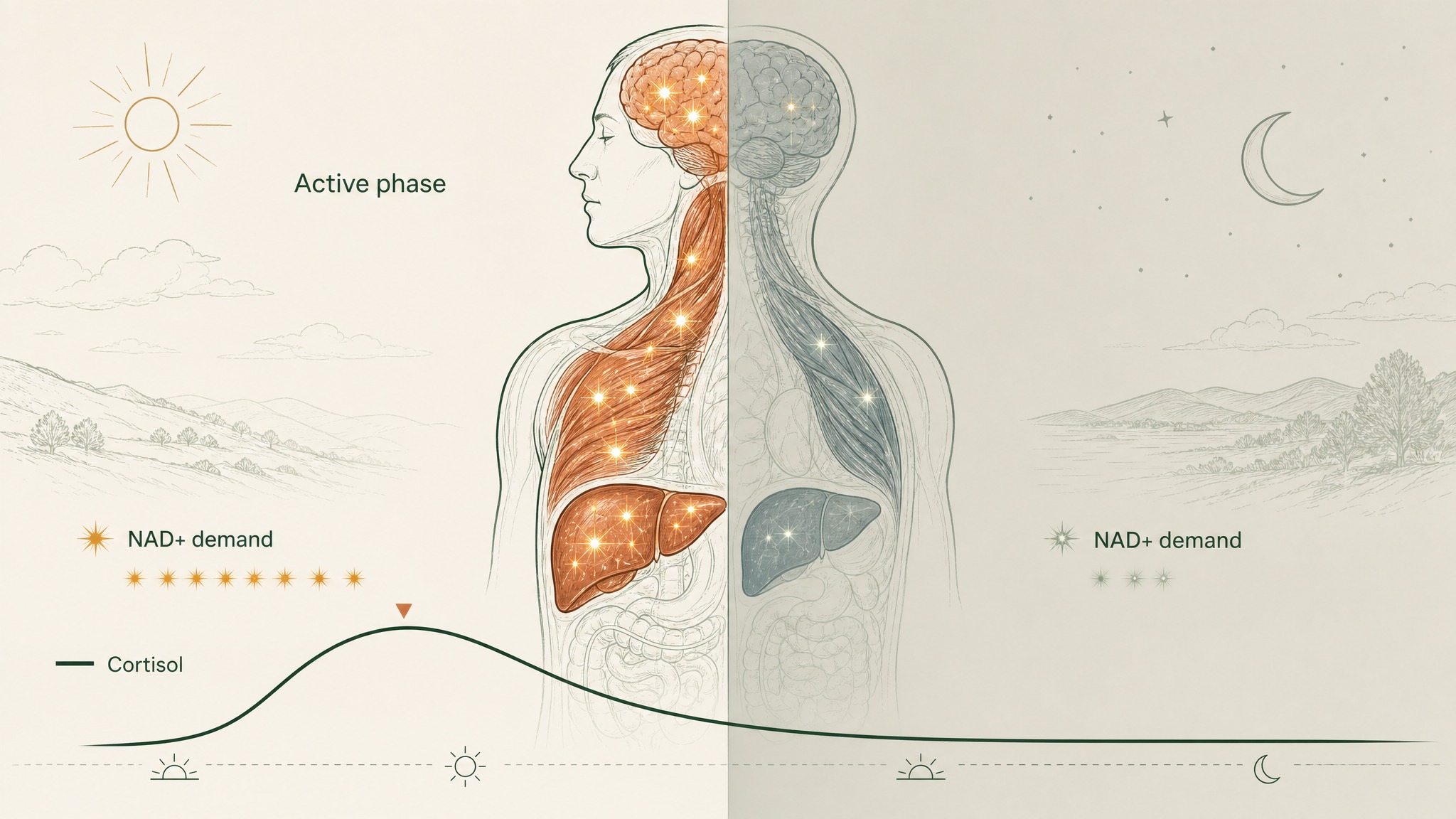
Your body's NAD+ demand peaks during the day when your liver, muscles, and brain are most active.
The 2021 NMN insulin-sensitivity trial dosed in the morning too (Yoshino et al., 2021). So did the 2023 NMN dose-ranging study that found 600 mg as the sweet spot (Yi et al., 2023). When you look at the literature as a whole, morning dosing is the de facto convention, and that convention is what your bottle's "any time" claim is leaning on without saying so.
There's a second reason worth noting. NAD+ precursors can be mildly stimulating in some people, similar to how a small B-vitamin pulse feels. Taking that pulse first thing in the morning means it lines up with your natural cortisol curve. Taking it at 9 pm asks your body to absorb an energising signal at the exact hour it should be winding down.
Should you take NAD on an empty stomach or with food?
For oral capsules of NMN or NR, the trial-supported habit is fasted, usually 15 to 30 minutes before breakfast. The reason is partly about absorption and partly about the daily rhythm we just covered.
When you take an oral NAD precursor with a big meal, two things compete with it:
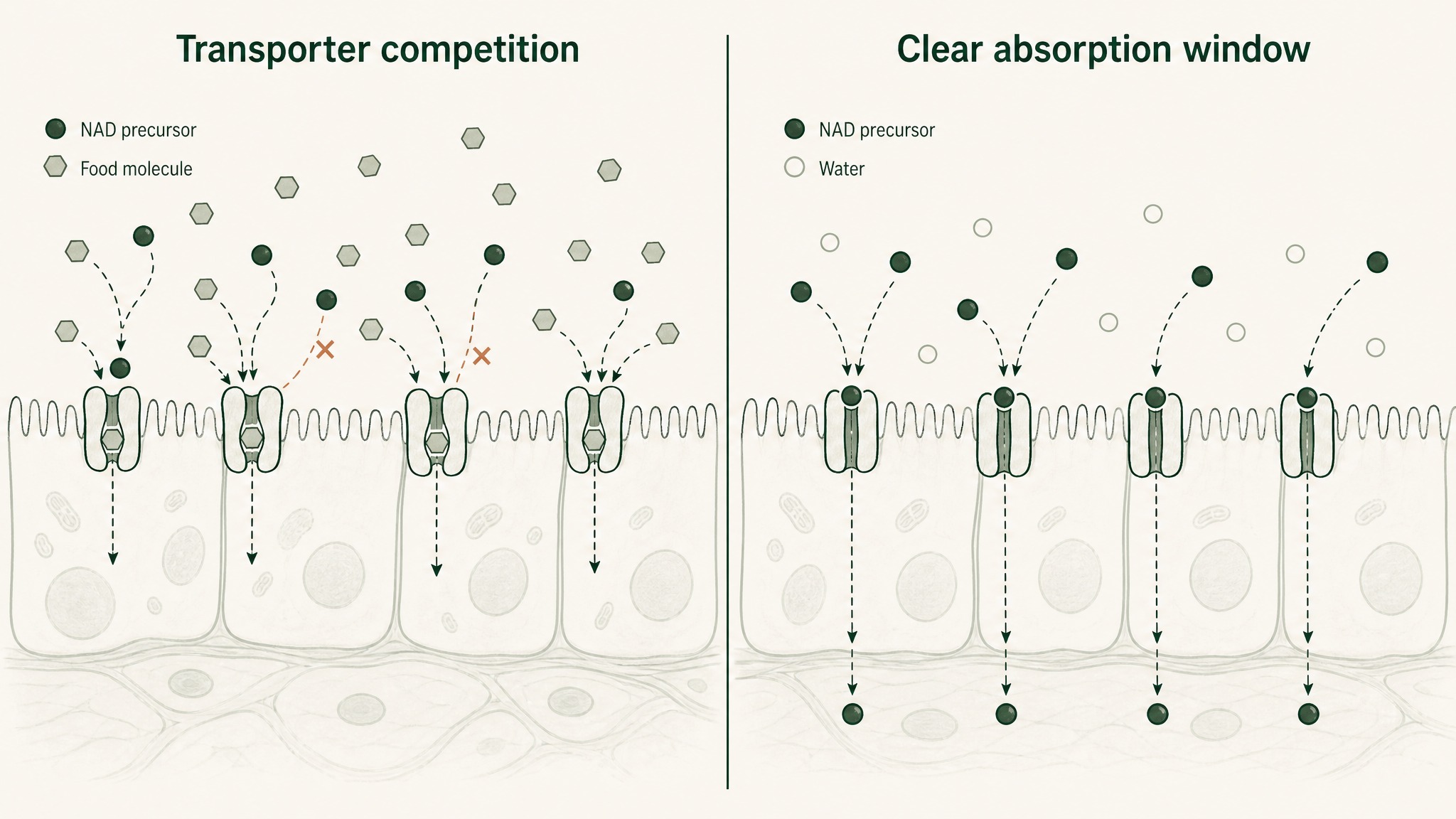
How food molecules compete with NAD precursors for the same intestinal transporters.
- Food competes for the same intestinal transporters that move small nucleotides across the gut wall.
- A higher insulin response from a carb-heavy meal can blunt some of the sirtuin signalling NAD+ is meant to support.
That doesn't mean food cancels the supplement. It just means the cleanest absorption window, based on the trial protocols, is fasted and early.
A short list of practical defaults:
- NR oral capsule: 250 to 500 mg with water, on waking, before food.
- NMN oral capsule: 250 to 900 mg with water, on waking, before food.
- Sublingual direct NAD+: under the tongue on waking, no food required, dose set in milligrams (not grams) because the route does the work.
If a fasted stomach makes you queasy, taking it with a small protein-led breakfast is a reasonable compromise. The label that says "any time" is hedging; the trial protocol is not.
What happens if you take an NAD supplement at night?
Honest answer: a fraction of users report sleep disruption, and a fraction report nothing at all. The research on this is thin and anecdotal, but the pattern is consistent enough to be worth flagging.
Why might evening dosing cause an issue? NAD+ is a substrate for sirtuins, and sirtuins help drive the wake-side of your body clock. Layer extra fuel onto that pathway at 10 pm and you're asking the system to do daytime work during the night-time recovery window.
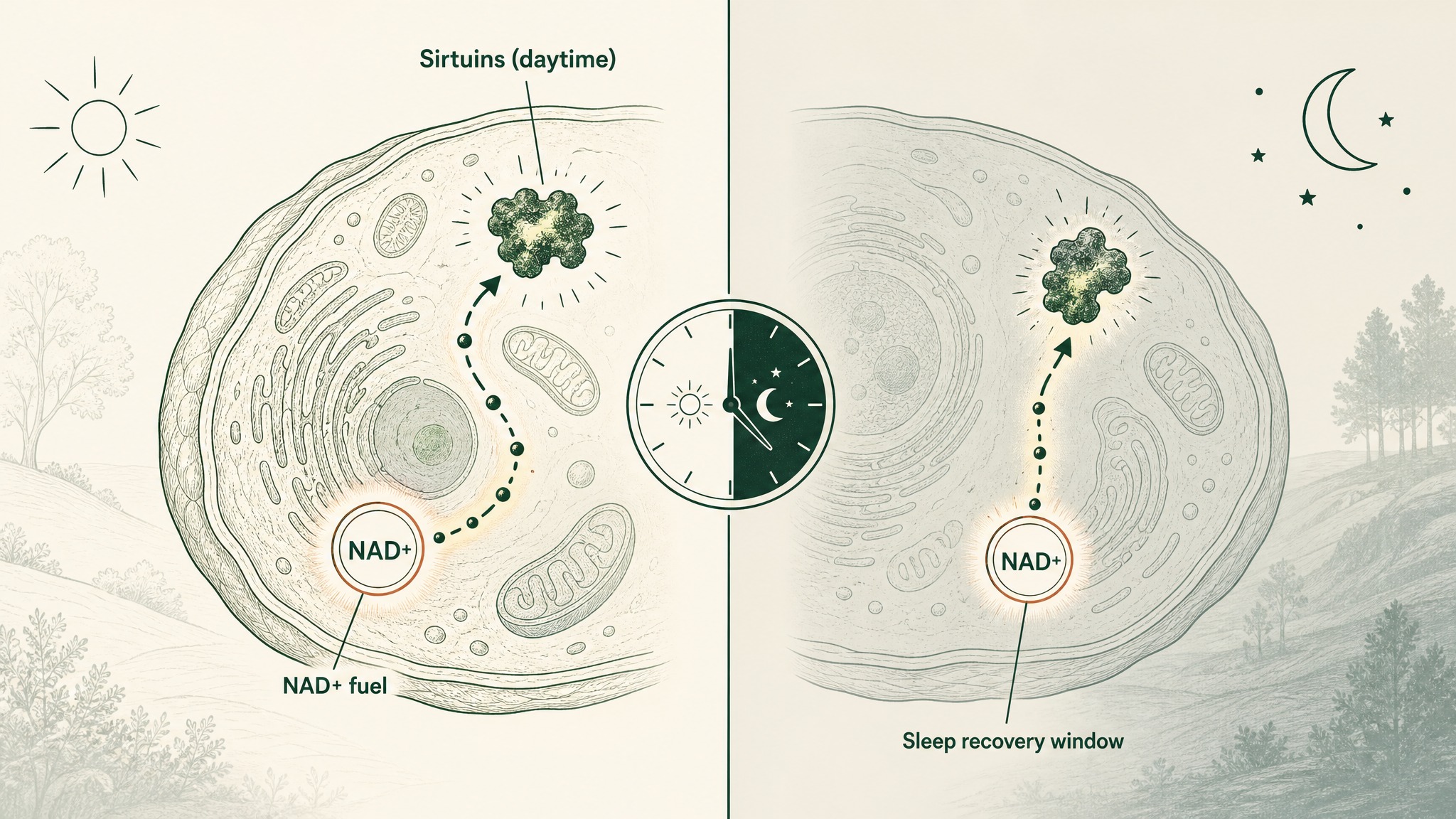
Why extra NAD+ at night can keep your daytime cellular machinery running when it should rest.
Some users report:
- Lighter, more fragmented sleep when NMN is taken after 6 pm
- Vivid or restless dreaming
- A subtle "wired" feeling 60 to 90 minutes after dosing
Members experience this differently. Plenty take an NAD supplement in the evening with no noticeable change. But if you are starting fresh and your sleep is already average rather than rock-solid, the conservative move is to dose in the morning until you know how your body responds.
There is one practical exception. If your goal is supporting late-evening exercise recovery and you already sleep well, an early-evening dose (say, two hours before bed) is a more defensible time than right at lights-out.
Is there a best time for NMN versus NR versus direct NAD+?
The answer differs by molecule, and it tracks how each one moves through your body.
NR and NMN are both precursors. Your cells absorb them, convert them through a couple of enzyme steps, and route them into the NAD+ pool. Both peak in the blood within roughly one to two hours of an oral dose and clear within four to six hours (Conze et al., 2019; Irie et al., 2020).
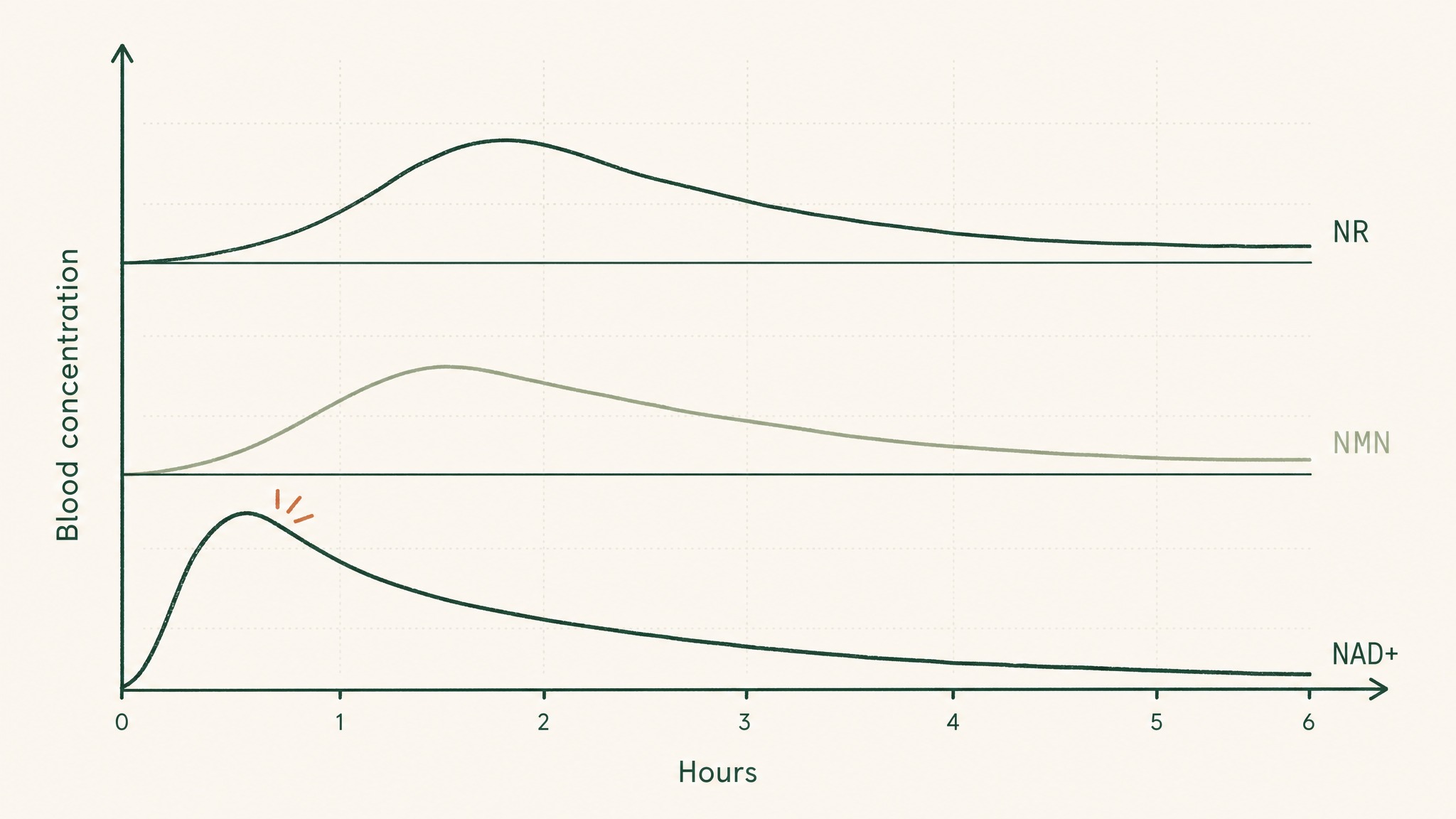
How NR, NMN, and direct NAD+ reach your bloodstream at different speeds and heights.
Direct NAD+ is the molecule itself, not a precursor. Taken sublingually, it bypasses the gut entirely and shows up in circulation faster. For a deeper look at why the delivery route matters as much as the dose, it comes down to how much survives the trip.
Here's how this changes the timing question by form:
- NR (oral capsule): Morning, fasted. Half-life is short, so a second dose has limited overlap.
- NMN (oral capsule): Morning, fasted. Some users report afternoon dosing for energy support; evening dosing is the most likely sleep-disruptor of the three.
- Direct NAD+ (sublingual): Morning is still the most studied, but the faster onset gives more flexibility. Pre-workout or post-workout dosing has more practical logic here than with a slow-absorbing capsule.
The first lesson of the three is the same: the form decides how strict the timing rules need to be. The faster the molecule reaches your blood, the more leeway you have on the clock.
How does sublingual delivery change the timing question?
It changes almost everything about it. A sublingual tablet dissolves under your tongue and the molecule passes through the thin tissue there straight into your bloodstream, bypassing your stomach, your gut enzymes, and your liver's first pass on the way through. The food question, the absorption window question, and the gut-discomfort question all reduce in size.
In our protocol design work on LEGACY, the absorption route was the question we kept coming back to. Once a molecule gets into circulation via the sublingual route, the clock starts ticking on minutes rather than hours, which is why the same dose can produce a noticeably faster response than a capsule taken with breakfast. That observation is about delivery mechanics under research conditions, not a therapeutic claim.
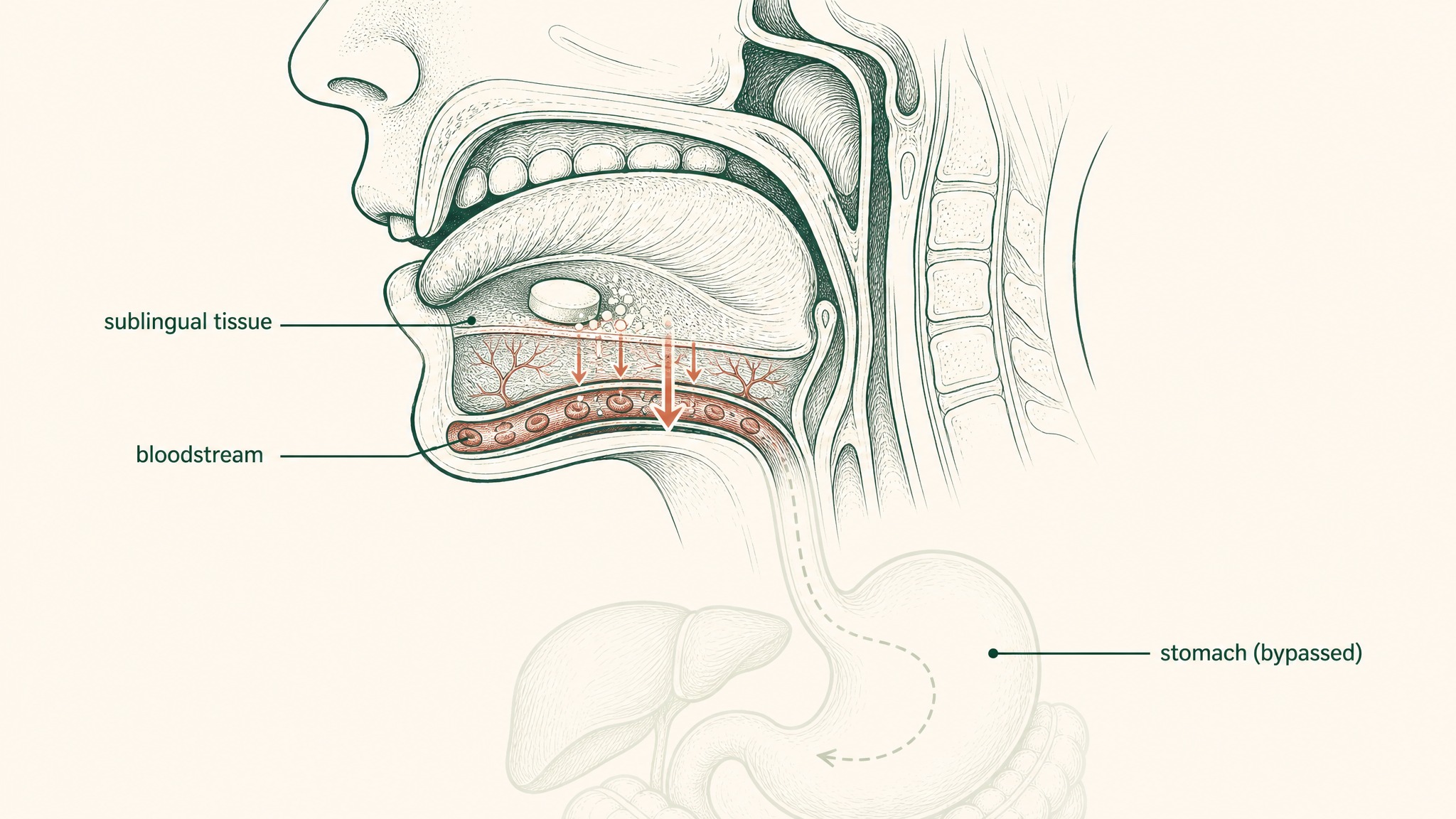
Sublingual tablet dissolves under the tongue and enters the bloodstream directly, skipping digestion.
This is the same logic behind VERISORB sublingual technology. Routing around the gut means a small dose can do the work a large oral dose only attempts.
For someone using a sublingual NAD+ protocol, the timing guidance simplifies:
- Take it on waking, before coffee, before brushing teeth.
- Hold under the tongue for the full instructed time, usually 60 to 120 seconds.
- Skip food and water for 10 to 15 minutes after to let absorption finish.
That's it. No need to time around meals. No need to set an alarm for a second dose. The route did the heavy lifting that timing has to compensate for with an oral capsule.
How often should you dose, once or twice a day?
For most healthy adults using a precursor, once a day in the morning is the trial-supported default. Twice-daily dosing is the exception, not the rule, and it's rarely been shown to beat a clean single dose in published comparisons.
The case for once daily comes down to two things:
- NAD+ precursors clear within hours, but the body's NAD+ pool turns over more slowly. A single morning dose feeds the rising part of the cycle, where most demand sits.
- Adding a second dose adds cost and habit friction without strong evidence of a bigger NAD+ rise in healthy adults.
The case for split dosing is narrower and applies to a specific kind of user:
- High training volumes (two-a-day sessions) where late-afternoon energy support is the goal
- Existing users at the top end of NMN doses (600 to 900 mg) who get GI tolerance issues from a single hit
- Sublingual users using one dose for general support and a second pre-workout
Outside those cases, split dosing tends to be brand marketing rather than biology. If a label is pushing you to dose three or four times a day, the most likely explanation is that the per-tablet dose is intentionally low.
What should you stack with your NAD supplement and when?
Stacking is where most people get this wrong. The pairing question matters because some compounds share NAD+'s circadian fit, and some compete with it for absorption.
A handful of pairings that have a research-backed logic, mostly when taken in the same morning window:
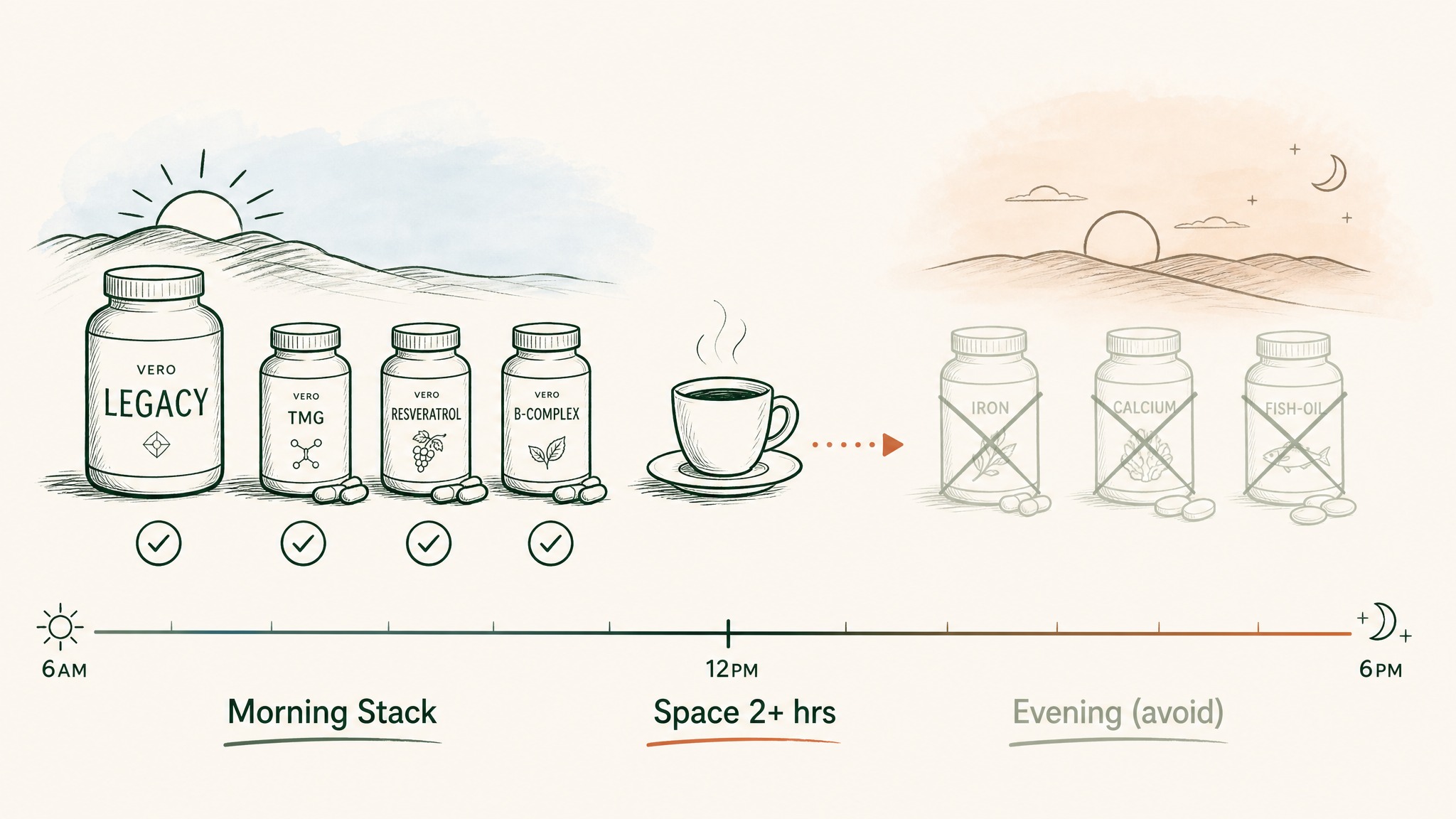
NAD+ stacks best with B-vitamins and resveratrol in the morning, but needs spacing from iron, calcium, and fish oil.
- Trimethylglycine (TMG): often paired with NMN to support methylation; safe to co-dose in the morning.
- Resveratrol: a sirtuin co-activator; trials have used it alongside NR or NMN with no obvious clash.
- B-vitamin complex: since NAD+ metabolism shares the niacin family, a clean morning B-complex makes biological sense.
A few pairings that benefit from spacing apart by at least two hours:
- Iron and calcium supplements: can compete for gut transporters with NMN and NR.
- Coffee: doesn't block NAD precursor absorption, but it can blunt the empty-stomach window if you drink it the moment you wake.
- High-fat fish-oil capsules: taking these in the same fasted window can slow precursor absorption.
If you want a deeper read on the whole longevity stack, the pairings get richer with magnesium, omega-3s, and sirtuin support compounds layered across morning and evening. The rule of thumb: NAD precursors go with breakfast and water, not with your dinner stack.
When will you actually feel anything from changing the timing?
The most honest answer: the rise in blood NAD+ shows up in the lab within days, but what you feel takes longer and is more subjective.
In the 2019 dose-ranging trial, NR raised whole-blood NAD+ within two weeks at the higher doses, with a dose-dependent climb (Conze et al., 2019). The 2018 NR trial saw the rise hold steady over six weeks of daily dosing (Martens et al., 2018). The 2023 NMN trial measured a clean rise across dose groups and a modest improvement in walking distance (Yi et al., 2023).
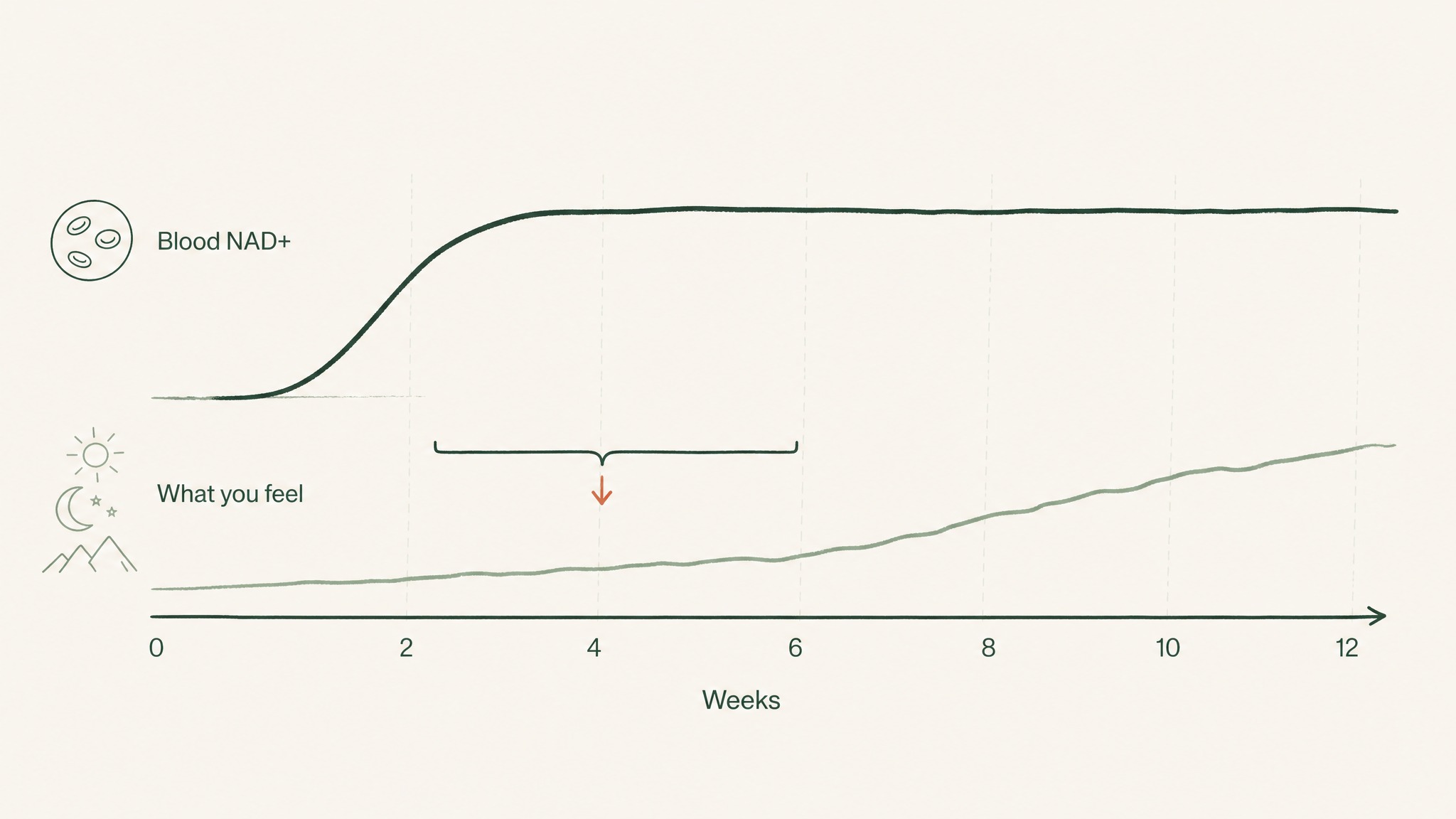
Blood NAD+ rises within two weeks, but energy and sleep improvements take six to twelve weeks.
What does that mean for you, the user? Plan in months, not days. Two to four weeks for the biochemistry to shift, six to twelve weeks for subjective markers like energy, sleep depth, and exercise tolerance to reveal themselves. Track one or two things, not ten. And keep the timing consistent for a full cycle before you start tweaking, because changing the dose and the time at once will tell you nothing useful.
Frequently Asked Questions
Is morning or night the best time to take NAD?
Morning, based on the published trials and the body's own NAD+ rhythm. Most controlled studies have dosed in the morning, often fasted, and research suggests NAD+ levels naturally rise in the early waking hours. Evening dosing can disrupt sleep in some users, particularly with NMN.
Can you take NAD with coffee?
Yes, but the cleanest absorption window for an oral capsule is fasted, with water, 15 to 30 minutes before food or caffeine. If you can't skip the morning coffee, take the supplement first, wait the window, then drink. Sublingual NAD+ avoids this question entirely.
Should NMN be taken on an empty stomach?
The trial-supported habit is fasted in the morning. Food can compete with NMN for gut transporters, and a fasted dose lines up with the rising part of your daily NAD+ cycle. If a fasted stomach makes you nauseous, a small protein breakfast is a reasonable compromise.
How long until you feel anything?
Lab markers like blood NAD+ rise within two to four weeks at trial doses. Subjective benefits like energy or sleep quality take six to twelve weeks of consistent daily dosing, if they show up at all. Plan in months, not days.
Can you take NAD every day forever?
Most published safety data on NR and NMN runs to several months in healthy adults at trial doses (Conze et al., 2019; Martens et al., 2018; Yi et al., 2023). Long-term safety beyond a year is still being studied. If you take prescription medication or have a medical condition, talk to a clinician before starting any daily protocol.
References
- Conze et al. (2019). Safety and metabolism of long-term administration of NIAGEN (NR) in a randomized, double-blind, placebo-controlled clinical trial of healthy overweight adults. Scientific Reports. https://www.nature.com/articles/s41598-019-46120-z. Retrieved 2026-06-26.
- Martens et al. (2018). Chronic nicotinamide riboside supplementation is well-tolerated and elevates NAD+ in healthy middle-aged and older adults. Nature Communications. https://pubmed.ncbi.nlm.nih.gov/29599478/. Retrieved 2026-06-26.
- Yoshino et al. (2021). Nicotinamide mononucleotide increases muscle insulin sensitivity in prediabetic women. Science. https://pubmed.ncbi.nlm.nih.gov/33888596/. Retrieved 2026-06-26.
- Yi et al. (2023). The efficacy and safety of beta-nicotinamide mononucleotide supplementation: a multicentre, randomised, double-blind, placebo-controlled, dose-dependent clinical trial. GeroScience. https://pubmed.ncbi.nlm.nih.gov/35451086/. Retrieved 2026-06-26.
- Irie et al. (2020). Effect of oral administration of nicotinamide mononucleotide on clinical parameters and nicotinamide metabolite levels in healthy Japanese men. Endocrine Journal. https://pubmed.ncbi.nlm.nih.gov/31685720/. Retrieved 2026-06-26.
- Peek et al. (2013). Circadian clock NAD+ cycle drives mitochondrial oxidative metabolism in mice. Science. https://pubmed.ncbi.nlm.nih.gov/24051248/. Retrieved 2026-06-26.
- Massudi et al. (2012). Age-associated changes in oxidative stress and NAD+ metabolism in human tissue. PLOS ONE. https://pubmed.ncbi.nlm.nih.gov/22745795/. Retrieved 2026-06-26.
Ready to support your longevity protocol with sublingual NAD+? Explore VERO LEGACY →
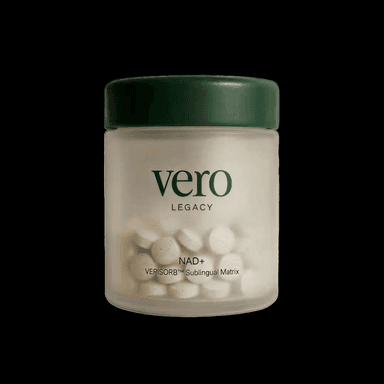
LEGACY™
NAD+Engineered around 300mg NAD+. Replenishes systemic NAD+ levels and drives mitochondrial function
Clinical Context
Important Notice: VERO protocols are nutritional and systemic optimisation formats. They are not intended to diagnose, treat, cure, or prevent any medical condition. These statements have not been evaluated by the Food and Drug Administration.