

Does an NAD supplement really work? What the human trials, blood NAD data and null findings actually show, and how to tell if yours is doing anything.
Key Takeaways
- NAD precursors (NR, NMN) reliably raise blood NAD+ in human trials. This is the strongest, most replicated finding in the category.
- The effect on biomarkers depends heavily on the population. Yoshino showed insulin sensitivity gains in prediabetic women. Dollerup showed nothing in obese men.
- Subjective effects (energy, focus, recovery) are reported by users but not confirmed in large blinded trials. Members experience varies widely.
- Form and route matter more than brand. Direct oral NAD+ has the weakest evidence. Sublingual delivery bypasses the first-pass liver loop that limits standard capsules.
- If you want to know whether yours is doing anything, blood-test before you start and again at twelve weeks. The data beats the journal every time.
Introduction
If you've been staring at a forty-dollar bottle of NAD pills wondering whether it actually does anything, you're asking the right question. The longevity shelf is stacked with confident promises about energy and mornings that feel like they used to. Most bottles skip the one detail that decides whether any of it works.
This guide is for research purposes only. It walks through what "really work" honestly means for an NAD supplement, what the human trials show, and where the evidence gets thin. If you're impatient, the VERO LEGACY sublingual NAD protocol exists because most oral NAD capsules underperform for a specific reason — one the human trials keep pointing at.
The short version:
- The science is real but narrower than the marketing. Human trials show NAD precursors can raise blood NAD+, but raising NAD+ is not the same thing as making you feel different.
- Two precursors have the strongest human evidence: nicotinamide riboside (NR) and nicotinamide mononucleotide (NMN). Direct NAD+ in oral capsules has almost none.
- Some trials show real outcomes: insulin sensitivity, gait speed, grip strength. Others show clean nulls: NR did nothing for insulin sensitivity in obese men, NR didn't improve walking distance in heart failure.
- Whether yours works depends on the form, the dose, the route, and what you're actually trying to change.
What does "really work" actually mean here?
This is where most of the argument falls apart before it starts. "Works" can mean three completely different things, and brands lean on whichever one suits them.
The three meanings, in plain language:
Three separate ways a NAD supplement could work: raising blood levels, improving clinical markers, or boosting daily energy and focus.
- Raises blood NAD+. Does swallowing this pill put more NAD into your bloodstream, where your cells can use it?
- Changes a biomarker your doctor would care about. Insulin sensitivity, blood pressure, inflammation markers, or muscle strength on a real test.
- Changes how you feel day to day. Energy, sleep, mental sharpness, recovery — the subjective stuff that made you buy the bottle.
A supplement can hit one of those without hitting the other two. NAD precursors are actually quite good at the first, mixed on the second, and almost silent in the human trials on the third. That mismatch is the whole reason this question keeps coming up.
Does an NAD supplement raise your blood NAD?
Yes. The right form at the right dose does. This is the strongest single piece of evidence in the whole category, and it's genuinely settled.
The three trials that pinned this down:
- Martens 2018 (Nature Communications). Healthy middle-aged and older adults took 1,000 mg of nicotinamide riboside (NR) daily for six weeks. Blood NAD+ in their immune cells rose by about 60% versus placebo.
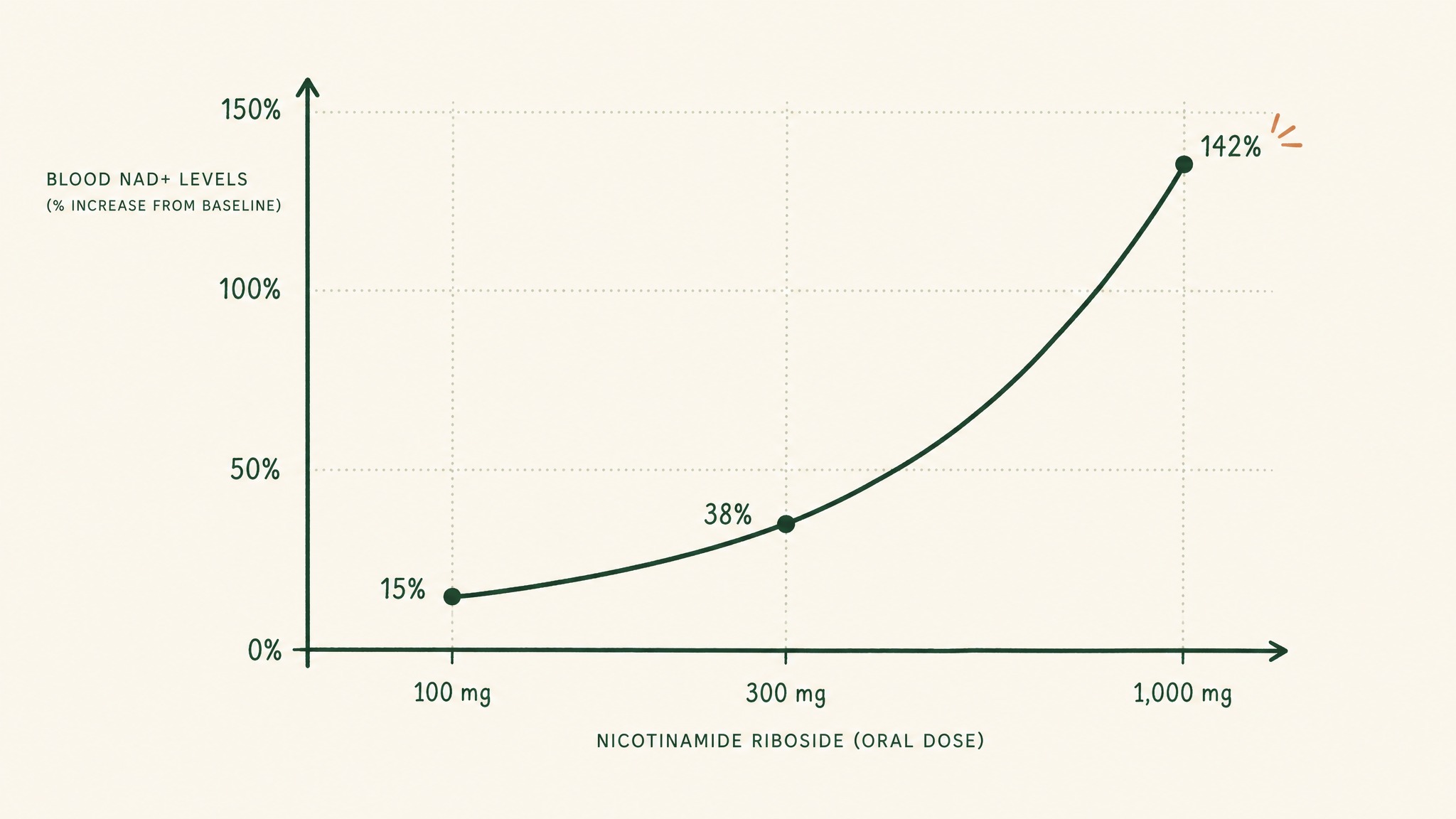
- Conze 2019 (Scientific Reports). Ran the dose response more carefully. At 100 mg, 300 mg, and 1,000 mg of NR per day, whole-blood NAD+ climbed by roughly 22%, 51%, and 142%. Dose matters, and the curve is not flat.
- Yamaguchi 2024 (Endocrine Journal). Eight weeks of oral NMN in middle-aged Japanese men. NAD+ in blood cells rose steadily across the study and the regimen was well tolerated.
The pattern across all three is the same. Oral precursors get into your blood, your cells convert them, your NAD pool rises.
A quick reality check on that, though. Blood NAD+ rising is the first hurdle, not the finish line. It tells you the molecule is reaching the right place, but it does not tell you anything will change because of it.
Does it actually change anything in human trials?
Here the picture gets more honest. Some trials show real outcomes. Others land flat. The pattern of which is which is more interesting than either alone.
The trials that did show something
Why NAD+ rises in all patients, but only some show measurable health improvements.
Yoshino and colleagues published a 2021 trial in Science that quietly became the most cited NAD paper in years. Postmenopausal women with prediabetes took 250 mg of NMN daily for ten weeks. Their muscle insulin sensitivity improved by 25% ± 7%, measured with the gold-standard clamp method — a real biomarker, not a vibe.
Igarashi and colleagues, published in NPJ Aging in 2022, ran a parallel study in healthy Japanese men aged 65 and older. The same 250 mg daily dose of NMN over twelve weeks produced small but nominally significant gains:
- Gait speed improved. Gait speed is a marker of healthy ageing that tracks mortality risk.
- Left grip strength improved.
- Blood NAD+ and its metabolite concentrations rose.
These are modest effects, not miracles. They're also exactly the biomarkers gerontologists care about, and they came out of a clean, placebo-controlled design.
The trials that landed flat
Dollerup and colleagues ran a 2018 trial in the American Journal of Clinical Nutrition that the supplement industry doesn't quote nearly enough. Obese, prediabetic men took 2,000 mg of NR per day for twelve weeks. Their NAD+ went up. Their insulin sensitivity, endogenous glucose production, and lipid mobilisation did not.
In our protocol design work, we've learned to read trials like Dollerup carefully. It isn't a failure of the molecule. It's a signal that the population decides the outcome — prediabetic men and postmenopausal women carry different metabolic states, and what raises NAD+ in both doesn't translate into the same functional benefit in either.
Wang and colleagues published a 2022 trial in JACC Basic to Translational Science on NR in heart failure with reduced ejection fraction. Blood NAD+ roughly doubled. Six-minute walk distance? No change. Cardiac structure? No change. Quality of life? No change. The molecule got in. The clinical needle did not move in twelve weeks.
So the honest reading is this. NAD precursors raise NAD+ reliably. Whether that translates into something a doctor can measure depends on the population, the dose, and the outcome you're tracking.
Why do most people feel nothing on an NAD supplement?
If the science is real, why do so many users report close to nothing? Three reasons stack up, and they matter in this order.
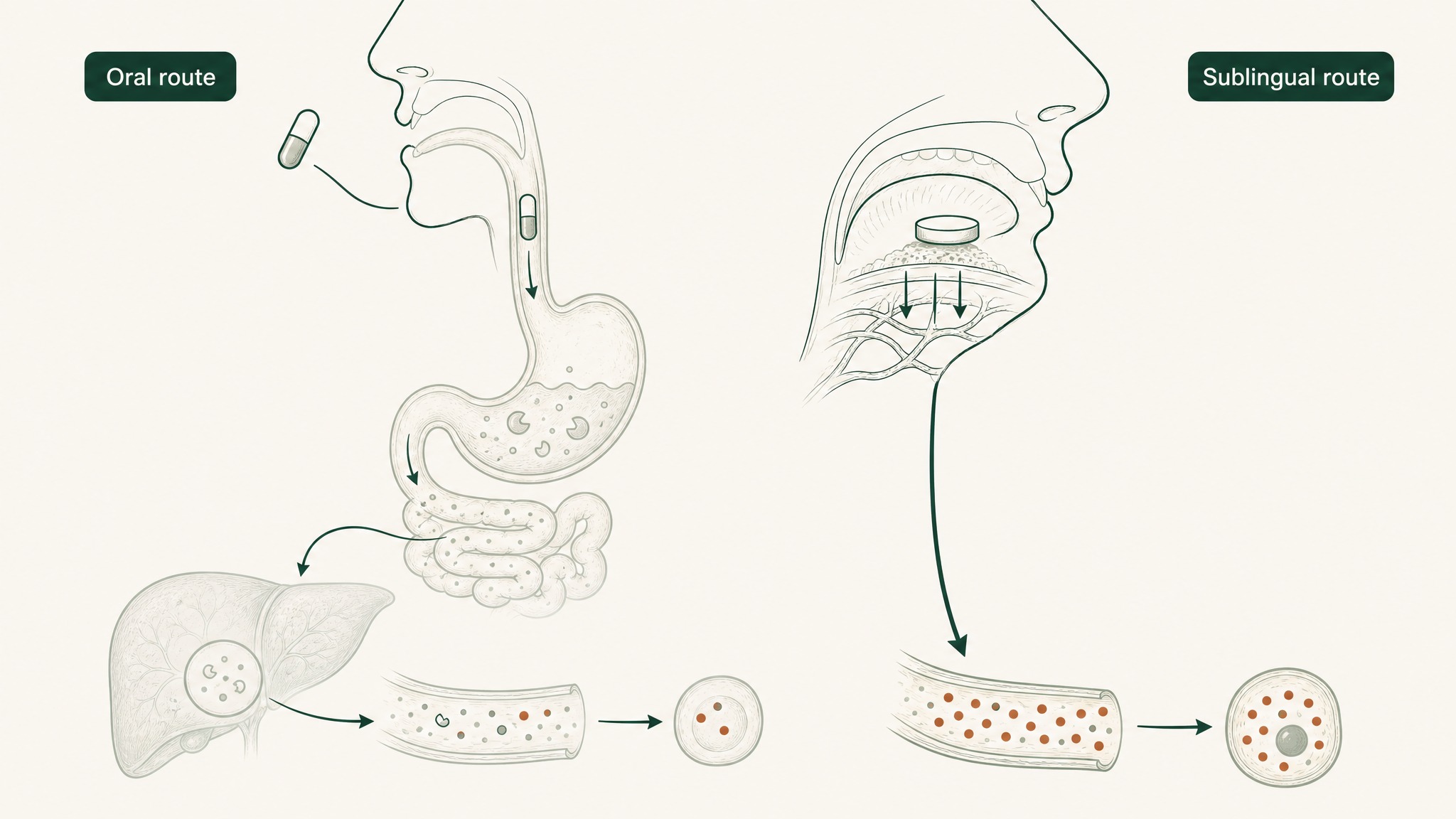
- Bioavailability is bad. NAD+ itself is a big, polar molecule with a molecular weight of about 663 daltons. It does not cross cell membranes easily, which is why the precursor pathway exists in the first place. When you swallow a capsule labelled "NAD+," almost none of the actual NAD+ molecule survives the trip from stomach to bloodstream. NR and NMN do better, but they still face stomach acid, gut enzymes, and a liver that breaks most of what arrives into smaller building blocks before sending anything back out.
- Blood chemistry is not lived experience. Your cellular energy production is not the same thing as how energetic you feel. Insulin sensitivity is not the same thing as feeling less foggy after lunch. The trials measure the first kind of thing. The subjective stuff is what bottles promise.
- Route decides how much of the dose survives. Oral capsules and tablets work, but they work the long way around: through your gut, through your liver, into your bloodstream. That route loses most of the dose to first-pass metabolism, the process where your liver breaks compounds down before they reach systemic circulation. Sublingual delivery — a tablet that dissolves under your tongue — bypasses that detour and enters your bloodstream through the thin tissue lining your mouth. This is the same principle behind sublingual nitroglycerin in cardiology, where bypassing the liver is the whole point. For an NAD precursor, that route lets a smaller dose deliver more of itself intact, which is the thinking behind VERO LEGACY and its VERISORB sublingual delivery system.
Oral NAD supplements lose most of their dose to liver metabolism, while sublingual delivery enters the bloodstream directly.
So is NAD a "real" supplement or longevity theatre?
It's real. It's also narrower than the marketing.
Real, in the sense that:
- Blood NAD+ can be raised by oral NR or NMN. This is confirmed in multiple placebo-controlled human trials.
- In the right population, that rise tracks with measurable outcomes (Yoshino on insulin sensitivity, Igarashi on muscle function).
- The FDA has issued a "no questions" letter for nicotinamide riboside chloride (GRN 635). That review allows the precursor to be sold legally as a food ingredient in the US.
Narrower, in the sense that:
- Not every trial shows benefit. Dollerup and Wang are real null findings in real populations.
- Most of the positive trials are small, short, and measure surrogates rather than hard clinical endpoints.
- The subjective claims ("more energy," "sharper focus") have not been demonstrated in any large, blinded human trial of NAD precursors. Users report these effects, but the evidence is anecdotal, not clinical.
If someone tells you it's pure marketing, they haven't read Yoshino. If someone tells you it's miracle fuel, they haven't read Dollerup. Both have to be true for the picture to make sense.
How can you tell if your NAD supplement is actually working?
This is the practical question. There are three reasonable ways to answer it, and they line up from most rigorous to most human.
The three routes, cleanest first:
- Blood test before and at eight to twelve weeks. Several labs offer dried blood spot tests for NAD+. If the number rises meaningfully, the supplement is doing what the trials say it does. If it doesn't move, change the form, dose, or route before the year of bottles drains your wallet.
- Track a biomarker the trials have moved. For a healthy person, that might be HbA1c, fasting insulin, grip strength, or a timed gait-speed test you can do at home. For an older adult, gait speed and grip strength are the cleanest markers of the kind of changes Igarashi reported.
- Keep a subjective journal for ninety days. Sleep quality, energy at 3pm, perceived recovery, mental sharpness. Be honest about placebo, dose adjustments, and whether you started anything else at the same time. If nothing shifts, that's data too.
A blunt note from our research work: most users overestimate what they feel in the first month, and underestimate what they see on the third blood test. The trial data follows the same shape. Give it twelve weeks before deciding.
Which form gives you the best shot at it working?
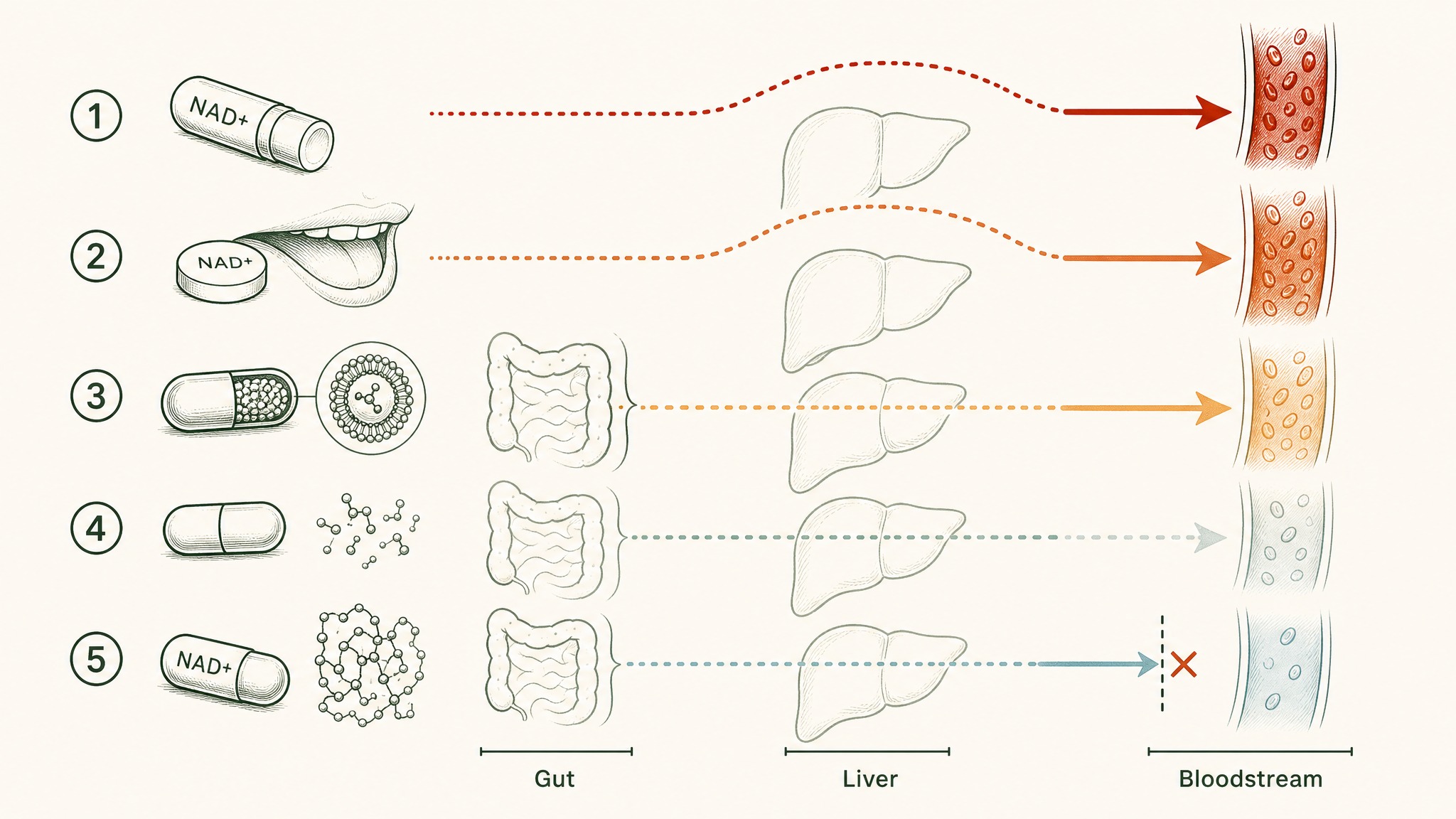
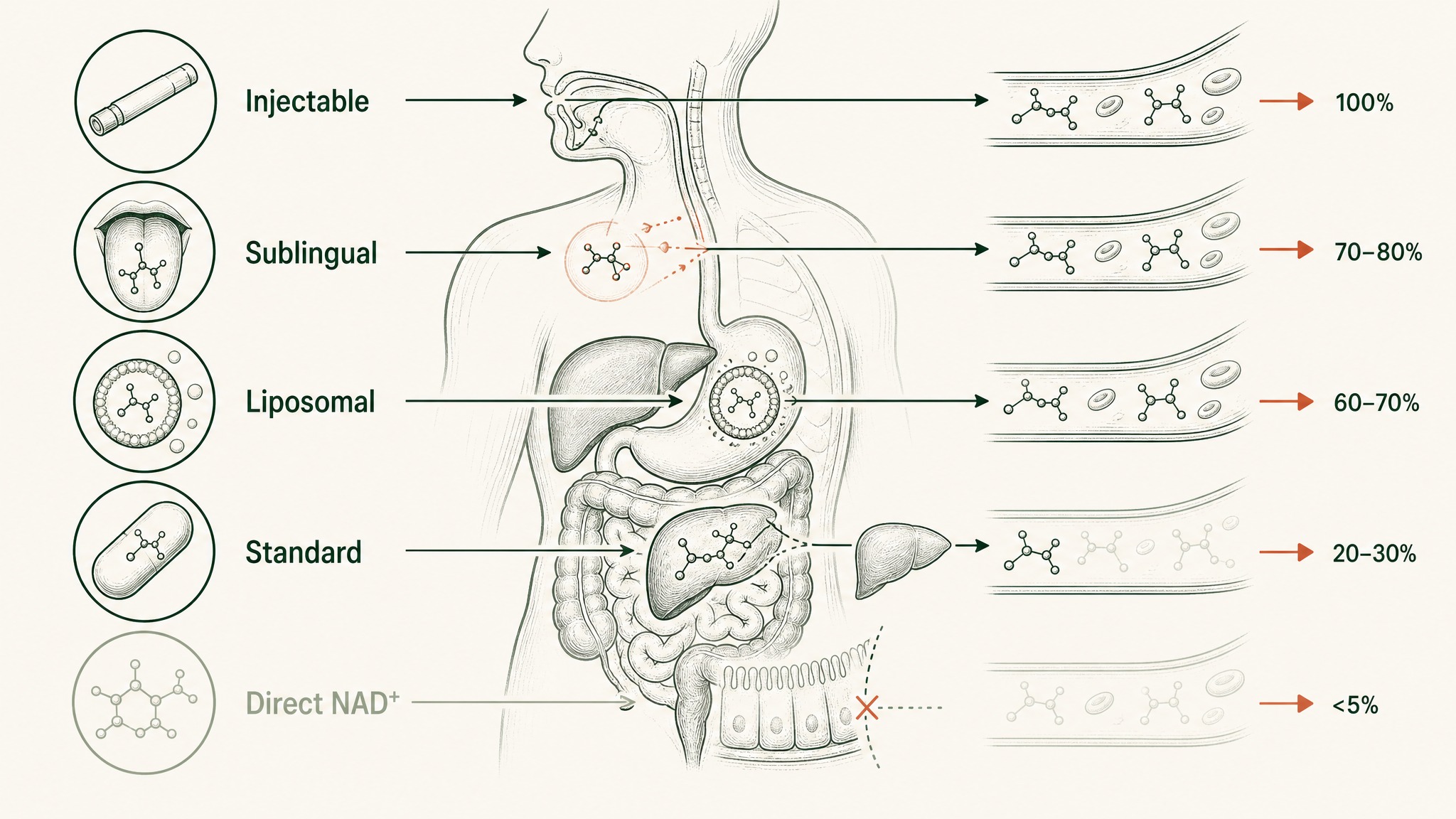
If you've decided to try one, the form and route decide most of the outcome before the dose does. The rough hierarchy looks like this.
- Injectable NAD or NMN. Bypasses your gut and liver entirely. Expensive, clinic-bound, not a daily proposition for most people.
- Sublingual NMN or NAD+. A small daily dose that absorbs directly into the bloodstream under the tongue, missing the gut and the liver loop.
- Liposomal oral NAD+ or NMN. Encapsulates the molecule in fatty bubbles to improve gut absorption. Better than plain capsules, still goes through the liver.
- Standard capsule NR or NMN. The most studied route in the human trials. It works, but needs higher doses (often 250 to 1,000 mg) to overcome first-pass losses.
- "NAD+" capsules. Direct NAD+ in a capsule is the worst-studied form. The molecule's size and charge make oral absorption poor, and the trials use precursors for exactly that reason.
How five different NAD+ routes reach your bloodstream with varying efficiency.
If you've tried a capsule and felt nothing, the next sensible experiment is the route, not the dose. Sublingual NMN at a smaller daily dose often outperforms a larger capsule dose for the same molecule, because more of what you actually swallow reaches your bloodstream.
The honest verdict
Does an NAD supplement really work? In the literal, measurable sense, yes. The best-studied forms raise blood NAD+ reliably, and in the right population they shift biomarkers a careful doctor would notice.
In the marketing sense — energy, focus, the cinematic version of feeling younger — the human trials are quieter than the bottle suggests.
What members experience varies enormously. Some feel a real difference. Others feel nothing despite biochemical changes happening in the background. If you go in expecting a measurable lift in your NAD pool and a slim chance of feeling something noticeable, you'll be where the data actually sits.
FAQ
How long until an NAD supplement starts working?
The blood NAD+ rise begins within a few weeks at clinically studied doses, based on the Conze 2019 dose-response data and Trammell 2016 single-dose kinetics. Biomarker shifts in the positive trials (Yoshino, Igarashi) appeared at 10 to 12 weeks. If you're tracking subjective effects, give it at least eight weeks before drawing conclusions.
Is NMN or NR better?
Both raise blood NAD+ in human trials. NR has the longer safety record and the FDA "no questions" letter (GRN 635). NMN has the positive Yoshino insulin sensitivity result and the Igarashi muscle function result. Pick the one with the form factor and route you can actually stick to.
Does an oral NAD supplement work at all?
It raises blood NAD+ when the form is NR or NMN. Direct NAD+ in oral capsules has poor evidence because the molecule is too large and polar for efficient oral absorption. Sublingual and injection routes work around that limit.
Why didn't I feel anything from my NAD supplement?
The most likely reasons: the form was direct NAD+ rather than a precursor, the dose was below the threshold the trials use (usually 250 mg minimum for NMN, 300 mg or more for NR), the route was oral rather than sublingual or injection, or the timeframe was too short. A twelve-week trial of a different form or route is the most sensible next experiment.
Can NAD supplements actually slow ageing?
Research suggests an NAD precursor can shift biomarkers tied to ageing (insulin sensitivity, gait speed, grip strength) in specific populations. No human trial has shown that an NAD supplement extends lifespan or slows the ageing process itself, because the trials needed to demonstrate that would take decades. The honest framing is "biomarker improvement in some trials," not "anti-ageing."
References
- Massudi H, Grant R, Braidy N, Guest J, Farnsworth B, Guillemin GJ. Age-associated changes in oxidative stress and NAD+ metabolism in human tissue. PLoS One. 2012;7(7):e42357. https://pmc.ncbi.nlm.nih.gov/articles/PMC3407129/. Retrieved 2026-07-08.
- Clement J, Wong M, Poljak A, Sachdev P, Braidy N. The plasma NAD+ metabolome is dysregulated in "normal" aging. Rejuvenation Res. 2019;22(2):121-130. https://pmc.ncbi.nlm.nih.gov/articles/PMC6482912/. Retrieved 2026-07-08.
- Martens CR, Denman BA, Mazzo MR, et al. Chronic nicotinamide riboside supplementation is well-tolerated and elevates NAD+ in healthy middle-aged and older adults. Nat Commun. 2018;9(1):1286. https://pmc.ncbi.nlm.nih.gov/articles/PMC5876407/. Retrieved 2026-07-08.
- Conze D, Brenner C, Kruger CL. Safety and metabolism of long-term administration of NIAGEN (nicotinamide riboside chloride) in a randomized, double-blind, placebo-controlled clinical trial of healthy overweight adults. Sci Rep. 2019;9:9772. https://pubmed.ncbi.nlm.nih.gov/31278280/. Retrieved 2026-07-08.
- Trammell SAJ, Schmidt MS, Weidemann BJ, et al. Nicotinamide riboside is uniquely and orally bioavailable in mice and humans. Nat Commun. 2016;7:12948. https://pubmed.ncbi.nlm.nih.gov/27721479/. Retrieved 2026-07-08.
- Yoshino M, Yoshino J, Kayser BD, et al. Nicotinamide mononucleotide increases muscle insulin sensitivity in prediabetic women. Science. 2021;372(6547):1224-1229. https://pmc.ncbi.nlm.nih.gov/articles/PMC8550608/. Retrieved 2026-07-08.
- Igarashi M, Nakagawa-Nagahama Y, Miura M, et al. Chronic nicotinamide mononucleotide supplementation elevates blood nicotinamide adenine dinucleotide levels and alters muscle function in healthy older men. NPJ Aging. 2022;8(1):5. https://pmc.ncbi.nlm.nih.gov/articles/PMC9158788/. Retrieved 2026-07-08.
- Yamaguchi S, Irie J, Mitsuishi M, et al. Safety and efficacy of long-term nicotinamide mononucleotide supplementation on metabolism, sleep, and nicotinamide adenine dinucleotide biosynthesis in healthy, middle-aged Japanese men. Endocr J. 2024;71(2):153-169. https://pubmed.ncbi.nlm.nih.gov/38191197/. Retrieved 2026-07-08.
- Dollerup OL, Christensen B, Svart M, et al. A randomized placebo-controlled clinical trial of nicotinamide riboside in obese men: safety, insulin-sensitivity, and lipid-mobilizing effects. Am J Clin Nutr. 2018;108(2):343-353. https://pubmed.ncbi.nlm.nih.gov/29992272/. Retrieved 2026-07-08.
- Wang DD, Airhart SE, Zhou B, et al. Safety and tolerability of nicotinamide riboside in heart failure with reduced ejection fraction. JACC Basic Transl Sci. 2022;7(12):1183-1196. https://pmc.ncbi.nlm.nih.gov/articles/PMC9831861/. Retrieved 2026-07-08.
- Herman TF, Santos C. First-pass effect. StatPearls. NIH National Library of Medicine. https://www.ncbi.nlm.nih.gov/books/NBK551679/. Retrieved 2026-07-08.
- Chini CCS, Tarragó MG, Chini EN. NAD and the aging process: role in life, death and everything in between. Mol Cell Endocrinol. 2017;455:62-74. https://pmc.ncbi.nlm.nih.gov/articles/PMC5419884/. Retrieved 2026-07-08.
- US Food and Drug Administration. Agency response letter GRAS Notice No. GRN 000635 (nicotinamide riboside chloride). https://www.fda.gov/food/gras-notice-inventory/agency-response-letter-gras-notice-no-grn-000635. Retrieved 2026-07-08.
Want a sublingual NAD protocol designed to bypass the gut and liver loop? Explore VERO LEGACY.
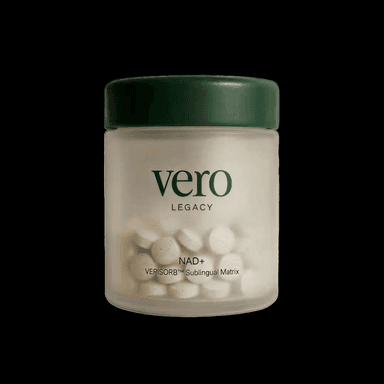
LEGACY™
NAD+Engineered around 300mg NAD+. Replenishes systemic NAD+ levels and drives mitochondrial function
Clinical Context
Important Notice: VERO protocols are nutritional and systemic optimisation formats. They are not intended to diagnose, treat, cure, or prevent any medical condition. These statements have not been evaluated by the Food and Drug Administration.