

What people actually take NAD supplements for, from energy and focus to metabolic support and longevity, and what the human trials really show.
Introduction
You've seen NAD everywhere. Longevity podcasts, your gym buddy's shelf, expensive IV clinics charging $600 a session. If you're wondering what an NAD supplement is actually used for, you're in the right place. This article is for research purposes only, not medical advice.
Here's the short version. People take NAD supplements to push back against age-related fatigue, sharpen thinking, support metabolic health, speed athletic recovery, and slow the visible parts of aging. Some clinics also use high-dose intravenous NAD as part of addiction-recovery protocols.
Below you'll get every real use case in plain English, what the human trials actually show for each one, and which form of NAD (there are four) makes sense for which goal. For the impatient, our NAD-precursor protocol is LEGACY.
Key Takeaways
- NAD is the tiny helper molecule your cells need for energy production, DNA repair, and aging-gene regulation, and it drops steadily with age.
- The seven real use cases are: everyday energy, cognitive focus, metabolic health, athletic recovery, longevity, skin resilience, and clinical IV protocols.
- The sharpest recent human evidence is for metabolic support in midlife women (Yoshino 2021 in Science).
- Delivery beats label dose: oral capsules hit a bioavailability wall, while sublingual and IV routes get much more of the molecule into your blood.
- NMN, NR, direct NAD+, and IV are all sold as "NAD supplements" but behave very differently in your body.
What is NAD, in one sentence?
NAD (short for nicotinamide adenine dinucleotide) is a helper molecule your cells use to turn food into energy, patch up damaged DNA, and switch aging-related genes on and off. Think of it as the AA battery that powers hundreds of jobs inside every one of your cells. Without enough of it, everything slows down.
Every one of those jobs stops running at full speed the moment NAD gets scarce.
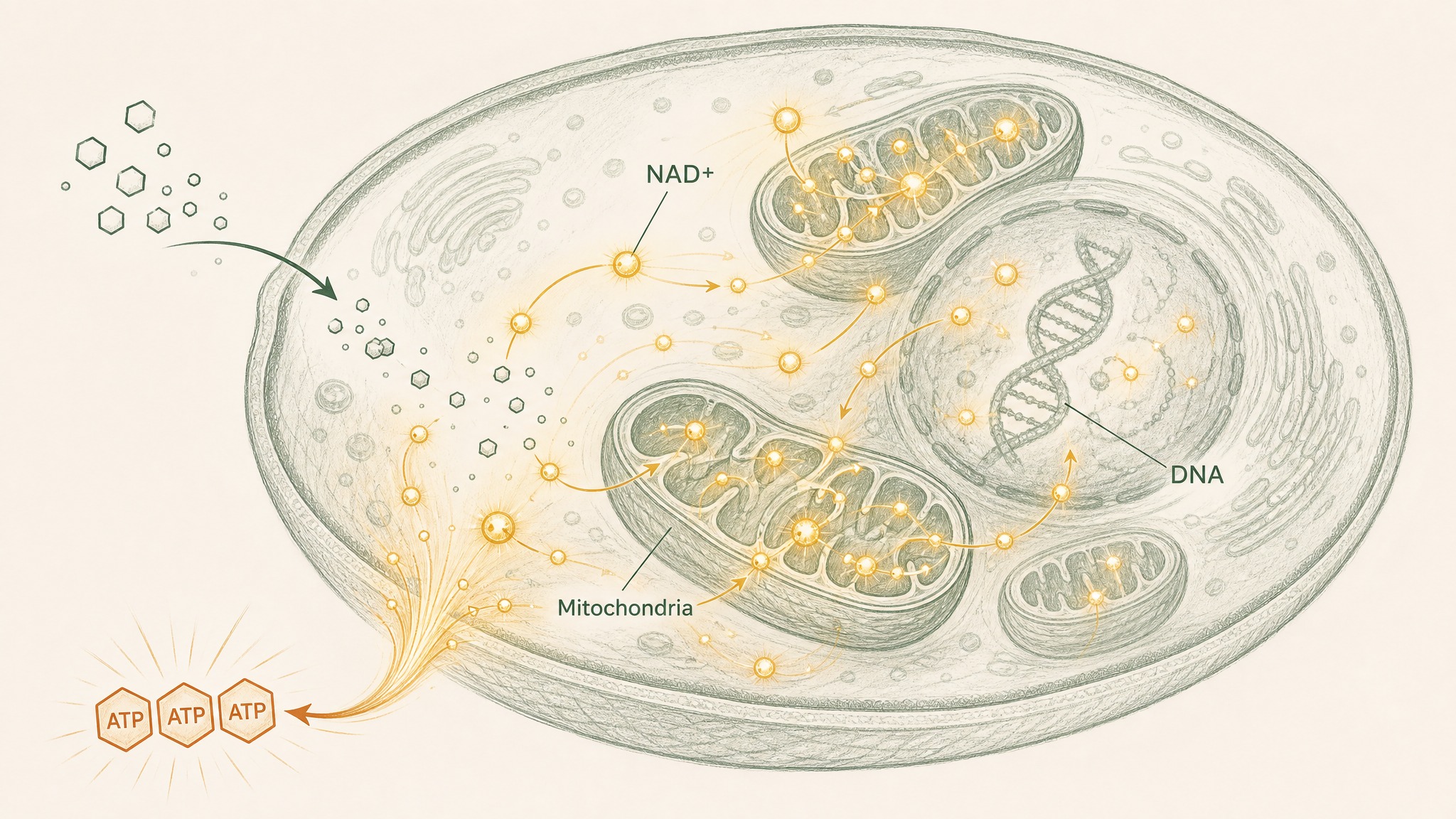
NAD molecules power energy production, DNA repair, and gene switches inside your cells.
Why do people take an NAD supplement in the first place?
By your forties, your cellular NAD levels are already trending down. Massudi and colleagues at UNSW measured NAD+ in human skin samples across a wide age range in 2012 and found a strong negative correlation with age in both men and women. The older the sample, the less NAD it carried.
Here's what that quiet decline looks like in real life:
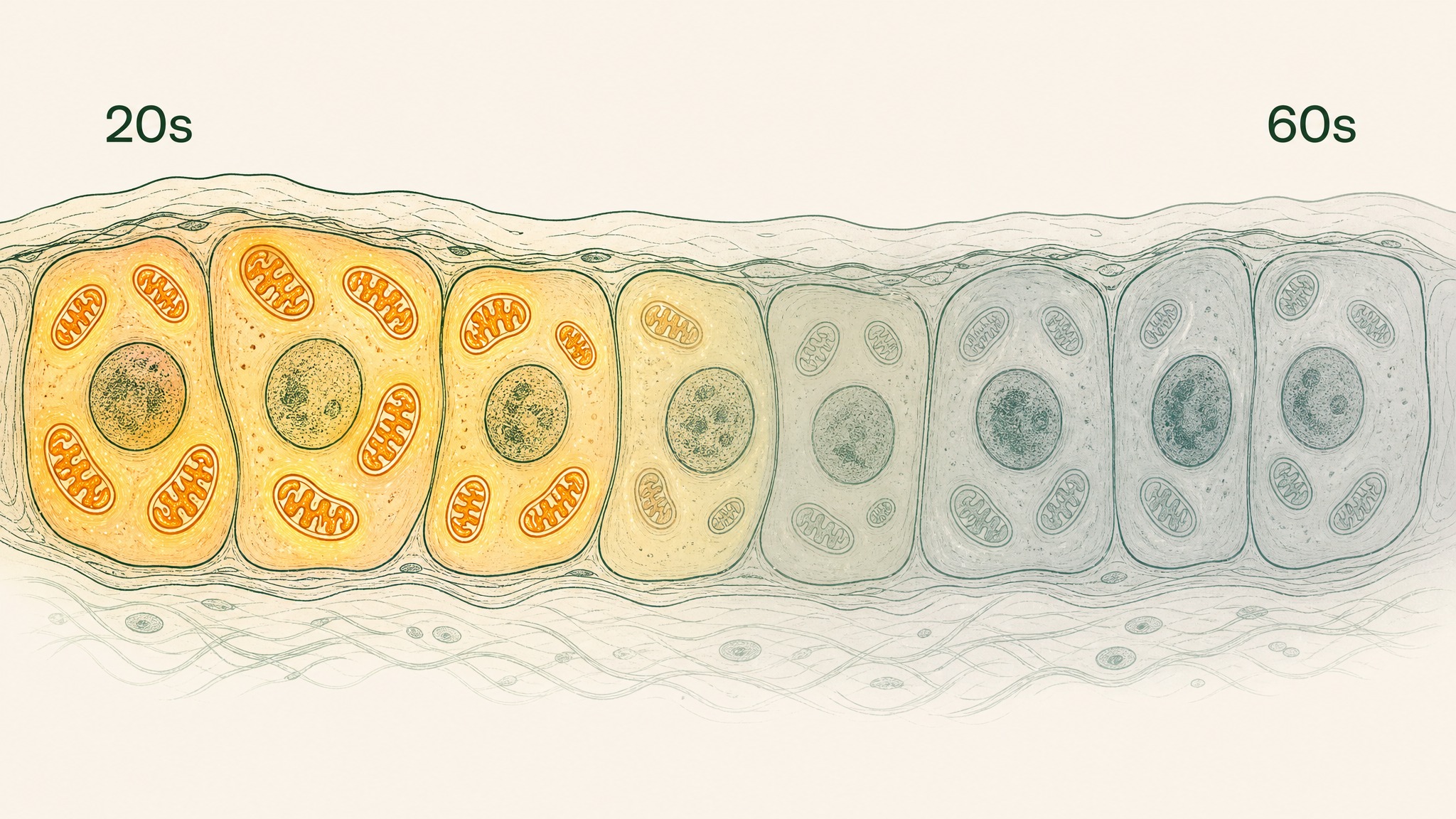
NAD+ levels drop consistently across the lifespan, with a sharper decline after forty.
- You get tired earlier in the day
- Workouts feel harder than they did five years ago
- Sleep is less restorative
- Your face starts to look tired even when you're not
If lower NAD tracks with feeling older, the pitch is simple: raise NAD, feel younger.
Users report that's exactly what pulls them toward an NAD supplement in the first place. The theory is clean. Whether the supplement in front of you actually delivers on it is a separate question, and we'll get to it below.
What is an NAD supplement actually used for? The 7 real applications
Here's the shortlist the research literature and the longevity community keep circling back to:
- Everyday energy and fatigue reduction
- Cognitive performance and focus
- Metabolic and blood-sugar support
- Athletic recovery and muscle output
- Longevity and cellular aging
- Skin resilience and appearance
- Alcohol recovery and NAD IV therapy
Let's take them one at a time.
1. Energy and fatigue
This is the number-one reason people buy their first NAD supplement. The logic makes biological sense. NAD is a required cofactor (meaning your cells physically can't finish the job without it) for the electron transport chain, the machinery inside your mitochondria (your cellular power plants) that turns food into ATP, the energy currency your muscles and brain actually spend.
Less NAD means less throughput, which means less energy on tap. Elhassan and colleagues at Birmingham gave older adults nicotinamide riboside (NR, a precursor your body converts into NAD) for 21 days in 2019 and saw a clear rise in muscle NAD along with a drop in circulating inflammatory markers. The direct "do you feel more energetic" question is still open, but the underlying machinery does move.
2. Cognitive performance and focus
Members experience this second most often. Brain cells burn through a huge share of your daily NAD, so the pitch is that restoring it should support thinking and focus. Small human trials, with Martens 2018 in Nature Communications the cleanest, have shown chronic NR is well tolerated and reliably lifts NAD levels in healthy middle-aged and older adults, though specific cognitive endpoints weren't the primary win in that study.
The honest answer here is that human cognition data is thin. Most of the brain-and-NAD story still rests on rodent work.
Research suggests the mechanism is real. The question is whether an oral supplement moves the needle in your head specifically.
3. Metabolic and blood-sugar support
This one has the strongest recent human data of any use case on the list. Yoshino and colleagues published a 2021 trial in Science that ran 10 weeks of nicotinamide mononucleotide (NMN, one step closer to NAD than NR) in overweight postmenopausal women with prediabetes. Muscle insulin sensitivity improved: a real, measured outcome in real people.
If you're in your forties or fifties and metabolic health is the main goal, this is the use case with the sharpest published evidence today.
4. Athletic recovery and muscle output
Regular exercisers reach for NAD supplements to shorten recovery windows and hold onto their training capacity as they age. The Elhassan 2019 muscle-metabolome trial found NR raised muscle NAD and shifted several inflammatory markers in a favourable direction in older adults.
The picture for hard-training athletes is less settled. Dolopikou and colleagues in 2020 saw improved performance markers with a single acute dose of NR in older sedentary adults but not the same signal in younger active people. Translation: the older you are, the more likely NAD supplementation matters for your training.
5. Longevity and cellular aging
This is the marquee use case, the one that put NAD on longevity podcasts in the first place. The story links NAD to sirtuins (a family of proteins that regulate aging-related genes) and to PARPs (enzymes that repair damaged DNA). Both require NAD to do their jobs.
The mechanism is well documented. The human data on how long you'll live is, honestly, still theoretical. What research suggests you can measure today is a shift in aging biomarkers, not a change in lifespan.
6. Skin resilience and appearance
NAD sits upstream of the same DNA-repair machinery your skin cells use to answer UV damage and daily oxidative stress. In our protocol design work at Peak Human Labs, members experience combining an oral NAD precursor with topical support and noticing changes in how their skin holds structure across a year. That's a research-context observation, not a clinical claim.
Published human trials on skin outcomes with oral NAD alone are early. Regard this as a supportive use, not a stand-alone one.
7. Alcohol recovery and NAD IV therapy
This is the outlier. In specialised addiction clinics, high-dose intravenous NAD is used during alcohol and opioid withdrawal. The clinical protocols are decades old, but the modern evidence base is thin — mostly case series and small observational studies, not large randomised trials.
If you see NAD advertised for hangovers or recovery, understand that the clinical use case is real but sits at the far end of the intervention spectrum. Oral capsules do not come close to reproducing an IV drip. Talk to a licensed clinician before considering it.
Does an NAD supplement actually deliver on any of these uses?
Sort of. Here's the honest breakdown.
The mechanism is real. NAD really does drop with age, and raising blood NAD really is possible with the right precursor.
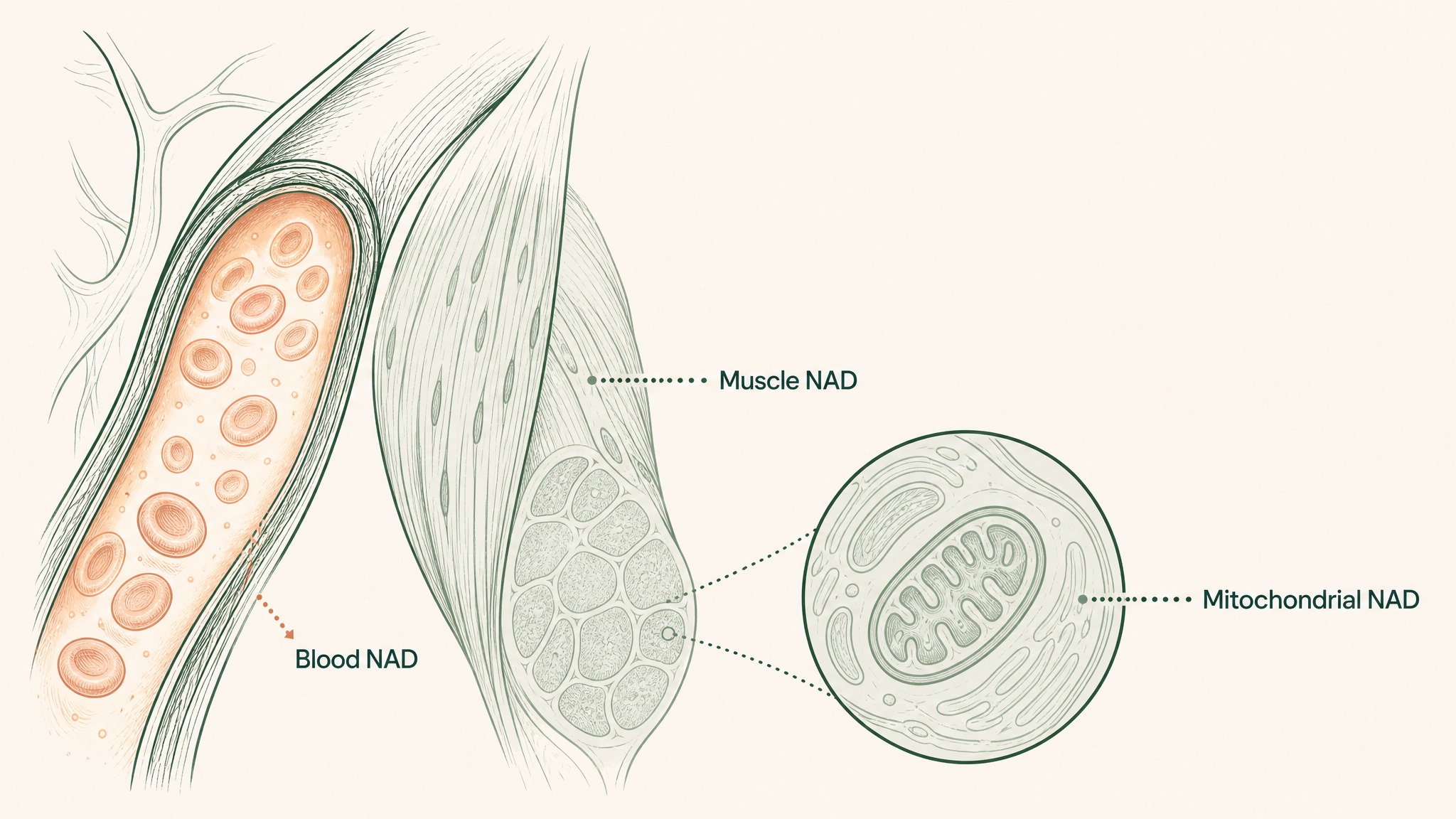
Why raising blood NAD+ doesn't automatically raise it everywhere your body needs it.
Trammell 2016 in Nature Communications showed blood NAD+ rose up to 2.7-fold after a single oral dose of NR in humans. Airhart 2017 in PLoS ONE ran the follow-up pharmacokinetic study and reported blood NAD+ roughly doubled at steady state on 1000 mg of NR twice daily.
What's less certain is whether the change you feel in the mirror matches the change in the assay. Blood NAD is not the same as muscle NAD, or brain NAD, or mitochondrial NAD. This is where delivery method starts to matter more than the label on the bottle.
If you'd like the more sceptical deep-dive on whether the pill in front of you actually works, we've written does NAD supplement really work as a companion piece.
Which form of NAD supplement works best for each use?
There are four forms sold as an NAD supplement. Each has a very different profile.
- NMN (nicotinamide mononucleotide) — one enzymatic step from NAD. Strongest recent metabolic-outcome data (Yoshino 2021).
- NR (nicotinamide riboside) — two steps from NAD. Longest human safety record (Martens 2018, Airhart 2017).
- Direct NAD+ — the actual molecule. Fragile in the stomach; almost none survives unless the delivery system protects it.
- NAD IV or IM — the injectable route. High blood levels, high cost, needs a clinician.
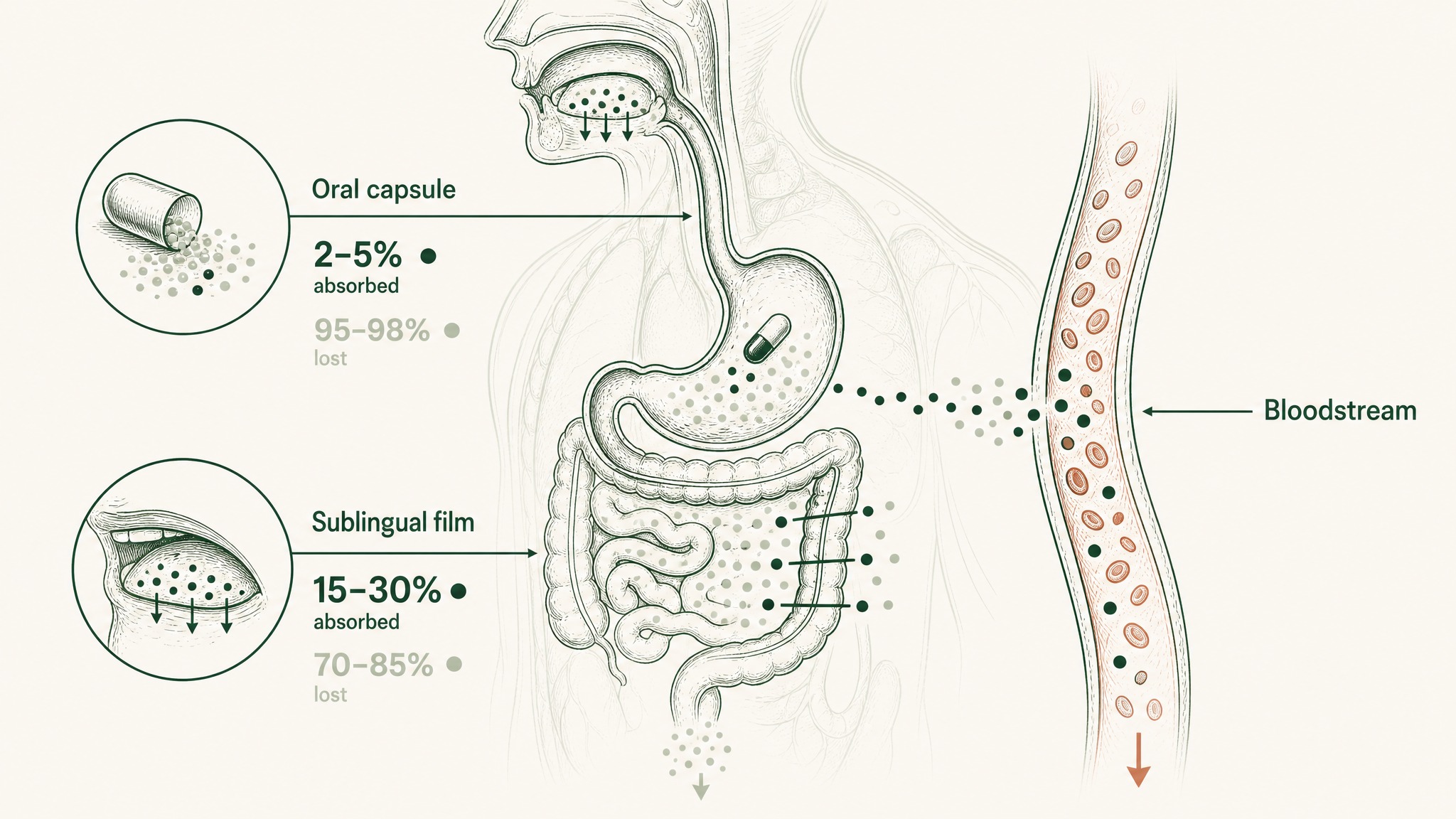
How four NAD supplement forms reach your bloodstream differently.
For metabolic health, the NMN data is currently strongest. For long-term daily use with the deepest human-safety record, NR wins. For raw absorbed dose without a needle, sublingual delivery matters, and that's the design behind LEGACY, our NAD-precursor protocol. It uses VERISORB sublingual film to sidestep the stomach and liver entirely.
How much NAD do you need to see a real effect?
Doses in the published human trials cluster around 300 to 1000 mg per day of the precursor (NR or NMN). That's the range where Martens saw blood-NAD elevation and Yoshino saw metabolic improvement.
But there's a catch, and it's the same catch every oral peptide and precursor faces. If your capsule delivers 500 mg to your stomach and roughly 2-5% survives digestion, your bloodstream sees 10-25 mg. If a sublingual film delivers the same 500 mg and 15-30% survives, your bloodstream sees 75-150 mg.
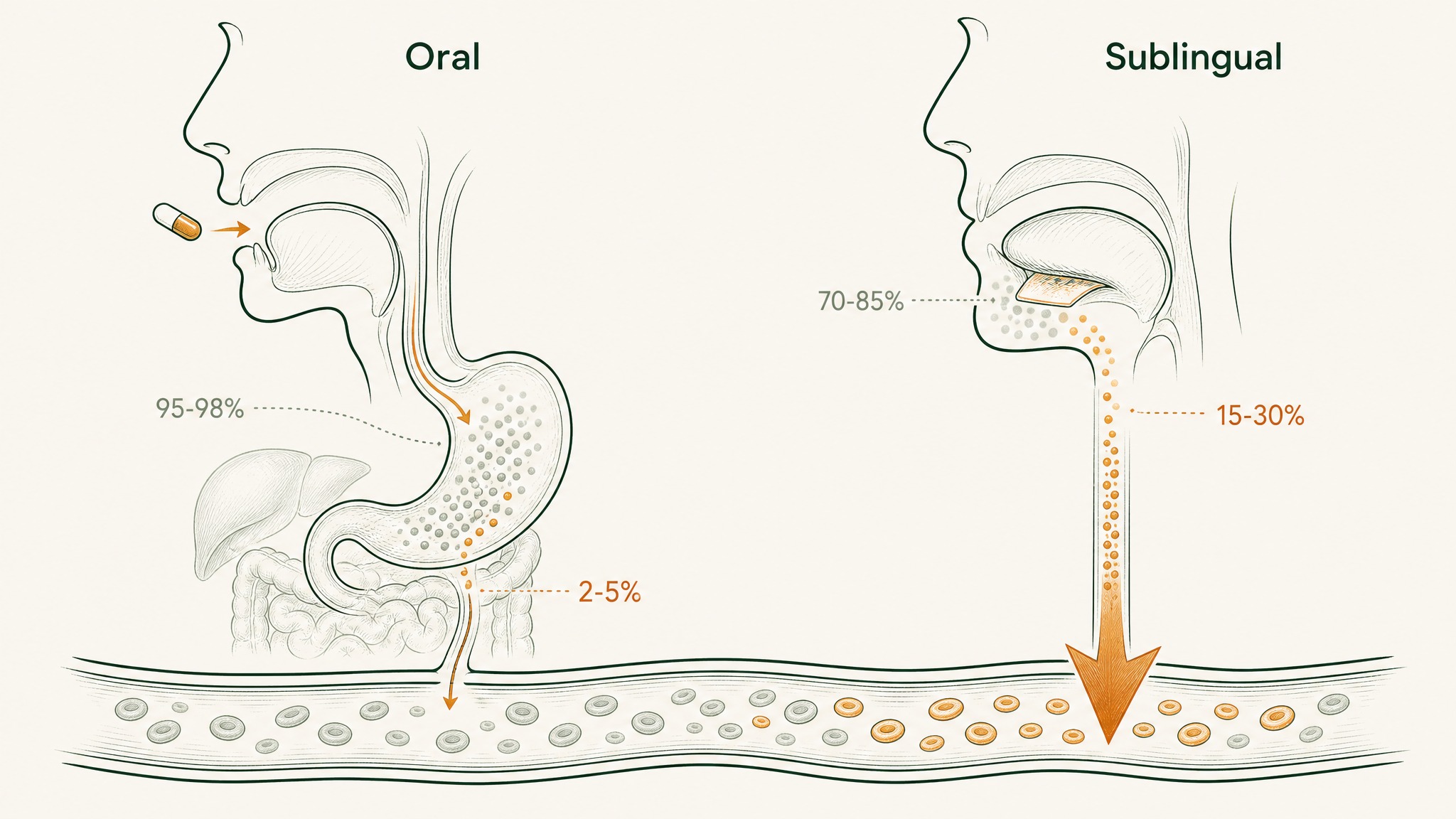
Why a sublingual dose reaches your blood ten times stronger than the same amount swallowed.
Same label. Roughly ten times the delivered dose.
This is why every VERO protocol puts delivery method ahead of label dose. If it doesn't reach your cells, it doesn't matter what the bottle says.
Who shouldn't take an NAD supplement?
A few groups should talk to a clinician first, not skim a longevity podcast:
- Anyone currently in active cancer therapy (the DNA-repair and metabolic effects of NAD interact with several chemotherapies)
- Anyone pregnant or breastfeeding
- Anyone on immunosuppressive medication after transplant
- Anyone with a personal or family history of methylation-related conditions
For everyone else, the human trials to date have found NR and NMN well tolerated at the doses tested, with the most common reported side effect being mild flushing or GI upset at very high doses.
Frequently Asked Questions
What is NAD supplement used for most commonly?
Most people take an NAD supplement for one of three reasons: to push back against age-related fatigue, to support cognitive clarity and focus, or to slow the visible and functional parts of cellular aging. The metabolic-support use case, especially in midlife women, has the sharpest published human data to date.
Do NAD supplements actually raise NAD in your body?
Yes. Oral NR reliably lifts blood NAD in humans (Trammell 2016, Airhart 2017), and NMN improved insulin sensitivity in Yoshino 2021's postmenopausal cohort. Whether that blood-NAD rise translates into every downstream outcome (energy, cognition, longevity) is a separate question, and the answer varies by outcome.
Is NAD supplement good for energy?
Users report improved energy on NAD precursors, and the mechanism, with NAD acting as a required cofactor for mitochondrial ATP production, supports the story. Small trials in older adults, including Elhassan 2019, have shown NAD-related shifts in muscle biology. Trials measuring subjective energy with hard endpoints are still limited.
What is NAD IV therapy used for?
NAD IV therapy is used in specialised addiction-recovery clinics as part of alcohol and opioid withdrawal protocols, and by some wellness clinics for high-dose longevity support. The clinical protocols are decades old, but the modern published evidence base is limited. Cost runs $400 to $1500 per session and it needs a licensed clinician.
How long does it take to feel anything from an NAD supplement?
The trials showing metabolic changes (like Yoshino 2021) ran 8 to 10 weeks. Subjective energy shifts, when users report them, tend to show up in the first 2 to 6 weeks. Anyone claiming next-day energy from a capsule is telling you a placebo story, unless they're on an IV drip.
Is oral NAD better than an injection?
Injection delivers a much higher dose to the bloodstream, faster, at higher cost, and needs a clinician. Oral is convenient but faces the bioavailability wall unless it uses sublingual or liposomal delivery.
For most people, a well-designed sublingual precursor is the practical middle ground. For a full route comparison, see our NAD supplement vs injection breakdown.
Can I take NAD every day?
Published trials running daily oral NR or NMN for 6 to 12 weeks reported the supplements as well tolerated with no serious adverse events. Long-term (multi-year) daily-use safety data at RCT level doesn't exist yet. Most protocols cycle it, and this is worth discussing with a longevity-literate clinician if you plan to stay on it indefinitely.
References
- Massudi, H., Grant, R., Braidy, N., Guest, J., Farnsworth, B., & Guillemin, G. J. (2012). Age-associated changes in oxidative stress and NAD+ metabolism in human tissue. PLoS ONE, 7(7), e42357. https://journals.plos.org/plosone/article?id=10.1371/journal.pone.0042357. Retrieved 2026-07-08.
- Trammell, S. A. J., Schmidt, M. S., Weidemann, B. J., et al. (2016). Nicotinamide riboside is uniquely and orally bioavailable in mice and humans. Nature Communications, 7, 12948. PMID 27721479. https://www.nature.com/articles/ncomms12948. Retrieved 2026-07-08.
- Airhart, S. E., Shireman, L. M., Risler, L. J., et al. (2017). An open-label, non-randomized study of the pharmacokinetics of the nutritional supplement nicotinamide riboside (NR) and its effects on blood NAD+ levels in healthy volunteers. PLoS ONE, 12(12), e0186459. https://journals.plos.org/plosone/article?id=10.1371/journal.pone.0186459. Retrieved 2026-07-08.
- Martens, C. R., Denman, B. A., Mazzo, M. R., et al. (2018). Chronic nicotinamide riboside supplementation is well-tolerated and elevates NAD+ in healthy middle-aged and older adults. Nature Communications, 9, 1286. PMID 29599478. https://www.nature.com/articles/s41467-018-03421-7. Retrieved 2026-07-08.
- Elhassan, Y. S., Kluckova, K., Fletcher, R. S., et al. (2019). Nicotinamide riboside augments the aged human skeletal muscle NAD+ metabolome and induces transcriptomic and anti-inflammatory signatures. Cell Reports, 28(7), 1717-1728.e6. PMID 31412242. https://www.cell.com/cell-reports/fulltext/S2211-1247(19)31217-4. Retrieved 2026-07-08.
- Dolopikou, C. F., Kourtzidis, I. A., Margaritelis, N. V., et al. (2020). Acute nicotinamide riboside supplementation improves redox homeostasis and exercise performance in old individuals: a double-blind cross-over study. European Journal of Nutrition, 59(2), 505-515. https://link.springer.com/article/10.1007/s00394-019-01919-4. Retrieved 2026-07-08.
- Yoshino, M., Yoshino, J., Kayser, B. D., et al. (2021). Nicotinamide mononucleotide increases muscle insulin sensitivity in prediabetic women. Science, 372(6547), 1224-1229. DOI 10.1126/science.abe9985. https://www.science.org/doi/10.1126/science.abe9985. Retrieved 2026-07-08.
Curious how VERO's sublingual precursor stack fits into a longevity protocol? Start with LEGACY, our NAD-precursor protocol. Or browse the full protocol library if you're not sure which one fits.
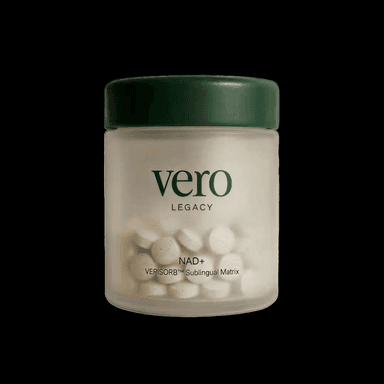
LEGACY™
NAD+Engineered around 300mg NAD+. Replenishes systemic NAD+ levels and drives mitochondrial function
Clinical Context
Important Notice: VERO protocols are nutritional and systemic optimisation formats. They are not intended to diagnose, treat, cure, or prevent any medical condition. These statements have not been evaluated by the Food and Drug Administration.