

You're looking at NAD supplements and wondering if NAC belongs in your stack. Here's what research suggests about picking one, or running them both.
You've probably landed on this comparison because you're already leaning toward NAD. Maybe you've read that NAD is the longevity supplement to pay attention to, and now you're wondering whether NAC deserves shelf space in your stack, or whether it's a distraction dressed up in similar three-letter clothing. If you want to see how each one fits into a structured supplement protocol, that context helps before you decide. Both promise cleaner cellular function. Both sit in the "longevity" aisle. Neither one does what the other does.
This guide is for research purposes only, and it's the version of the comparison for people who've decided NAD is on the shopping list. We'll walk through what changes when you frame the decision from the NAD side, how the delivery method flips the whole picture, and whether stacking NAC on top of NAD makes sense for the goal you actually have.
Short answer up top: if you're chasing energy, mitochondrial reserve, and slower biological ageing, NAD is your first move. NAC is a useful antioxidant precursor, but it answers a different question. Research suggests they work best as complementary tools, not substitutes.
Key Takeaways
- NAD and NAC share three letters and a shelf. They target different pathways. NAD feeds mitochondrial energy and sirtuin activity. NAC feeds glutathione (antioxidant defence).
- For most longevity-framed goals (energy, recovery, cognitive sharpness), NAD is the first-choice tool. NAC is a complementary antioxidant, not a substitute.
- Delivery method matters far more for NAD than for NAC. Oral NAC is cheap enough to dose around low bioavailability. Oral NAD+ largely doesn't survive the trip, which is why sublingual delivery reshaped the NAD category.
- Stacking NAD and NAC in the same protocol is common and low-risk. Take NAD in the morning, NAC with a mid-day meal.
- Neither molecule has a human lifespan trial. Read every "proven longevity" claim through that lens.
- This article is for research purposes only. Talk to your physician before adjusting any supplement protocol.
So which one should you buy first?
Think of NAD as your power grid and NAC as fuel for your emergency generator. If your city has power problems, you fix the grid first. You only think about the generator when you know how much backup you actually need.
Most people who land on a NAD vs NAC comparison already know they want longevity support. The real question is which molecule maps to the outcome you can feel, and how soon.
- Buy NAD first if: your goal is energy, cognition, workout recovery, or the general "feeling less worn out at 42 than you did at 41" bucket. NAD sits directly on your mitochondrial pipeline.
- Buy NAC first if: your specific priority is respiratory clearance, glutathione recovery after heavy training, or blunting an oxidative-stress driver you can already point to.
- Buy neither first if: you haven't fixed sleep, protein intake, and Zone 2 minutes. Both molecules amplify a working system. Neither one rescues a broken one.
Members experience the clearest wins when the choice is framed by outcome, not by chemistry. In our protocol design work, the NAD-first sequencing tends to produce more visible check-ins (morning energy, workout recovery, cognitive sharpness) in the first four to eight weeks, which makes it easier to know whether the tool is working. NAC's wins are quieter and take longer to sense.
What's the actual difference between what they do?
NAC and NAD share three letters and a shelf. They don't share a job.
- NAC (N-acetylcysteine) is a small modified amino acid. Your body strips the acetyl group off and uses the cysteine to build glutathione, your home-made antioxidant.
- NAD (nicotinamide adenine dinucleotide) is a coenzyme. It's the molecule your mitochondria pass electrons through to make ATP (your cellular energy currency), and the molecule your sirtuins and PARP enzymes burn through when they do DNA repair.
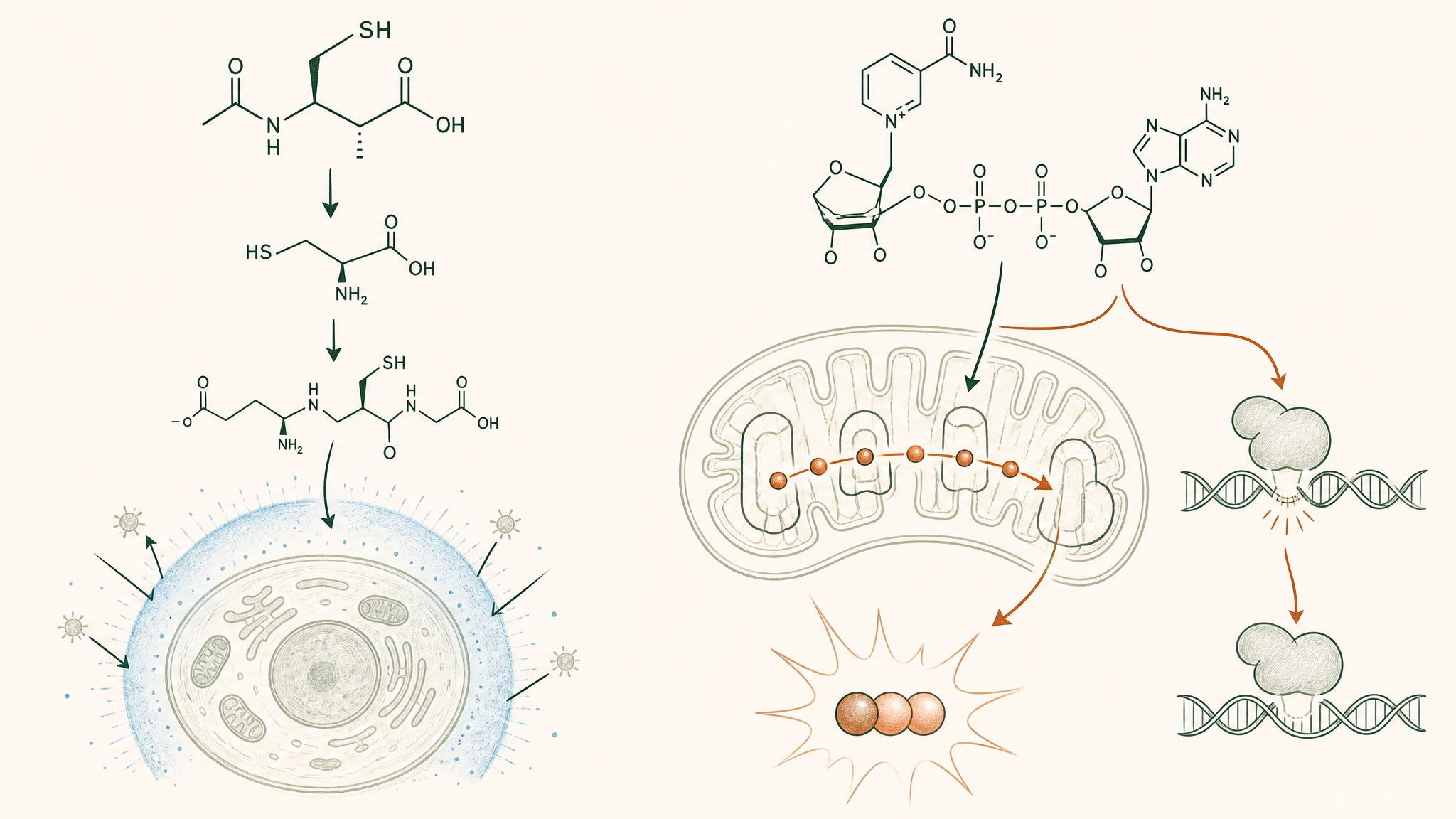
NAC builds antioxidants; NAD powers energy and DNA repair.
One is fuel for cleanup. The other is fuel for energy and repair. That's the whole map at 30,000 feet.
For a NAD-focused view of what an NAD supplement actually is and which precursor to pick, our NAD supplement primer is the next stop. This article covers both the buyer's decision and the pathway detail.
Why does the delivery method flip the comparison?
Picture two boxes on a delivery truck. NAC is a cheap box that's fine losing 90% of its contents in transit, because you can just send more. NAD is an expensive box where every gram matters, so the route is worth engineering.
This is the piece that most NAD vs NAC comparisons quietly skip.
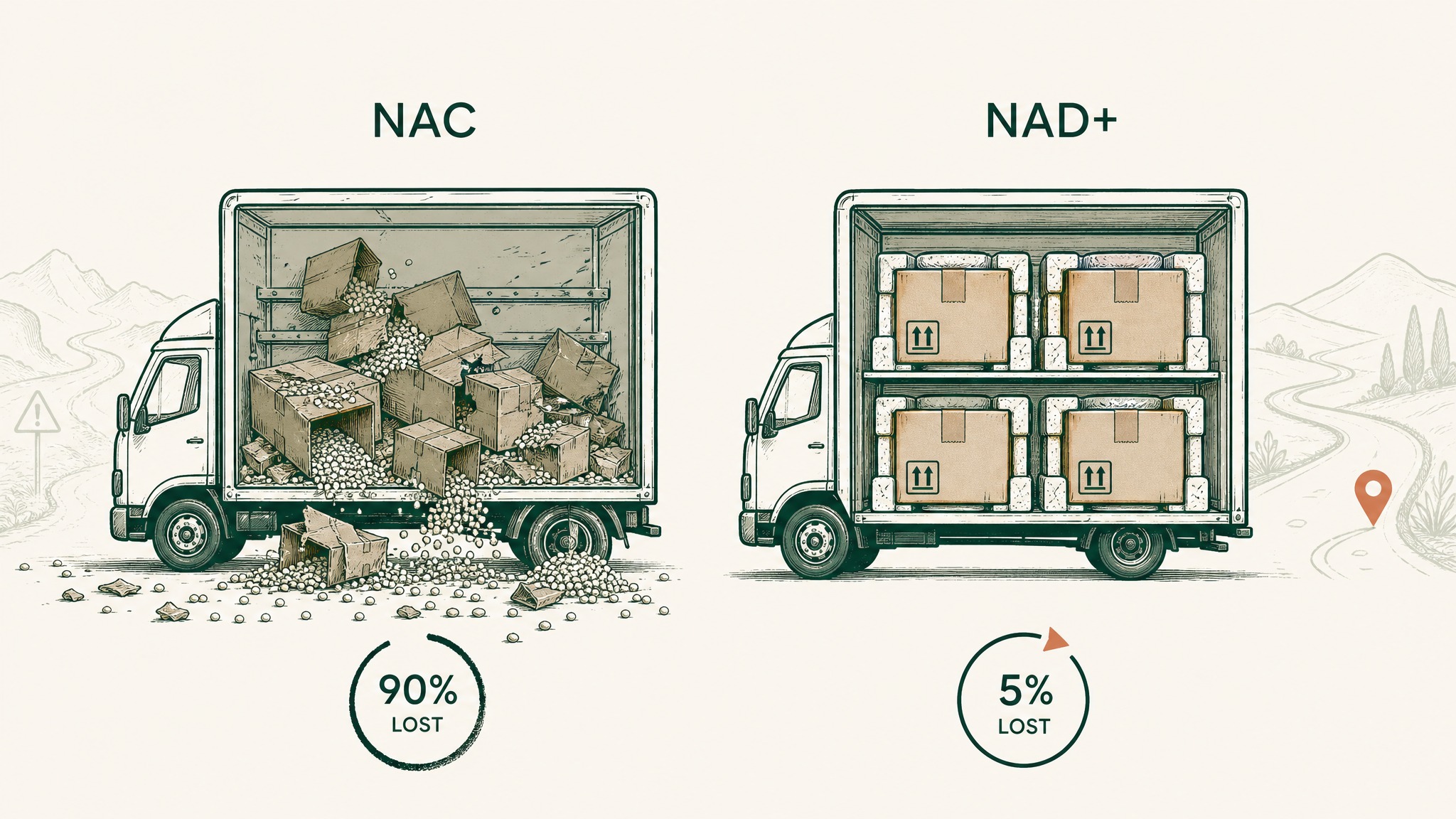
Why NAC tolerates high loss in transit but NAD+ requires precision delivery.
NAC bioavailability is low, but you can dose around it. Borgström and colleagues (1986) reported oral NAC bioavailability in the range of 4 to 10%. That sounds bad on paper. In practice, NAC is cheap enough that most research protocols simply push the dose (600 to 1,200 mg twice daily) and accept the loss.
NAD delivery is where the whole category got rebuilt. Oral NAD+ itself is destroyed almost entirely in the gut. NAD precursors like NR and NMN do better on paper, but the systemic exposure of the parent molecule is still debated. Yoshino and colleagues (2021) reported metabolic markers shifting in postmenopausal women taking oral NMN, but the intact-molecule pharmacokinetics remain a moving target.
Delivery method decides how much of the molecule your bloodstream ever actually sees.
In our protocol design at Peak Human Labs, when we model dosing for a longevity stack, we work backwards from delivery method first, then dose. A well-delivered 300 mg sublingual NAD+ often outperforms a 1,000 mg oral capsule that loses most of its payload before it reaches the bloodstream. That's the whole design principle behind VERISORB, VERO's sublingual delivery platform, and it's the reason LEGACY is built around sublingual NAD+ rather than a bigger oral capsule.
NAC has no popular sublingual equivalent in the consumer market yet. The economics haven't pushed it there, because the cheap-and-plentiful oral route is good enough for the outcomes NAC is asked to deliver.
Can you stack NAD and NAC together?
Yes. Most well-built longevity protocols do. The two molecules don't share a metabolic pathway. They don't compete for the same absorption window. Research suggests the pairing is complementary rather than redundant.
Practical rules if you stack them:

Taking NAD+ first thing in the morning on an empty stomach aligns with your body's natural sirtuin rhythm.
- Time NAD in the morning. NAD precursors are research-suggested to align with your morning sirtuin rhythm. First thing, fasted, is the most common protocol. Our guide on the best time to take an NAD supplement covers the timing rationale.
- Time NAC with a meal. NAC has a sulphurous odour and can cause mild GI upset on an empty stomach. Twice daily with food is the standard research protocol.
- Stagger them by at least a few hours. There's no known direct interaction, but cleaner spacing makes it easier to attribute any effect (or side effect) to the right molecule when you're self-experimenting.
This isn't medical advice. If you're on nitrates, blood thinners, or oncology therapy, talk to your physician before adding NAC. NAC interactions in those settings have been documented.
Most members experience their stack running smoother when NAD lands first thing and NAC lands mid-day with lunch. It's the cheapest scheduling win in the book.
What does the research actually show for each?
Both molecules have real signal. The evidence base looks different in shape.
NAD precursors have been the main character in the last decade of longevity research. In animal work, raising NAD has been observed to shift healthspan markers in mice, with reported changes in mitochondrial function and sirtuin-mediated DNA repair (Mills et al., 2016). In humans, Trammell and colleagues (2016) reported in Nature Communications that oral NR was observed to raise blood NAD+ in volunteers, with a dose-dependent response. Yoshino and colleagues (2021) reported metabolic markers shifting in postmenopausal women on oral NMN.
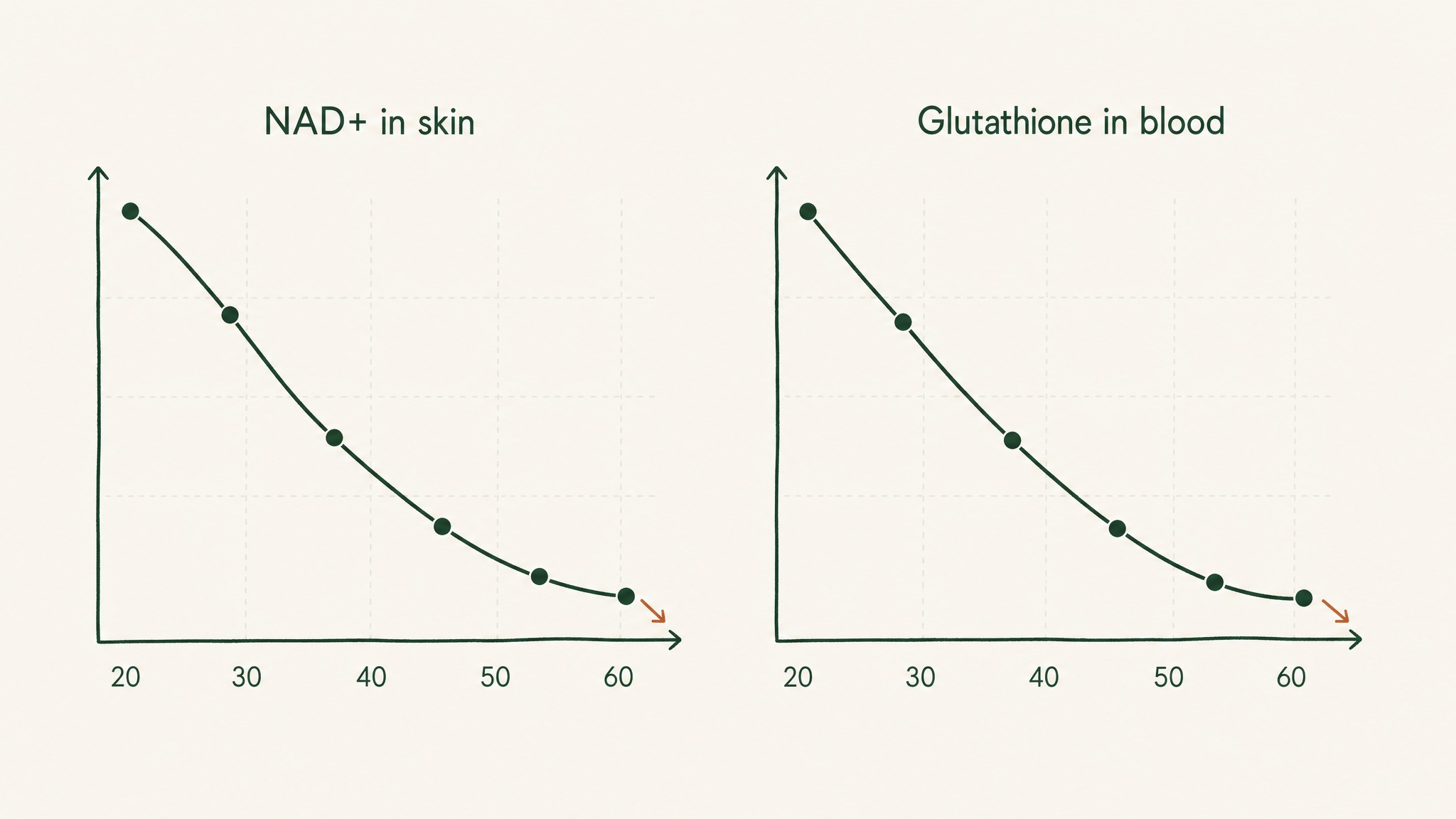
NAD+ and glutathione both drop roughly 50% between young adulthood and age 60.
Massudi and colleagues (2012) also measured NAD in human skin and reported a decline of roughly 50% between young adulthood and age 60. That's the ageing signal the whole NAD-precursor category built its case on.
NAC has a longer clinical track record, but in a narrower band. Its evidence base sits mostly in respiratory conditions, acetaminophen toxicity (as a hospital IV protocol, not a supplement use case), and glutathione recovery in oxidative stress. Sekhar and colleagues (2011) reported that NAC was observed to raise glutathione levels in older adults whose glutathione had declined with age, with downstream effects on inflammation markers.
The honest limits on both:
- Neither molecule has run a human lifespan trial.
- Anyone selling you a "proven longevity pill" is overselling on either side.
- The NAD side has the animal-model breadth. The NAC side has the clinical-history depth.
Read every comparative claim through that lens.
How do you actually dose NAD vs NAC in a real protocol?
This is where the two molecules diverge fastest.
NAC dosing in research protocols is consistent: 600 to 1,200 mg, twice daily, with food. It's cheap. The dose is high because oral bioavailability is low, and there's no penalty for pushing it. Most consumer NAC capsules land in this range.
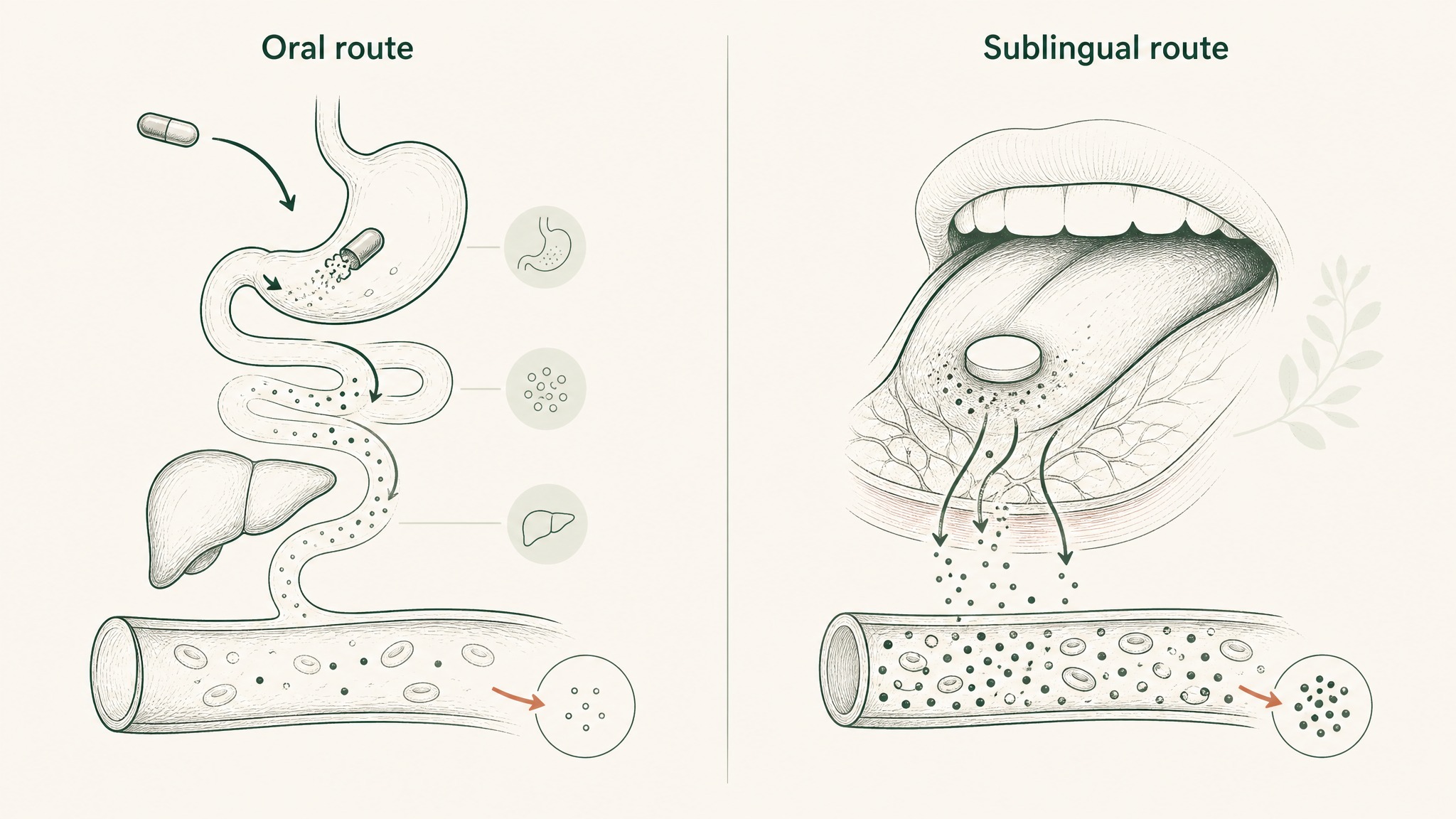
How sublingual delivery bypasses stomach acid and liver metabolism to reach your bloodstream more efficiently.
NAD dosing is a much harder question. It depends on the precursor and the delivery method:
- Oral NMN: consumer capsules commonly land in the 250 to 1,000 mg range, once daily. Systemic exposure varies widely.
- Oral NR: consumer capsules typically 100 to 300 mg, once daily. Trammell and colleagues (2016) showed measurable blood NAD+ rises in this range.
- Sublingual NAD+: doses drop significantly (often 200 to 500 mg) because delivery efficiency rises. This is the design principle behind LEGACY.
A "high" NAD dose that goes through the digestive demolition still delivers less to your bloodstream than a "low" NAD dose that arrives through the sublingual route. This is the single most misunderstood point in NAD dosing, and the reason label doses can be misleading.
For a deeper dose comparison across delivery methods, see our NAD supplement vs injection breakdown.
How do you pick your first NAD supplement?
If you've decided NAD is the priority (as most people landing on this comparison have), the shopping decision compresses to three questions:
- What precursor? NR and NMN are the two well-researched consumer options. Niacinamide is the cheap end. Direct oral NAD+ is the poor-bioavailability end.
- What delivery route? Oral capsule, sublingual tablet, or clinical injection. Each has a different absorption profile and price point. Our comparison of NAD supplement vs injection walks the trade-offs.
- What price per effective dose? Not price per capsule. Price per milligram that reaches your bloodstream. A cheap oral capsule that loses 90% of the payload is not cheap in practice.
Members experience the smoothest ride when the choice is filtered through these three, in this order. The best NAD supplement guide walks through the buyer's decision in more detail.
If a sublingual route matches how you want to run your protocol, VERO built LEGACY around sublingual NAD+ using our VERISORB platform, which routes the molecule through the membranes under your tongue and skips the digestive breakdown.
Frequently asked questions
Should I take NAD or NAC first?
NAD first if your goal is energy, mitochondrial function, or general longevity support. NAC first if your goal is antioxidant recovery from a specific oxidative stressor like heavy training or an inflammatory event. Members experience the clearest wins from the NAD side when the goal is age-related energy decline.
Can NAC raise NAD levels?
Not directly. NAC feeds the glutathione pathway. NAD is fed by its own precursors (NR, NMN, niacinamide). Some research has looked at indirect redox-balance crosstalk between the two, but if your goal is raising NAD, use a targeted NAD precursor.
Is it safe to take NAD and NAC together?
There's no known direct interaction. Most longevity-orientated protocols stack them. Take NAD in the morning, NAC with food later in the day. If you're on nitrates, blood thinners, or oncology drugs, talk to your physician first.
Is NAD better than NAC for longevity?
Research suggests NAD has a larger body of longevity-specific evidence, mostly from animal models and pharmacokinetic work in humans. NAC has a longer general clinical history but a narrower longevity focus. Neither has a human lifespan trial.
How long does it take to notice NAD supplements working?
Users report noticing energy and workout recovery shifts in the first four to eight weeks on well-delivered NAD protocols. Sublingual delivery tends to produce a faster subjective response than oral capsules because more of the molecule reaches the bloodstream intact.
Do I need both NAD and NAC, or just one?
Depends on your goal. If you're chasing energy and mitochondrial support, NAD alone is usually enough to start. If you're also stacking heavy training, high alcohol load, or specific respiratory concerns, adding NAC gives you the antioxidant lever. Start with NAD, add NAC after four to eight weeks if you decide the antioxidant angle matters.
Should I choose sublingual or oral NAD?
Sublingual routes more of the dose through your bloodstream than oral capsules do, because the tongue's membranes skip your digestion. That matters more for NAD than for NAC, because oral NAD+ largely does not survive the trip. Our peptide pill bioavailability explainer covers why the delivery route matters so much for expensive molecules.
References
- Trammell SAJ, Schmidt MS, Weidemann BJ, et al. (2016). Nicotinamide riboside in humans and mice: pharmacokinetic and bioavailability findings. Nature Communications. https://doi.org/10.1038/ncomms12948. Retrieved 2026-07-01.
- Yoshino M, Yoshino J, Kayser BD, et al. (2021). Nicotinamide mononucleotide and muscle insulin sensitivity in prediabetic women: clinical trial findings. Science. https://doi.org/10.1126/science.abe9985. Retrieved 2026-07-01.
- Mills KF, Yoshida S, Stein LR, et al. (2016). Long-term nicotinamide mononucleotide administration in mice: age-associated physiological-decline study. Cell Metabolism. https://doi.org/10.1016/j.cmet.2016.09.013. Retrieved 2026-07-01.
- Massudi H, Grant R, Braidy N, Guest J, Farnsworth B, Guillemin GJ. (2012). Age-associated changes in oxidative stress and NAD+ metabolism in human tissue. PLoS ONE. https://doi.org/10.1371/journal.pone.0042357. Retrieved 2026-07-01.
- Borgström L, Kågedal B, Paulsen O. (1986). Pharmacokinetics of N-acetylcysteine in man: absorption study. European Journal of Clinical Pharmacology. https://pubmed.ncbi.nlm.nih.gov/3792445/. Retrieved 2026-07-01.
- Sekhar RV, Patel SG, Guthikonda AP, et al. (2011). Glutathione synthesis in aging adults: dietary cysteine and glycine supplementation findings. American Journal of Clinical Nutrition. https://doi.org/10.3945/ajcn.110.003483. Retrieved 2026-07-01.
Ready to bring the NAD side of your stack up to spec? Start with VERO LEGACY, our sublingual NAD+ protocol →
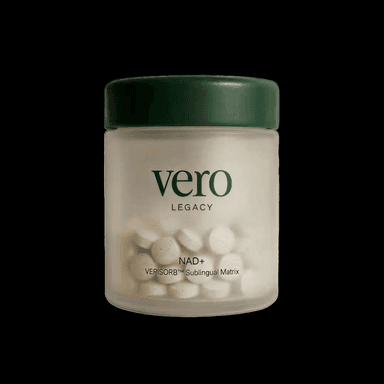
LEGACY™
NAD+Engineered around 300mg NAD+. Replenishes systemic NAD+ levels and drives mitochondrial function
Clinical Context
Important Notice: VERO protocols are nutritional and systemic optimisation formats. They are not intended to diagnose, treat, cure, or prevent any medical condition. These statements have not been evaluated by the Food and Drug Administration.