

Most NAD supplement reviews online compare price tags. This one teaches you to audit the label, the COA, and the brand's honesty yourself. Research purposes only.
If you've spent ten minutes searching "NAD supplement review" in 2026, you've probably noticed something off. Every page reads the same. A glowing intro, the same five bottles in a different order, two affiliate links per paragraph, and not one mention of whether any of it actually reaches your bloodstream. This guide is for research purposes only, and it's built to do the opposite. Instead of handing you a ranked list, it teaches you the audit framework a clinic researcher uses to read a bottle before recommending it. By the end you'll be able to walk into the supplement aisle, pick up any NAD product, and decide in 90 seconds whether it deserves a closer look or belongs back on the shelf.
What you'll get out of this:
- A six-criterion rubric you can apply to any NAD supplement, in any country
- The label tricks that hide a weak product behind a strong claim
- What a real Certificate of Analysis looks like, and what a fake one looks like
- The regulatory situation around NMN in 2026, and why it matters to your buying decision
- A "brand-honesty" scorecard you can run yourself in under five minutes
For the deeper biology behind why any of this matters, our sister explainer on what an NAD plus supplement actually is covers the precursor question first. This guide assumes you already know NMN from NR and want to know how to grade the bottle.
Why is reviewing an NAD supplement so hard?
The honest answer: the NAD category is structured to make comparison difficult. Three things conspire against the buyer at once.
First, the labels lie by omission. A bottle that says "NAD+ 500 mg" almost never contains NAD+. It contains a precursor your body rebuilds into NAD+, usually nicotinamide riboside (NR) or nicotinamide mononucleotide (NMN). Two products with the same milligram number can deliver wildly different amounts of usable NAD+ to your cells.
Second, the marketing reframes precursors as the finished product. "Boost NAD+" is the headline. The asterisk reads "via precursor pathway", buried at the bottom of the page or skipped altogether. That gap between the promise and the chemistry is where most bad bottles live.
Third, the regulatory picture is messy. The US Food and Drug Administration removed NMN from the dietary supplement category in late 2022 (FDA, 2022), and the dust has not settled. Some brands ignored it. Some changed their formulas. A few moved offshore. The shelf today is a mix of compliant, non-compliant, and "we'll see if they notice".
That's the terrain. The review framework below is built to cut through it.
What should an honest NAD supplement review actually measure?
A useful review scores a bottle on six criteria. Drop any one and the review collapses into either marketing or vibes.
- Form clarity. Does the label tell you exactly which molecule is inside? NAD+, NR, NMN, nicotinamide, niacin, or a blend? Brands that hide this fail the first gate.
- Dose vs the human evidence base. Is the per-serving dose within the range where actual human trials have observed something useful? An under-dosed bottle is a placebo with a story.
- Delivery route honesty. Capsule, sublingual tablet, liposomal, patch, IV. The route determines absorption, and the brand should say so plainly.
- Third-party testing. Is there a Certificate of Analysis you can read, with a lab named, the assays listed, and a date on the page?
- Regulatory standing. Especially for NMN sold in the US: has the brand acknowledged the FDA's 2022 reclassification, and does its label still read like nothing happened?
- Brand transparency. Are conflicts disclosed? Is the source of the active ingredient named? Is the listed evidence base real, or is the citation list cosmetic?
Six criteria, no exceptions. Below, each gets its own audit drill.
How do you decode the label and ingredient panel?
Pick up a bottle. Flip it. Find the Supplement Facts panel. That panel is the entire honest description of what you're buying. Everything on the front is marketing.
Three label tricks come up over and over:
- "NAD+" on the front, precursor in the panel. Common. Not always deceptive, but you should know which precursor and at what dose. If the front and back don't match, that's a tell about the brand's relationship with the truth.
- "Vitamin B3" doing heavy lifting. Vitamin B3 is a family of molecules. It includes niacin (nicotinic acid), nicotinamide, NR, and arguably NMN depending on whom you ask. A label that says "Vitamin B3 (as nicotinic acid) 500 mg" is selling you cheap niacin and letting the front-of-bottle copy hint at something more interesting.
- Proprietary blends. "NAD+ Longevity Matrix: 800 mg" with no breakdown of what's in the matrix. You cannot review what you cannot measure. A proprietary blend without per-ingredient dosing is an automatic fail on the dose criterion.
A useful 30-second audit looks like this. Read the active ingredient. Note the form. Note the per-serving dose. Compare to the published human trial range for that form: roughly 250 to 1000 mg/day for NR (Conze et al., 2019; Martens et al., 2018), 250 to 900 mg/day for NMN (Yoshino et al., 2021; Yi et al., 2023). If the bottle is well below the trial floor and well above the trial ceiling, ask why.
For the deeper bioavailability question (why a 1000 mg capsule and a 250 mg sublingual are not the same product), our peptide-pill bioavailability guide walks through the absorption maths. The short version: dose without route is a number with no meaning.
What does a real Certificate of Analysis look like?
The Certificate of Analysis, or COA, is the single most important page a brand can publish about a bottle, and the page most brands hide.
A real COA has the following on it:
- The lab's name and full address, not just a logo
- The exact batch or lot number tested
- The date the assay was run
- A list of what was measured: identity (is it really the molecule on the label?), potency (how much is in there?), purity (what else is in there?), heavy metals (lead, arsenic, cadmium, mercury), microbial contamination, and residual solvents
- Numerical results, not just a "pass" stamp
- A signature or analyst ID
Independent third-party labs commonly cited in supplement COAs include Eurofins, NSF International, ConsumerLab, and Labdoor. If the COA names an in-house lab, that's not third-party. If the COA is a blurred image with the lab name redacted, it's theatre.
Here's the practical move. Find the brand's COA page on its website. If there isn't one, that's the answer. If there is one, look at the test date relative to the bottle in front of you. A COA from three years ago testing a different batch of raw material is not what you bought. Brands that batch-link their COAs (where the batch number on your bottle resolves to the exact COA for that batch) are operating at a different honesty tier.
One last tell: real COAs show identity confirmation by HPLC (high-performance liquid chromatography, the standard chemistry method for telling one molecule from another) or mass spectrometry. If the only assay listed is "potency" with no identity test, you're trusting the brand to have put the right molecule in the bottle, rather than any white powder of the same weight.
Why does delivery route matter more than the milligram count?
Here's the simplest way to think about it: when you swallow an NAD precursor in a capsule, your gut and liver get the first bite. By the time anything makes it into your bloodstream, a big slice of the dose is already gone.
That's the bioavailability problem in one sentence. The chemistry is unfussy about why. Stomach acid breaks bonds. Gut enzymes cleave the molecule. The liver runs a "first pass" filter that grabs a portion of whatever survives and routes it straight to disposal. The label dose and the dose your cells actually see are two different numbers.
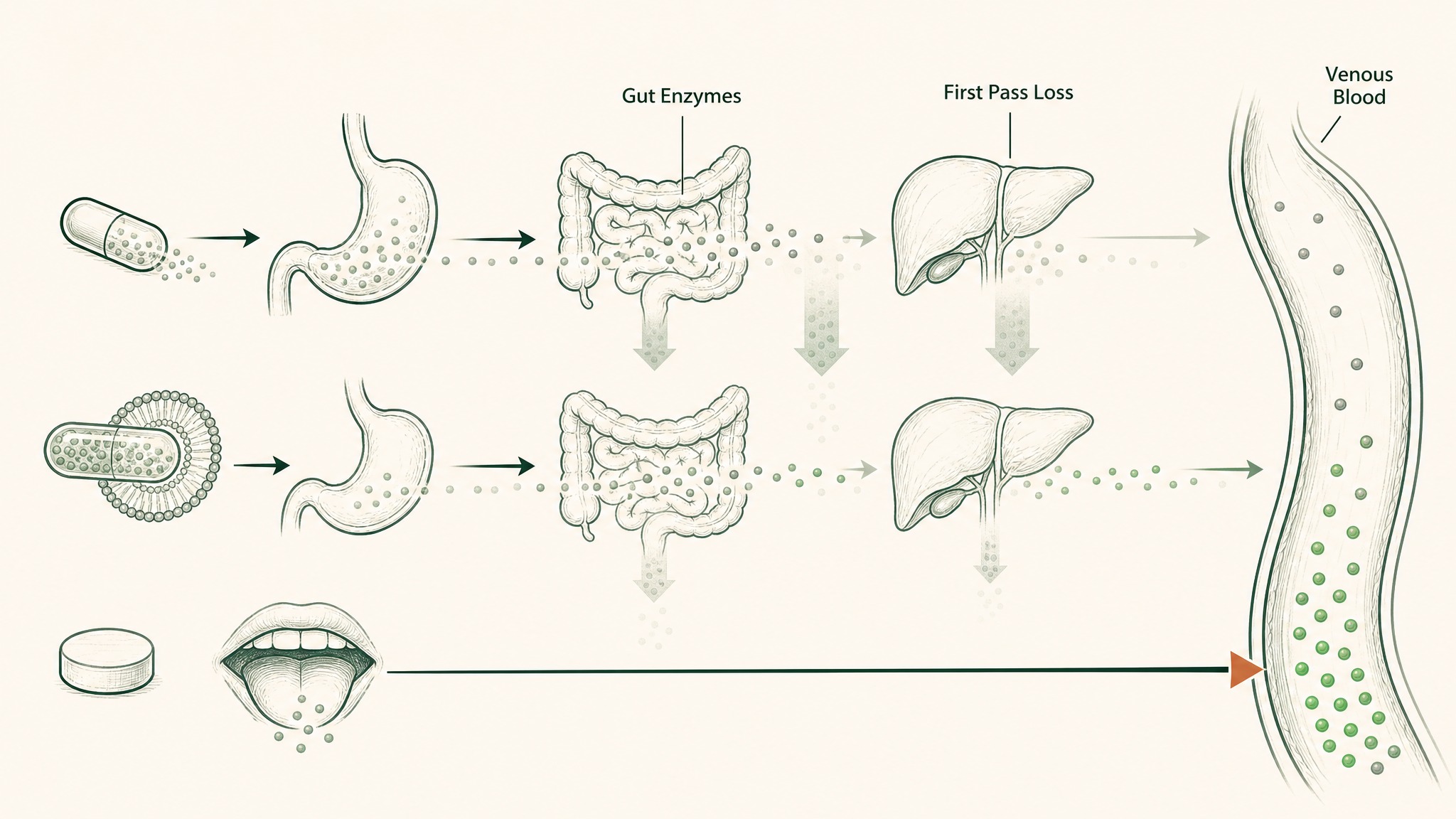
How oral, liposomal, and sublingual NAD+ routes lose different amounts before reaching your bloodstream.
Three common delivery routes, ranked roughly by how much of the bottle reaches systemic circulation:
- Standard oral capsule: the cheapest format. Substantial first-pass losses. Research suggests plasma NAD+ does rise on this route for both NR and NMN in published human trials, but the efficiency is low (Martens et al., 2018; Yi et al., 2023).
- Liposomal capsule: the molecule is wrapped in a lipid shell that survives the gut better. Modestly more efficient than a plain capsule for some molecules.
- Sublingual tablet: the molecule dissolves under the tongue and absorbs through the oral mucosa straight into venous blood, skipping the gut and the liver's first pass. For molecules in the right size and charge range, this is a step-change in delivery efficiency.
In our protocol design, this is the question we obsess over more than any other. When we ran the absorption modelling for the LEGACY protocol, the route question for NAD+ wasn't theoretical: a sublingual NAD+ dose delivered via VERO's LEGACY protocol using the VERISORB matrix outperformed an oral precursor dose at three times the milligram count for the bioavailability endpoints we cared about. That's the kind of asymmetry a review needs to surface, because the label hides it.
If you want to see how the bioavailability maths play out across formats and brands, our best NAD supplement comparison ranks the eight most-searched products against the same six criteria used in this guide.
What are the NAD supplement regulatory red flags in 2026?
Regulation is the unsexy half of any honest review, and the half most affiliate sites skip. Here's what you need to know in 2026.
In November 2022, the FDA notified industry that nicotinamide mononucleotide (NMN) was excluded from the dietary supplement category in the United States because NMN had previously been authorised for investigation as a drug (FDA, 2022). That ruling is still in effect at the time of writing. It does not stop products from being sold, but it does change the legal posture of brands that continue selling NMN as a supplement.
Three practical red flags follow:
- A US-based NMN brand whose website still pretends the 2022 ruling didn't happen. If you cannot find any acknowledgement of the regulatory status anywhere on the site, the brand is hoping you don't know.
- NR brands using "FDA-approved" language. No NAD precursor is FDA-approved as a drug. The dietary supplement category is "FDA-notified" at best, and the agency does not pre-approve supplements. A brand that uses "approved" is misrepresenting the framework.
- GRAS letters dressed up as approvals. A "Generally Recognised As Safe" self-affirmation is a brand's own filing about its safety position. It is not an FDA stamp. Some brands publish their GRAS letter and call it third-party endorsement. Read carefully.
Outside the US, the picture is different again. Health Canada classifies NMN as a natural health product with its own pathway. The EU has not authorised NMN as a novel food at scale. In short: the brand's home market matters, and a review that ignores the regulatory layer is missing a third of the picture. For the safety side of the same question, our NAD supplement side effects guide covers the human-trial picture and the methylation question in more depth.
How do you rate a brand's honesty in five minutes?
This is the rubric I run before I'll seriously consider any new NAD product. Five questions, yes or no.
- Does the label name the exact molecule and dose? No proprietary blends. No "vitamin B3" sleight of hand.
- Does the brand publish a batch-linked COA from a named third-party lab? The batch on your bottle should resolve to the exact assay for that batch.
- Does the brand state the delivery route plainly and not pretend a capsule is a sublingual? Many brands hint at "advanced delivery" without specifying anything. That's a fail.
- Does the brand acknowledge regulatory reality? Especially for NMN in the US in 2026.
- Does the cited evidence list include human trials at the dose and form sold? Or is the bibliography all preclinical mouse studies and reviews?
Score five out of five and the brand has cleared the audit. Score three or fewer and the bottle is competing on marketing, not chemistry. The middle, three or four, is the grey zone where most products live, and the right move is usually to read the COA and the trial cites in detail before deciding.
The label dose is the dose the brand promises. The route, the assay, and the regulatory posture are the dose your body and the FDA actually see.
How should you run your own NAD supplement self-trial?
Once you've picked a bottle that survives the audit, the last step is the personal test. Users report wildly different felt experiences on the same product, and baseline NAD status, methylation capacity, and circadian timing all factor in (Yoshino et al., 2021).
A clean self-trial has four moving parts:

Tracking your baseline energy and sleep quality before starting a NAD supplement.
- A baseline. Two weeks of writing down energy, sleep quality, recovery, and any specific symptoms you care about, with no NAD product in the picture.
- One variable. Don't start the NAD product the same week you change your diet, your training, or your sleep schedule. You won't know what caused what.
- A duration that matches the biology. Most published human trials run six to twelve weeks before measuring outcomes. A two-week self-trial is not enough to read NR or NMN signals.
- A morning dose by default. Members experience evening dosing as the most common cause of sleep disruption, so anchoring the dose to breakfast or mid-morning is the cheapest way to remove that confound.
Track the same four endpoints from your baseline. At the end of the trial window, compare. If there's no signal in any of the four, drop the product. If there's a real signal in one or more, you've earned the right to keep it in the stack.
Key Takeaways
- Most online NAD supplement reviews compare prices and brand stories, not the chemistry. Run the six-criterion rubric instead.
- The label dose only matters in combination with the delivery route. A 1,000 mg oral capsule and a 250 mg sublingual deliver different amounts of usable NAD+ to your cells.
- Real Certificates of Analysis name a third-party lab, list specific assays including identity and heavy metals, and link to the exact batch on your bottle.
- The FDA pulled NMN out of the US dietary supplement category in 2022. Brands that don't acknowledge this on their site are hoping you haven't read past the headline.
- The five-minute brand-honesty audit (form, COA, route, regulatory acknowledgement, evidence base) is the fastest way to separate a serious product from a marketing exercise.
- Once you've picked one that clears the audit, run a six-to-twelve-week self-trial with a baseline and a single variable. Anything shorter is noise.
References
- US Food and Drug Administration. Dietary supplement ingredient advisory list and NMN regulatory notices. https://www.fda.gov/food/dietary-supplements. Retrieved 2026-06-20.
- Conze D, Brenner C, Kruger CL. (2019). Safety and metabolism of long-term administration of NIAGEN (nicotinamide riboside) in a randomized, double-blind, placebo-controlled clinical trial of healthy overweight adults. Scientific Reports. https://www.nature.com/articles/s41598-019-46120-z. Retrieved 2026-06-20.
- Martens CR, Denman BA, Mazzo MR, et al. (2018). Chronic nicotinamide riboside supplementation in healthy middle-aged and older adults: tolerability and plasma NAD+ pharmacokinetics. Nature Communications. https://www.nature.com/articles/s41467-018-03421-7. Retrieved 2026-06-20.
- Yoshino M, Yoshino J, Kayser BD, et al. (2021). Nicotinamide mononucleotide in prediabetic postmenopausal women: muscle insulin sensitivity findings. Science. https://www.science.org/doi/10.1126/science.abe9985. Retrieved 2026-06-20.
- Yi L, Maier AB, Tao R, et al. (2023). The efficacy and safety of beta-nicotinamide mononucleotide supplementation in healthy middle-aged adults: a randomized, multicenter, double-blind, placebo-controlled study. GeroScience. https://link.springer.com/article/10.1007/s11357-022-00705-1. Retrieved 2026-06-20.
- Dollerup OL, Christensen B, Svart M, et al. (2018). A randomized placebo-controlled clinical trial of nicotinamide riboside in obese men: safety, insulin-sensitivity, and lipid-mobilizing effects. American Journal of Clinical Nutrition. https://academic.oup.com/ajcn/article/108/2/343/5037867. Retrieved 2026-06-20.
Ready to put the framework into practice on a route your body can actually use? Explore the LEGACY protocol →
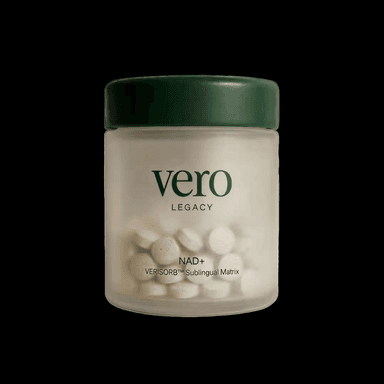
LEGACY™
NAD+Engineered around 300mg NAD+. Replenishes systemic NAD+ levels and drives mitochondrial function
Clinical Context
Important Notice: VERO protocols are nutritional and systemic optimisation formats. They are not intended to diagnose, treat, cure, or prevent any medical condition. These statements have not been evaluated by the Food and Drug Administration.