

Most NAD supplement reviews are paid placements wearing a lab coat. How to read them, and what the honest sources agree on. Research purposes only.
Open three tabs of "NAD supplement reviews" right now and you'll notice something strange. The top five articles agree on almost everything: the same eight products, the same five-star icons, the same "boosts cellular energy" line. That kind of agreement isn't science. It's a single affiliate template being rewritten across the internet. This guide is for research purposes only, and it's built to teach you how to read the review landscape itself: who writes these things, what they hide, and which voices are worth listening to before you spend a hundred dollars on a bottle.
We're not going to hand you another ranked list. There's already a careful audit framework for a single bottle and a comparison roundup of the eight best NAD supplements for that. What's missing on the internet, and what this piece tries to fix, is review literacy. By the end you'll know how to spot a fake review in under a minute, what the legitimate sources actually agree on, and where the consensus is so thin that nobody should be making confident claims.
What you'll get out of this:
- A taxonomy of where NAD reviews come from, ranked by how much you should trust each kind
- The four telltale signs of a paid placement dressed as a scientific review
- The handful of facts the honest sources actually agree on, drawn from human trials
- A short FAQ on the questions reviewers won't answer plainly
Why are NAD supplement reviews so unreliable in 2026?
Imagine if every restaurant review on the internet was written by the restaurant. That's roughly the state of the NAD supplement review category right now.
The structural problem is simple. NAD products carry high price tags, repeat-purchase economics, and a 30 to 70 percent affiliate commission to whoever sends the buyer. That last number is the whole story. A reviewer who ranks Product A first earns sixty dollars from every reader who clicks. A reviewer who ranks it eighth earns nothing. Across thousands of monthly visitors, the financial pull bends the entire category in one direction.
Three things follow from that pull:
- The same eight products appear on almost every list, because those are the ones with active affiliate programs
- The "scientific" language is templated, often run through an AI rewriter and seeded with the same five citations
- Anything the brand doesn't want measured (real bioavailability, dose vs trial floor, regulatory status) gets quietly skipped
Once you see the pattern, you can't unsee it. The shelf isn't being reviewed. It's being ranked by who pays the most per click.
Who actually writes the NAD supplement reviews you find online?
There are five kinds of voices in this space, and they don't deserve equal weight. Here's the field at a glance, ordered from most to least trustworthy.
| Voice | Typical conflict of interest | Useful for | Trust level |
|---|---|---|---|
| Peer-reviewed journal review | Minimal | The actual evidence base | High |
| Clinician blog or substack | Variable; check disclosure | Mechanism explainers | Medium-high |
| Reddit threads (r/Longevity, r/Nootropics) | Astroturf risk | Side-effect anecdotes | Mixed |
| YouTube reviewers | Affiliate codes, brand sponsorships | Product unboxings | Low |
| Affiliate "best of" listicles | 30 to 70 percent commission | Spotting paid placements | Very low |
The longer version of each row:
- Peer-reviewed review articles in journals. Real review papers (the kind with citations and a methods section) sit on PubMed and PMC. These are slow, dry, and don't recommend brands, but they're the only honest read on what the human evidence actually shows. Start with the primary trial papers themselves (Conze 2019, Martens 2018, Yoshino 2021, Yi 2023, all linked below), not with the listicles citing them.
- Clinician blogs and academic substacks. A practising clinician writing under their real name and credentials has reputational skin in the game. The good ones cite primary sources and acknowledge uncertainty. The bad ones run an affiliate funnel quietly in the background, so check the disclosure.
- Reddit threads on r/Longevity, r/Nootropics, r/Biohackers. These contain useful first-hand reports and the occasional knowledgeable user, but they're also heavily astroturfed (more on that below). Read them as anecdote, not evidence.
- YouTube reviewers. Some are honest, most aren't. The tell is the affiliate code in the description and the brand-supplied B-roll. Useful for product unboxings; useless for clinical claims.
- Affiliate-funded "best of" listicles. This is most of what shows up on a search-engine front page. Disclosure rules require an affiliate tag somewhere on the page, so look for it before reading further. The honest sites surface it at the top. The dishonest ones bury it in a footer.
A reasonable working rule: if a review article doesn't tell you what financial relationship the writer has with the brand it's ranking first, close the tab.
How do reviewers fake scientific credibility?
The pattern repeats so often it's worth naming. Here are the four moves to watch for.
The first is citation theatre. A long block of references appears at the bottom of the article, formatted to look like a journal bibliography. Click through and most of them are either unrelated, paywalled abstracts the writer never read, or mouse studies dressed up as human evidence. A real citation includes the year, the journal, and a quote or page reference that supports the specific claim made.
The second is mechanism substitution. The reviewer can't show you that the product works in humans, so they describe what the molecule is supposed to do inside a cell. "Activates sirtuins. Supports mitochondrial function. Drives ATP production." All true, sometimes, in a petri dish. None of it tells you what happens when you swallow the bottle.
The third move is dose obfuscation. The reviewer notes the milligrams on the label without comparing them to the trial range. A 100 mg NMN capsule and a 900 mg NMN capsule get the same write-up: "potent NAD support". Research suggests the human trials that observed an actual rise in blood NAD clustered in the 250 to 900 mg range for NMN (Yoshino et al., 2021; Yi et al., 2023). Anything below that floor is a placebo with a story.
The fourth is the fake COA reference. The article says "third-party tested" with a small leaf icon. There's no link to an actual certificate, no lab name, no batch number, no assay results. A real COA is a PDF you can open, read, and verify. The brand wins by gesturing at testing without publishing it.
If a review uses any two of these four moves, it's a paid placement wearing a lab coat. If it uses three or four, close it and find another source.
What do the legitimate NAD reviews actually agree on?
Here's the useful exercise. Strip out the affiliate noise, read the actual peer-reviewed reviews and the longest-form clinician explainers, and a small set of agreed-on facts emerges. Knowing this short list is more valuable than reading another twenty rankings.
- NAD+ falls with age in most tissues. Multiple human and animal datasets confirm this trend. The magnitude varies by tissue and study, but the direction is consistent (Massudi et al., 2012).
- Oral NMN and NR raise blood NAD levels in human trials at clinically relevant doses. This part is real and replicated. The size of the rise, and whether it translates to outcomes you can feel, is still being studied (Conze et al., 2019; Martens et al., 2018).
- NAD+ itself does not survive an oral capsule intact. It's a large, charged molecule. The stomach destroys it. This is why almost no brand sells "oral NAD+" honestly: when they do, the dose label is meaningless because the absorbed fraction is close to zero. Sublingual and IV routes are the only ones that put NAD+ proper into the bloodstream (StatPearls, 2024).
- NMN's US regulatory status remains contested. In late 2022, the FDA reversed course on whether NMN qualifies as a dietary supplement, the New Dietary Ingredient pathway has been the subject of agency correspondence since, and the resulting grey market is still being navigated. The general FDA dietary supplements information page is a starting point for the current rules (FDA dietary supplements).
- Whether NAD repletion meaningfully slows ageing in humans is still an open question. The mouse data is exciting. The human data is encouraging but not yet conclusive. Honest reviewers say so. Dishonest ones don't.
That's the consensus. Everything beyond it (specific brand rankings, "best NMN of 2026", celebrity endorsements) is opinion at best and conflict-of-interest at worst.
In our protocol design work, when we benchmark a new precursor formulation, we score it against this same five-fact list first. If a product can't survive a stomach simulation and doesn't have human PK data, it doesn't matter how clever the marketing is, the dose your bloodstream sees is the dose that counts.
What about the Certificate of Analysis: what reviewers don't check
The single biggest review failure in this category is the COA gloss. Reviewers say "third-party tested" and move on. They don't open the certificate, because most of the time there isn't one to open.
A real Certificate of Analysis has all of the following:
- The name and full address of the testing lab, not a generic "ISO-accredited" sticker
- The specific batch or lot number tested (so you can match it to the bottle in your hand)
- The date the assay was run, recent enough to be meaningful (within the last 12 months)
- Numerical results for identity, potency, purity, heavy metals, and microbial contamination
- An analyst signature or ID code
A review that says "third-party tested" without linking to a current COA is doing your audit work for you. Badly. The legitimate test is this: if you can't open the PDF in two clicks from the brand's product page, the testing claim doesn't exist for review purposes.
For the deeper "why the label dose isn't the dose your cells see" question, our peptide-pill bioavailability primer walks the absorption maths in full.
Does Reddit on r/Longevity or r/Nootropics tell you anything real?
Mixed. Reddit's strength is volume: thousands of voluntary user reports across years of threads. Its weakness is that any review-driven community of this size attracts brand-paid posters and bot accounts. You're reading real users and astroturf in the same thread, and it's not always obvious which is which.
Some practical filters that help:
- Check the account's post history. Brand-promoter accounts post one product positively across multiple subreddits in a short window. Long-tenured accounts with varied subreddit activity are usually real.
- Read "I felt amazing on day three" reports with caution. NAD repletion doesn't have a sharp subjective onset for most people. Members experience changes (energy, sleep quality, exercise recovery) over weeks, and individuals vary a lot. Anyone reporting a dramatic three-day transformation is either an outlier or selling something.
- Trust threads where users name specific COA results, lab numbers, and brand failures. Those are hard to fake convincingly.
A useful rule: Reddit is good for "did anyone else notice this side effect" questions. It's poor for "which brand is best" questions. The first is signal, the second is incentive structure.
How should a useful NAD supplement review be structured?
If you ever sit down to write one yourself (or evaluate someone else's), the test is whether all six of these get answered plainly.
- What's the active molecule? NAD+ direct, NMN, NR, niacinamide, niacin, or a blend? The label often hides this.
- What's the per-serving dose, compared to the human trial range? A bottle below the trial floor isn't really being tested by trial data, no matter how the marketing reads.
- What's the delivery route? Capsule, liposomal, sublingual, IV. Research suggests the route is the single biggest variable separating products that move blood NAD from products that don't (StatPearls, 2024).
- What does the COA actually say? Linkable, current, batch-matched, with numbers.
- What's the brand's relationship with the regulators? Especially relevant for NMN in the US since the 2022 FDA letter. Has the brand acknowledged it on their site?
- What's the reviewer's relationship with the brand? Affiliate, sponsorship, no relationship. Disclosed up front or buried.
Six questions. If the review doesn't try to answer at least four of them, it's not a review, it's a placement.
What does VERO LEGACY look like under the same lens?
A note on conflict of interest, because the rules above apply to us as much as anyone. VERO produces LEGACY, a sublingual NAD+ protocol delivered using our VERISORB sublingual film technology. LEGACY is part of the VERO LEGACY longevity protocol, and members experience it through a subscription rather than a one-off bottle. Naming that up front is the disclosure half the reviews on this topic skip.
Run our product through the same six-question test:
- Active molecule: NAD+ direct, not a precursor.
- Per-serving dose: 25 mg sublingual, well below an oral capsule dose because sublingual delivery doesn't carry the same first-pass losses (oral NAD+ is destroyed before it reaches the bloodstream, so capsule dose comparisons are not equivalent).
- Delivery route: Sublingual film, which research suggests bypasses the hepatic first-pass metabolism that wipes out most of an oral dose (StatPearls, 2024).
- COA: Published per batch on the product page.
- Regulatory standing: NAD+ itself (not NMN), which sidesteps the 2022 NMN reclassification question entirely.
- Reviewer relationship: This article is published by VERO. You're reading a brand-published explainer. Read its framing with appropriate scepticism, which is exactly the lens we're asking you to apply everywhere else.
That's the test. Apply it to every NAD review you read, including this one, and the category becomes a lot easier to navigate.
Frequently asked questions about NAD supplement reviews
Are any NAD supplement reviews on the front page of Google trustworthy?
Some, but not most. Look for disclosure at the top of the page, a clinician byline with credentials, citations that link to primary sources (not other listicles), and acknowledgement of uncertainty. The peer-reviewed reviews on PubMed and PMC are slower reads but the only sources with no commercial conflict.
Is the FDA going to ban NMN?
The FDA's 2022 letter excluded NMN from the dietary supplement category in the US. It hasn't been enforced uniformly, and many brands still sell it. The current status is unclear and changing. Outside the US, NMN remains widely available with country-specific rules.
Do NAD supplement reviews ever measure actual bioavailability?
Almost never. They quote label dose and stop there. The honest measure is how much active molecule reaches your bloodstream, which depends on route, formulation, and individual gut chemistry. Bioavailability data exists in published pharmacokinetic studies but rarely makes it into consumer reviews.
How long should you trial an NAD supplement before evaluating it?
Most published human trials run 6 to 12 weeks before measuring blood NAD changes. Reviewing your own response on a shorter window risks confusing day-to-day variability for product effect. Users report most subjective changes (energy, sleep, exercise recovery) emerging over the first 4 to 8 weeks rather than immediately.
Are Reddit reviews of NAD supplements reliable?
Reddit is useful for side-effect reports and for spotting brand failures (mislabelled bottles, customer-service problems, refund issues). It's less useful for "best brand" rankings, because heavily reviewed product categories attract paid posters. Check post history before trusting any single account.
Key Takeaways
- Most NAD supplement reviews are affiliate placements with templated language and the same eight products in different orders.
- Peer-reviewed review papers on PubMed and PMC are the only sources with no commercial conflict, and the honest place to start.
- Four signs of a paid placement: citation theatre, mechanism substitution, dose obfuscation, fake COA reference.
- The legitimate consensus is narrow: NAD falls with age, oral precursors raise blood NAD in trials, oral NAD+ itself doesn't survive the stomach, NMN's US regulatory status is contested, human ageing outcomes are still being studied.
- Apply the same six-question test (molecule, dose vs trial range, route, COA, regulatory standing, reviewer relationship) to every review you read, including this one.
References
- Conze, Brenner & Kruger. (2019). Safety and metabolism of long-term administration of NIAGEN (nicotinamide riboside chloride) in a randomized, double-blind, placebo-controlled clinical trial of healthy overweight adults. Scientific Reports. https://pubmed.ncbi.nlm.nih.gov/31278280/. Retrieved 2026-06-21.
- Martens et al. (2018). Chronic nicotinamide riboside supplementation is well-tolerated and elevates NAD+ in healthy middle-aged and older adults. Nature Communications. https://pubmed.ncbi.nlm.nih.gov/29599478/. Retrieved 2026-06-21.
- Yoshino et al. (2021). NMN supplementation and insulin sensitivity in postmenopausal women with prediabetes. Science. https://pubmed.ncbi.nlm.nih.gov/33888596/. Retrieved 2026-06-21.
- Yi et al. (2023). The efficacy and safety of beta-nicotinamide mononucleotide supplementation in healthy middle-aged adults: a randomized, multicenter, double-blind, placebo-controlled, parallel-group, dose-dependent clinical trial. GeroScience. https://pubmed.ncbi.nlm.nih.gov/36482258/. Retrieved 2026-06-21.
- Massudi et al. (2012). Age-associated changes in oxidative stress and NAD metabolism in human tissue. PLoS ONE. https://journals.plos.org/plosone/article?id=10.1371/journal.pone.0042357. Retrieved 2026-06-21.
- Herman & Santos. (2023). First-pass effect. StatPearls / NCBI Bookshelf. https://www.ncbi.nlm.nih.gov/books/NBK551679/. Retrieved 2026-06-21.
- US Food and Drug Administration. Dietary supplements regulatory information. https://www.fda.gov/food/dietary-supplements. Retrieved 2026-06-21.
Reading reviews is half the work. The other half is choosing a protocol that publishes its evidence. Explore the VERO LEGACY longevity protocol →
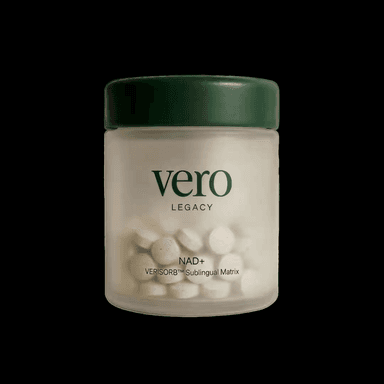
LEGACY™
NAD+Engineered around 300mg NAD+. Replenishes systemic NAD+ levels and drives mitochondrial function
Clinical Context
Important Notice: VERO protocols are nutritional and systemic optimisation formats. They are not intended to diagnose, treat, cure, or prevent any medical condition. These statements have not been evaluated by the Food and Drug Administration.