

What does Semax peptide do? Research suggests it lifts BDNF, modulates serotonin and enkephalin signalling, and shifts resting brain network coordination.
Quick answer: published research has documented three things Semax does in your brain. It lifts a protein called BDNF that your neurons use to grow and maintain themselves. In published rodent and human work, it has been observed to modulate serotonin, dopamine, and enkephalin signalling in specific brain regions. And in resting fMRI work, the compound has been observed to shift how your brain's threat-detection centre coordinates with its memory regions, all within minutes of an intranasal dose.
Available for research purposes only outside Russia. Here's what's actually happening at each layer.
What Does Semax Peptide Do, In One Paragraph?
Picture your brain as an open-plan office with a maintenance crew running 24 hours a day. They repair connections, sweep up debris, and decide which memories stay and which fade. Semax does not show up with a megaphone or a stimulant payload. In rodent research, scientists have observed it walking into that office and handing the crew a stack of new work orders.
Those work orders, across the published literature, fall into three buckets:
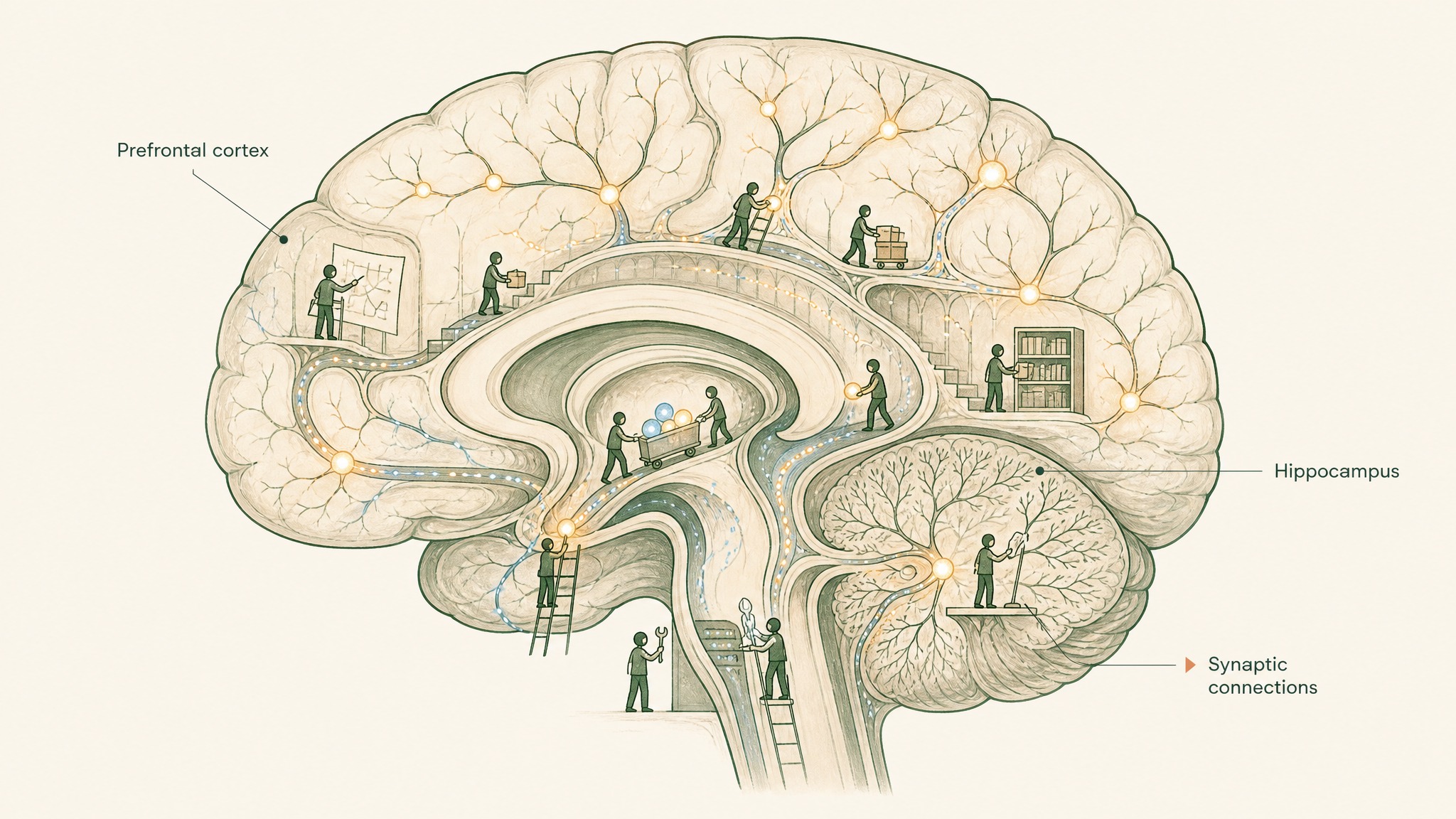
Semax activates your brain's maintenance crew to strengthen connections and clear cellular debris.
- A growth-factor lift (more BDNF, more of its receptor TrkB)
- A neurotransmitter nudge (serotonin, dopamine, and your brain's enkephalin "calm" network)
- A network-level shift visible on fMRI in healthy adults within twenty minutes of a single dose
Each layer matters for a different reason. Take them in order.
How Does Semax Reach Your Brain In The First Place?
Your blood vessels around the brain are wrapped in a tight security checkpoint called the blood-brain barrier. Most molecules don't get past it. A peptide like Semax that you swallowed would never make it past that point, because your stomach acid would have already chewed it up.
That's why every published Semax study uses intranasal spray. The tissue inside the top of your nose (called the olfactory mucosa) sits above a sheet of nerve fibres that run directly into the brain. Research suggests small molecules dosed there can hitch a ride up those fibres, skipping the blood-brain barrier almost entirely.
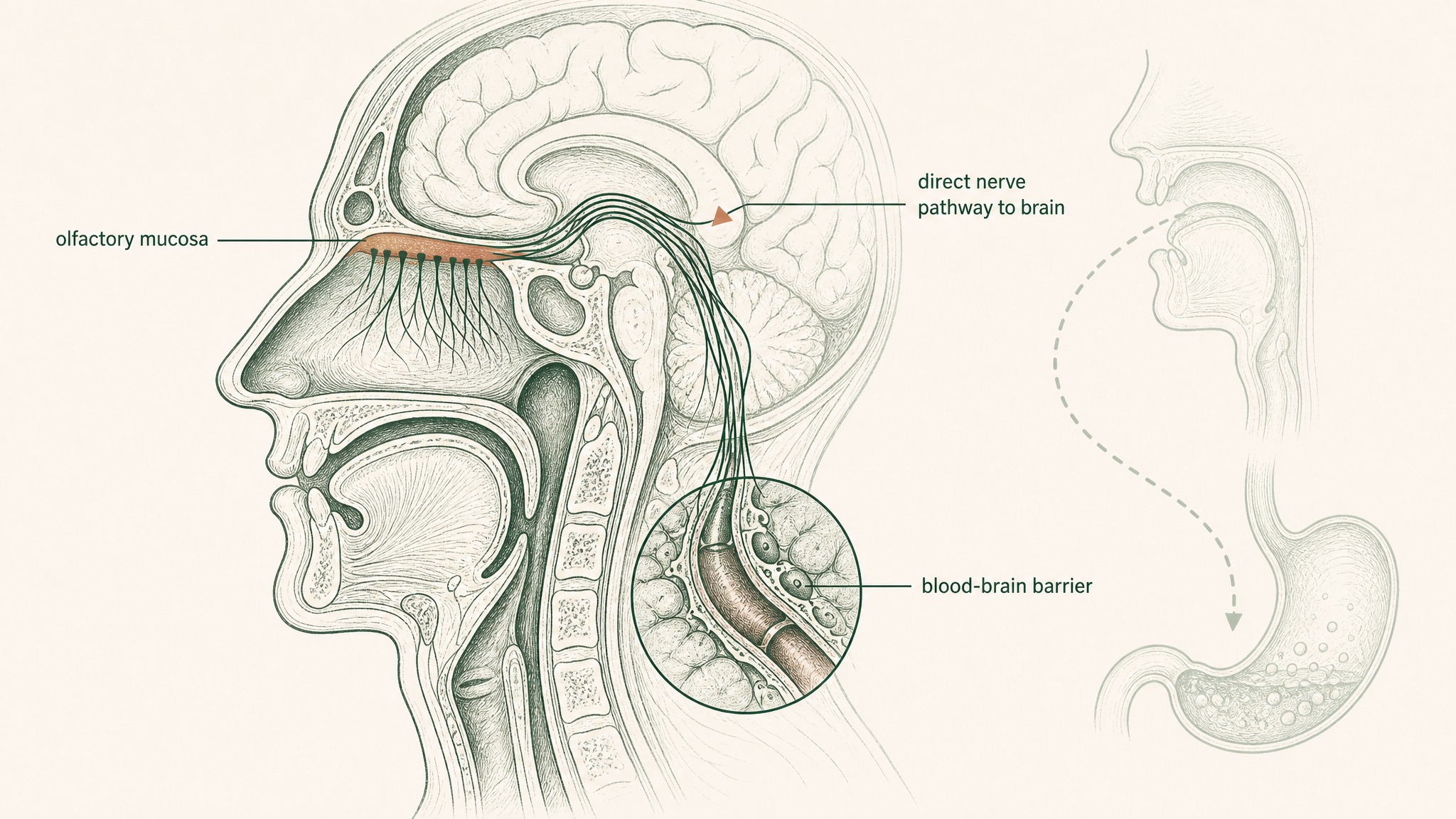
Intranasal peptides bypass stomach acid and the blood-brain barrier via direct nerve fibers in the nasal tissue.
The four routes, ranked by how much research backs each one for this peptide:
- Intranasal: the studied route. The molecule was engineered around it
- Sublingual: thin research base for Semax specifically. Mechanism plausible, not well-characterised
- Oral capsule: essentially absent. Stomach acid degrades the peptide before absorption
- Injection: documented in animal work but rarely chosen. Sacrifices the direct-to-brain advantage
In the research cycles we've run mapping cognitive peptides to protocol design, the delivery question for Semax always comes back to one fact: this molecule was built for the intranasal lane. Anyone working with it outside that route is working with a partially-understood version.
What Does Semax Do To BDNF Levels In The Brain?
If you've never met BDNF before, here's the plain version. Brain-derived neurotrophic factor is a protein your neurons release to keep themselves and their neighbours healthy. Think of it as the fertiliser your brain uses on its own connections.
When BDNF is plentiful, neurons grow new branches, strengthen the synapses they share, and survive stress better. When BDNF runs low (which it does with age, depression, and chronic stress), those maintenance jobs slow down.
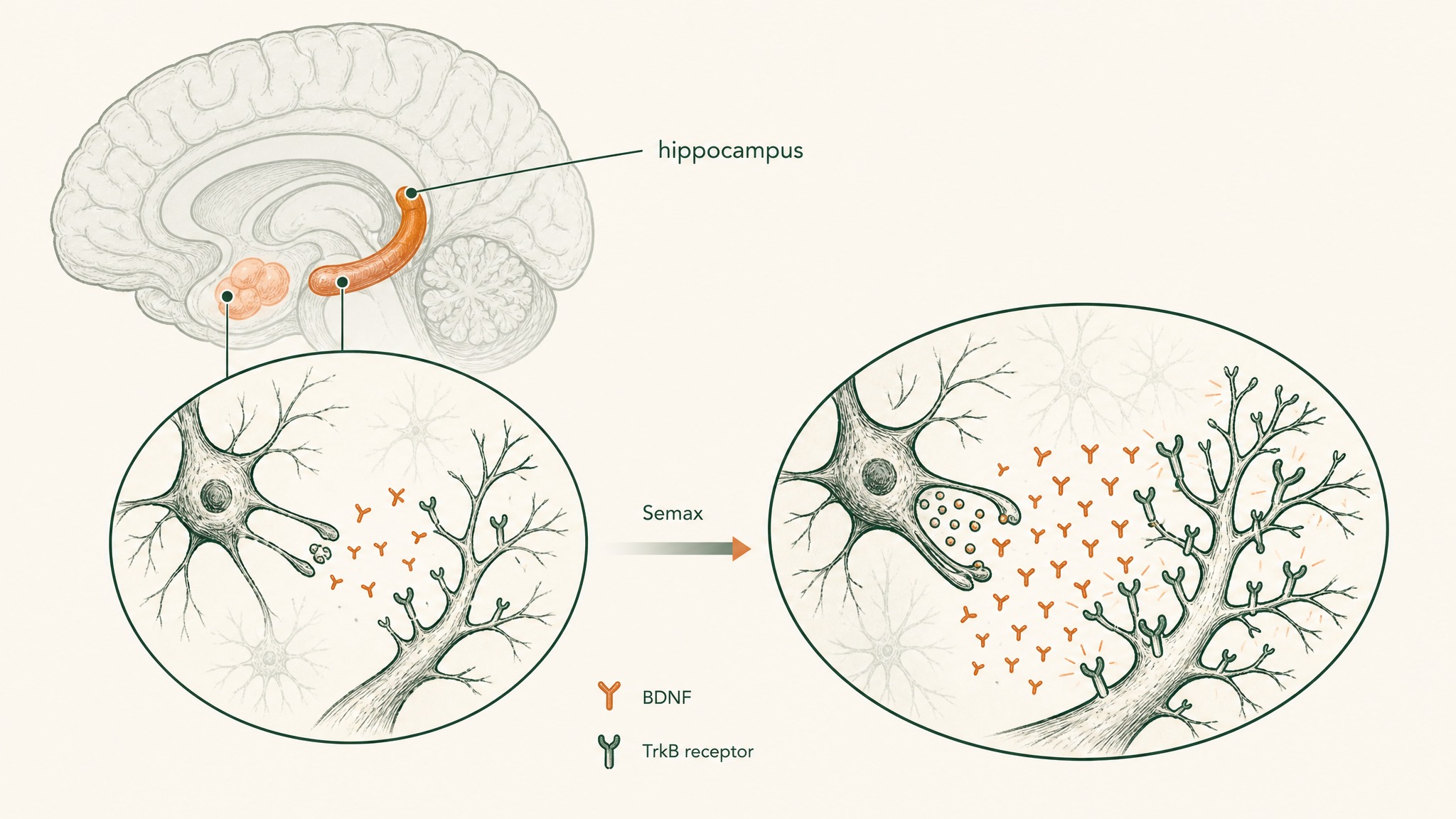
BDNF proteins released from neurons bind to receptors on neighboring cells, strengthening synaptic connections.
What does Semax do to that picture?
In rat experiments, Dolotov and colleagues observed that a single intranasal Semax application produced a 1.4-fold rise in BDNF protein in the hippocampus, the brain region your memory most depends on (Dolotov et al., Brain Research, 2006, PMID 16996037). A parallel study from the same group documented the same lift in the basal forebrain, which runs your sustained attention circuits (Dolotov et al., J Neurochem, 2006, PMID 16635254).
In the rat work, researchers framed the effect this way: not a push on the neurons themselves, but a nudge to make more of their own maintenance signal.
In follow-up cell-culture work from the same lineage, the rise in BDNF was paired with a measurable rise in TrkB receptor binding (TrkB is BDNF's matching receptor). More signal and more receptors listening for that signal is a richer maintenance environment than either change alone would create.
The honest caveat: rats aren't humans, and BDNF rising in hippocampus tissue isn't the same as your working memory sharpening on a Tuesday. But the mechanism story here is one of the cleanest in modern peptide research.
If you want the wider cognitive-peptide map (Selank, GHK-Cu, and others working through related mechanisms), our overview of peptides for cognition walks through the family.
How Does Semax Change Your Brain's Network Coordination?
Your brain isn't a stack of isolated regions firing on demand. It's more like an open-plan office where everyone hears snippets of everyone else's conversations and shifts their attention based on what just got loud. Researchers call that pattern resting-state functional connectivity.
In 2020, Panikratova and colleagues ran an fMRI study to see what Semax does to that office in healthy adults. Fifty-two volunteers received intranasal Semax, Selank, or placebo. The researchers scanned them five and twenty minutes after dosing (Panikratova et al., Dokl Biol Sci, 2020, PMID 32342318).
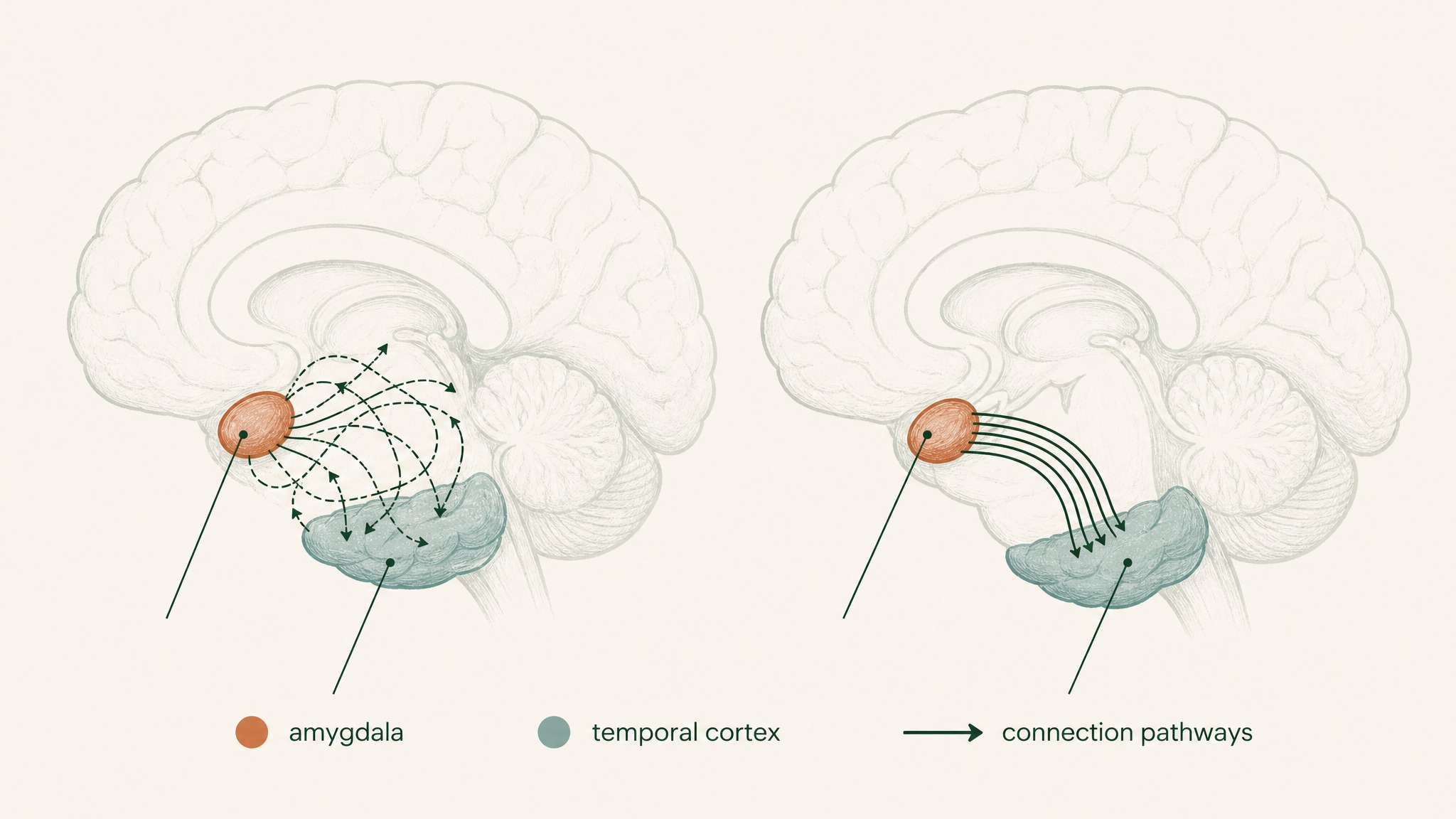
How Semax reorganizes communication between the amygdala and memory regions in the brain.
What they observed in the Semax arm:
- A measurable shift in how the amygdala (your brain's threat-detection centre) coordinated with temporal cortex regions involved in memory integration
- The shift pattern was specific to Semax and not seen in the placebo arm
- The change pattern matched what you'd predict from the BDNF and attention research: a calmer threat-monitoring loop and more orderly memory traffic
What the study did not measure was direct cognitive performance. Nobody's working memory was tested afterward. So the leap from "network coordination shifted" to "your day got sharper" is still a leap.
Members experience interest in this particular paper because it's one of the few human imaging datasets on Semax outside Russia's clinical record. It points at a real, measurable change happening inside healthy adult brains within twenty minutes of a nasal spray.
What Does Semax Do To Serotonin And Dopamine?
Most people learn about neurotransmitters as on-off switches. They are not. They are more like background levels on a mixing board, sliding up or down across different brain regions depending on what's being signalled and where.
Russian research groups working on Semax in the late 1990s and 2000s reported a consistent pattern across small animal-model studies:
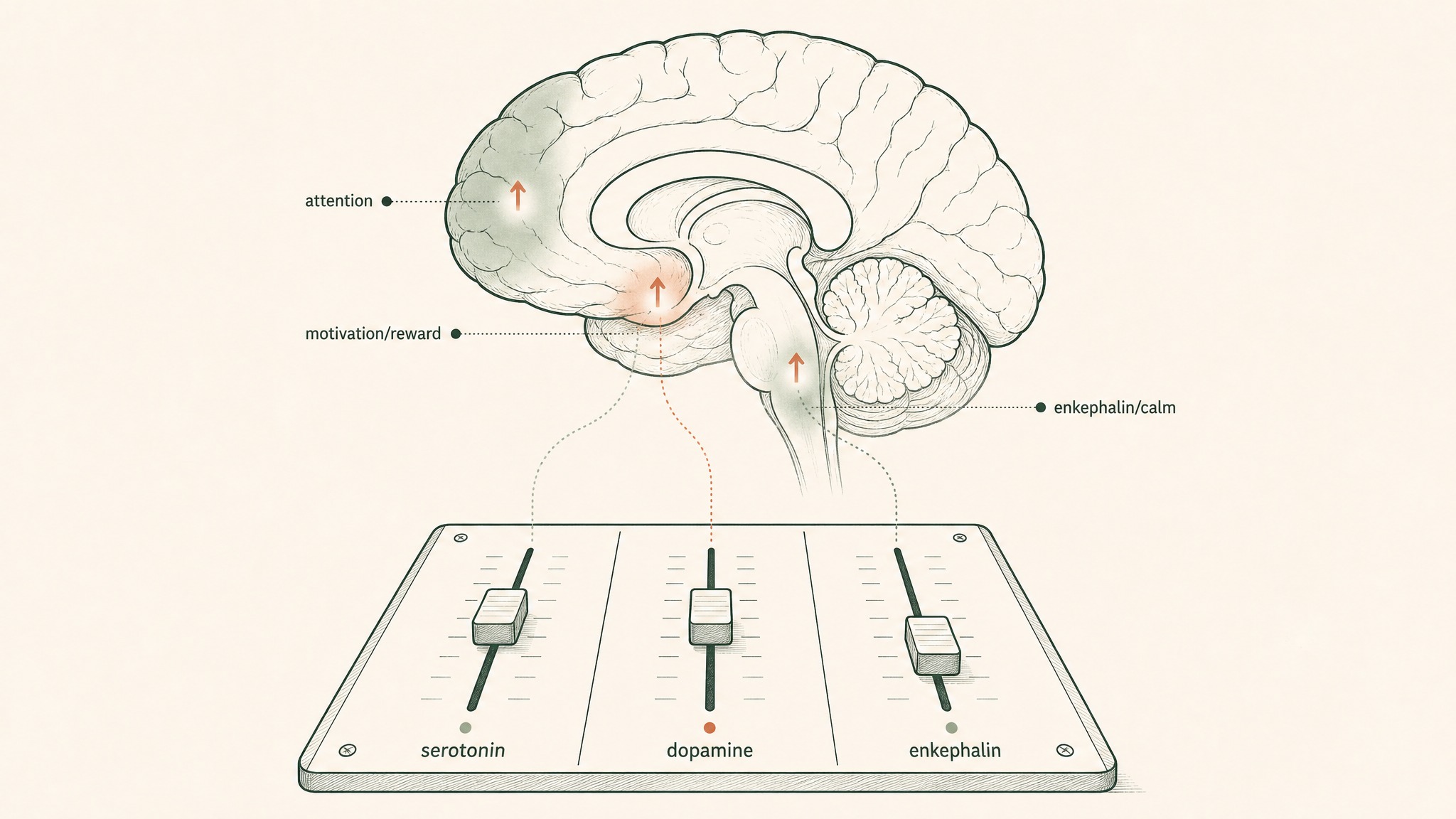
How Semax gently raises neurotransmitter levels in specific brain regions, like adjusting faders on a mixing board.
- Localised lifts in serotonin signalling in attention-related brain regions
- Modulation of dopamine pathways in motivation and reward circuits
- Engagement of the brain's enkephalin network, your internal opioid-like calming signal
None of those are the screaming, dose-dependent neurotransmitter floods you would see with a stimulant or an antidepressant drug. They are closer to subtle rebalancing of the mixing-board levels.
That mix matches what you would predict from a peptide whose biggest documented job is helping neurons grow and maintain themselves. The compound isn't driving neurotransmitter release directly. It's shifting the environment those neurotransmitter systems operate in.
If the cognitive-focus profile is what brought you here, the VERO CLARITY Protocol covers the wider stack we map to this domain.
What Does Semax Do To Stress And Anxiety Signalling?
Picture your brain's threat-detection circuit as a smoke alarm. In an anxious state, the sensitivity is cranked up. Small inputs trigger the alarm, the alarm does not reset quickly, and your prefrontal cortex (the manager who is supposed to evaluate whether the smoke is real) ends up shouting over a constantly going siren.
What does Semax do to that picture? Two things, based on the published research:
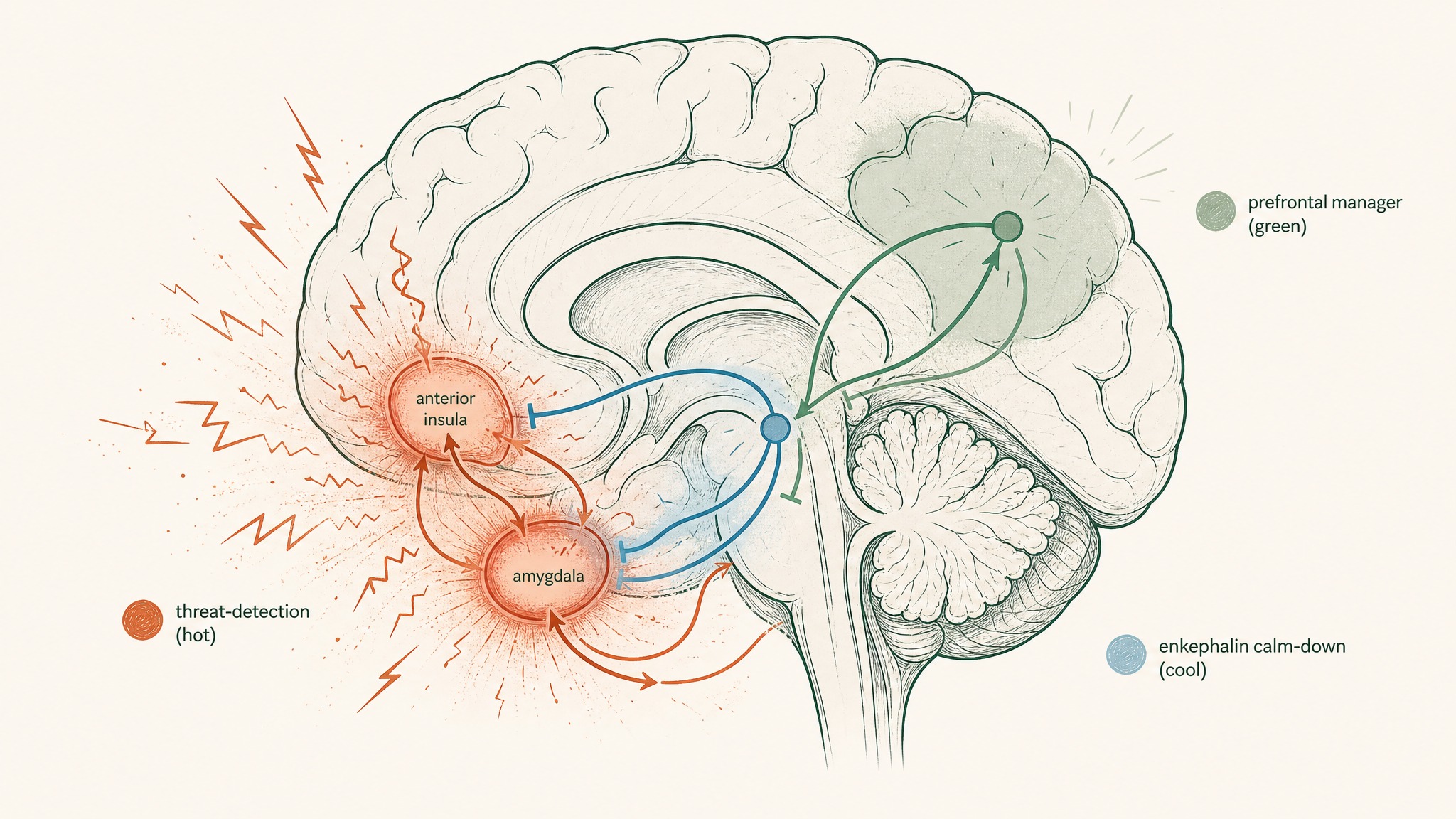
How enkephalin and prefrontal signalling quiet an overactive threat-detection circuit.
- It has been observed to engage the enkephalin pathway, your body's internal calm-down signalling network, which sits next to (and quietens) the threat-detection loop
- It nudges BDNF in the same circuits, which in rodent work has been documented as supporting healthier connection patterns over time rather than just turning the alarm volume down in the moment
This isn't anxiolytic-medication territory. Semax does not bind the same receptors as a benzodiazepine, and it doesn't produce the same kind of sedation. The published Russian work and the 2020 fMRI study both point at something quieter: a measurable, modest shift in how the threat-monitoring circuit balances against the rest of the brain.
That overlap with anti-anxiety signalling is one reason Semax and Selank are often studied together. The two peptides share BDNF and enkephalin territory, even though their structures and main use cases differ.
How Quickly Does Semax Start Working?
Think of two clocks ticking at different speeds. The first tracks the receptor-level effects, ticking in minutes. The second tracks the structural changes, ticking in days and weeks.
On the fast clock, here is what the research has documented:
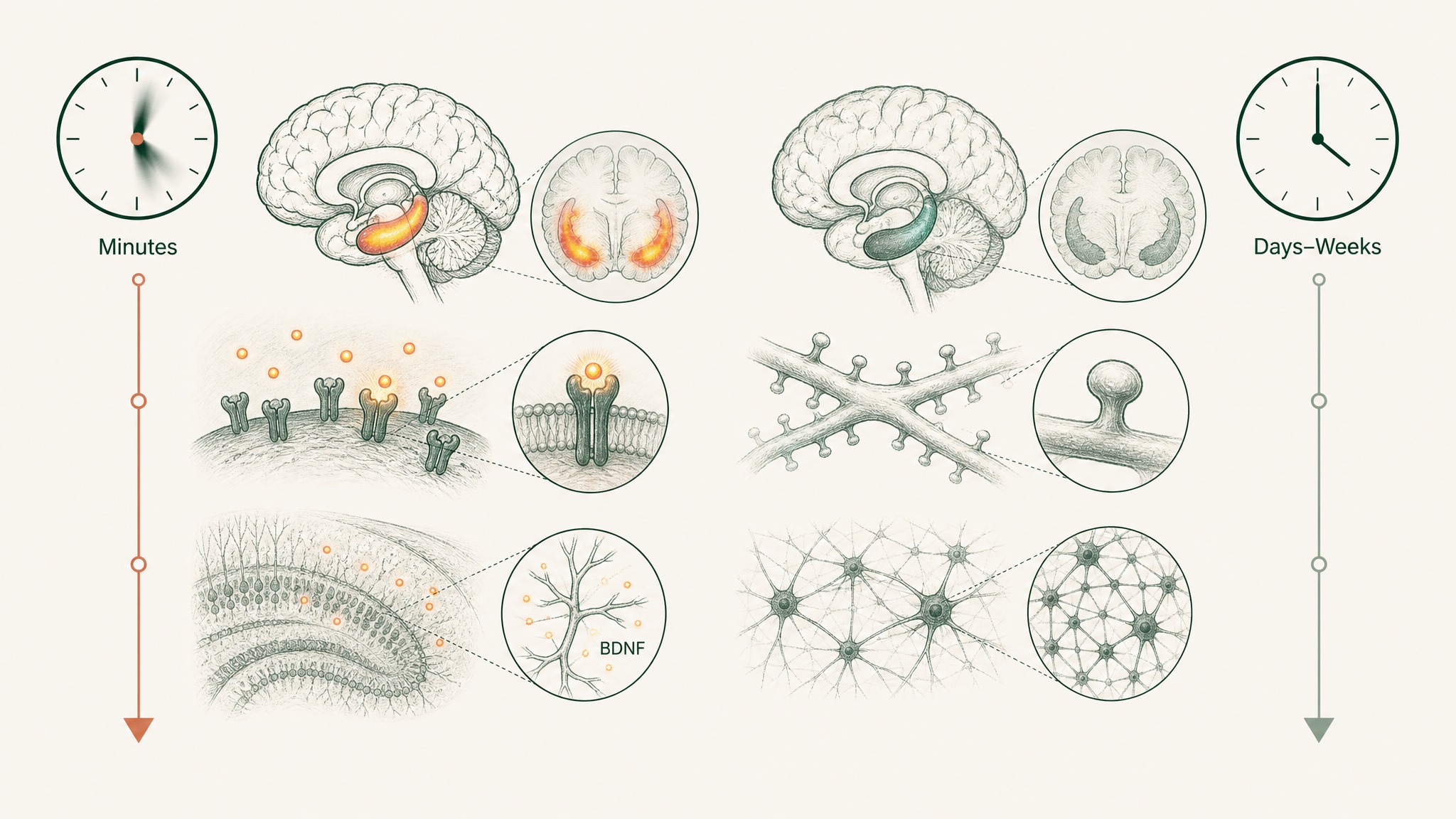
Semax's fast neurochemical effects appear within minutes, while structural brain changes develop over weeks.
- Within five minutes of intranasal dosing, Semax is measurable in brain tissue in animal studies
- Within five to twenty minutes, fMRI-detectable changes in brain network coordination appear in healthy adults
- BDNF protein levels rise in rat hippocampus tissue within hours of a single application
- The Pro-Gly-Pro stabiliser tail extends Semax's half-life from a couple of minutes to about twenty minutes after a nasal dose
On the slow clock, the picture is harder to pin down. Most rodent BDNF work uses repeated dosing across days, not single doses. Most Russian clinical work in stroke recovery and cognitive impairment is multi-week.
The honest summary: research suggests the acute neurochemical changes happen fast, but the structural and learning-related effects appear to need sustained exposure. Compounds that engage growth-and-maintenance signalling tend to work on the slow clock, regardless of how quickly the initial receptor-level changes show up.
What Does Semax Not Do?
This matters because the gap between marketing-channel claims and the actual research is wide.
What the published research does not establish:
- Stimulant-style focus boosts on a healthy adult within a single dose
- IQ gains or measurable working-memory increases in cognitively normal adults (the human-performance trials at scale haven't been published)
- A therapeutic option for cognitive decline outside the Russian clinical record
- Anything resembling a smart-drug guarantee
Users report subjective improvements in focus, calm, and mental fatigue. Those reports are interesting, but they are not the same kind of evidence as a randomised controlled trial.
The honest read is that Semax has a real, mechanistically credible neurotrophic and neuromodulatory signal, and Russia's clinical experience with it as a useful neurology compound extends back nearly three decades. Western replication of those clinical outcomes is thin, and the specific use case of cognitive enhancement in healthy adults remains under-studied. If you want the use-case-by-use-case breakdown, our companion piece on what Semax peptide is used for walks through it.
How Does Semax Compare To Selank Mechanistically?
The two compounds are siblings. A short table makes the overlap and the differences easier to hold in your head:
| Mechanism layer | Semax | Selank |
|---|---|---|
| Origin | Engineered from an ACTH(4-10) fragment | Engineered from tuftsin, an immune-signalling molecule |
| BDNF effect | Documented lift in rat hippocampus and basal forebrain | Documented lift, smaller body of work |
| Serotonin / dopamine | Both touched in localised attention regions | Serotonin shift more central to the mechanism story |
| Enkephalin pathway | Engaged | Engaged |
| Research framing | Cognition and stroke recovery dominate the literature | Anxiolytic profile dominates the literature |
| Half-life (intranasal) | About 20 minutes after the stabiliser tail was added | Comparable |
The point of the table is not that one is "better." It is that the two peptides share a lot of signalling territory but were studied for different primary outcomes, which shapes what you read about each. If you have already read up on Selank, very little of the Semax mechanism story will surprise you.
What's The Author's Read On What Semax Does?
In the research cycles we've run mapping peptide mechanisms to protocol design, my read on Semax is this: it is one of the cleanest examples of a peptide whose mechanism story (BDNF and TrkB, enkephalin, modest neurotransmitter modulation) lines up coherently with its observed clinical use pattern (cognitive support, post-stroke recovery, focus regulation). The mechanism doesn't promise a stimulant high, and the literature doesn't claim one either.
The shorthand: mechanism story credible, clinical signal real inside Russia, Western replication still thin.
What I keep flagged for anyone working with the literature: the cognitive-performance trials in healthy adults remain small, the human imaging research lives in only a couple of papers, and Western replication of the Russian clinical record is genuinely sparse. None of that invalidates the mechanism. It just means the gap between "real, interesting signal" and "established therapeutic" remains wider than the marketing channels admit.
Frequently Asked Questions
What does Semax peptide do in the brain?
Three things the published research has documented. Researchers have observed it lifting BDNF (the protein your neurons use to grow and maintain themselves) in rat hippocampus and basal forebrain tissue, modulating serotonin, dopamine, and enkephalin signalling in localised brain regions, and shifting resting brain network coordination on fMRI in healthy adults within twenty minutes of an intranasal dose.
None of those effects are stimulant-style. They sit closer to the brain's growth-and-maintenance signalling than to its reward-and-arousal circuitry.
How fast does Semax act?
On the receptor and signalling clock, fast. Within five to twenty minutes, fMRI-detectable shifts in brain network coordination appear after intranasal dosing in healthy adults. BDNF protein levels rise in rat hippocampus tissue within hours of a single application.
On the structural clock, the effects appear to need sustained exposure. The Russian clinical work and the rodent cognitive studies both lean on multi-day or multi-week dosing.
Does Semax make you smarter?
That is not what the published research establishes. What the literature has documented is a modest, mechanistically-credible signal toward better neuron maintenance, more BDNF, and shifted brain network coordination. Whether that translates to measurable working-memory or IQ gains in healthy adults remains under-studied.
Users report subjective improvements in focus and fatigue. Those reports are interesting but are not the same kind of evidence as a controlled trial.
Is Semax a stimulant?
No. Stimulants like caffeine and amphetamine work by driving direct neurotransmitter release, which produces an acute spike in arousal. Semax does not work that way.
In rodent and cell-culture research, the compound's main observed job has been signalling the brain's own growth-and-maintenance machinery to do more of what it already does. The effects appear gradual rather than acute, and the dose-response curve does not look like a stimulant's.
Does Semax actually cross into the brain?
Yes, in the intranasal route. The olfactory mucosa (the tissue inside the upper part of your nose) sits above nerve fibres that run directly into the brain, giving small peptides like Semax a route past the blood-brain barrier.
The molecule has been measured in brain tissue within minutes of nasal dosing in animal studies. Other routes (oral, sublingual) have much thinner research support specifically for Semax.
What does Semax do that's different from Selank?
Both share BDNF, enkephalin, and serotonin signalling territory. The biggest practical difference is the research focus: Semax has been studied more in cognitive, focus, and stroke contexts; Selank has been studied more in anxiety contexts.
Their structures also differ. Semax is built on an ACTH fragment, Selank on tuftsin (an immune-signalling molecule). The mechanism stories overlap, but the research bases that grew up around each have different shapes.
Is Semax safe long-term?
Inside Russia's clinical record, it has been used as a neurology compound for nearly three decades, and that record forms the bulk of the long-term safety data that exists. Outside Russia, the long-term safety database in humans is essentially absent.
The compound is available for research purposes only outside the Russian clinical system. Any work with it should be framed accordingly.
Key Takeaways
- In published rodent work, Semax has been observed to lift BDNF in hippocampus and basal forebrain tissue, modulate serotonin, dopamine, and enkephalin signalling in localised brain regions, and (in healthy adults) shift resting brain network coordination on fMRI within twenty minutes of an intranasal dose
- The peptide was engineered around the intranasal route and crosses into the brain via olfactory nerve pathways. Oral, sublingual, and injection routes for Semax specifically have much thinner research support
- The mechanism story (growth signalling, modest neurotransmitter modulation) is consistent and credible. The acute clock measures in minutes. The structural clock measures in days to weeks
- Semax is not a stimulant. It does not produce dose-dependent neurotransmitter floods, and the dose-response curve looks more like a long-term maintenance compound than an acute focus aid
- The 2020 Panikratova fMRI work is one of the few human imaging studies outside Russia. It established measurable brain-network changes after a single nasal dose but did not measure direct cognitive performance
- Outside Russia, Semax is available for research purposes only. Western trial replication remains thin, and long-term safety data outside the Russian clinical record is sparse
References
- Dolotov OV, Karpenko EA, Inozemtseva LS, et al. (2006). Semax, an analogue of ACTH(4-10): BDNF and TrkB regulation in rat hippocampus. Brain Research. https://pubmed.ncbi.nlm.nih.gov/16996037/. Retrieved 2026-06-24.
- Dolotov OV, Karpenko EA, Seredenina TS, et al. (2006). Semax, an analogue of ACTH(4-10): specific binding and BDNF protein levels in rat basal forebrain. Journal of Neurochemistry. https://pubmed.ncbi.nlm.nih.gov/16635254/. Retrieved 2026-06-24.
- Panikratova YR, Andryushchenko AV, Kupriyanov RV, et al. (2020). Functional connectivity of brain areas after intranasal administration of Selank and Semax in healthy volunteers. Doklady Biological Sciences. https://pubmed.ncbi.nlm.nih.gov/32342318/. Retrieved 2026-06-24.
- Storozhevykh TP, Tukhbatova GR, Senilova YE, et al. (2007). Effects of Semax and its Pro-Gly-Pro fragment on calcium homeostasis and neuronal survival under glutamate stress. Bulletin of Experimental Biology and Medicine. https://pubmed.ncbi.nlm.nih.gov/18239779/. Retrieved 2026-06-24.
- Gusev EI, Skvortsova VI, Miasoedov NF, et al. (1997). Semax in the acute period of hemispheric ischaemic stroke: clinical and electrophysiological observations. Zh Nevrol Psikhiatr Im S S Korsakova. https://pubmed.ncbi.nlm.nih.gov/11517472/. Retrieved 2026-06-24.
- Wikipedia contributors. Semax overview and regulatory background. https://en.wikipedia.org/wiki/Semax. Retrieved 2026-06-24.
Curious how Semax fits into a broader cognitive peptide research stack? Explore the CLARITY Protocol →

CLARITY™
Coming SoonEngineered around 10mg Dihexa. Drives advanced synaptic connectivity and neurogenesis
Clinical Context
Important Notice: VERO protocols are nutritional and systemic optimisation formats. They are not intended to diagnose, treat, cure, or prevent any medical condition. These statements have not been evaluated by the Food and Drug Administration.