

Semax is a synthetic ACTH-fragment peptide. Research suggests uses across cognition, focus, stroke recovery, and neuroprotection, for research purposes only.
If you've landed here, you're trying to figure out what Semax peptide is actually used for, separate from marketing claims and forum hype. Short answer: published research covers four areas. Cognition and learning, focus and anxiety regulation, stroke recovery in the hospital setting, and cellular neuroprotection in lab studies.
The compound is available for research purposes only outside of Russia. That legal-research separation matters when you read what users report online.
What Is Semax, In Plain English?
Think of Semax as a short stretch of biological message text that your body would normally recognise. Researchers in Moscow took a small piece of a hormone your pituitary gland already makes (called ACTH, the molecule that tells your adrenals to release cortisol), trimmed it down to a seven-letter fragment, and bolted on a stability tail so the body wouldn't tear it apart in minutes.
The molecule itself:
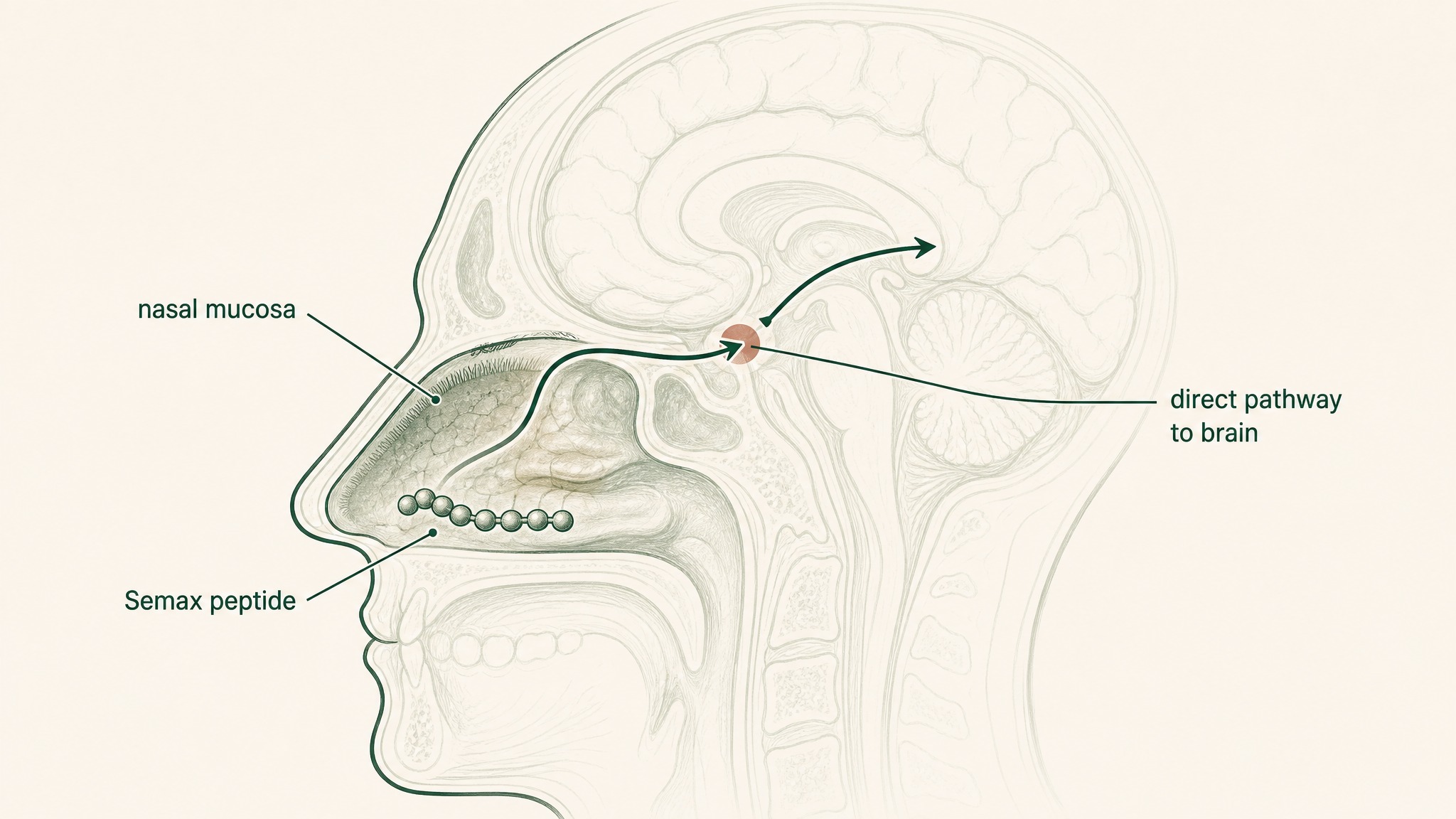
Semax peptide entering the brain via the nasal mucosa's direct express lane.
- Seven amino acids long (a chain of seven building blocks)
- Built from the ACTH(4-10) sequence, the part of ACTH that doesn't trigger the cortisol response
- Stabilised with three extra residues (Pro-Gly-Pro) tacked on the end
- Most commonly delivered as a nasal spray, because the tissue inside your nose has a direct express lane to the brain
In the research cycles we've run on cognitive peptides, the cleanest mental model I keep returning to is this: Semax is not a stimulant or a "smart drug" in the supplement-aisle sense. It does not work by spiking dopamine or shoving adrenaline through your system. It works by tilting which proteins your brain cells decide to produce.
What Is Semax Peptide Used For? The Short Version
Three places the published research keeps returning to:
- Cognitive function and memory. Most of the BDNF and learning data lives here
- Stroke recovery. Russian clinical research used Semax in acute ischaemic stroke care
- Anxiety, focus, and attention regulation. A smaller body of work overlapping with how Selank is studied
There's also a quieter cellular research thread on neuroprotection (keeping brain cells alive during oxygen or glutamate stress), which sits underneath all three of the bigger use cases.
The shorthand: Semax is studied for things related to brain maintenance. Growth signals, recovery from injury, attention regulation, and protection from stress. Members experience interest in this profile because almost every modern brain-health goal sits in one of those buckets.
How Did Semax Get From The Lab To Modern Research?
The story starts in the early 1980s at the Institute of Molecular Genetics in Moscow. A team led by Nikolai Myasoedov was studying ACTH fragments after researchers noticed that even when ACTH no longer triggered the cortisol release, smaller pieces of it still affected behaviour and learning in animal models.
Their question was simple: what if you could keep the brain effects of ACTH while removing the stress-axis activation?
Semax was the answer they engineered. The seven-amino-acid fragment kept the cognitive signalling, the Pro-Gly-Pro tail extended its half-life from a couple of minutes to about 20 minutes after intranasal delivery, and by the late 1990s Russian regulators had approved it for clinical use.
Most of the modern published research traces back to this Moscow lineage. That's not a problem, but it's a context detail you should know before treating the literature as routine Western journal output.
How Does Semax Actually Work In The Brain?
Three mechanisms keep showing up across the research:
- BDNF production. Brain-derived neurotrophic factor is the protein your neurons use to grow and maintain their connections
- Serotonin and dopamine modulation in specific brain regions
- Anti-stress gene expression that helps brain cells survive low-oxygen or chemically toxic environments
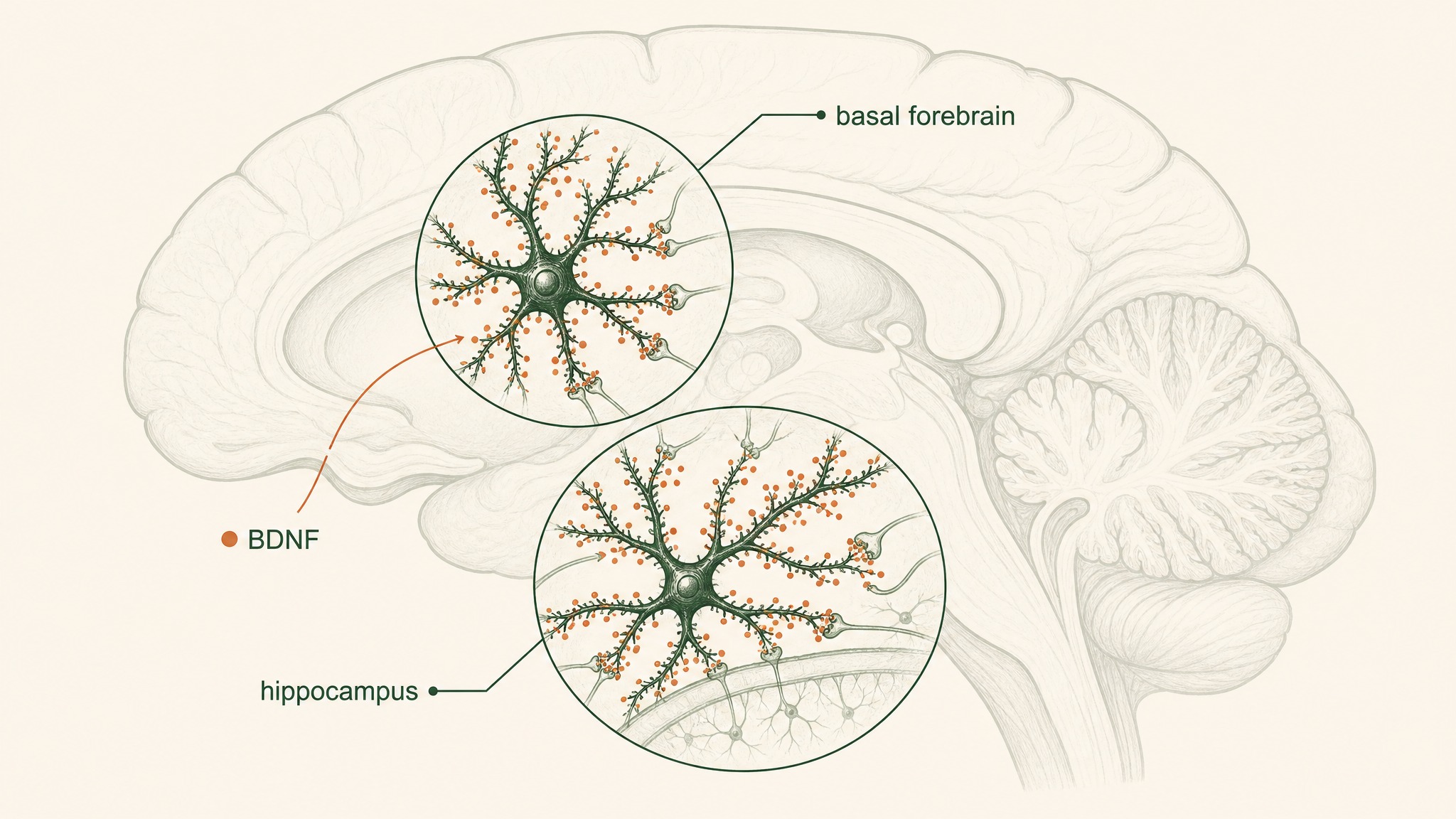
BDNF protein clusters around synapses in the hippocampus and basal forebrain after Semax exposure.
The cleanest of the three is the BDNF story. In rat experiments, Dolotov and colleagues observed that a single intranasal Semax application produced a 1.4-fold rise in BDNF protein in the hippocampus, the brain region most directly tied to learning and forming new memories (Dolotov et al., Brain Research, 2006, PMID 16996037).
A parallel study from the same group documented the same BDNF lift in the rat basal forebrain, an area central to sustained attention (Dolotov et al., J Neurochem, 2006, PMID 16635254). The basal forebrain is roughly the brain's equivalent of the lighting director on a film set. Without it, you can't keep attention on what matters.
Think of BDNF as fertiliser for brain cells. Semax does not push neurons to fire harder, it nudges them to grow and maintain their own infrastructure.
If you want a deeper dive into the BDNF pathway across multiple cognitive peptides, our peptides for cognition overview unpacks how this same mechanism shows up for Selank, GHK-Cu, and others.
What Does The Research Say About Semax And Cognition?
This is the most studied use case. In animal models, the pattern is consistent across small trials:
- BDNF goes up
- Performance on learning tasks improves
- Effects are gradual rather than acute
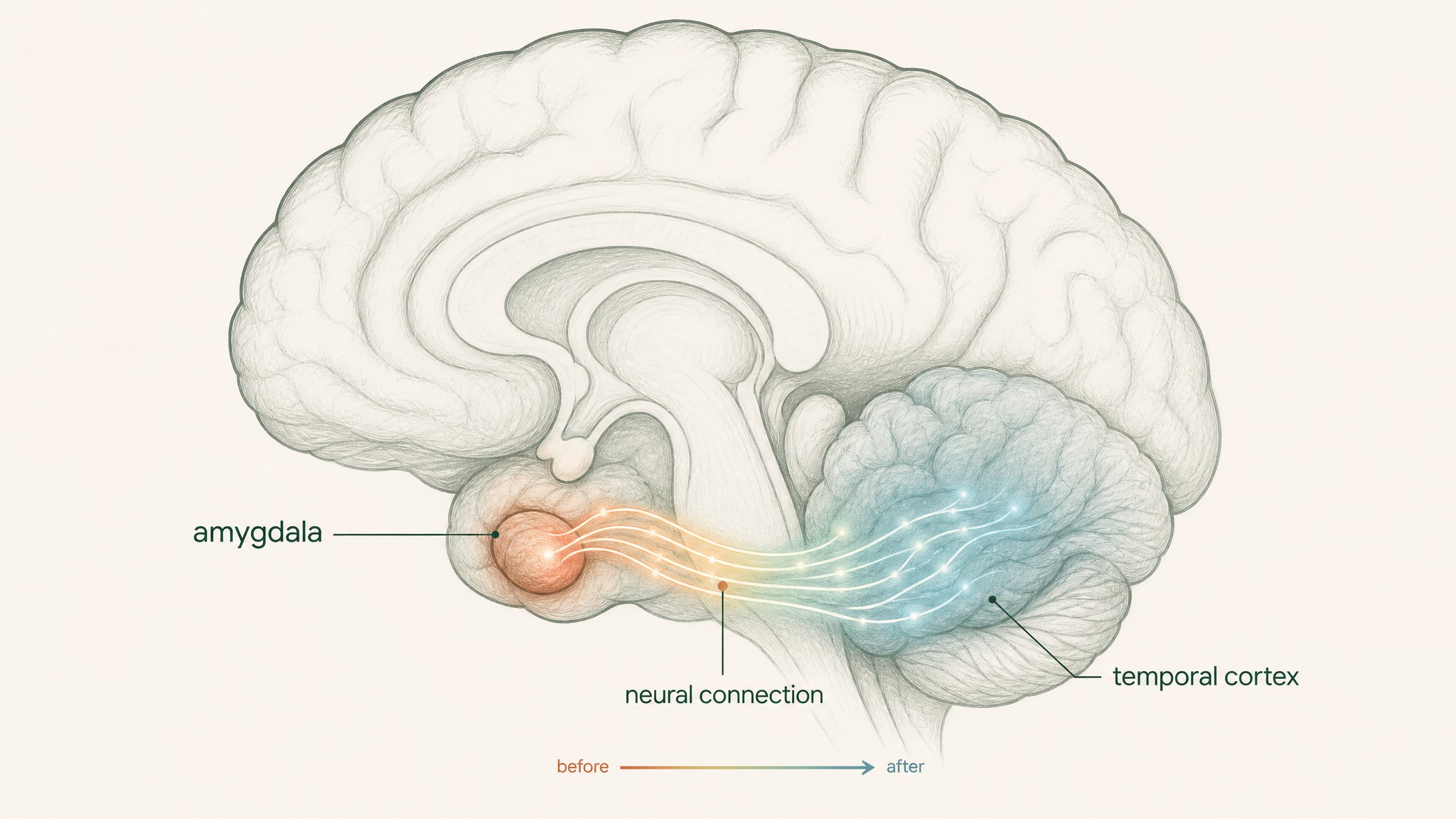
How Semax shifts communication between your brain's threat-detection and memory centers.
In conditioned avoidance learning tasks (where rats learn to associate a sound with a mild stimulus and avoid it), Dolotov's groups reported Semax-treated animals outperformed controls. In sustained attention rodent models, similar gains showed up across multiple intranasal-dose protocols.
Human imaging research is more recent. A 2020 fMRI study (functional MRI, which lights up which brain regions are coordinating with each other at rest) gave Semax, Selank, or placebo to 52 healthy adults and scanned them five and twenty minutes after dosing. In the Semax arm, the researchers observed measurable shifts in how the amygdala (your brain's threat-detection centre) connected with temporal cortex regions involved in memory integration (Panikratova et al., Dokl Biol Sci, 2020, PMID 32342318).
What this study established was modest but useful. The investigators reported that resting brain network organisation in healthy people shifted within minutes of intranasal dosing, and the change pattern matched what you'd predict from the BDNF and attention research. The study did not measure direct cognitive performance gains, which is a gap to know.
A note on intent: the early Russian work tested Semax in clinical populations (anxiety, fatigue, post-stroke). Whether the same effects scale to healthy adults seeking a focus advantage is a question the data hints at but doesn't fully answer. Research suggests yes, in part, but the human cognitive-performance trials haven't been published at scale yet.
If cognition is your research interest, the VERO CLARITY Protocol covers the broader peptide stack we map to this domain.
What Does The Research Say About Semax And Stroke Recovery?
This is the use case Western audiences hear about least often. Inside Russia, it's one of the main reasons Semax exists clinically.
Three threads run through this body of work:
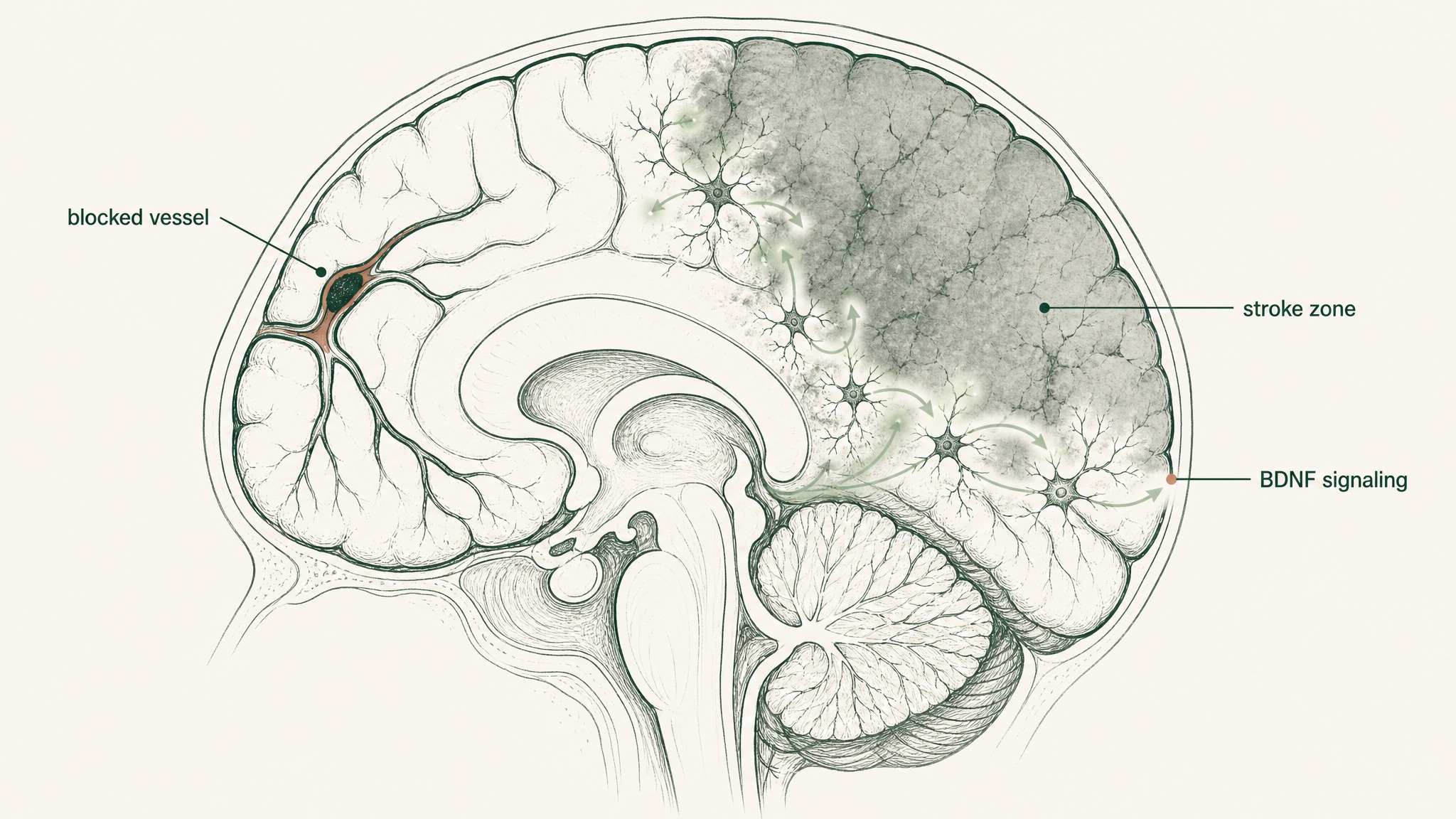
How BDNF helps surviving neurons reorganize around a stroke injury site.
- A clinical track in acute stroke neurology
- A cellular track on neuronal survival under stress
- A mechanism track tying both back to BDNF signalling
Gusev and colleagues published the foundational clinical study in 1997. They administered Semax in the acute period of hemispheric ischaemic stroke (the type caused by a blocked brain blood vessel) and tracked both clinical recovery and electrophysiology. In the trial cohort, patients receiving Semax (12 mg daily in moderate cases, 18 mg daily in severe cases, alongside standard care) showed accelerated recovery of neurological function compared to controls receiving conventional therapy alone, and the EEG and somatosensory evoked potential recordings tracked an improved pattern of brain activity recovery (Gusev et al., Zh Nevrol Psikhiatr Im S S Korsakova, 1997, PMID 11517472).
The proposed mechanism overlapped with the BDNF work. The same neurotrophin signals understood to support neuronal growth during healthy learning also appear to support the way surviving neurons reorganise around an injury site after a stroke. Russian stroke protocols still use Semax in this acute window, although Western trial replication has not been published at the same depth.
Below the clinical work sits the cellular research. In cultured rat cerebellar granule cells, Storozhevykh and colleagues observed that Semax and its Pro-Gly-Pro tail fragment delayed the development of calcium dysregulation under glutamate toxicity and lifted neuronal survival by roughly 30% versus untreated controls (Storozhevykh et al., Bull Exp Biol Med, 2007, PMID 18239779).
That kind of in-vitro work doesn't predict human outcomes on its own. It does explain part of why a peptide developed for cognitive research kept showing up in stroke neurology rounds in Moscow.
Why Is Semax Studied For Attention And Anxiety?
The anxiety thread is the third leg of the use-case stool. Russian clinical work on Semax overlaps heavily with research on Selank (its anxiolytic cousin), and the two compounds are often studied together.
The overlap exists for a reason:
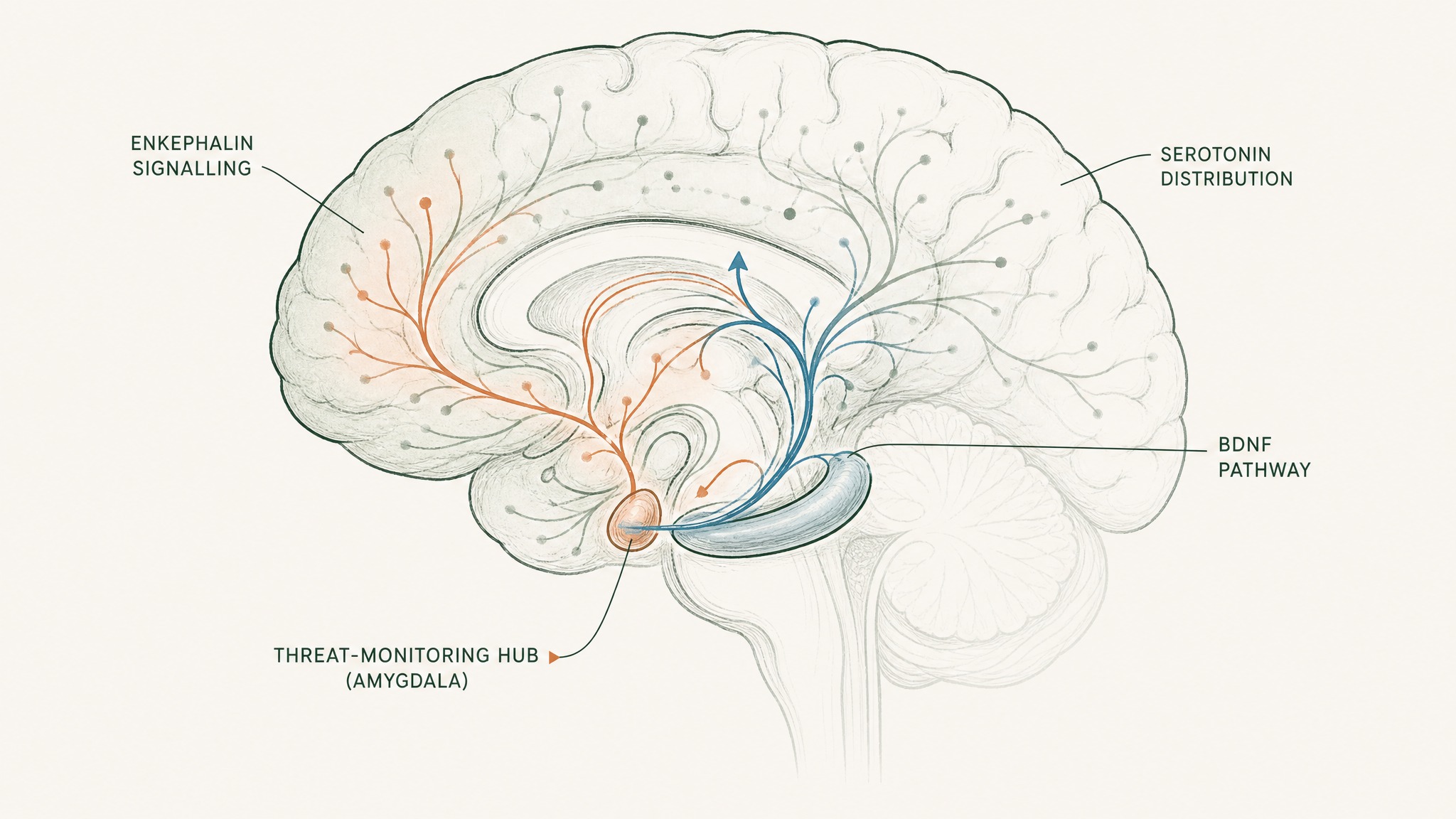
Three brain pathways that Semax and Selank both influence: enkephalin, BDNF, and serotonin.
- Both modulate enkephalin signalling (your brain's internal opioid-like calming network)
- Both touch BDNF and serotonin pathways
- Both have been deployed in anxiety, fatigue, and post-stress recovery research
The 2020 Panikratova fMRI study above is the cleanest example of the side-by-side approach. In healthy adults, the Semax arm shifted brain network coordination in ways consistent with reduced threat-monitoring activity, which is what you'd predict for a focus-and-calm profile rather than a stimulant profile.
A second note: in Russia, Semax has been studied off-label in attention regulation work for children, including ADHD-adjacent contexts. The Western literature has not replicated this depth, and the framing here is research-only. Users report subjective improvements in focus and reduced fatigue, but those reports are not the same kind of evidence as a randomised trial.
Is Semax Approved Or Available Anywhere?
Short answer:
- Russia. Approved for clinical use in cognitive impairment, ischaemic stroke recovery, and related neurology indications since the late 1990s
- United States. Not approved. Not scheduled. Sold as a research chemical only
- European Union. Not approved. Classified as a research compound
- Canada, UK, Australia. Not approved for human therapeutic use
The compound's available worldwide for research purposes only outside of the Russian clinical system. That research-only framing matters legally, and matters for how anyone working with the compound should think about evidence quality.
The most common research delivery format is intranasal spray, since it's the route used in nearly every published animal and human study. Sublingual delivery research for Semax is much thinner, and oral capsule research is essentially absent, because the molecule is a tiny peptide that gets shredded by stomach acid before it can reach the bloodstream intact.
| Route | Research depth for Semax | Why |
|---|---|---|
| Intranasal spray | Extensive (most published studies) | Olfactory mucosa gives small peptides direct brain access |
| Sublingual | Thin | Limited published Semax data; mechanism plausible but not well-characterised |
| Oral capsule | Essentially absent | Stomach acid degrades the peptide before absorption |
| Injection | Limited | Bypasses gut but loses the direct-to-brain advantage of intranasal |
That delivery limit is part of why the VERISORB sublingual approach we use at VERO was designed around peptides where sublingual absorption has either been studied or can plausibly be matched against the intranasal route's brain access.
What's The Honest Limit Of The Evidence?
There are real reasons to be careful here.
- Geographic concentration. Most published Semax research comes from a small number of Russian research groups, with Western replication still thin
- Animal-to-human translation. Rat hippocampus BDNF doesn't automatically equal human working-memory gains
- Long-term safety. Published multi-year human safety data is essentially absent outside the Russian clinical record
- Marketing inflation. Forum and supplement-channel claims about Semax routinely outrun what the studies actually showed
That doesn't make the underlying mechanism science wrong. It means the honest position is somewhere between "this is a real signal worth studying" and "this is a settled treatment". The settled-treatment side is overclaiming.
Research suggests genuine cognitive and neuroprotective signalling activity. The work to extend that to broad human cognitive enhancement is still ongoing.
How Does Semax Fit Into A Modern Peptide Research Stack?
If you're mapping Semax into a peptide research stack, three context details matter:
- Delivery route. Semax is studied intranasally, full stop. Anyone running Semax research alongside sublingual or oral peptide formats needs to keep the delivery routes separated mentally
- Mechanism overlap with Selank. The two are siblings. If you've researched Selank, the Semax profile won't surprise you
- Cognitive vs recovery framing. Choose which use case the research is exploring (cognition, post-stroke recovery, anxiety modulation), because the outcome metrics differ
For the broader cognitive peptide territory, our internal CLARITY Protocol maps the compound family we consider most research-relevant for this domain. For the wider question of how to think about choosing any peptide research direction, the how to choose a peptide protocol guide unpacks the framework.
Frequently Asked Questions
What is Semax peptide used for?
Semax has been studied for four main purposes in the published research. Cognitive support (particularly memory and learning), focus and attention regulation, stroke recovery in acute clinical settings, and cellular neuroprotection.
The strongest mechanism story is around BDNF, the protein your brain uses to grow and maintain its own connections. Outside of Russia, where it's clinically approved, Semax is available for research purposes only.
Is Semax the same as Selank?
No. They were developed by the same research lineage in Moscow, and they share some signalling territory (BDNF modulation, serotonin, enkephalin pathways), but the structures differ.
Semax is built on an ACTH(4-10) fragment. Selank is built on tuftsin, an immune-signalling molecule. Their research profiles overlap in anxiety and attention work but diverge in their cleanest use cases.
How is Semax usually administered?
Almost all published research uses intranasal delivery, where Semax is dosed as a nasal spray. The tissue inside the nose (called the olfactory mucosa) gives small peptides relatively direct access to brain regions, bypassing most of the body's normal barriers.
Sublingual and oral delivery for Semax are not well-studied. The molecule is a peptide and would be digested by stomach acid before it could reach the bloodstream intact.
Does Semax act like a stimulant?
No. Stimulants like caffeine or amphetamine work by directly nudging neurotransmitter release. Semax does not.
The 2006 Dolotov work and the 2020 Panikratova fMRI study both point to a mechanism more like long-term maintenance support. Increased BDNF production, shifted brain network coordination, modulated serotonin in specific regions. Effects appear gradual rather than acute.
What are the limits of Semax research?
Three honest limits. First, most studies come from Russian research groups and Western replication is still thin. Second, the human cognitive-performance studies are smaller than the animal-model BDNF work, so the chain from "BDNF rises in rats" to "your working memory improves" is not fully proven.
Third, long-term safety data outside the Russian clinical record is essentially absent.
Why is Semax studied for stroke recovery?
Because the same BDNF signalling that supports healthy learning also appears to support brain repair after injury. The 1997 Gusev study used Semax in acute ischaemic stroke patients and tracked both clinical and EEG-based recovery improvements.
Cell-culture studies have since observed that Semax supports neuronal survival during the kind of glutamate stress that surrounds a stroke site. Russian stroke neurology has used Semax in this acute window for decades, although Western replication trials are thin.
Is Semax legal?
In Russia, Semax is an approved clinical compound for cognitive and neurology indications. Outside Russia (including the US, UK, EU, Canada, and Australia), Semax is not approved for human therapeutic use and is classified as a research chemical. Anything beyond research purposes only sits outside the regulatory frame of those jurisdictions.
Key Takeaways
- Semax is a seven-amino-acid synthetic peptide built from an ACTH fragment, developed in Moscow in the 1980s and approved for clinical use in Russia for cognitive and stroke neurology indications
- The most studied use cases are cognitive function and learning, attention and anxiety regulation, acute ischaemic stroke recovery, and cellular neuroprotection
- The clearest mechanism is BDNF upregulation. In rodent and cell-culture work, researchers observed that Semax does not stimulate neurons directly; it lifts the brain's production of its own maintenance and growth signalling proteins
- Human imaging research (2020 fMRI) reported measurable changes in brain network coordination in healthy adults within minutes of intranasal dosing, consistent with the BDNF-pathway story
- Outside Russia, Semax is available for research purposes only. There is no Western therapeutic approval, and long-term human safety data outside the Russian clinical record is essentially absent
- Honest position: real mechanistic signal, genuine clinical precedent inside Russia, but Western replication and human cognitive-performance trials remain thin. Hold the evidence at that level
References
- Dolotov OV, Karpenko EA, Inozemtseva LS, et al. Semax, an analog of ACTH(4-10): BDNF and trkB regulation in rat hippocampus. Brain Research. https://pubmed.ncbi.nlm.nih.gov/16996037/. Retrieved 2026-06-22.
- Dolotov OV, Karpenko EA, Seredenina TS, et al. Semax, an analog of ACTH(4-10): specific binding and BDNF protein levels in rat basal forebrain. Journal of Neurochemistry. https://pubmed.ncbi.nlm.nih.gov/16635254/. Retrieved 2026-06-22.
- Gusev EI, Skvortsova VI, Miasoedov NF, et al. Semax in the acute period of hemispheric ischaemic stroke: clinical and electrophysiological study. Zh Nevrol Psikhiatr Im S S Korsakova. https://pubmed.ncbi.nlm.nih.gov/11517472/. Retrieved 2026-06-22.
- Panikratova YR, Andryushchenko AV, Kupriyanov RV, et al. Functional connectivity of brain areas after intranasal administration of Selank and Semax in healthy volunteers. Doklady Biological Sciences. https://pubmed.ncbi.nlm.nih.gov/32342318/. Retrieved 2026-06-22.
- Storozhevykh TP, Tukhbatova GR, Senilova YE, et al. Effects of Semax and its Pro-Gly-Pro fragment on calcium homeostasis and neuronal survival under glutamate stress. Bulletin of Experimental Biology and Medicine. https://pubmed.ncbi.nlm.nih.gov/18239779/. Retrieved 2026-06-22.
- Wikipedia contributors. Semax overview and regulatory background. https://en.wikipedia.org/wiki/Semax. Retrieved 2026-06-22.
Curious how Semax fits into a broader cognitive peptide research stack? Explore the CLARITY Protocol →

CLARITY™
Coming SoonEngineered around 10mg Dihexa. Drives advanced synaptic connectivity and neurogenesis
Clinical Context
Important Notice: VERO protocols are nutritional and systemic optimisation formats. They are not intended to diagnose, treat, cure, or prevent any medical condition. These statements have not been evaluated by the Food and Drug Administration.