

Evidence-graded BPC-157 benefits guide. What research shows for tendon repair, gut recovery, and tissue research, plus sublingual vs injection data.
Most articles about BPC-157 benefits read like a wishlist. Tendons, ulcers, joints, brain, blood vessels, mood, sleep, recovery, every domain you can name. Reality is messier, which is exactly why a structured, evidence-graded approach like the RESTORE protocol matters more than any single claim. Some of those claims sit on a decade of repeated rodent work and a few small human series. Others are essentially one study, often funded by a vendor, sometimes never replicated.
This guide grades the BPC-157 benefits by what the research actually shows, not what a product page wants you to believe. We'll cover the strongest evidence, the moderate evidence, the preliminary stuff, and the gap nobody likes to talk about, the one between rat models and humans. Everything here is published for research purposes only.
If you came in expecting a "miracle peptide" pitch, you'll be disappointed. If you wanted to know which BPC-157 benefits are worth taking seriously and which are still speculation, keep reading.
Key Takeaways
- BPC-157 is a 15-amino-acid synthetic peptide derived from a protein in human gastric juice. It's not FDA-approved and is used in research settings only.
- The strongest BPC-157 benefits evidence covers tendon and ligament repair plus GI mucosal recovery, both supported by deep rodent work and limited human data.
- Mechanism research consistently points to nitric oxide signalling, VEGFR2 angiogenesis, and growth hormone receptor upregulation.
- Delivery route matters enormously. Standard oral capsules deliver under 2% bioavailability. Sublingual with a properly engineered carrier approaches injection-route absorption.
- Short-term animal safety is clean. Long-term human safety data does not exist. Cancer-angiogenesis interaction is a theoretical open question.
- BPC-157 sits in a research-use regulatory category in 2026, with no clinical approval and ongoing FDA review.
What Is BPC-157, in Plain English?
BPC-157 is a 15-amino-acid sequence pulled from a larger protein found in human gastric juice. The letters stand for Body Protection Compound. Croatian researchers in the 1990s isolated the parent protein because something in stomach fluid seemed to protect the gut lining from damage, and they wanted to know what.
Think of it as a fragment your stomach already makes, copied and produced synthetically for research. It's not a drug. It's not FDA-approved for any condition. Pharmacies that compound it in the US do so under a research-use category, not as a treatment.

BPC-157 is a 15-amino-acid fragment naturally found in your stomach's protective fluid.
A quick orientation on the basics:
- BPC stands for Body Protection Compound, named for the gut-protection effects that first got attention
- The 157 refers to the specific 15-amino-acid sequence the researchers chose
- The natural source is human gastric juice, where the parent protein occurs
- The synthetic version is what every study uses, because the natural amount is tiny
Research suggests BPC-157 acts more like a signalling molecule than a structural building block. It tells cells in damaged tissue to do things they'd already do on their own, just faster and more completely. That framing matters. It's why most of the documented BPC-157 benefits involve repair processes your body is already capable of, not new tricks the peptide invents from scratch.
How Does BPC-157 Actually Work?
The short answer: nobody has a complete map. The longer answer is that researchers have identified three pathways that show up consistently in BPC-157 studies, and any honest mechanism discussion starts there.
Imagine your body's repair system as a city's emergency dispatch. When tissue gets damaged, calls go out, crews are sent, resources are routed. BPC-157 seems to amplify several of those dispatch signals at once. It's not building anything itself. It's making sure the right messages reach the right cells.

Three signaling pathways BPC-157 amplifies to accelerate tissue repair.
Three pathways come up again and again in the literature:
- Nitric oxide signalling. Nitric oxide controls blood vessel dilation, immune-cell movement, and platelet behaviour. Research suggests BPC-157 modulates nitric oxide synthase activity, the enzyme that produces it.
- VEGFR2 activation. VEGFR2 is the receptor that triggers angiogenesis, the growing of new blood vessels into damaged tissue. New vessels mean oxygen and nutrients reach repair cells faster.
- Growth hormone receptor upregulation. Growth hormone is one of the body's master signals for tissue building. Animal studies show BPC-157 increases the density of these receptors on tendon and ligament cells, making them more responsive to whatever growth hormone is already circulating.
In our review of the published research, the pattern that stands out is consistency across the angiogenesis pathway. Even studies that disagree on dose, route, or tissue type tend to converge on VEGFR2 as a shared mechanism. That's a useful anchor for understanding why BPC-157 benefits cluster around tissues that need a strong blood supply to repair, tendons, gut lining, muscle, wound beds.
What the research does not show is BPC-157 directly building new collagen, or directly killing inflammation, or directly creating muscle. It signals. The cells do the rest. When users report results, they're really describing their own repair machinery running on a stronger signal, not the peptide doing the work itself.
What Are the Evidence-Backed Benefits of BPC-157?
Not every BPC-157 benefit has equal evidence behind it. Some sit on a deep stack of rodent studies plus early human work. Others are essentially one paper that nobody has replicated yet. Grouping them honestly is the only way to make sense of what's worth taking seriously.
Here's how the major benefit domains stack up:

How BPC-157 evidence strength ranges from proven in animals to speculative across different body systems.
| Benefit Domain | Evidence Tier | Study Type | Human Data? |
|---|---|---|---|
| Tendon and ligament repair | Strongest | Rodent plus small human case series | Limited |
| GI mucosal recovery | Strong | Rodent plus early human pilot | Yes, small samples |
| Muscle recovery | Moderate | Rodent | No |
| Joint health | Moderate | Rodent | Anecdotal |
| Vascular and cardiovascular | Emerging | Rodent | No |
| Cognition and neuroprotection | Preliminary | Rodent | No |
| Anti-inflammatory, systemic | Emerging | Rodent plus in vitro | No |
A few rules to read this table by. "Strongest" still does not mean "clinically proven in humans". It means the rodent evidence is deep, repeated, and has at least early human signal. "Preliminary" means one or two animal studies suggest something interesting and nothing further has been confirmed. Everything below "Strong" should be regarded as a research direction, not a benefit you can count on.
Tendon, Ligament, and Soft Tissue Repair
This is where the BPC-157 evidence is strongest. Multiple research groups, starting with the original Zagreb team and replicated by labs in Asia, have shown that BPC-157 accelerates tissue repair in transected Achilles tendons, torn medial collateral ligaments, and crushed quadriceps muscle in rat models.
The Chang group at National Taiwan University published one of the most cited papers, showing that BPC-157 increased tendon outgrowth, cell migration, and cell survival in cultured tendon fibroblasts. The same group followed up with in-vivo studies confirming the effect in surgically transected Achilles tendons.
What this looks like in research terms:
- Tendon-to-bone repair happened faster and with higher tensile strength in the BPC-157 group
- Cell migration in tendon explants was measurably accelerated
- Growth hormone receptor expression on tendon cells went up under BPC-157 exposure
The honest caveat is that human evidence remains limited to case series and anecdotal reports from sports medicine clinicians using compounded BPC-157 in private practice. There's no large-scale randomised controlled trial. The BPC-157 tendon repair story is convincing in rats and plausible in humans, not proven.
Gut Health and GI Mucosal Recovery
BPC-157 gut health research is the second-strongest evidence pillar, and it's where the peptide got its name. Rodent studies have repeatedly shown protection against NSAID-induced stomach damage, accelerated repair in experimental ulcer models, and improvements in colitis models.
A small human pilot study tested PL 14736, a peptide identical to BPC-157, in patients with ulcerative colitis. Endoscopic and clinical improvements were reported. The sample was small and the work has not been followed up with a larger trial, but it's one of the very few times BPC-157 has been studied in humans with a clinical endpoint.
Why does this matter for delivery format? Because the gut lining is the first tissue a sublingual or oral peptide encounters, and the parent protein originates there. Sublingual delivery captures more peptide than oral capsules without forcing systemic exposure to be the only route. For gut-focused research applications, route choice changes which tissues see the most exposure first.
Muscle, Joint, and Post-Exercise Recovery
Rodent crush-injury studies form most of the BPC-157 muscle recovery evidence. Cerovecki's group showed that BPC-157 accelerated regeneration of crushed gastrocnemius muscle in rats, with improved walking-track scores and faster restoration of cross-sectional area.
Joint health research follows a similar pattern. Animal models of osteoarthritis and ligament injury show benefit. Human data is anecdotal, mostly from athletes and biohackers self-reporting on forums. Members experience varied results, with some reporting clear improvement in chronic injury sites and others reporting nothing measurable.
WADA, the World Anti-Doping Agency, classifies BPC-157 as a non-approved substance under section S0 of the prohibited list. That puts it off-limits for competing athletes. The classification has shifted over the years, so any athlete considering research use should check the current year's list directly.
Vascular, Neuroprotective, and Systemic Effects
This is where the evidence gets thinner and the speculation gets louder. The angiogenesis pathway that drives tendon and gut repair also shows up in cardiovascular and wound-repair models, which is biologically coherent.
Preliminary rodent work has reported effects on serotonin and dopamine signalling, plus some neuroprotection in stroke and traumatic brain injury models. Whether any of this translates to humans is unknown. The studies exist; the replications and human follow-ups largely do not.
Read this category as a research direction, not a benefit list. If a marketing page leads with "BPC-157 for brain health" or "BPC-157 for depression", the evidence behind that claim is far weaker than the gut and tendon evidence.
Why Does Delivery Format Change BPC-157 Outcomes?
This is the section every other BPC-157 article skips or dismisses in a sentence. It's also the section that determines whether the research-grade benefits translate to the real world. The peptide that never reaches your tissues cannot signal anything.
Here's the simplest way to think about peptide delivery. When you swallow a peptide in a standard capsule, stomach acid and digestive enzymes handle it the same way they handle a piece of steak. They break it down into amino acid fragments. By the time anything reaches your bloodstream, less than 2% of the original peptide is intact. That's the first-pass metabolism problem.

Why sublingual delivery preserves peptides intact while swallowed capsules break them down in your stomach.
Subcutaneous injection bypasses the gut entirely. The peptide enters tissue under the skin and reaches circulation with high bioavailability. It's the route every rodent study uses, and the route every published human case series uses, because it's the route that delivers a known amount of intact peptide.
Sublingual delivery, the route VERO uses in its RESTORE protocol, sits in a different category. The membrane under your tongue absorbs small molecules directly into circulation, skipping the stomach and the liver's first-pass filter. With a properly engineered carrier matrix, sublingual peptides can approach injection-route bioavailability without the needle.
| Route | Estimated Bioavailability | Onset | Practical Friction |
|---|---|---|---|
| Subcutaneous injection | High, reference standard | Fast | Needles, cold chain, reconstitution |
| Conventional oral capsule | Under 2% | Slow if any | Convenient but largely ineffective |
| Sublingual with VERISORB carrier | Approaches injection benchmark | Fast | No needles, room temperature |
The VERISORB sublingual technology is what makes the third row viable. Most oral peptide products on the market are not sublingual, they're capsules that get swallowed, which means they're row two. Reading any peptide product label means asking: is this designed to be absorbed under the tongue, or is it a regular pill that gets digested? The difference is roughly fifty-fold in bioavailability.
For BPC-157 specifically, the route decision matters even more because the gut tissue is one of the target sites. Sublingual delivery means BPC-157 reaches systemic circulation intact while still passing through the GI mucosa on its way out. For more on this distinction, see our breakdown of sublingual vs oral peptide delivery.
Is BPC-157 Safe? What Research Shows and Doesn't
The safety picture for BPC-157 looks reassuring at first glance and gets more complicated when you read carefully. Animal toxicology studies have consistently shown a wide safety margin, with no acute toxicity at doses far above what research protocols use. No major organ damage signals have been reported in published rodent work.
Human safety data is where the picture thins out. The few human pilot studies in inflammatory bowel disease reported no serious adverse events, but the sample sizes were small and the durations short. There is no published long-term human safety data. None.
Three concerns come up repeatedly in informed discussions:
- Cancer and tumour growth. BPC-157 promotes angiogenesis, the growth of new blood vessels. Tumours also depend on angiogenesis to grow. Whether BPC-157 could theoretically accelerate undiagnosed tumour growth is an open question with no human data on either side. Animal studies have not consistently flagged a tumour signal, but the studies were not designed to detect one.
- Histamine and gynecomastia. Online forums regularly mention these. The published literature does not document either as a consistent side effect. They're plausible based on peptide biology but unconfirmed in any controlled study.
- Long-term effects. Nobody has run a multi-year safety study in humans. Anyone using BPC-157 for research purposes only is operating outside that data set.
The honest framing is that BPC-157 has a clean short-term animal safety profile, limited short-term human data, and zero long-term human data. That's not a green light, it's a research category. Members experience varies, and any decision to participate in BPC-157 research should be made with that data gap in mind.
What's the Regulatory Status of BPC-157 in 2026?
BPC-157 is not FDA-approved as a drug. In late 2023, the FDA moved it from Section 503A to Section 503B's "do not compound" list for traditional compounding pharmacies, citing insufficient safety data. The status has been challenged and the regulatory position remains active.
In practical terms, BPC-157 in 2026 is available through research-use channels and specific compounding routes that comply with current FDA guidance. Most credible sources describe it as a research compound, not a medication, and use research-purposes-only language because that's what the regulatory position requires.
A few key points to keep straight:
- BPC-157 is not approved for any clinical condition
- It is not legal to market or sell as a treatment for any disease
- Research-use language is not a marketing dodge, it's the only legally accurate framing
For a deeper breakdown of the current rules and how they got there, see our BPC-157 FDA regulatory status page.
How Does BPC-157 Compare to TB-500 and Other Peptides?
BPC-157 and TB-500 get mentioned together so often that some research protocols pair them. They're not the same molecule and they don't work the same way, even though both show up in tissue-repair research.
A quick summary:

BPC-157 and TB-500 trigger different repair pathways, though both support tissue .
- BPC-157 is a 15-amino-acid fragment from gastric juice that signals through angiogenesis, growth hormone receptor, and nitric oxide pathways. It's most studied in tendons and gut.
- TB-500 is a 7-amino-acid fragment of Thymosin Beta-4, a repair signalling protein your body produces in response to injury. It's most studied in wound repair research, muscle, and cardiac tissue.
- The two are sometimes stacked in research protocols because their mechanisms overlap without being identical.
Frequently Asked Questions
Is BPC-157 legal?
BPC-157 is not FDA-approved for any medical condition. It's available through research-use channels and is not classified as a controlled substance in the US. WADA prohibits it for competing athletes under section S0. Selling it as a treatment for any disease is not legal in the US.
How long does it take to feel BPC-157 benefits?
Published rodent studies show measurable tissue effects within one to two weeks of daily dosing. Human anecdotal reports vary widely, with some users reporting changes in two to three weeks and others noting nothing until four to six weeks. There is no clinical trial data on time-to-effect in humans.
Can BPC-157 be taken orally?
Standard oral capsules deliver less than 2% bioavailability because peptides are destroyed by stomach acid and digestive enzymes. Sublingual delivery, where the peptide absorbs under the tongue, bypasses that problem and approaches injection-route bioavailability. The two routes are not equivalent despite both being "non-injectable".
Does BPC-157 cause cancer?
There is no published evidence that BPC-157 causes cancer. The theoretical concern is that BPC-157 promotes angiogenesis, and tumours depend on angiogenesis to grow. Whether BPC-157 could accelerate an existing undiagnosed tumour is unknown. No human study has been designed to detect this signal.
What's the difference between BPC-157 and TB-500?
BPC-157 is a 15-amino-acid fragment from gastric juice, signalling primarily through angiogenesis and growth hormone receptor pathways. TB-500 is a 7-amino-acid fragment of Thymosin Beta-4, acting through actin-binding and cellular migration mechanisms. They're often paired in research protocols but they're different molecules with different evidence bases.
Is BPC-157 safe for women?
Published animal studies have not shown sex-specific safety concerns. Human safety data is limited for both sexes, and there are no studies in pregnant or breastfeeding women. Hormonal interactions specific to women have not been characterised in the published literature.
Can BPC-157 help an old injury?
Rodent research shows BPC-157 effects in both acute and chronic injury models, with chronic models showing slower but still measurable improvement. Human anecdotal reports describe variable results in old soft-tissue injuries. There is no controlled human data on chronic injury specifically.
References
- Chang CH, Tsai WC, Lin MS, Hsu YH, Pang JS. The promoting effect of pentadecapeptide BPC 157 on tendon healing involves tendon outgrowth, cell survival, and cell migration. J Appl Physiol (1985). 2011. https://pubmed.ncbi.nlm.nih.gov/21030672/. Retrieved 2026-05-27.
- Krivic A, Anic T, Seiwerth S, Huljev D, Sikiric P. Achilles detachment in rat and stable gastric pentadecapeptide BPC 157. J Orthop Res. 2006. https://pubmed.ncbi.nlm.nih.gov/16518814/. Retrieved 2026-05-27.
- Cerovecki T, Bojanic I, Brcic L, et al. Pentadecapeptide BPC 157 (PL 14736) improves ligament healing in the rat. J Orthop Res. 2010. https://pubmed.ncbi.nlm.nih.gov/20225319/. Retrieved 2026-05-27.
- Seiwerth S, Brcic L, Vuletic LB, et al. BPC 157 and standard angiogenic growth factors. Gastrointestinal tract healing, lessons from tendon, ligament, muscle and bone healing. Curr Pharm Des. 2014. https://pubmed.ncbi.nlm.nih.gov/24180371/. Retrieved 2026-05-27.
- Sikiric P, Seiwerth S, Rucman R, et al. Stable gastric pentadecapeptide BPC 157: novel therapy in gastrointestinal tract. Curr Pharm Des. 2011. https://pubmed.ncbi.nlm.nih.gov/21443487/. Retrieved 2026-05-27.
- Veljaca M, Pavic Sladoljev D, Mildner B, et al. Safety, tolerability, and pharmacokinetics of PL-14736, a peptide salt, after single intravenous and subcutaneous administration in healthy volunteers. Inflamm Bowel Dis. 2003. https://pubmed.ncbi.nlm.nih.gov/12792221/. Retrieved 2026-05-27.
- US Food and Drug Administration. Guidance for Industry: Estimating the Maximum Safe Starting Dose in Initial Clinical Trials for Therapeutics in Adult Healthy Volunteers. 2005. https://www.fda.gov/regulatory-information/search-fda-guidance-documents/estimating-maximum-safe-starting-dose-initial-clinical-trials-therapeutics-adult-healthy-volunteers. Retrieved 2026-05-27.
- World Anti-Doping Agency. Prohibited List 2026. https://www.wada-ama.org/en/prohibited-list. Retrieved 2026-05-27.
Researching tissue-repair peptides for yourself? See the RESTORE protocol →
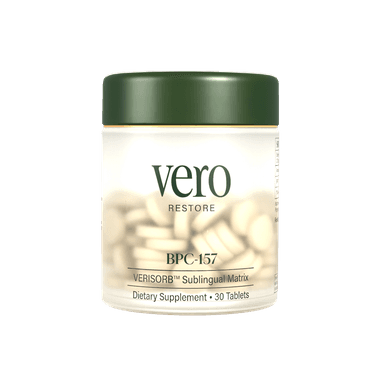
RESTORE™
BPC-157Engineered around 0.5mg BPC-157 (arginate salt). Accelerates deep tissue and joint recovery
Clinical Context
Important Notice: VERO protocols are nutritional and systemic optimisation formats. They are not intended to diagnose, treat, cure, or prevent any medical condition. These statements have not been evaluated by the Food and Drug Administration.