
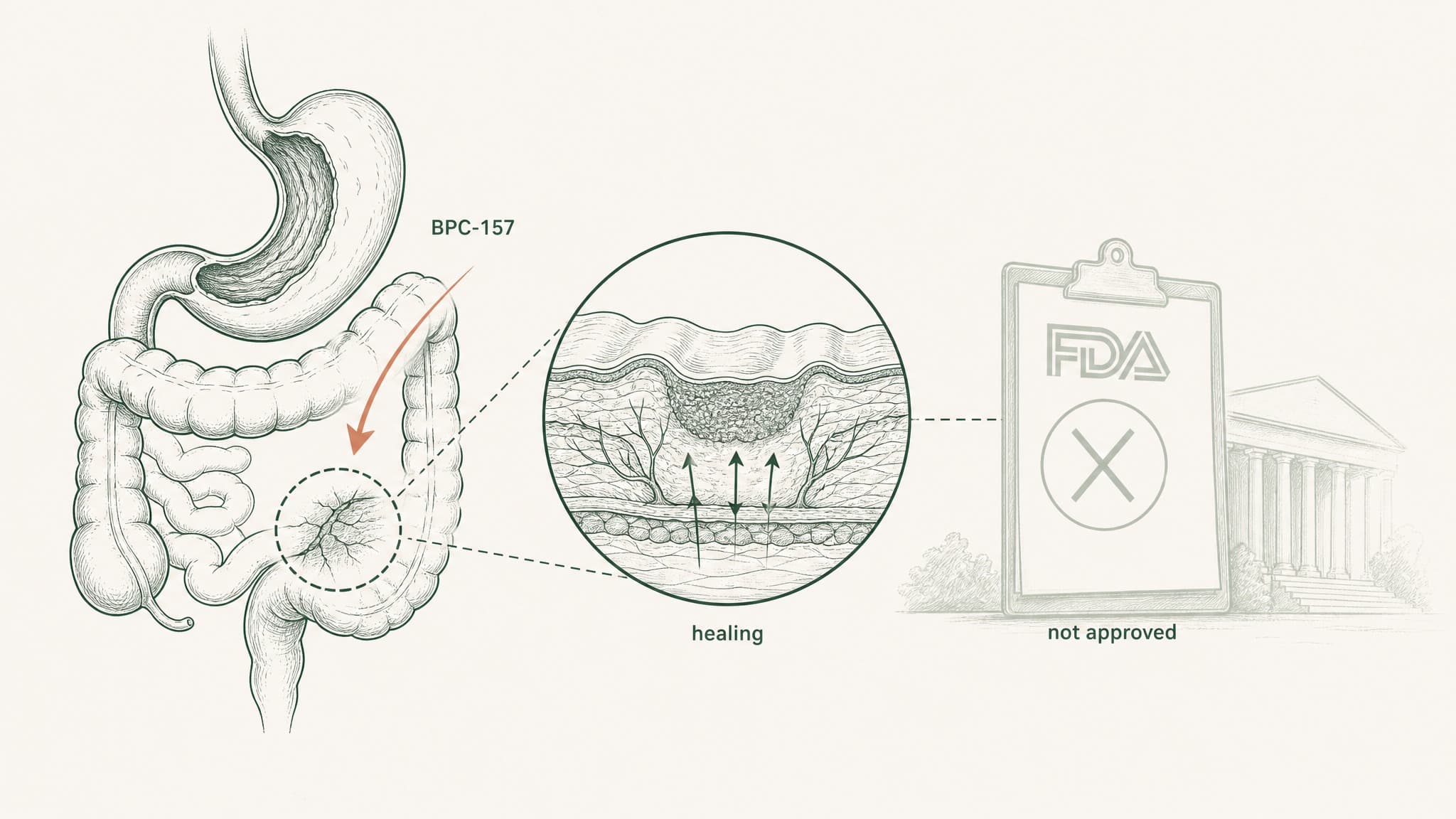
BPC-157 isn't FDA-approved. Here's what the July 2026 compounding committee vote actually changed, what the FDA still hasn't decided, and what the research shows.
If you've looked into BPC-157 at all, you've probably hit the same wall: vague answers, forum arguments, and a regulatory picture that seems built to confuse. It's one of the first things people ask about when they start looking at a structured recovery protocol, which makes the confusion especially frustrating.
Here's the short version: the compound isn't banned, and it isn't approved either. What changed in July 2026 is that, for the first time in years, a real regulatory body actually moved on it, just not in the direction most headlines implied.
This is a plain walkthrough of where BPC-157 stands with the FDA right now, what an advisory committee actually voted on in July, and what the underlying research shows once you separate it from the noise. Research suggests the regulatory story here is more interesting than a simple "legal or not" answer, and it's worth getting straight.
Key Takeaways
- BPC-157 is not FDA-approved for any use in humans. No completed Phase 1, 2, or 3 human trial has ever been run on it in the US.
- On July 23, 2026, an FDA advisory committee voted 8-6, with one abstention, to recommend BPC-157 be added to the list of substances compounding pharmacies can legally prepare, tied to a specific ulcerative colitis use case. That's a recommendation, not a decision.
- FDA's own scientists argued against the recommendation, questioning both the effectiveness data and whether the substance is even well-characterized enough to set quality standards.
- BPC-157 isn't a scheduled controlled substance in the US. It's legally purchasable as a research chemical, a separate question from the compounding debate above.
- Animal research on tendon, gut, and connective tissue repair is extensive and has held up across independent labs for over a decade. Human evidence is limited to one small retrospective review.
Exploring a research protocol built around recovery and cellular resilience? The RESTORE Protocol is where VERO members start. Explore RESTORE →
What BPC-157 Actually Is
Picture a long strand of pearls, that's roughly what a protein is: hundreds of amino acids clipped together in sequence. Now snip out just fifteen of those pearls, the exact stretch found in a much larger protein in human gastric juice (the digestive fluid in your stomach). That fifteen-piece fragment is BPC-157, a peptide researchers isolated and now manufacture synthetically in a lab.
A few things are worth knowing before the regulatory story makes any sense:
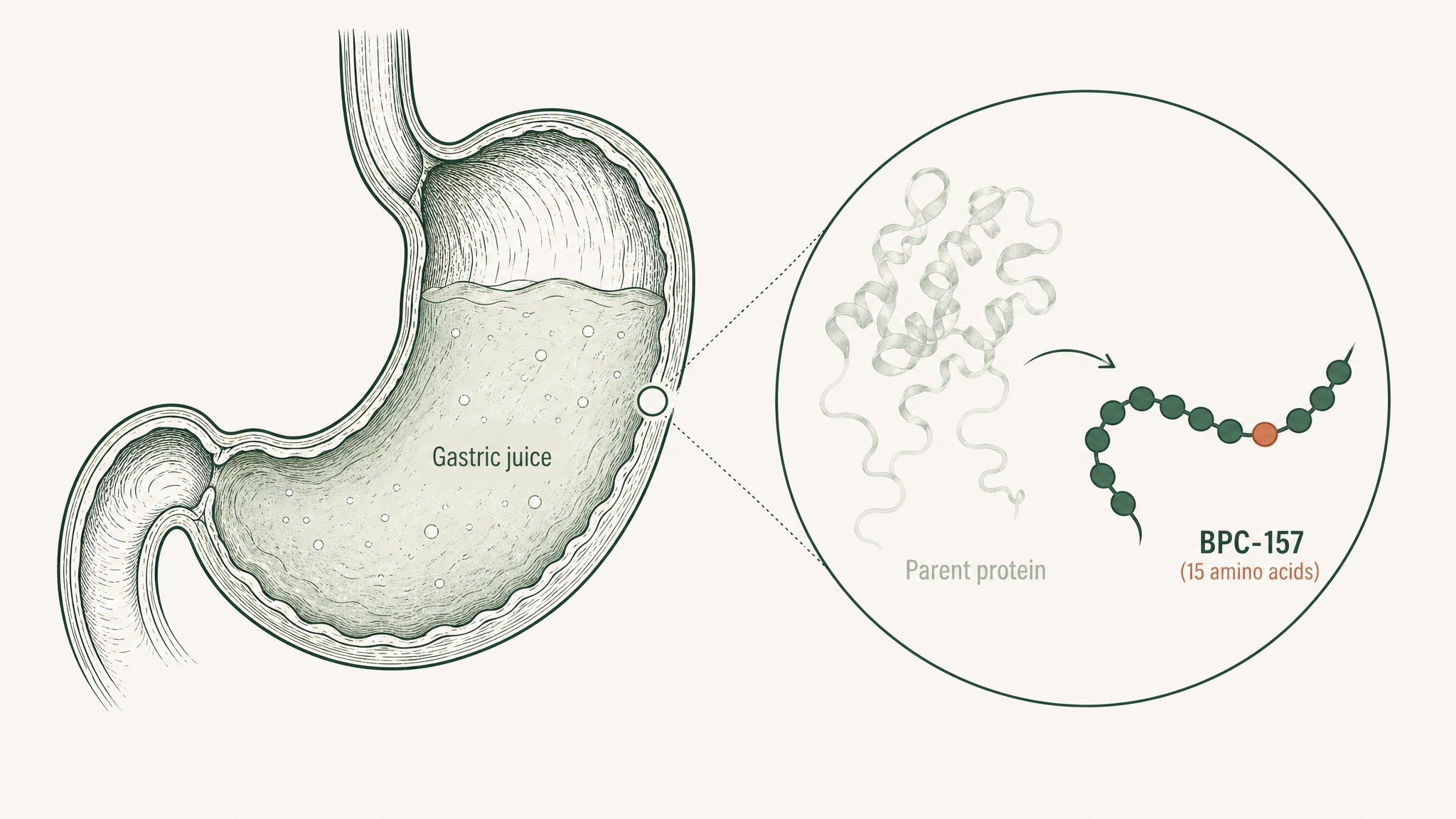
A fifteen-amino-acid fragment isolated from a much larger protein found in stomach fluid.
- It's a 15-amino-acid fragment, not a full protein.
- It's made in a lab today, not extracted from stomach tissue.
- Its natural origin is exactly why it's hard to patent, and that turns out to be the whole story below.
The gastric-juice origin is why researchers first got curious about gut protection and tissue repair, and it's also part of why BPC-157 has never gone through FDA trials. More on that in a minute.
BPC-157 isn't extracted from animals or plants, and it isn't a "natural supplement" in the herbal sense. What researchers work with today is a precisely manufactured, chemically defined molecule.
What "FDA Approval" Actually Requires
Before getting into BPC-157 specifically, it's worth being precise about what "FDA approval" means. The term gets thrown around loosely, and it's doing a lot of work in this story.
Getting a drug approved means clearing three phases of human trials, each one bigger and slower than the last:
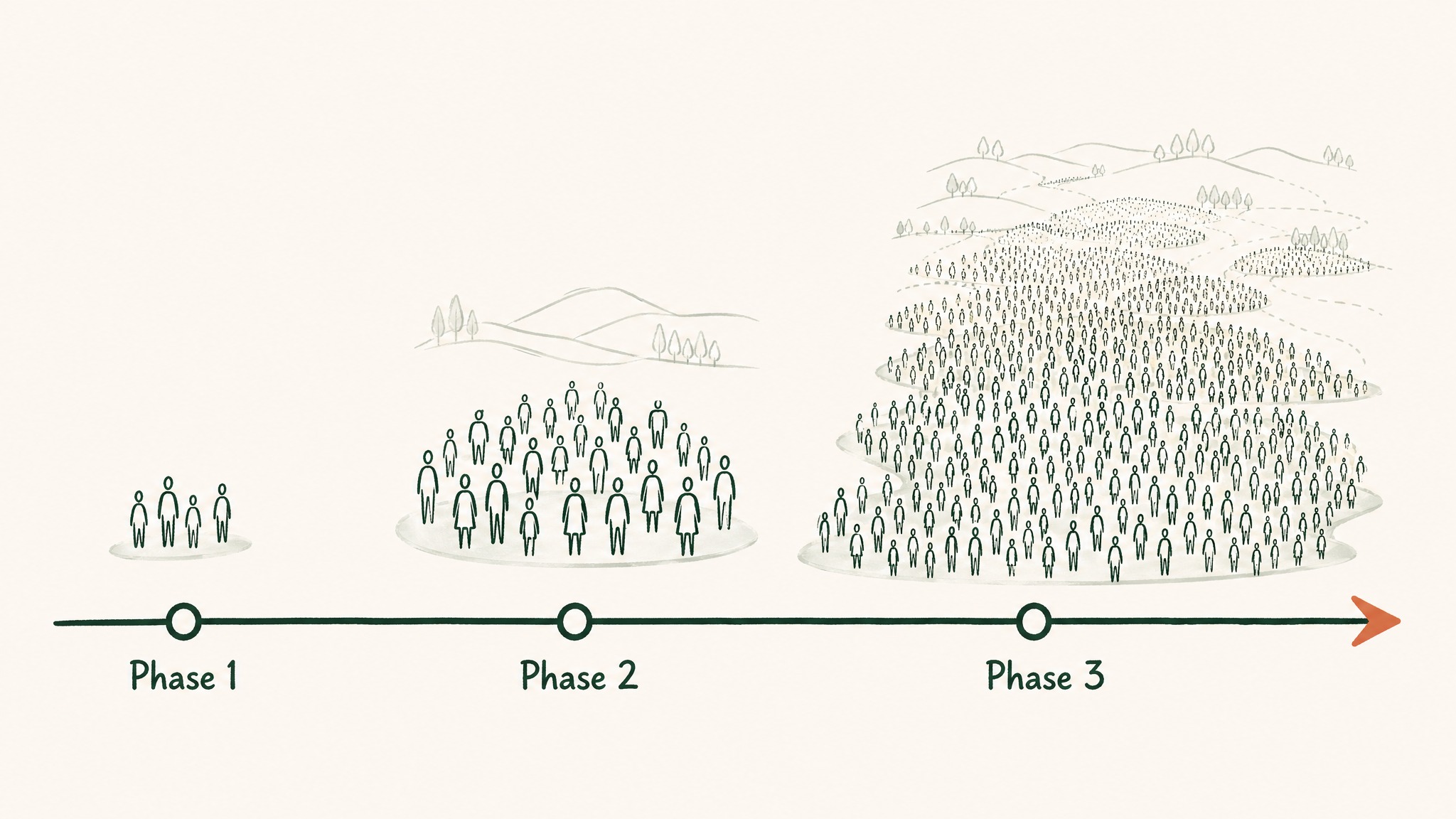
The three phases of human trials required before FDA approval of any drug.
- Phase 1: a small group of people, checking whether the compound is safe at all.
- Phase 2: a larger group, checking whether it actually works.
- Phase 3: thousands of people across multiple sites, confirming it works while watching closely for side effects.
None of these three phases has ever been completed for BPC-157 in the United States.
That pipeline isn't cheap. A 2020 analysis in JAMA looked at 63 FDA-approved drugs from 2009 to 2018 and put the median cost of bringing one to market at roughly $985 million, with the average pulled up past $1.3 billion once you factor in the drugs that fail along the way (Wouters, McKee & Luyten 2020, JAMA). BPC-157 has never entered that pipeline here.
That's a statement about where the evidence sits, not a verdict that the compound is dangerous. FDA approval requires completed human trial data. BPC-157 doesn't have it, and understanding why gets at something structural rather than sinister.
Why the Human Trials Haven't Happened
Here's where the story gets genuinely interesting, and where blaming "regulatory obstruction" misses the real reason.
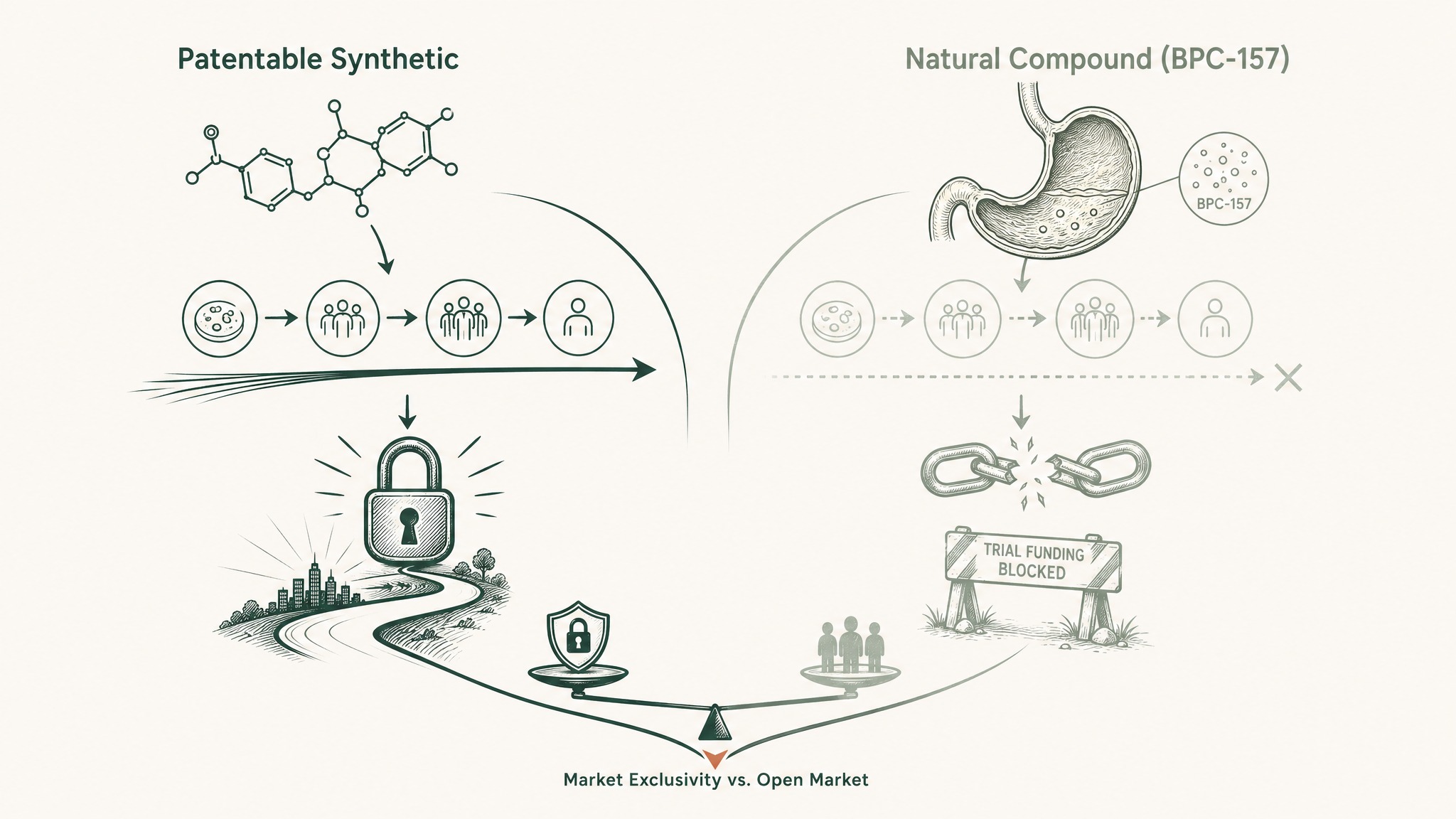
Drug companies fund billion-dollar trials when they can lock in exclusive sales rights afterward through a patent. That exclusivity is how they earn the investment back over the life of the patent.
BPC-157 is a fragment of a naturally occurring human protein, which makes it very hard for any one company to patent exclusively. Without that exclusivity, no pharmaceutical company has the financial incentive to spend a billion dollars proving it works in a formal trial. The compound isn't secret or unusually risky, it's commercially unattractive to the only entities with the resources to run the trials that would settle the question.
This pattern shows up again and again with naturally occurring compounds that have promising research behind them: the biology looks interesting, but the business case for a trial never quite closes. Curious readers are left with preclinical data and a real human-evidence gap rather than a clean approved-or-not answer.
The Compounding Pharmacy Story: What Actually Changed in 2026
There's a separate regulatory lane that matters here: compounding pharmacies, which prepare custom drug formulations for individual patients rather than mass-producing a standard product. They operate under Section 503A of the Food, Drug, and Cosmetic Act, and the FDA keeps lists of which "bulk drug substances" these pharmacies are and aren't permitted to use.
This is where the real news is. In 2025, the FDA asked its Pharmacy Compounding Advisory Committee (PCAC) to evaluate whether a batch of research peptides, BPC-157 among them, should be made eligible for compounding. That committee finally took the question up at a meeting on July 23-24, 2026.
Here's what happened on the BPC-157 vote specifically:
- The panel voted 8-6, with one abstention, to recommend adding BPC-157 to the approved 503A compounding list, tied to a defined ulcerative colitis use case, not general use.
- FDA's own scientists argued against it. During the meeting, agency staff questioned whether BPC-157 was even "well-characterized" enough to set reliable quality standards, and the agency's briefing materials cited a lack of evidence supporting its effectiveness for that specific indication.
- Committee votes like this are advisory. The FDA is not bound by them and will make its own final call.
Worth flagging: reporting from STAT News on the same vote noted that a majority of the panelists who voted in favor had ties to the peptide industry, a detail worth weighing when you decide how much signal to take from an 8-6 split.
So where does that leave things? BPC-157 cleared its first real regulatory hurdle in years, a committee recommendation, but that's a long way from "approved," and it's not even the same as "cleared for compounding" yet.
What Happens Next
A committee recommendation doesn't change what's legal today. If the FDA agrees with the panel, it still has to open formal notice-and-comment rulemaking before BPC-157 could actually land on the 503A list, the standard federal process where the agency proposes a rule, takes public comment, and then issues a final decision.
Nothing is legal to compound today that wasn't legal yesterday. As of late August 2026, the FDA hasn't announced a final decision on the July vote, and the realistic timeline most regulatory observers point to runs into late 2026 at the earliest, more plausibly sometime in 2027.
That gap between "committee recommended it" and "compounding pharmacies can actually use it" is where most of the public confusion lives.
What the Animal Research Actually Shows
While the human clinical record is thin, the preclinical picture, meaning studies in animal models and cell cultures rather than in people, is substantial and has held up across independent labs for over a decade.
A 2019 review in Cell and Tissue Research looked across tendon, ligament, and skeletal muscle studies in animal models and found consistently positive healing outcomes, while being upfront that the work has mostly been done in small rodent models and that human efficacy remains unconfirmed (Gwyer, Wragg & Wilson 2019, Cell and Tissue Research).
Fibroblasts migrate toward damaged tendon tissue when the FAK-paxillin signaling pathway is activated.
Research suggests the underlying mechanism runs through more than one biological pathway.
A 2011 study in the Journal of Applied Physiology zoomed into tendon fibroblasts, the cells responsible for building and repairing tendon tissue, in rat-tissue and cell-culture experiments. Researchers found that BPC-157 dose-dependently increased activity in what's called the FAK-paxillin pathway, a signaling chain that tells fibroblast cells to divide and migrate toward damaged tissue, and the same experiments showed accelerated tendon-explant outgrowth and fibroblast migration (Chang et al. 2011, Journal of Applied Physiology).
On the gut side, a 2020 study in Current Pharmaceutical Design found that in animal models, BPC-157 helped stabilize intestinal permeability (how easily substances pass through the gut lining) and showed cytoprotective effects, meaning it appeared to help preserve the stomach lining against damage from NSAIDs like ibuprofen and aspirin (Park et al. 2020, Current Pharmaceutical Design). Given that BPC-157 originates from gastric juice, researchers find that connection mechanistically coherent.
A few other things researchers keep coming back to, per a 2021 review in Frontiers in Pharmacology covering wound-healing research across skin, muscle, tendon, and connective tissue in animal models (Seiwerth et al. 2021, Frontiers in Pharmacology):
- BPC-157 was previously given to humans in early clinical trials for ulcerative colitis and multiple sclerosis, with no toxicity reported at the doses used.
- In separate animal safety testing, researchers never reached what's called the "LD1" threshold, the dose at which 1% of test subjects die, even at high experimental doses.
- The compound's research footprint spans an unusually wide range of tissue types for a single molecule.
None of that substitutes for controlled human trials. It's the reason researchers keep circling back to the compound rather than moving on from it.
The Human Evidence Gap: What Actually Exists
It would be dishonest to write this without being direct: the human data on BPC-157 is thin. The animal research is genuinely interesting. It's still animal research, and that distinction matters more than marketing copy usually admits.
The most-cited piece of human data is a 2021 retrospective chart review published in Alternative Therapies in Health and Medicine (Lee & Padgett 2021, Alternative Therapies in Health and Medicine). Researchers at a private clinic reviewed 16 patients who'd received intra-articular BPC-157 injections, meaning injected directly into the knee joint, for various types of knee pain.
The review relied on the patients' own reports.
Users report meaningful experiences in research contexts like this one, but the study's own authors were careful to frame it correctly: this was a retrospective chart review, not a randomized controlled trial. A chart review is a data point. It isn't a conclusion.
The early ulcerative colitis and multiple sclerosis trials mentioned above tell you BPC-157 has been given to humans before without raising obvious safety red flags. But safety observations from small early-phase work are a long way from the effectiveness evidence the FDA requires for approval, or apparently, even for a compounding recommendation, based on what agency scientists argued in July.
Is BPC-157 Banned for Athletes?
One thread that comes up constantly involves anti-doping rules, and it's worth separating cleanly from the FDA story, because it answers a completely different question.
The World Anti-Doping Agency (WADA) added BPC-157 to its Prohibited List in 2022. A 2025 peer-reviewed review in Pharmaceuticals covering BPC-157's research and regulatory history noted that ban was temporary, and that as of that review's publication, BPC-157 was not listed as currently banned by WADA (Józwiak et al. 2025, Pharmaceuticals).
A doping ban and an FDA approval answer two completely different questions, and WADA's list changes from year to year. Members experience genuine confusion here because the compound's anti-doping status and its FDA status get conflated constantly, when they're decided by entirely separate bodies on entirely separate timelines. Anyone who needs a definitive current answer, competitive athletes especially, should check WADA's published list directly rather than relying on last year's status.
Where BPC-157 Stands Right Now
The honest summary, at a glance:
- The DEA doesn't schedule it. It's legal to purchase as a research chemical.
- The FDA hasn't approved it as a drug. No completed human trials of any phase have been run in the US.
- The compounding pharmacy question is still open. An advisory committee recommended BPC-157 for a narrow ulcerative colitis use case in July 2026, over FDA staff's own objections, and formal rulemaking, if it happens, realistically extends into 2027.
- WADA added it to the Prohibited List in 2022. A 2025 review reported that ban as temporary and said BPC-157 wasn't currently listed at the time of writing, so check WADA's current list for the live status.
None of that adds up to "approved" or "banned." It adds up to a compound that just cleared its first real regulatory hurdle in years, a non-binding recommendation, with the agency's own scientists on record against it and a final decision still pending.
The preclinical work has held up across independent research groups for more than a decade, even as the clinical gap in humans remains real and shouldn't be smoothed over. Any engagement with BPC-157 by researchers today is for research purposes only, and that's not boilerplate, it's an accurate description of where the compound sits in the evidence hierarchy right now.
The more interesting question isn't whether BPC-157 is "approved" or "banned." It's whether the FDA ultimately follows its own staff's objections or its advisory committee's recommendation, and what that decision does to compounding access from here. That's worth watching.
Curious how VERO approaches BPC-157 research responsibly, within the current regulatory picture? See the RESTORE Protocol →
Frequently Asked Questions
Is BPC-157 legal to buy in the United States?
BPC-157 is not a scheduled controlled substance under US federal law, so it's legal to purchase as a research chemical. It cannot legally be sold or marketed for human therapeutic use, since it hasn't received FDA approval for any indication. Its status for compounding pharmacy use is a separate track that's still being decided.
What happened with BPC-157 and the FDA in July 2026?
On July 23, 2026, the FDA's Pharmacy Compounding Advisory Committee voted 8-6, with one abstention, to recommend BPC-157 be added to the list of substances 503A compounding pharmacies can legally use, specifically for an ulcerative colitis use case. FDA staff had argued against it, citing gaps in effectiveness and quality data. The vote is advisory only; the FDA makes the final call and isn't bound by it, and no final decision had been announced as of late August 2026.
Why hasn't BPC-157 been FDA approved if the animal research looks promising?
FDA approval requires completed Phase 1, 2, and 3 human clinical trials, a process a 2020 JAMA analysis put at a median cost of roughly $985 million per drug. Because BPC-157 is derived from a naturally occurring human protein, it's very difficult for any single company to patent exclusively, which removes the financial incentive for a pharmaceutical company to fund those trials. This is a funding and patent-structure problem, not a regulatory block based on known safety concerns.
What does the human research on BPC-157 actually show?
Human data is limited. The most-cited study is a 2021 retrospective chart review of 16 patients who received intra-articular BPC-157 injections for knee pain, which relied on the patients' own reports. BPC-157 was also given to humans in earlier trials for ulcerative colitis and multiple sclerosis without reported toxicity, though those trials weren't designed to prove effectiveness.
Researchers consistently note that larger randomized controlled trials are the missing piece.
How does BPC-157 work in animal research?
Research suggests BPC-157 acts through more than one pathway. In tendon tissue, studies in animal models and cell cultures show it activates the FAK-paxillin pathway, which prompts fibroblast cells to divide and migrate toward damaged tissue. In gastrointestinal tissue, animal studies point to cytoprotective effects that help preserve the stomach lining, consistent with the compound's origin in gastric juice.
Has BPC-157 shown any safety concerns in research settings?
Preclinical safety data has been consistently reassuring across animal studies; a 2021 review in Frontiers in Pharmacology noted the LD1 threshold, the dose at which 1% of test subjects die, was never reached even at high experimental doses. Early human trials for ulcerative colitis and multiple sclerosis reported no toxicity. As with any compound lacking completed human trials, its long-term safety profile in people hasn't been formally established.
Can a compounding pharmacy legally prepare BPC-157 right now?
Not yet. As of August 2026, an FDA advisory committee recommended BPC-157 for a specific ulcerative colitis use case, but the FDA hasn't issued a final decision, and its own staff argued against the recommendation. If the FDA moves forward, formal rulemaking still has to happen first, a process that realistically extends into 2027.
Until then, compounding access remains unchanged.
Is BPC-157 banned by WADA for athletes?
It was added to WADA's Prohibited List in 2022. A 2025 peer-reviewed review noted that ban was temporary and that BPC-157 wasn't listed as currently banned as of that review, but WADA's list is reviewed and republished annually. Competitive athletes should check WADA's current published list directly rather than relying on any single year's status, since it's a separate determination from FDA approval or compounding eligibility.
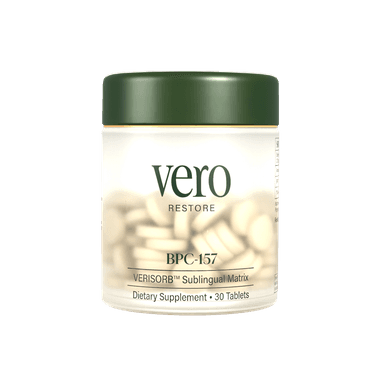
RESTORE™
BPC-157Engineered around 0.5mg BPC-157 (arginate salt). Accelerates deep tissue and joint recovery
Clinical Context
Important Notice: VERO protocols are nutritional and systemic optimisation formats. They are not intended to diagnose, treat, cure, or prevent any medical condition. These statements have not been evaluated by the Food and Drug Administration.