

The best peptides for men, ranked by goal and by whether they can be used without a needle. Recovery, muscle, skin. For research purposes only.
Best peptides for men by goal is this guide's central question, paired with the one every other guide skips: which delivery route actually gets the compound into circulation. That missing question is exactly why a structured, evidence-graded approach like the RESTORE protocol exists, and it's the thread this guide pulls on. Everything here is written for research purposes only.
Most of the front-page results assume you'll be drawing research-chemical liquid into a syringe and injecting yourself in the stomach. That's a big assumption. It quietly rules out most of the men actually reading these articles.
So this guide does two things nobody else on the page does. It ranks peptides by goal (recovery, muscle, skin, and the goals that genuinely need a prescription), and it filters every one of them through a second axis: can you realistically use this at home without a needle? Users report that second question is the one they actually wanted answered.
Key Takeaways
- The best peptides for men depend entirely on your goal. For recovery it's BPC-157 and TB-500; for muscle it's the growth-hormone-axis peptides.
- The most ignored variable is delivery. Swallowed peptide capsules are largely destroyed before they reach your blood, injection has high absorption but real-life friction, and sublingual (under the tongue) sits in between.
- Most peptide evidence is animal research. Human data is thin for the recovery names, and we label the evidence tier for every single one.
- Some of the goals men search hardest for (serious fat loss, testosterone) are served by peptides that are injectable and prescription-gated. We say so plainly instead of selling around it.
- Everything here is research-use framing. None of these are FDA-approved consumer products, and grey-market purity is a genuine risk. Third-party testing is non-negotiable.
What Do Peptides Actually Do for Men (and What Don't They)?
Let's start where the consensus already is: a peptide is a short chain of amino acids, the same building blocks that make up the protein in your food. Your body already runs on thousands of them. The ones in this guide are lab-made copies of signals your body uses, studied for research purposes.
Now the plain-English version. Think of a peptide as a key cut to fit one specific lock on the surface of your cells. It doesn't do the work itself. It tells a cell that's already capable of the work to get on with it.
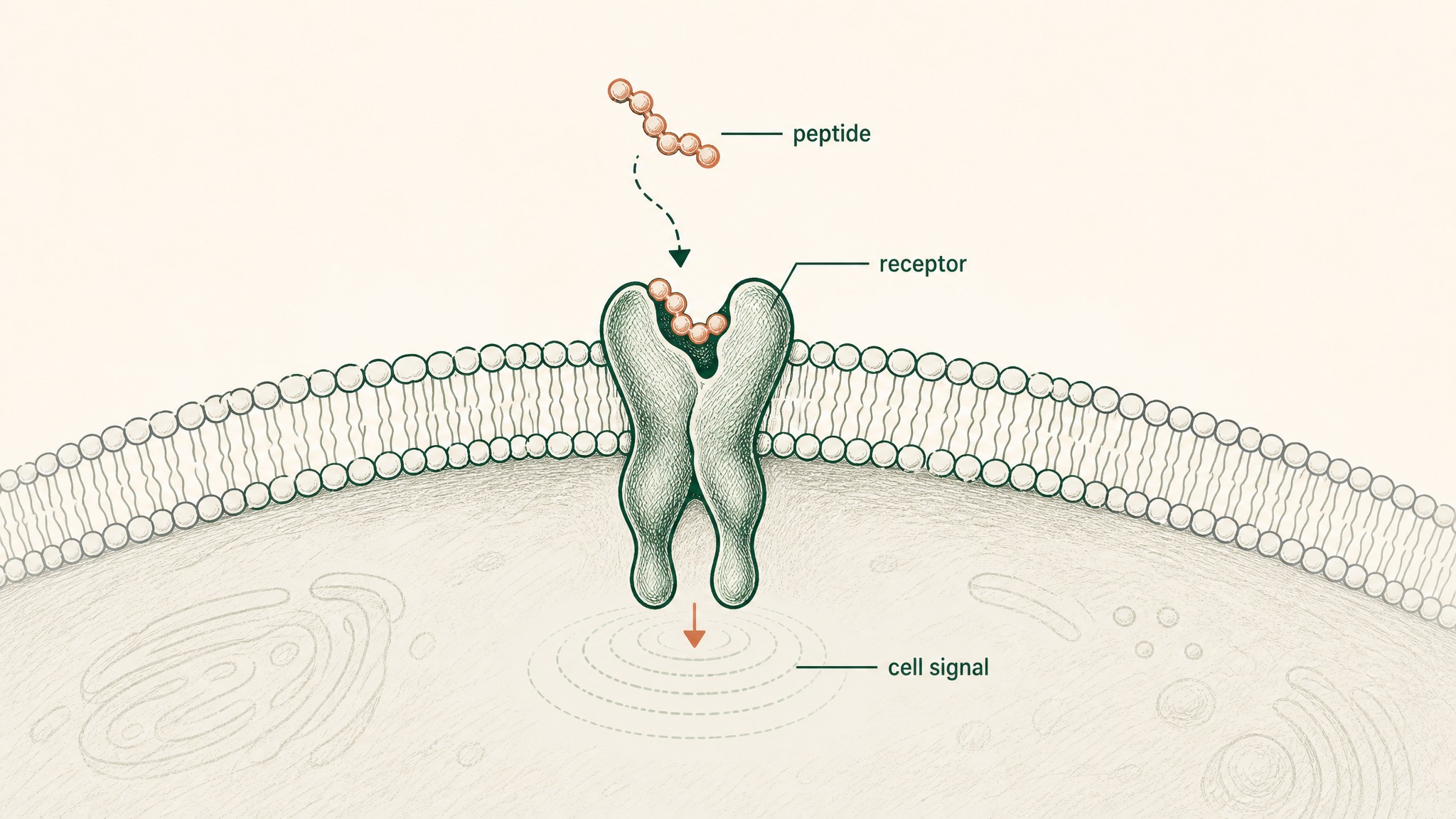
A peptide binds to its specific receptor on the cell surface, triggering an internal signal.
That's the honest frame, and it matters:
- Peptides are signals, not hormones. They nudge processes your body already runs, rather than flooding your system the way testosterone or growth hormone would.
- They're specific. One peptide tends to talk to one pathway, which is why they're grouped by goal rather than sold as a fix for everything.
- They're mostly research compounds. Very few are approved drugs. Most sit in a research-use category, which is why the framing throughout this guide is research, not medicine.
What don't they do? They don't replace training, sleep, or protein. And no peptide on this page has the human-trial weight behind it that an approved medication has, apart from the prescription GLP-1s we'll cover honestly at the end. Anyone promising a needle-free miracle is selling the hype, not the science.
Why Does How You Take a Peptide Decide Whether It Works?
Here's the part every other guide skips. You can pick the perfect peptide for your goal and still get almost nothing out of it, because the route it takes into your body decides how much of it survives.
The single most important sentence in this article: the label dose and the dose that reaches your bloodstream are rarely the same number.
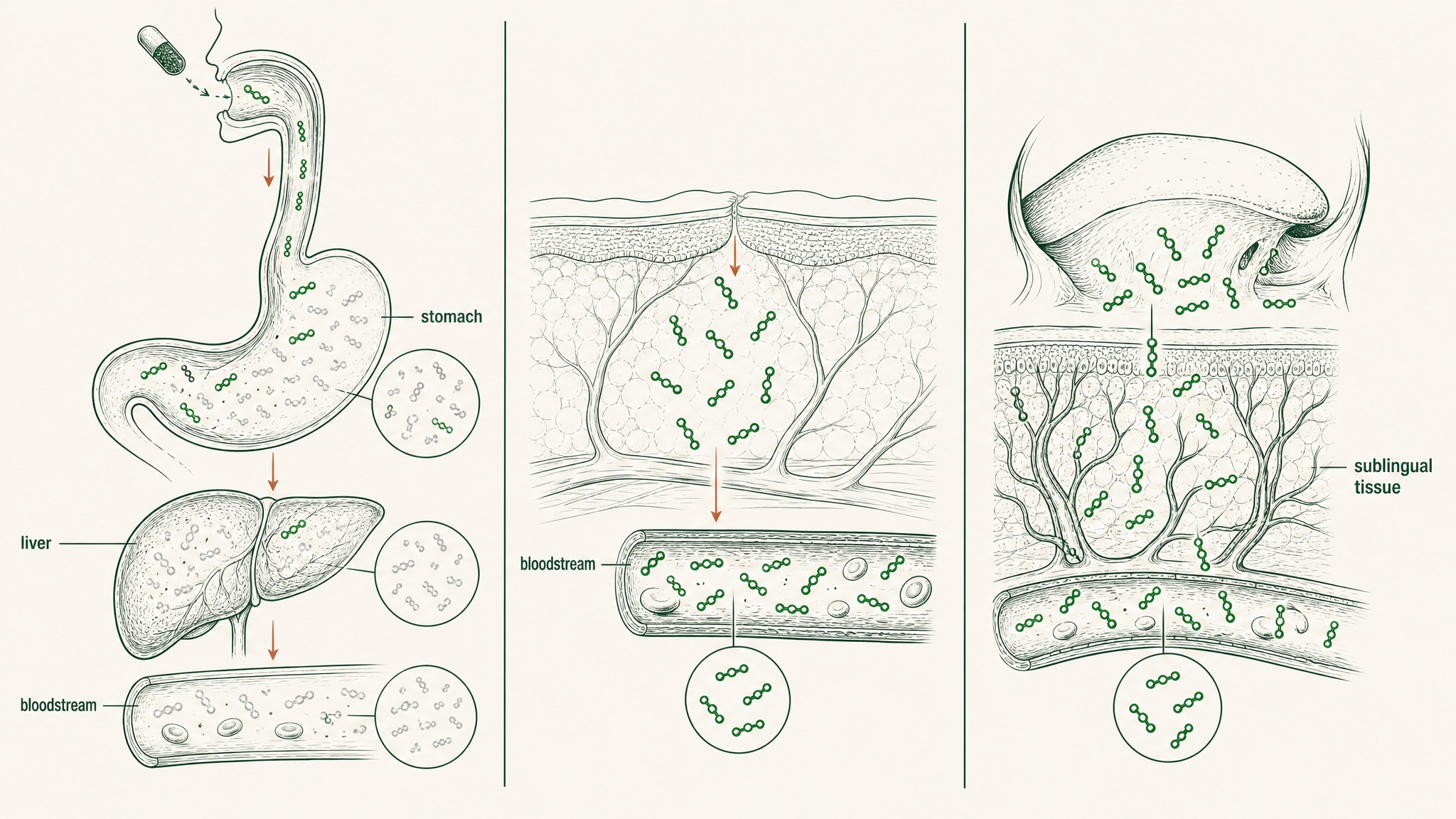
Why the same peptide dose produces vastly different results depending on whether you swallow, inject, or place it under your tongue.
Picture your gut as an airport security checkpoint that's a little too aggressive. Swallow a peptide in a normal capsule and your stomach acid plus digestive enzymes handle it like any other bit of protein: they break it down for parts. Whatever survives then hits your liver, which filters it again before it ever reaches circulation. Pharmacologists call that combined toll first-pass metabolism, which is just a fancy way of saying "most of it gets destroyed on the way in."
How bad is the toll? For a standard swallowed peptide capsule, often only a sliver reaches your blood, often a small fraction of what's on the label.
Injection skips the checkpoint entirely, which is why laboratory research uses it. But it comes with real-world friction, and it's the friction, not the science, that puts most men off:
- Injection involves extra preparation steps.
- Many research peptides need cold-chain storage, so travel and daily life get complicated.
- The whole thing lives in a grey-market, clinic-or-DIY zone most people won't touch.
Sublingual delivery (holding it under your tongue) is the middle path. The tissue under your tongue is thin and rich with blood vessels, so a well-engineered carrier can move a molecule straight into circulation and bypass the stomach-and-liver toll, the same reason a nitroglycerin tablet for chest pain goes under the tongue instead of down the hatch. In our protocol design, the whole point of the needle-free sublingual delivery work is to close the gap between "impressive in a study" and "something a man will actually use." A peptide you'll use beats a stronger one you won't.
The route comparison, in one place:
| How you take it | Roughly how much reaches your blood | The real-life catch |
|---|---|---|
| Swallowed capsule | Often a small fraction | Cheap and easy, but most of it is broken down first |
| Subcutaneous injection | The majority of the dose | High absorption, but needles, reconstitution, and cold storage |
| Sublingual (under the tongue) | In between, when the carrier is engineered for it | Needle-free, but only as good as the delivery matrix |
Numbers are general pharmacology ranges, not a promise for any specific compound. Absorption varies by molecule. This is the filter we apply to every peptide below.
What Are the Best Peptides for Men by Goal?
Rather than crown one "best" peptide (a meaningless title when the goals are this different), here's the honest map: goal by goal, the peptides men actually search for, how strong the evidence is, and whether you could realistically use it without a needle.
How we chose and ranked these. Every peptide here was held to the same four criteria, our own RESTORE included:
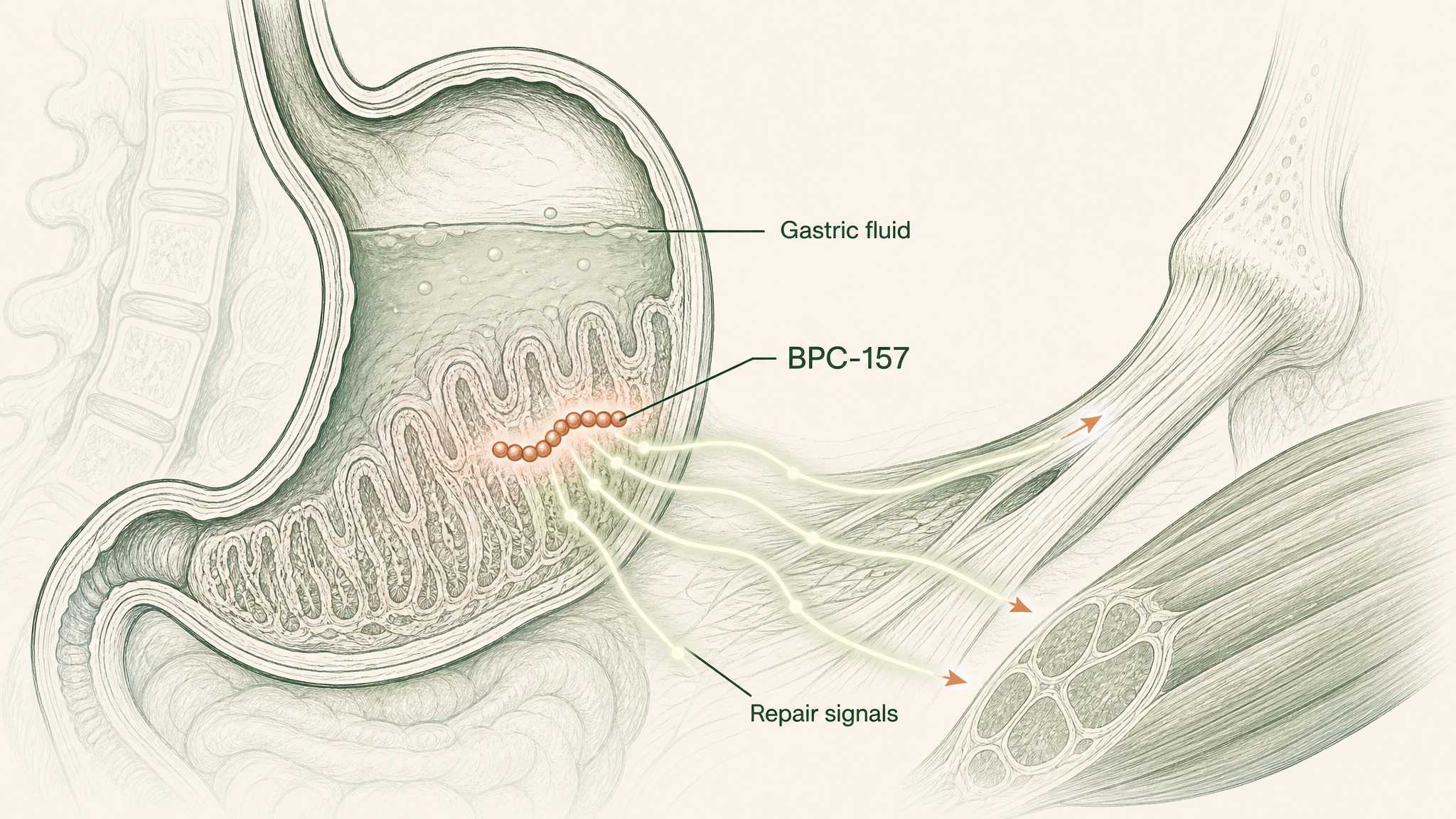
BPC-157, a repair-signalling molecule found in stomach fluid, is thought to amplify your body's own tissue-repair messages, based on animal research.
- Mechanism fit. Does the biology plausibly point at the goal?
- Evidence tier. Human trial, animal model, or preclinical only? We weight human data highest and label every claim.
- Route feasibility. Can a man realistically use it at home, or is it injection-only?
- Safety and legality. Reported side effects, purity risk, and where it sits with the FDA and anti-doping bodies.
Rankings without a stated method are just opinions in a table, and since the June 2026 spam update, unexplained "best of" lists get flagged for exactly that. One disclosure up front: VERO makes the RESTORE protocol, which uses BPC-157 and appears below. RESTORE is our own protocol, and we ranked it on the identical rubric instead of parking it at #1.
The route-tagged summary, before we go deep:
| Goal | Peptides men search for | Evidence tier | Needle-free option? |
|---|---|---|---|
| Recovery and joints | BPC-157, TB-500 | Mostly animal | Yes (sublingual) |
| Muscle and body composition | CJC-1295, Ipamorelin, Sermorelin | Limited human PK | Mostly injection-only |
| Skin, hair, aesthetics | Collagen peptides | Modest human data | Yes (oral) |
| Fat loss, testosterone | Semaglutide, tirzepatide | Strong human RCT (GLP-1s) | No (prescription, injectable) |
You can also shop peptides for men by protocol if you already know your goal. Now the detail.
Recovery, Injury and Joint Health: BPC-157 and TB-500
If you're over 35 and lifting, playing five-a-side, or just noticing that a tweaked shoulder takes three weeks instead of three days, this is the category you came for. Recovery peptides are the most-searched group among men for a reason: the goal is universal, and the frustration is real.
BPC-157 is the headline name. It's a 15-amino-acid fragment based on a protein found in your own stomach fluid, studied because something in gastric juice seems to protect and repair tissue.
- In animal research, BPC-157 has been studied for tendon, ligament, and muscle-to-bone repair, with rat models showing organized tissue and bone regrowth after surgical injury.
- Research suggests, in those animal models, that it acts as a signalling molecule: it appears to amplify repair messages the body already sends, rather than building tissue itself.
- The honest caveat: there are no human randomized trials. Every strong BPC-157 finding so far is preclinical. We cover this in depth in the BPC-157 benefits guide.
BPC-157 is also the compound behind our own RESTORE (BPC-157) protocol, delivered sublingually so the absorbed dose isn't left to a capsule's mercy. Ranked on the rubric, it earns its spot on route feasibility and mechanism, not on human proof it doesn't yet have.
TB-500 is the synthetic cousin of thymosin beta-4, a protein your body uses in wound repair. In animal research, thymosin beta-4 has been observed to support dermal wound closure and blood-vessel formation in aged and diabetic mouse models. Same caveat as BPC-157: strong in rodents, unproven in humans. You can read the fuller picture in what is TB-500.
An honest limitation for both of these: because the human evidence is thin, dosing in research is scaled from animal studies, and long-term human safety data simply doesn't exist yet. That's not a reason to panic. It's a reason to regard these as research compounds and to insist on tested material.
Muscle Growth and Body Composition: CJC-1295, Ipamorelin, Sermorelin
This is the bodybuilding-forum category, and it's where the injection assumption bites hardest. The peptides men stack for muscle mostly work by nudging your own growth-hormone axis, and mostly come as injectables.
The mechanism in plain English: these compounds are growth-hormone secretagogues, a mouthful that just means "things that ask your pituitary gland to release more of its own growth hormone." They're not synthetic GH. They're the doorbell, not the delivery.
- CJC-1295 is a long-acting GHRH analog. In a small human study, CJC-1295 raised growth hormone and IGF-1 levels for several days per dose, which is the clearest human data in this group.
- Ipamorelin is usually paired with it as a gentler, more selective GH-release nudge. Its evidence is largely mechanistic and preclinical, so don't assume the same human weight as CJC-1295.
- Sermorelin is the elder statesman: a GHRH fragment that was once an FDA-approved product (marketed as Geref) for growth-hormone deficiency before being discontinued commercially.
The honest limitations stack up here:
- Almost all of these are injection-only in practice, which puts them behind the needle barrier this guide keeps flagging.
- Human evidence for real lean-mass gains (as opposed to raised GH numbers) is limited.
- They're on the WADA prohibited list, so if you're a tested competitive athlete, this whole category is off-limits.
If muscle is genuinely your goal, our best peptide stack for muscle growth guide grades the combinations honestly. The recurring theme: recovery peptides that let you train harder more often may do more for a natural lifter than chasing GH numbers you can't legally use in competition.
Skin, Hair and Aesthetic Vitality: Collagen Peptides
Men research this more than they admit, and the search terms prove it.
Collagen peptides (the hydrolyzed-protein kind you stir into coffee) are a separate, gentler category from the recovery and muscle peptides covered above, with their own modest human data.
The honest limitation across this goal generally: aesthetic peptide research is often preclinical or short-term, and results in men specifically are under-studied.
Fat Loss and Testosterone: What the Research Says (and What Needs a Prescription)
This is the section most affiliate sites blur, because the honest answer costs them a sale. So here it is straight: the peptides with the strongest human evidence for fat loss are prescription-gated and injectable. VERO does not sell them, and we'll tell you why plainly.
Fat loss is dominated by the GLP-1 class, and unlike almost everything else in this guide, the human evidence is genuinely strong:
- In the STEP-1 trial, adults taking semaglutide lost more body weight on average than those on placebo.
- In the SURMOUNT-1 trial, tirzepatide produced substantial average weight reduction in adults.
- These are prescription medications, injectable, and require medical supervision. They are not research-chemical vials to source grey-market, and handling them that way is where people get hurt.
Testosterone is the honest anticlimax. If your testosterone is genuinely low, the evidence-based route is a proper clinical workup and, if indicated, physician-managed therapy, not a peptide bought online. Some peptides (like gonadorelin or kisspeptin analogs) touch the hormonal axis, but they're prescription-gated and belong in a clinic.
The trust-building point: the goals with the loudest marketing are the ones where "just buy a peptide online" is the most dangerous advice. For these, the right move is a licensed provider, not a checkout page.
How Do You Choose the Right Peptide for Your Goal?
With the map laid out, choosing is less about finding the "strongest" peptide and more about matching four things in order. Rushing past the last two is how men waste money on compounds they'll never absorb or never legally use.
Work through it in this sequence:
- Start with the goal, not the molecule. Recovery, muscle, skin, or a prescription-territory goal? Your goal picks your shortlist, as in the table above.
- Check the evidence tier. Is there human data, or only animal models? A beautiful mechanism with zero human trials is a hypothesis, not a result.
- Filter by format. Research compounds come as injectables, sublinguals and topicals. The format decides how a compound is stored, handled and studied, so match it to the work before the name.
- Verify sourcing before you buy anything. No third-party test, no purchase. We'll cover exactly what to check next.
If that still feels like a lot, that's fair, and it's why we built a short guided path. You can find your protocol in 3 minutes and get pointed at the goal-matched option, or read our fuller walkthrough on how to choose a peptide protocol. The single most common mistake is skipping step three: buying a format that does not fit the work.
How Do You Check Sourcing, Purity and Safety?
Here's the uncomfortable truth about a research-use market: the molecule can be perfect and the vial can still be garbage. Because most of these compounds aren't sold as approved drugs, quality control is on you, and it's the step that actually protects you.
Approach sourcing like reading a food label, except the stakes are higher. The one document that matters most is a Certificate of Analysis (COA), the lab report that says what's actually in the product.
- Insist on a third-party COA. Not the seller's own claim: an independent lab's test of that batch, showing identity and purity.
- Check the purity figure. Reputable material is typically tested to high purity; vague or missing numbers are a red flag.
- Watch storage. Many peptides need refrigeration and degrade if mishandled, so cold-chain and expiry matter.
- Be skeptical of "pharmaceutical-grade" as a slogan. It's a marketing phrase unless a real COA backs it, and research suggests the grey market is full of under-dosed or mislabeled product.
Two more safety notes worth stating plainly. First, none of the research peptides here are FDA-approved consumer products, and the regulatory picture is actively moving, as we track in the BPC-157 FDA regulatory status explainer. Second, if you're a competitive athlete, several of these compounds sit on the WADA prohibited list, so a tested sport means checking the current list before you touch anything. And whatever the goal, talk to a licensed provider before starting; this is education, not medical advice.
Frequently Asked Questions
What is the best peptide for men? There's no single best peptide for men, because it depends on the goal. For recovery, BPC-157 has the most research attention; for muscle, the growth-hormone-axis peptides dominate but are injection-only. Match the peptide to your goal, then to a route you'll actually use.
Can you take peptides without injections? Some, yes. Recovery peptides like BPC-157 are studied in sublingual forms, and collagen peptides for skin come as oral products. The muscle-building GH-axis peptides, by contrast, are almost entirely injectable in practice.
Are peptides safe for men? Short-term animal safety looks reasonable for the most-studied recovery peptides, but long-term human safety data mostly doesn't exist, so honesty requires calling them research compounds. The bigger practical risk is grey-market purity. Third-party testing and a licensed provider's input matter more than the molecule itself.
How long do peptides take to work? It varies by compound and goal, and much of what's claimed comes from animal research rather than human timelines. Where human data exists (GLP-1 medications), effects on the measured marker showed up over weeks, not days. Anyone promising overnight results is selling hype.
What are the best peptides for men over 50? Over 50, the goals that tend to matter most are recovery and maintenance, so the recovery peptides (BPC-157) are the usual research focus. This also happens to have a needle-free route, which suits men who won't commit to daily injections.
Are peptides legal? Most research peptides aren't FDA-approved and sit in a research-use category rather than being illegal to possess, though the regulatory picture is shifting. Prescription peptides like semaglutide are legal only via a prescription. Competitive athletes should note that several peptides are banned under the WADA list.
References
- StatPearls / NCBI. Medication routes of administration and first-pass metabolism. https://www.ncbi.nlm.nih.gov/books/NBK568677/. Retrieved 2026-07-21.
- Sikiric P. et al. (2025). Stable gastric pentadecapeptide BPC 157 and muscle-to-bone junction research in rats. Pharmaceutics (PMC). https://pmc.ncbi.nlm.nih.gov/articles/PMC11768438/. Retrieved 2026-07-21.
- Teichman S.L. et al. (2006). CJC-1295, a long-acting analog of GH-releasing hormone: growth hormone and IGF-I secretion in healthy adults. Journal of Clinical Endocrinology & Metabolism. https://academic.oup.com/jcem/article-abstract/91/3/799/2843281. Retrieved 2026-07-21.
- Walker R.F. (2006). Sermorelin and adult-onset growth hormone insufficiency: a review. Clinical Interventions in Aging (PMC). https://pmc.ncbi.nlm.nih.gov/articles/PMC2699646/. Retrieved 2026-07-21.
- Wilding J.P.H. et al. (2021). Semaglutide in adults with overweight or obesity (STEP-1). New England Journal of Medicine. https://www.nejm.org/doi/full/10.1056/NEJMoa2032183. Retrieved 2026-07-21.
- Jastreboff A.M. et al. (2022). Tirzepatide and obesity: a phase 3 randomized trial (SURMOUNT-1). New England Journal of Medicine. https://pubmed.ncbi.nlm.nih.gov/35658024/. Retrieved 2026-07-21.
- World Anti-Doping Agency. 2026 Prohibited List, Section S2: peptide hormones, growth factors, and related substances. https://www.wada-ama.org/en/prohibited-list. Retrieved 2026-07-21.
Not sure which goal to start with? Find your protocol in 3 minutes → or explore the evidence-graded RESTORE protocol.
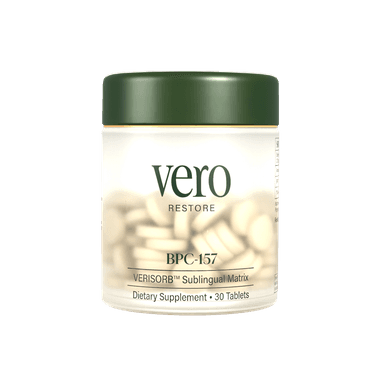
RESTORE™
BPC-157Engineered around 0.5mg BPC-157 (arginate salt). Accelerates deep tissue and joint recovery
Clinical Context
Important Notice: VERO protocols are nutritional and systemic optimisation formats. They are not intended to diagnose, treat, cure, or prevent any medical condition. These statements have not been evaluated by the Food and Drug Administration.