

Some peptides are FDA-approved, some need a prescription, some are sold research-use-only. Here's what's legal to buy and use in 2026, and why format matters.
Some peptides are legal. Some aren't. And a handful sit in a grey zone that regulators themselves were still voting on this month.
Here's the honest short answer to "are peptides legal": it depends entirely on which peptide, how it's sold, and what it's sold for. That's the consensus every pharmacist and FDA lawyer will give you, and it's correct. If you're researching peptides before buying, whether that's an injectable vial from a clinic or a finished sublingual protocol, the piece almost nobody explains is that the delivery format changes the legal lane the product travels in. This article is published for research purposes only.
The confusion is fair, because "peptide" isn't one thing legally. It's a category that spans FDA-approved blockbuster drugs, prescription-only compounded preparations, and vials labelled "not for human consumption." Below is the plain-English map, updated for what changed in 2026.
Key Takeaways
- "Are peptides legal" has no single yes/no answer: legality depends on the specific peptide, how it's sold, and whether it's approved, compounded, or research-use-only.
- Several peptides are fully FDA-approved prescription drugs, including semaglutide and tirzepatide; more than 80 peptide drugs have reached the market worldwide.
- Compounded peptides are legal only through a licensed pharmacy tied to a valid prescription, under the FDA's 503A framework.
- Peptides sold "for research use only" are not approved for human use, and marketing them for human consumption is where sellers cross a legal line.
- Delivery format matters: injectable compounded peptides follow a prescription pathway, while finished non-prescription oral or sublingual products are evaluated under a separate consumer-product framework.
Researching how peptides are formulated and delivered, within the current regulatory picture? Explore the VERO protocols →
So, Are Peptides Actually Legal in the US?
Whether a peptide is legal comes down to which of three federal buckets it falls into: approved drug, compounded preparation, or unapproved research chemical. Think of it like alcohol: a beer in a licensed bar, a home-brew shared with friends, and moonshine sold from a truck are treated very differently by the law, even though it's all ethanol. Peptides work the same way, and the "which bucket" question decides everything.
Here are the three buckets, plainly:
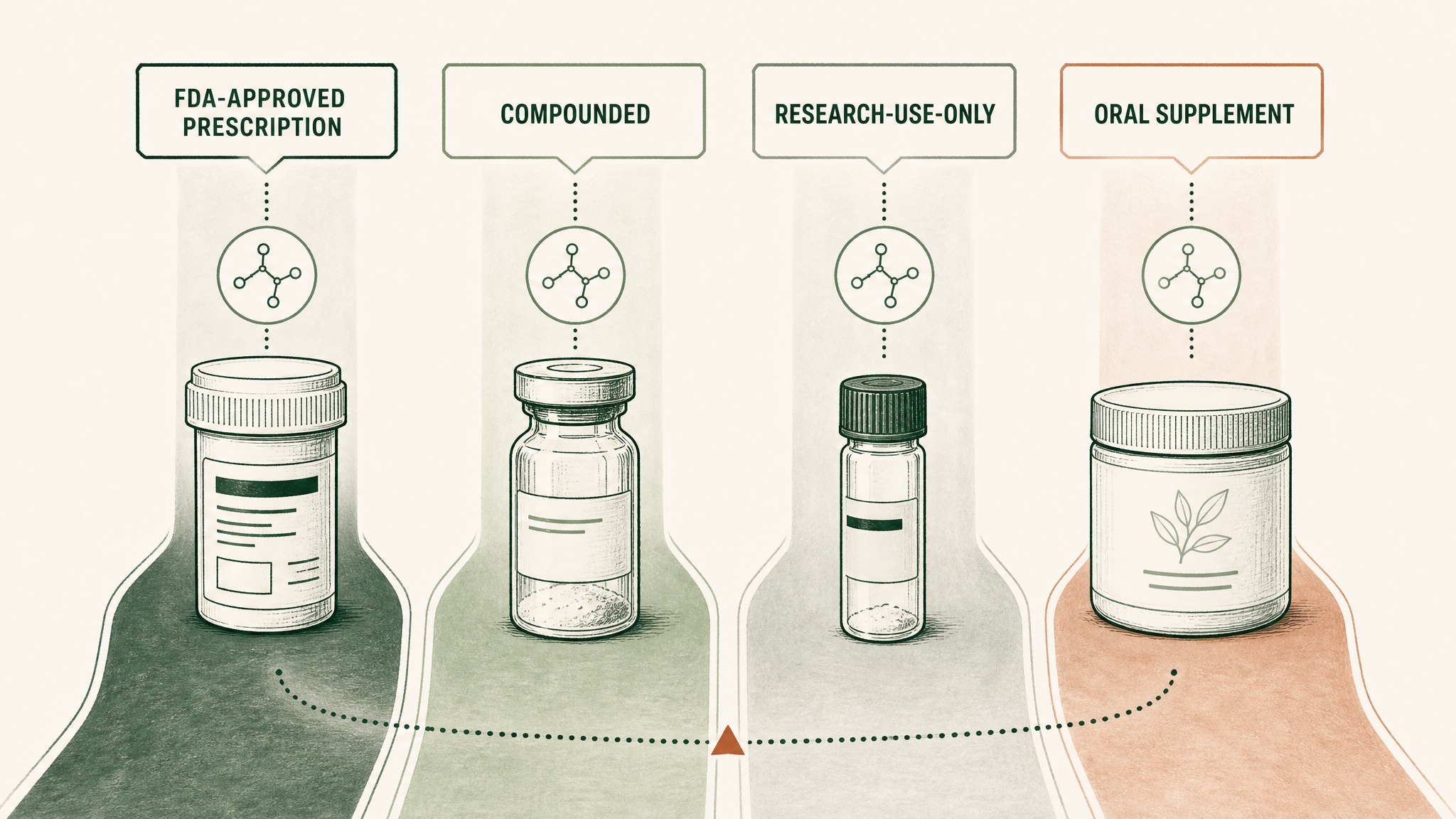
Three legal pathways for peptides: approved drugs by prescription, compounded by licensed pharmacy, and research-use-only chemicals.
- Approved drugs you can get with a prescription, sold under a brand name.
- Compounded peptides a licensed pharmacy can prepare for you, also by prescription.
- Research-use-only peptides sold for lab work, not for people.
More than 80 peptide drugs have already reached the market worldwide, so the category as a whole is deeply mainstream medicine (Muttenthaler et al. 2021, Nature Reviews Drug Discovery). The legal grey zone people argue about online is really about a small subset of newer research peptides, not the whole class. Getting a single drug through to approval is part of why: a 2020 JAMA analysis of 63 new drugs put the median research and development cost at roughly $985 million (Wouters et al. 2020, JAMA, PMID 32125404).
FDA-Approved Peptide Drugs
These are as legal as any medicine in your bathroom cabinet, with a valid prescription. Semaglutide, the molecule behind Ozempic and Wegovy, is an FDA-approved peptide drug, cleared for chronic weight management in 2021 (U.S. FDA, 2021). Tirzepatide, sold as Zepbound, gained FDA approval for the same use in 2023 (U.S. FDA, 2023).
These aren't fringe compounds. About one in eight US adults (12%) said in late 2025 that they were currently taking a GLP-1 drug of this kind (KFF, 2025).
Approved status means the manufacturer cleared the full human trial pipeline. You still need a prescription, and buying these from an unlicensed overseas source is a different, riskier story.
Compounded (Prescription-Only) Peptides
A compounding pharmacy is basically a bespoke tailor for medicine: it prepares a custom formulation for one patient rather than mass-producing a product. These pharmacies operate under Section 503A of the Food, Drug, and Cosmetic Act, and the FDA maintains lists of which bulk substances they can and can't use (U.S. FDA, Section 503A).
Legal here means one specific thing: prepared by a licensed pharmacy, tied to a valid prescription from a licensed prescriber. No prescription, no legal compounding. Buying "compounded" peptides from a website with no prescriber involved isn't the compounding pathway, it's something else.
Research-Use-Only and Unapproved Peptides
This is the bucket the "grey zone" reputation comes from. Research-use-only (RUO) peptides can be sold for legitimate laboratory work, but they are not approved for human use, and selling them as something you inject or swallow is where the legal line gets crossed. The vial being legal to sell for research does not make it legal to market for your body.
You'll spot these by the label: "for research purposes only" or "not for human consumption." Many newer compounds, including BPC-157's specific FDA regulatory status, live here. BPC-157 is not a scheduled controlled substance, so it's legal to purchase as a research chemical, but it can't legally be sold or marketed for human therapeutic use.
What Changed With the FDA in 2026?
The biggest 2026 shift is that a group of research peptides moved out of the FDA's most restrictive compounding category and toward formal review. In April 2026, the FDA began stepping BPC-157 and several other research peptides out of "Category 2," the designation for substances flagged as raising significant safety risks, and set a compounding advisory review in motion through a Federal Register notice published April 16, 2026 (U.S. FDA / Federal Register, 2026).
That advisory committee then met on July 23 and 24, 2026. Here's what actually happened, and what it didn't:
- The panel voted 8 to 6, with one abstention, to recommend adding BPC-157 to the approved 503A compounding list, for a narrow, specified use case rather than general use (NBC News, 2026).
- FDA scientists themselves objected to the recommendation, citing gaps in human safety and effectiveness data (NBC News, 2026).
- A committee vote is advisory. The FDA is not bound by it and will make its own final call.
So as of July 2026, the accurate status is "recommended by an advisory committee, over FDA staff objections, final decision pending." That's a real step up from "prohibited," and still a long way from "approved." Reporting on the vote also noted that several panelists who voted in favour run practices that administer peptides, which is worth knowing when you weigh the signal (STAT News, 2026).
Why Does Delivery Format Change the Legal Picture?
This is the piece almost no article covers: the same peptide can sit in a different legal lane depending on how it's delivered. Picture two doors into a building. An injectable vial walks through the "drug and compounding" door, where a prescription is the key. A finished, non-prescription oral or sublingual product walks through the "consumer product" door, evaluated under a different framework entirely.
Here's the practical breakdown:

How the same peptide follows different legal routes depending on whether it's injected or taken by mouth.
| Delivery Format | Legal Pathway | Prescription Needed | Example |
|---|---|---|---|
| Injectable, compounded | 503A / 503B compounding | Yes | Clinic-prepared BPC-157 vial |
| Injectable, approved drug | FDA-approved prescription drug | Yes | Semaglutide (Wegovy) |
| Research vial (RUO) | Research-use-only, not for humans | N/A | "Not for human consumption" BPC-157 |
| Finished oral or sublingual product | Consumer product / supplement framework | No | Sublingual tablet |
Finished non-prescription products are generally evaluated under the consumer-product and dietary-supplement framework created by the Dietary Supplement Health and Education Act of 1994 (DSHEA), where the manufacturer, not a pre-market FDA approval, carries responsibility for what's inside (U.S. FDA, Dietary Supplements). That's a genuinely different regulatory conversation from a compounded injectable. It's the lane VERO's sublingual VERISORB delivery technology is built around, and it's why the "is it legal" answer isn't the same for a vial and a tablet.
In our protocol design, the question we weigh most heavily is not just whether a compound is interesting, but which regulatory lane a given delivery format actually travels in, because that determines what we can responsibly offer and how it has to be framed. Research suggests unmodified peptides swallowed as ordinary pills barely survive the gut, with documented oral bioavailability often below 1 to 2 percent (Renukuntla et al. 2013, PMC3680128). That absorption problem, not the legal one, is what most finished-format engineering is trying to solve.
Is It Legal to Buy Peptides Online?
Buying a peptide online can be perfectly legal or clearly not, depending on what the seller claims it's for. A research chemical sold explicitly for lab use is generally legal to buy; the same vial marketed to you as an injectable "protocol" for building muscle is being sold illegally, because it's an unapproved product pitched for human use. The legality lives in the framing as much as the molecule.
The catch is the "research use only" label loophole. Sellers use RUO wording as legal cover while everyone involved understands the real intended use, which leaves you with zero guarantee about what's actually in the vial. That's exactly why third-party proof matters more than marketing copy.
Before you buy anything, look for:
- A recent certificate of analysis (COA) from an independent third-party lab, not the seller's own claim.
- Identity and purity testing, so you know the vial contains what the label says.
- A real, contactable company, not just a checkout page.
- Clear, honest labelling rather than disease claims dressed up as "research."
Users report that the products making the boldest human-outcome promises are often the ones with the thinnest testing behind them. If a seller won't show a COA, treat the silence as your answer.
Are Peptides Legal in Every State?
At the federal level, research peptides like BPC-157 are not scheduled controlled substances, so no US state treats simple possession the way it treats a narcotic. What varies state to state is mostly the rules around clinics, telemedicine prescribing, and compounding pharmacy oversight, not a blanket ban on the molecules themselves. In other words, the state-level differences you'll read about almost always concern the injectable and clinic-prescribed pathway, not finished consumer products.
A rough way to picture it:
| State Posture | What It Usually Means | Who It Affects Most |
|---|---|---|
| Permissive | Compounding and telemedicine access is broad | Clinics and compounding pharmacies |
| Moderate | Standard oversight of prescribers and pharmacies | Mostly prescribers |
| Restrictive | Tighter telemedicine and compounding rules | Clinics offering injectables |
The key takeaway for a buyer: most of this variation lives on the prescription and clinic side. A finished, non-prescription oral or sublingual product generally isn't what state compounding rules are written about. Because these rules can change, treat any state summary as a starting point and confirm current local rules before acting.
Are Peptides the Same as Steroids Legally?
No, peptides and anabolic steroids are legally distinct classes, and it matters. Anabolic steroids are Schedule III controlled substances under US federal law, which carries criminal penalties for illegal possession. Most research peptides are not scheduled at all, which is a completely different legal weight class, even though both can share a banned-substances list in elite sport.
The confusion comes from the gym context, where both get lumped together. But structurally and legally they're separate, and peptides and anabolic steroids sit in different legal categories for good reason. Conflating them leads people to assume peptides carry steroid-level legal risk, which usually isn't accurate.
A doping ban and a criminal schedule answer two different questions. For the record, the World Anti-Doping Agency prohibits BPC-157 for athletes, listing it under its "unapproved substances" (S0) category (USADA). That's a sport-eligibility issue, not a criminal one.
How Do You Buy Peptide Products Safely and Legally?
The safest legal path is to stay inside a recognised lane and demand proof at every step. Legality and legitimacy aren't the same thing: a product can be legal to sell and still be junk, so you're verifying both. Treat it like buying a used car, you want the service history, not just the salesperson's smile.
A practical checklist:
- Decide which lane you're in. Prescription and compounded route means a licensed prescriber and pharmacy. Finished-product route means a real consumer company.
- Demand a third-party COA. Insist on independent lab testing that verifies identity and purity, dated and batch-specific.
- Read the label honestly. "Research use only" plus human-use marketing is a contradiction, and a red flag.
- Check the claims. Disease or cure promises on a non-prescription product signal a seller ignoring the rules; learn how to tell a legitimate peptide pill from a scam.
- Verify the company. Contact details, real address, responsive support. Ghost checkout pages are a warning.
- Keep the framing straight. Buying for research is legal; representing an unapproved product as a human therapy is not.
Members experience far fewer surprises when they treat the COA as non-negotiable. The paperwork is boring, and it's the single best legal and safety filter you have.
Frequently Asked Questions
Is it legal to buy peptides online?
It can be. Research-use-only peptides are generally legal to buy for legitimate lab use, but they're not approved for human use, and a seller marketing them as something to inject or swallow is crossing a legal line. Approved peptide drugs like semaglutide are legal to buy only with a valid prescription from a licensed source.
Do you need a prescription for peptides?
For FDA-approved peptide drugs and for compounded peptides, yes. Approved drugs require a prescription by definition, and compounded peptides are only legal when prepared by a licensed pharmacy tied to a valid prescription under the 503A framework. Finished non-prescription consumer products sit in a separate lane and don't work the same way.
Are peptide supplements the same as compounded peptides?
No. A compounded peptide is a prescription preparation made by a licensed pharmacy for an individual patient. A finished peptide supplement is a consumer product evaluated under the dietary-supplement framework, where the manufacturer is responsible for safety and no pre-market FDA approval of the product is required. Different lanes, different rules.
Is BPC-157 legal?
BPC-157 is not a scheduled controlled substance in the US, so it's legal to purchase as a research chemical. It's not FDA-approved for any human use, so it can't legally be sold or marketed as a human therapy. Its compounding status is a separate, still-pending question after the July 2026 advisory vote covered above.
What changed with the FDA in 2026?
In April 2026, the FDA began moving BPC-157 and a group of other research peptides out of the restrictive Category 2, and put BPC-157 up for advisory-committee review. In July 2026, that committee voted 8 to 6, with one abstention, to recommend BPC-157 for compounding in a narrow, specified use case, over FDA staff objections. The FDA's final decision is still pending.
Are peptides banned in any states?
No US state currently treats research peptides like BPC-157 as scheduled controlled substances the way narcotics are handled. State-to-state variation mostly concerns telemedicine prescribing and compounding pharmacy oversight, which affects the injectable and clinic pathway more than finished consumer products. Because these rules change, confirm your current local rules before acting.
Are peptide skincare products regulated differently?
Yes. Topical peptide skincare is generally regulated as a cosmetic, a separate framework from both prescription drugs and ingestible supplements. Cosmetic peptides used for appearance sit outside the injectable and compounding conversation entirely, which is why a peptide face cream and a compounded injectable raise completely different legal questions.
Is it legal to travel with peptides?
For approved prescription peptides, travelling with them and your prescription documentation is generally fine domestically. Research-use-only and unapproved peptides are murkier, since carrying an unapproved product intended for human use can raise questions at borders. International travel adds another layer, because other countries classify peptides differently, so check the destination's rules first.
The Bottom Line
"Are peptides legal" is really three questions wearing one coat: which peptide, sold how, and for what. Approved peptide drugs are legal with a prescription, compounded peptides are legal only through a licensed pharmacy with a prescription, and research-use-only peptides are legal to sell for lab work but not to market for your body. The 2026 FDA movement on BPC-157 nudged one grey-zone compound closer to compounding access, without settling it.
The distinction almost everyone misses is delivery format: an injectable vial and a finished sublingual product travel in different legal lanes, and that's the lane VERO's research is built to respect. Whatever you're considering, the smart move is the same, verify the lane, demand third-party proof, and keep the framing honest.
Researching how peptides are formulated and delivered responsibly, within the current regulatory picture? Explore the VERO protocols →
References
- U.S. FDA. Section 503A of the Federal Food, Drug, and Cosmetic Act (pharmacy compounding). https://www.fda.gov/drugs/human-drug-compounding/section-503a-federal-food-drug-and-cosmetic-act. Retrieved 2026-07-31.
- U.S. FDA. Dietary Supplements overview (DSHEA framework). https://www.fda.gov/food/dietary-supplements. Retrieved 2026-07-31.
- U.S. FDA. FDA approval announcement for semaglutide (Wegovy), 2021. https://www.fda.gov/news-events/press-announcements/fda-approves-new-drug-treatment-chronic-weight-management-first-2014. Retrieved 2026-07-31.
- U.S. FDA. FDA approval announcement for tirzepatide (Zepbound), 2023. https://www.fda.gov/news-events/press-announcements/fda-approves-new-medication-chronic-weight-management. Retrieved 2026-07-31.
- U.S. FDA / Federal Register. Pharmacy Compounding Advisory Committee notice of meeting and public docket, April 16, 2026. https://www.federalregister.gov/documents/2026/04/16/2026-07361/pharmacy-compounding-advisory-committee-notice-of-meeting-establishment-of-a-public-docket-request. Retrieved 2026-07-31.
- NBC News. FDA advisory panel recommendation on BPC-157 for compounding pharmacies (8-6 vote), July 2026. https://www.nbcnews.com/health/health-news/peptides-restrictions-ease-fda-panel-recommend-bpc-157-scientists-rcna588879. Retrieved 2026-07-31.
- STAT News. FDA advisory panel vote on BPC-157 and KPV for compounding pharmacies, July 2026. https://www.statnews.com/2026/07/23/fda-panel-okays-peptides-compound-pharmacies-bpc-157-kpv/. Retrieved 2026-07-31.
- KFF. Poll: about 1 in 8 US adults currently taking a GLP-1 drug, November 2025. https://www.kff.org/public-opinion/poll-1-in-8-adults-say-they-are-currently-taking-a-glp-1-drug-for-weight-loss-diabetes-or-another-condition-even-as-half-say-the-drugs-are-difficult-to-afford/. Retrieved 2026-07-31.
- Muttenthaler M, King GF, Adams DJ, Alewood PF (2021). Trends in peptide drug discovery. Nature Reviews Drug Discovery (PMID 33536635). https://pubmed.ncbi.nlm.nih.gov/33536635/. Retrieved 2026-07-31.
- Wouters OJ, McKee M, Luyten J (2020). Estimated research and development investment needed to bring a new medicine to market, 2009-2018. JAMA (PMID 32125404). https://pubmed.ncbi.nlm.nih.gov/32125404/. Retrieved 2026-07-31.
- Renukuntla J, Vadlapudi AD, Patel A, Boddu SHS, Mitra AK (2013). Approaches for enhancing oral bioavailability of peptides and proteins. International Journal of Pharmaceutics (PMC3680128). https://pmc.ncbi.nlm.nih.gov/articles/PMC3680128/. Retrieved 2026-07-31.
- USADA. BPC-157: experimental peptide prohibited for athletes under the WADA Prohibited List (S0). https://www.usada.org/spirit-of-sport/bpc-157-peptide-prohibited/. Retrieved 2026-07-31.
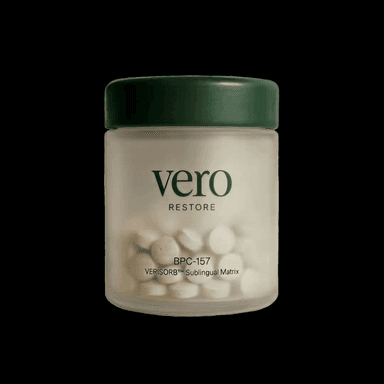
RESTORE™
BPC-157Engineered around 0.5mg BPC-157 (arginate salt). Accelerates deep tissue and joint recovery
Clinical Context
Important Notice: VERO protocols are nutritional and systemic optimisation formats. They are not intended to diagnose, treat, cure, or prevent any medical condition. These statements have not been evaluated by the Food and Drug Administration.