
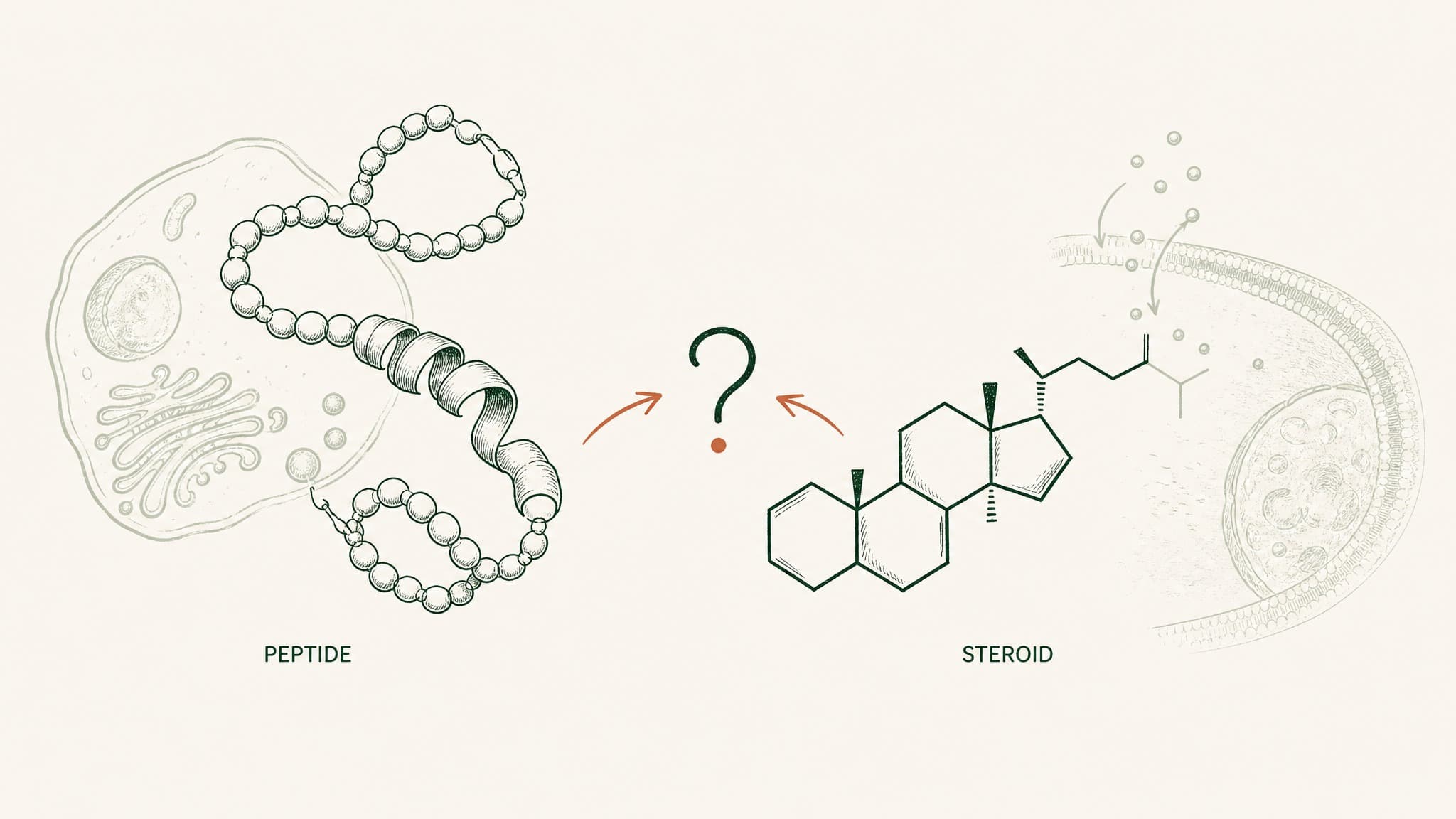
No, peptides are not steroids. They're two different classes of molecule with different structures, mechanisms, and legal status. Here's the science, with real numbers.
No, peptides are not steroids. They are two completely different classes of molecule that happen to share a corner of the same gym conversation. Peptides are short chains of amino acids (the same building blocks that make up the protein in your food), while steroids are fat-based molecules built on a rigid four-ring carbon skeleton.
The confusion is fair. Both can act like hormones, both show up in fitness and anti-aging talk, and both sit on the same banned-substances list in elite sport. But if you're looking into the research peptides VERO formulates, knowing this difference is step one, and this article is published for research purposes only.
Here's the cleanest way to hold it in your head: if a molecule is a chain of amino acids, it's a peptide; if it's built from cholesterol on a four-ring carbon backbone, it's a steroid. No single molecule is both. We'll walk through exactly why, with the actual numbers most explainers skip.
Key Takeaways
- Peptides are short chains of amino acids (roughly 2 to 50 of them); steroids are lipid molecules built on a 17-carbon, four-ring skeleton derived from cholesterol (StatPearls, NBK562260; StatPearls, NBK558960).
- They work through opposite mechanisms: steroids are fat-soluble and pass straight through the cell membrane to act on receptors inside the cell, while peptides are water-soluble and dock on receptors on the cell's outer surface (StatPearls, NBK541112).
- Anabolic-androgenic steroids are synthetic derivatives of testosterone; peptides are not derived from testosterone at all (StatPearls, NBK482418).
- Both are banned in Olympic sport, but as two separate categories: anabolic agents (class S1) and peptide hormones (class S2) on the WADA Prohibited List.
- Same-sounding, chemically unrelated: knowing which class a compound belongs to tells you how it's built, how it signals, and how it's regulated.
So Are Peptides Steroids, or Not?
Peptides and steroids belong to separate chemical families with different building blocks, different shapes, and different jobs. Comparing them is like comparing a bicycle chain to a car engine block: both are made of metal and both help something move, but nobody would call one the other.
The structural gap is easy to measure. Peptides are amino-acid chains, generally between 2 and 50 units long before they graduate to being called proteins (StatPearls, NBK562260). Steroids carry a completely different signature: a four-ring carbon core of 17 carbon atoms known as the gonane skeleton (StatPearls, NBK558960).
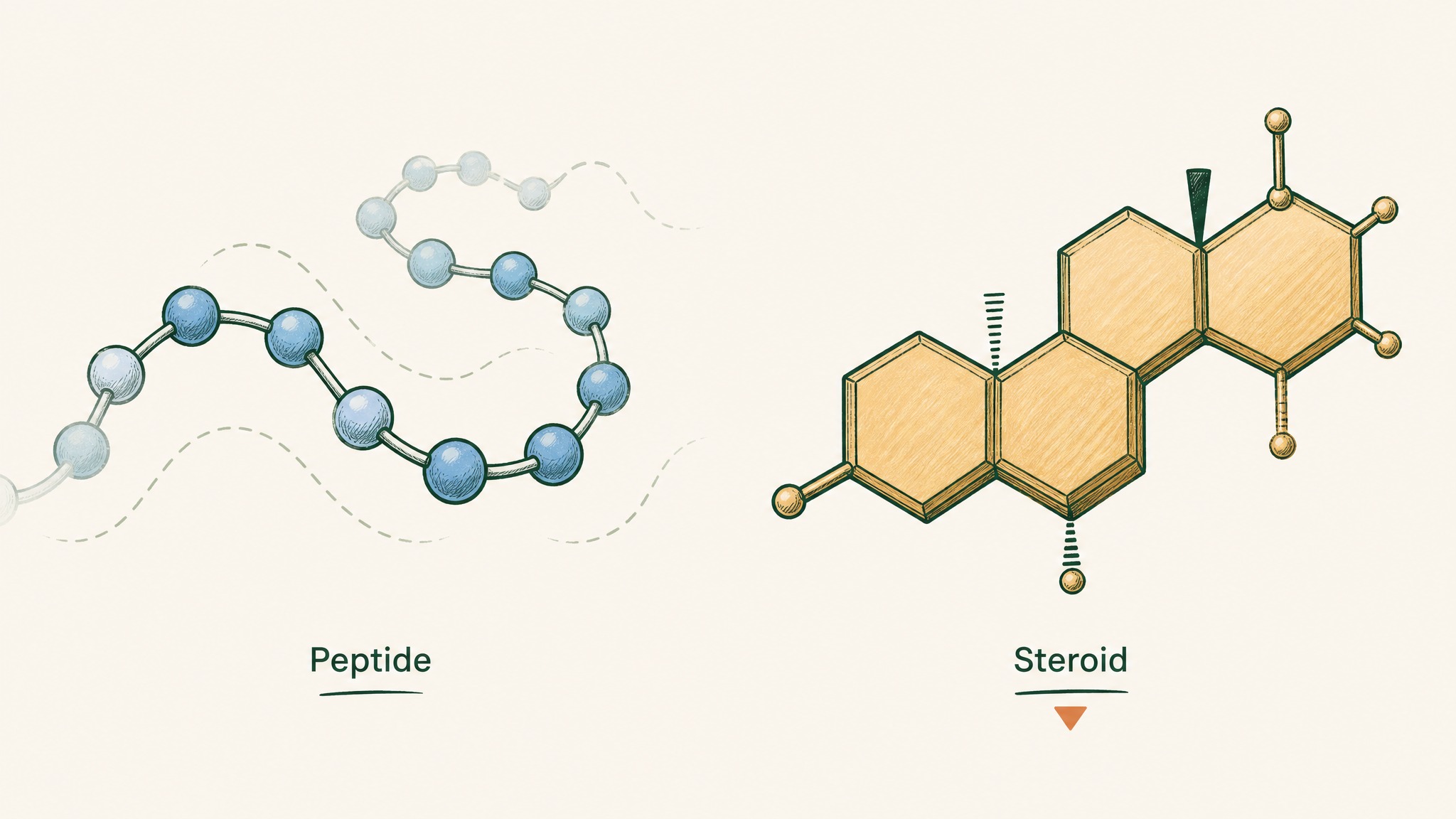
Peptides are flexible amino-acid chains; steroids are rigid four-ring carbon structures.
One is a flexible string of beads. The other is a rigid, fused set of rings. There is no overlap in the blueprint.
Here's the side-by-side:
| Feature | Peptides | Steroids |
|---|---|---|
| Building block | Amino acids | Cholesterol-derived rings |
| Core structure | Linear chain, ~2 to 50 amino acids | 17-carbon, four-ring skeleton |
| Solubility | Water-soluble (hydrophilic) | Fat-soluble (lipophilic) |
| Where they act | Receptors on the cell surface | Receptors inside the cell |
| Example | Oxytocin, insulin, BPC-157 | Testosterone, cortisol, estrogen |
That table is the whole answer in miniature. Everything below just explains each row.
What Exactly Is a Peptide?
A peptide is one of your body's short text messages, a small chain of amino acids that carries a signal from one place to another. Amino acids are the same units your body strings together to build muscle, enzymes, and the protein on your dinner plate; a peptide is just a short version of that chain.
The length is what defines the category. Chains of roughly 2 to 50 amino acids are peptides, and once a chain runs past about 50 it's usually called a protein instead (StatPearls, NBK562260). To make that concrete, here are three you may have heard of:
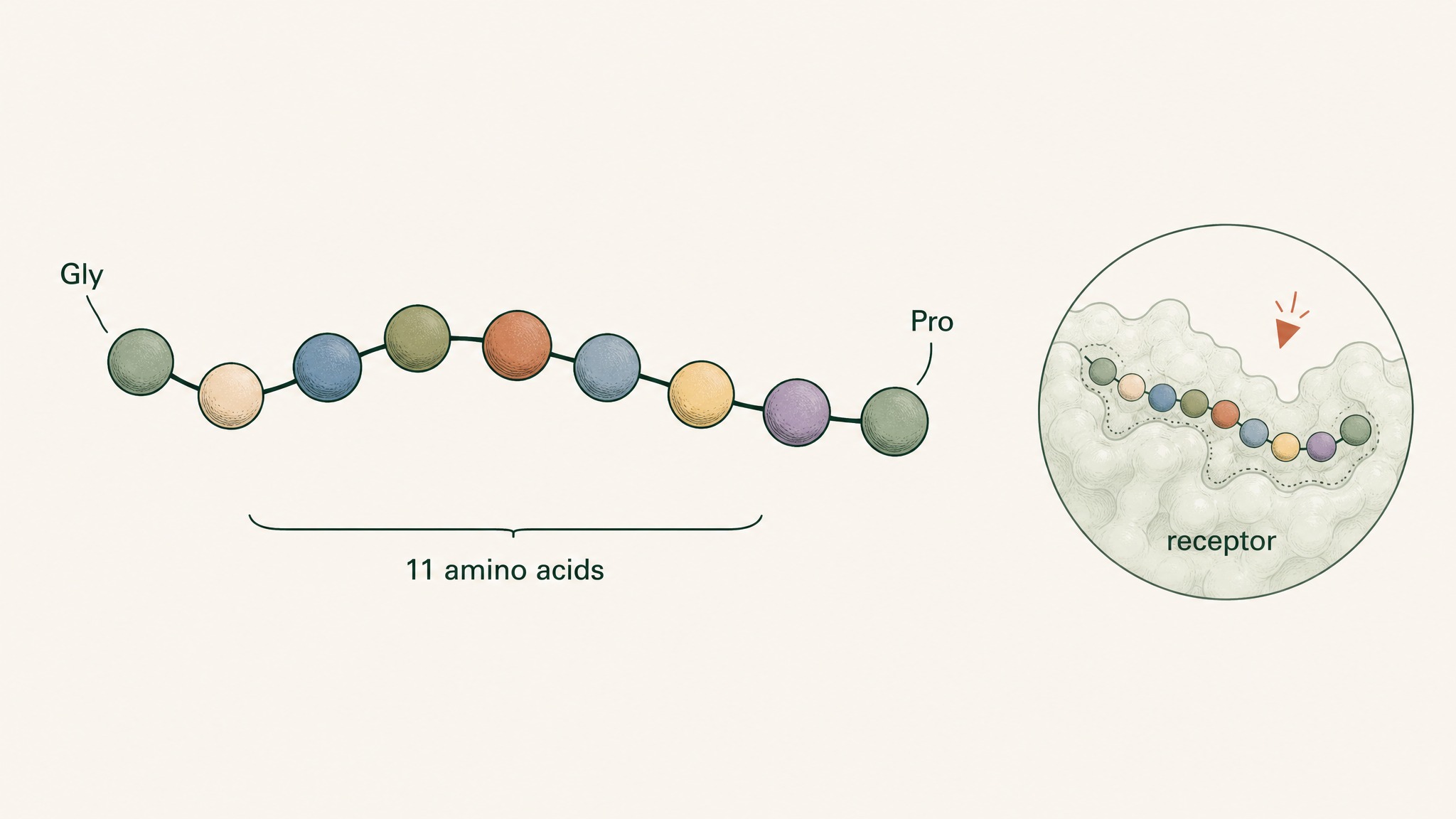
A short amino-acid chain locks into its matching receptor on a cell surface.
- Oxytocin: 9 amino acids, one of the shortest signalling peptides your body makes (StatPearls, NBK541112).
- BPC-157: a 15-amino-acid research peptide, first characterised in the 1990s (Sikiric et al. 1994, PubMed 7904712).
- Insulin: 51 amino acids across two linked chains, right at the border between peptide and protein (Endotext, NBK279029).
None of these has a steroid ring anywhere in its structure. They're built from amino acids, full stop. Research suggests these short chains act as precise signalling molecules, each one shaped to fit a specific receptor like a key cut for a single lock.
That last point matters for anyone comparing compounds. A peptide's job is defined by its exact amino-acid sequence, which is why swapping even one unit can change what it does. It's a different design philosophy entirely from the steroid family.
What Makes a Steroid a Steroid?
A steroid is a fat-based molecule built on a four-ring carbon skeleton, and every steroid your body produces traces back to cholesterol. Where a peptide is a chain, a steroid is a compact, rigid frame, closer to a small piece of scaffolding than a string.
The defining feature is that ring system. Every steroid shares a core of 17 carbon atoms arranged into four fused rings (StatPearls, NBK558960), and the whole family is assembled from cholesterol, itself a 27-carbon molecule (StatPearls, NBK513326). Testosterone, the reference steroid most people picture, has the compact molecular formula C19H28O2 (PubChem, CID 6013).
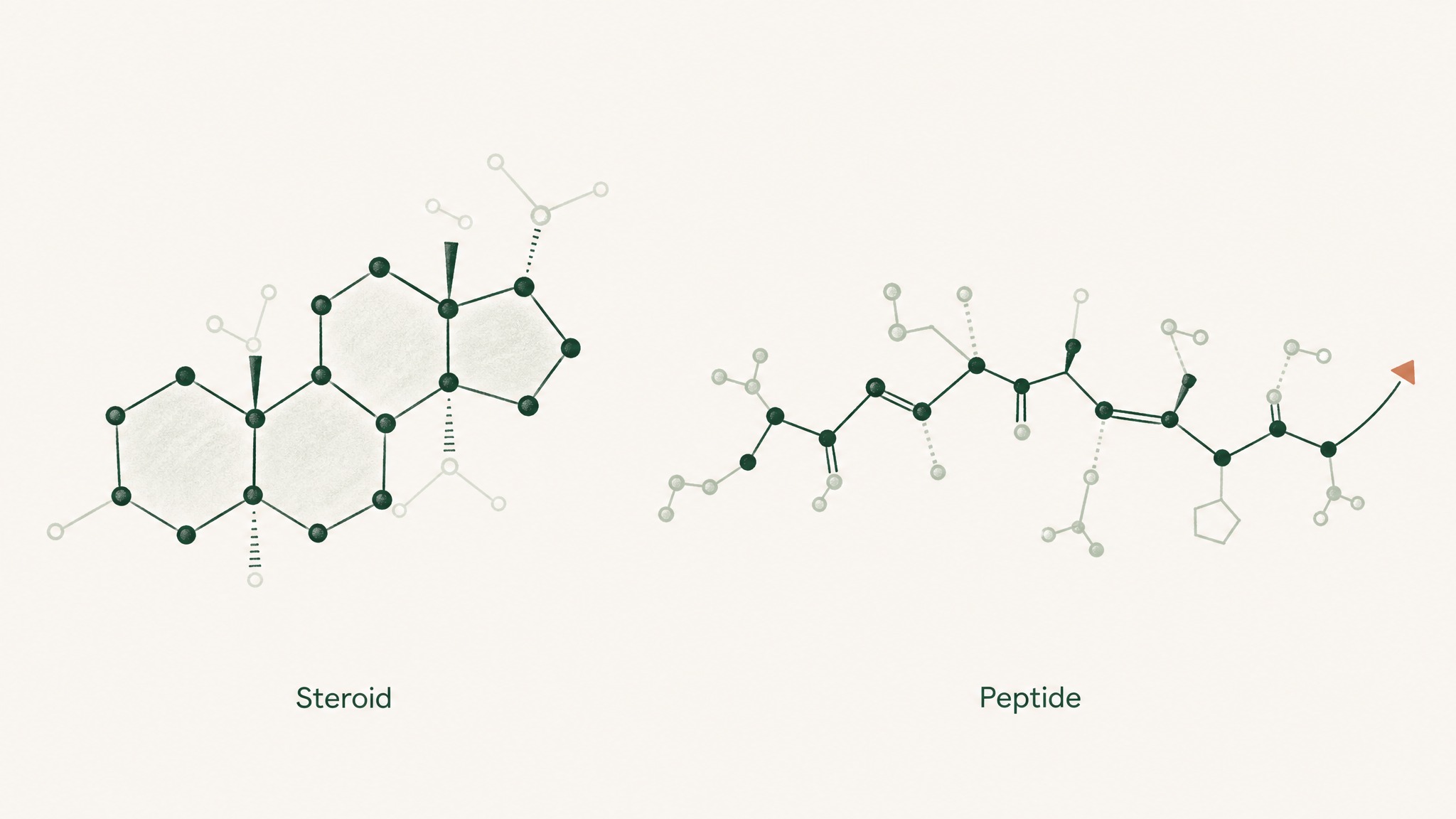
Steroids are rigid four-ring structures; peptides are flexible chains of amino acids.
The steroids that dominate the gym conversation are a specific sub-group. As NCBI's StatPearls puts it plainly, "Anabolic steroids (also known as androgenic steroids) are synthetic derivatives of testosterone" (StatPearls, NBK482418). Quick orientation on the family:
- Anabolic-androgenic steroids (testosterone and its lab-made cousins): tied to muscle and male characteristics.
- Corticosteroids (like cortisol): involved in stress response and inflammation.
- Sex steroids (estrogen, progesterone, testosterone): the reproductive hormones.
Notice that a peptide can't be a member of this list, because membership requires that four-ring carbon backbone. A chain of amino acids simply doesn't have one.
How Do Peptides and Steroids Work Differently in the Body?
Peptides and steroids don't just look different, they give orders to your cells in opposite ways. This is the deepest divide between them, and it comes straight from that solubility difference in the table above.
Picture a cell as a house with a locked front door. A steroid is fat-soluble, so it slips straight through the cell's fatty outer membrane like walking through the front door, then binds a receptor inside the cell that acts as a switch on your genes (StatPearls, NBK541112). A peptide is water-soluble and can't get through that fatty wall at all, so it rings the doorbell instead: it docks on a receptor on the outside surface and triggers a relay of signals inside (StatPearls, NBK541112).
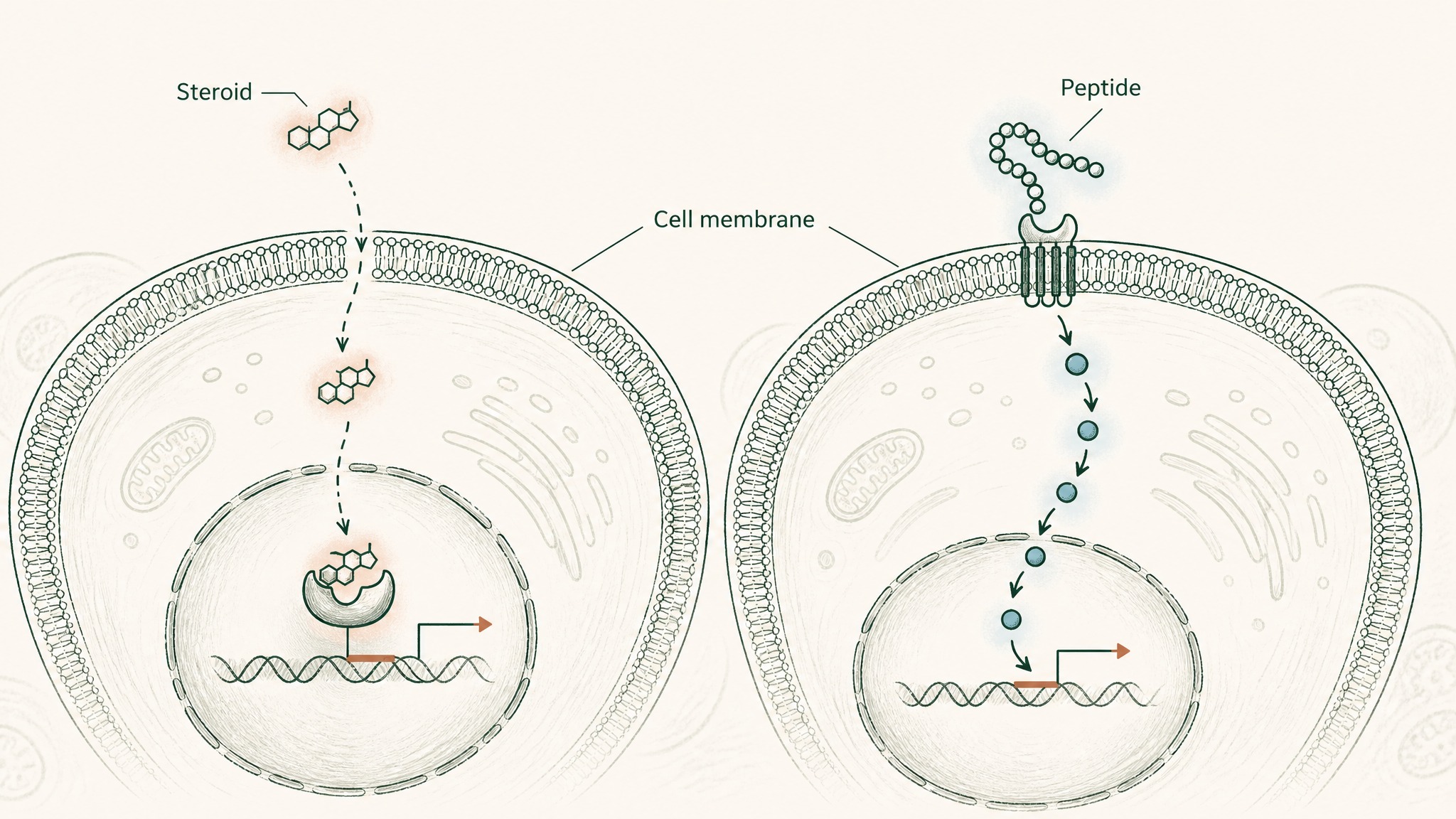
Steroids slip through the cell membrane to switch genes on; peptides dock on the surface and trigger a cascade.
Here's the two-path version:
- Steroid path: crosses the membrane, binds an intracellular receptor, and directly changes which genes get read. Slower to start, longer-lasting.
- Peptide path: binds a surface receptor and sets off a second-messenger cascade inside the cell. Faster, more targeted, shorter-lived.
In our protocol design, the question we weigh most heavily isn't peptide-versus-steroid on a chart. It's whether a given signalling molecule can survive the trip to the receptor it's meant to reach, because a molecule that never arrives can't signal anything. That single mechanical fact, surface receptor versus internal receptor, shapes how each class behaves and how each one has to be delivered.
Why Do People Confuse Peptides With Steroids?
People lump peptides and steroids together because both can behave like hormones and both are banned in elite sport, not because they're chemically related. The overlap is cultural and regulatory, not structural.
Two things drive most of the mix-up. First, both classes appear on the World Anti-Doping Agency Prohibited List, but as two clearly separate categories: anabolic agents sit in class S1, while peptide hormones and growth factors sit in class S2 (WADA 2026 Prohibited List). Second, anabolic steroid use is far more common than most people assume, with one large meta-analysis of 187 studies estimating global lifetime prevalence at 3.3%, rising to 6.4% among men (Sagoe et al. 2014, PubMed 24582699).
The reasons the two get blended:
- Both can act as, or mimic, hormones your body already makes.
- Both are marketed in overlapping fitness and longevity circles.
- Both are regulated substances in professional sport.
- Neither is a casual over-the-counter product, so they get filed together as "the banned stuff."
Being on the same list doesn't make two things the same thing. Caffeine and heroin are both on drug schedules somewhere; nobody confuses them.
The takeaway: shared reputation, zero shared chemistry.
Are Peptides Safer Than Steroids?
Being a peptide doesn't automatically make a compound safe, and being a steroid doesn't automatically make one dangerous; safety depends on the specific molecule, its dose, and how thoroughly it's been studied. That nuance gets lost when people frame it as a simple "peptides good, steroids bad" swap.
The honest status check is about evidence, not vibes. Most so-called research peptides have not been approved by the FDA as drugs, and much of the human safety data people cite online traces back to preclinical (animal or lab) studies rather than large human trials. Anabolic steroids, by contrast, are far better characterised in the medical literature, and that record includes well-established risks when misused.
A few things worth holding onto:
- "Natural" is not a safety category. Your body makes both peptides and steroid hormones already.
- Users report a wide range of experiences with research peptides, but individual anecdotes are not the same as controlled evidence.
- Dose, purity, and delivery route change the risk picture more than the class label does.
- Regulatory status is a signal: if a compound is sold "for research purposes only," it has not cleared the bar for approved human use.
The safest move is to judge any specific compound on its own evidence rather than on the chemical family it belongs to. Research suggests the class label tells you how a molecule is built, not whether it's right or safe for a given use.
Where Does Delivery Come In?
Whether a peptide even reaches your bloodstream depends less on what class it belongs to and more on how it's delivered. This is where the peptide-versus-steroid comparison gets practical, because the two classes behave very differently the moment you try to take them by mouth.
Steroids are fat-soluble, so many can survive digestion and absorb reasonably well as oral tablets. Peptides face the opposite problem: swallowed as a pill, they're treated like food protein and torn apart, which is why oral bioavailability (how much of what you swallow actually reaches your blood) for peptides typically lands under 1 to 2% (Renukuntla et al. 2013, PMC3680128). Out of every 100 milligrams in a capsule, 98 or more can be destroyed before doing anything.
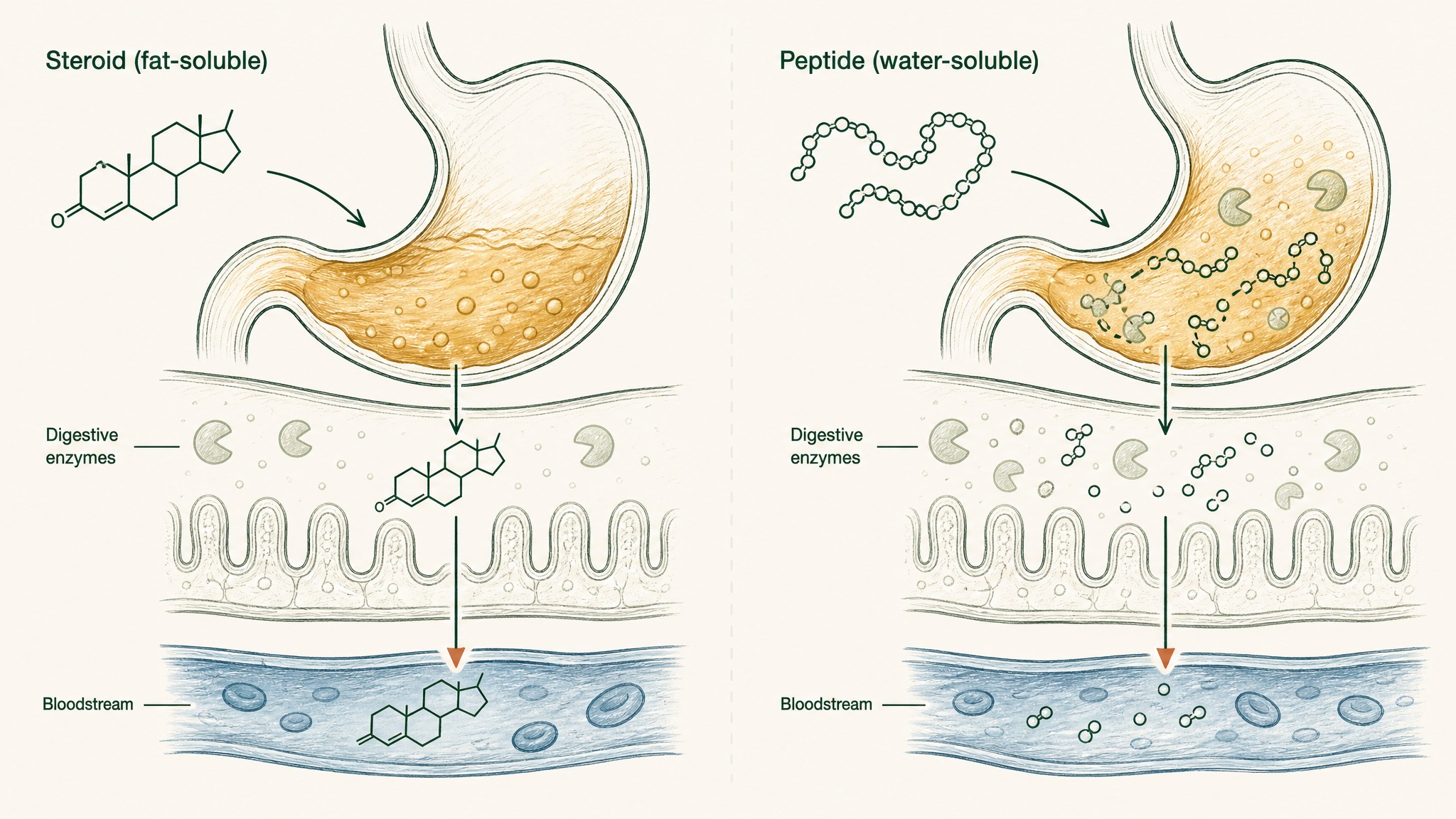
Why swallowed steroids survive digestion but peptides get torn apart.
That gap is exactly why delivery format is a core question for peptides and a minor one for steroids. Sublingual (under-the-tongue) and injectable routes both sidestep the gut's shredding machinery, which is the problem VERO's VERISORB sublingual matrix is built to address. It's also why a peptide like the 15-amino-acid compound in the RESTORE Protocol is formulated for sublingual delivery rather than a swallow-it capsule.
- Steroids: fat-soluble, often orally viable.
- Peptides: water-soluble and fragile, need a delivery route that bypasses digestion.
- Members experience the difference as onset and consistency, not just a number on a lab report.
So the class question ("are peptides steroids?") and the practical question ("will this even absorb?") turn out to be linked. The same chemistry that separates the two families also decides how each one has to be delivered.
Frequently Asked Questions
Are peptides a type of steroid? No. Peptides are chains of amino acids, and steroids are fat-based molecules built on a four-ring carbon skeleton derived from cholesterol (StatPearls, NBK558960). They belong to entirely separate chemical families.
Why are peptides and steroids talked about together? Because both can act like hormones and both are prohibited in elite sport, though as separate WADA categories (anabolic agents in S1, peptide hormones in S2). The link is reputation and regulation, not chemistry.
Is BPC-157 a steroid? No. BPC-157 is a 15-amino-acid peptide (Sikiric et al. 1994, PubMed 7904712), with no steroid ring structure. It's a research compound and is not FDA-approved as a drug.
Do peptides and steroids build muscle the same way? No. Steroids are fat-soluble and act on receptors inside the cell to change gene activity directly; peptides are water-soluble and signal through receptors on the cell surface (StatPearls, NBK541112). The mechanisms are fundamentally different.
Are peptides legal if steroids aren't? It depends on the specific compound and jurisdiction. Many research peptides are sold "for research purposes only" and are not approved for human use, while anabolic steroids are controlled substances in many countries. Neither category is a simple over-the-counter product.
References
- StatPearls / NCBI Bookshelf. Biochemistry, Peptide. https://www.ncbi.nlm.nih.gov/books/NBK562260/. Retrieved 2026-07-29.
- StatPearls / NCBI Bookshelf. Physiology, Progesterone (steroid ring structure). https://www.ncbi.nlm.nih.gov/books/NBK558960/. Retrieved 2026-07-29.
- StatPearls / NCBI Bookshelf. Biochemistry, Cholesterol. https://www.ncbi.nlm.nih.gov/books/NBK513326/. Retrieved 2026-07-29.
- StatPearls / NCBI Bookshelf. Biochemistry, Hormones (steroid vs peptide receptor mechanism). https://www.ncbi.nlm.nih.gov/books/NBK541112/. Retrieved 2026-07-29.
- StatPearls / NCBI Bookshelf. Anabolic Steroids. https://www.ncbi.nlm.nih.gov/books/NBK482418/. Retrieved 2026-07-29.
- Endotext / NCBI Bookshelf. Insulin: structure and structure-activity relationships. https://www.ncbi.nlm.nih.gov/books/NBK279029/. Retrieved 2026-07-29.
- Sikiric et al. (1994). Pentadecapeptide BPC 157: characterisation of a 15-amino-acid peptide. PubMed. https://pubmed.ncbi.nlm.nih.gov/7904712/. Retrieved 2026-07-29.
- Sagoe et al. (2014). Global epidemiology of anabolic-androgenic steroid use: a meta-analysis. Annals of Epidemiology. https://pubmed.ncbi.nlm.nih.gov/24582699/. Retrieved 2026-07-29.
- Renukuntla et al. (2013). Approaches for oral bioavailability of peptides and proteins. International Journal of Pharmaceutics. https://pmc.ncbi.nlm.nih.gov/articles/PMC3680128/. Retrieved 2026-07-29.
- PubChem / NCBI. Testosterone compound record (CID 6013). https://pubchem.ncbi.nlm.nih.gov/compound/6013. Retrieved 2026-07-29.
- World Anti-Doping Agency. 2026 Prohibited List. https://www.wada-ama.org/en/resources/2026-prohibited-list. Retrieved 2026-07-29.
Curious how a fragile amino-acid chain is engineered to actually reach your bloodstream? Explore the RESTORE Protocol →
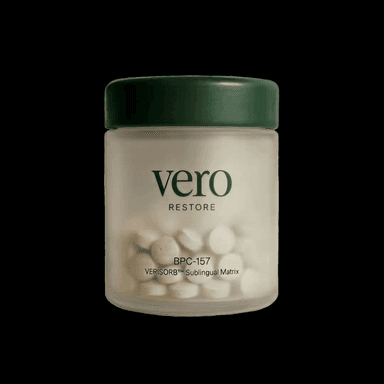
RESTORE™
BPC-157Engineered around 0.5mg BPC-157 (arginate salt). Accelerates deep tissue and joint recovery
Clinical Context
Important Notice: VERO protocols are nutritional and systemic optimisation formats. They are not intended to diagnose, treat, cure, or prevent any medical condition. These statements have not been evaluated by the Food and Drug Administration.