
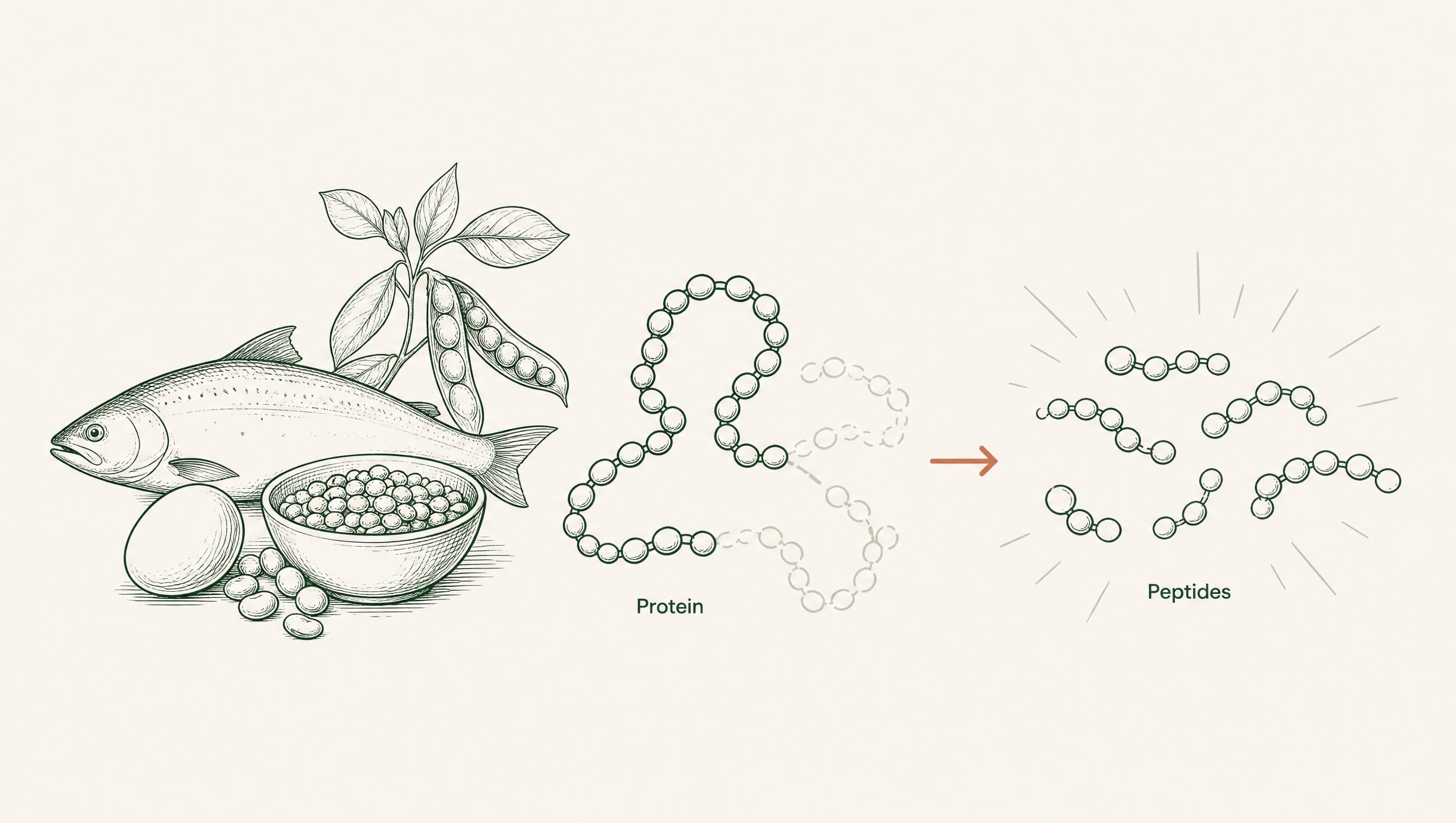
Some peptides are made by your own body, some are built in a lab, and both can be chemically identical. Here is the natural-vs-synthetic answer, with real numbers.
Both, actually. Some peptides are as natural as the insulin your pancreas made this morning, and some are built from scratch in a lab. Peptides are short chains of amino acids (the same building blocks that make up the protein on your dinner plate), and your body is running on thousands of them right now.
So when someone asks "are peptides natural," the honest answer is that it depends on which peptide you mean. The molecule itself is a naturally occurring class of thing. Whether a specific product is natural or synthetic comes down to how it was made, not what it fundamentally is.
If you're weighing up the research peptides VERO formulates, that distinction is the first thing worth getting straight, and everything here is shared for research purposes only. We'll back every claim with a real, sourced number, because the usual answer to this question skips them entirely.
Key Takeaways
- Peptides are a naturally occurring class of molecule: short chains of 2 to 50 amino acids, and your body is estimated to hold about 7,000 different peptides at any moment (StatPearls, NBK562260; McGill OSS).
- Whether a peptide is "natural" or "synthetic" depends on how it was made, not what it is: a lab-made peptide with the same amino-acid sequence is chemically identical to the body's own version (PMC12722964).
- Your body makes famous peptides on its own, including insulin (51 amino acids), glucagon (29), and oxytocin (9) (UniProt P01308).
- Peptides are in your food too: one 2025 review of dairy alone catalogued more than 3,200 distinct bioactive peptides across 192 studies (MDPI Dairy, 2025).
- Around 120 peptide medicines are on the market today, most manufactured synthetically even when the sequence copies a natural one (PMC11945313).
So, Are Peptides Actually Natural?
Peptides are a natural class of molecule, but not every peptide product is naturally sourced. That single sentence resolves most of the confusion around this question.
Think of it like sugar. The sugar in an apple and the sugar refined in a factory are the same molecule, just with different origin stories. Peptides work the same way: the category is natural, while any one product might come from a cell or from a chemist.
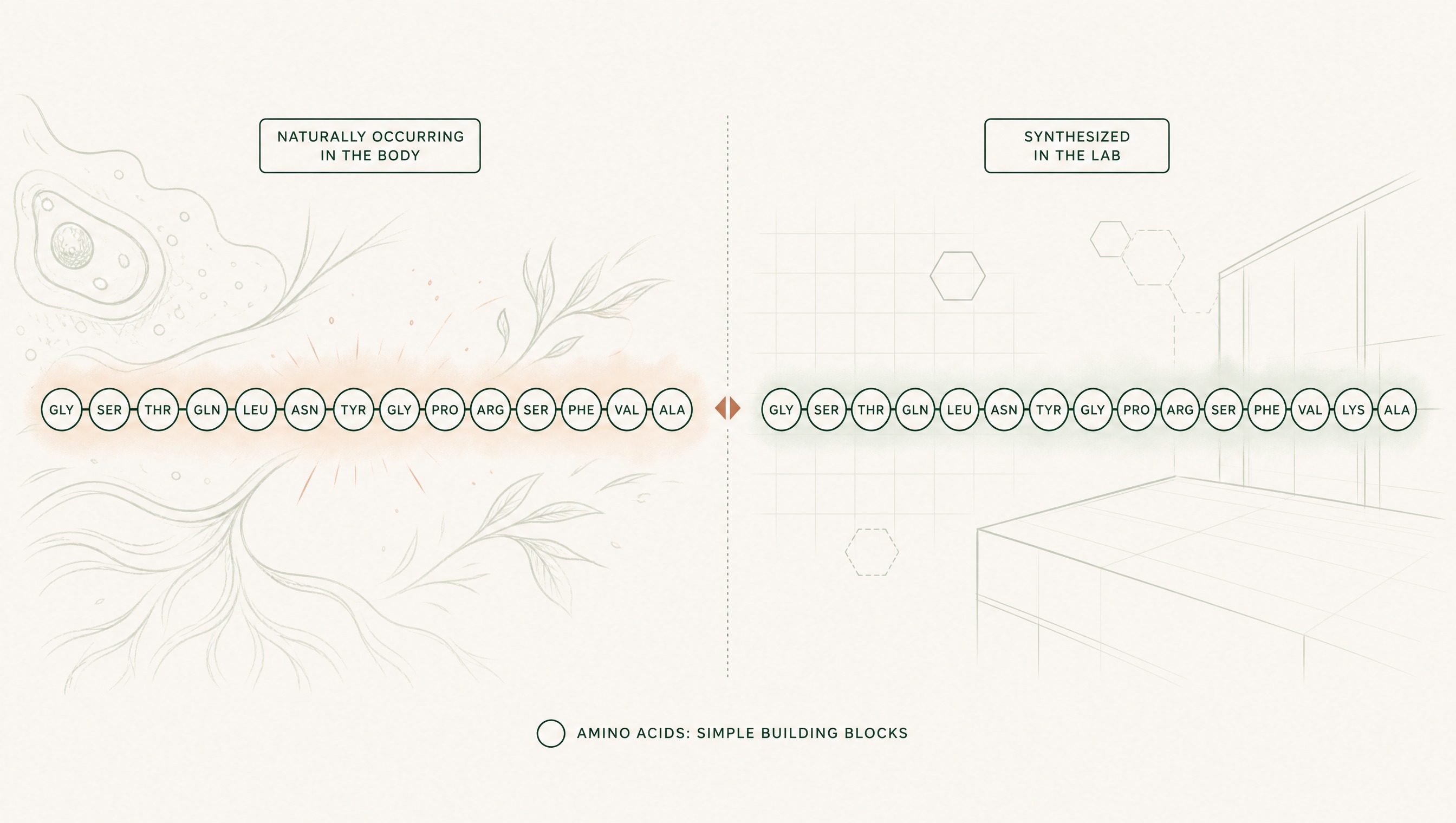
Natural and synthetic peptides have identical amino-acid sequences, just different origins.
The building block is simple. A peptide is a short string of 2 to 50 amino acids joined together (StatPearls, NBK562260). Your body is absolutely packed with them.
According to McGill University's Office for Science and Society, "it has been estimated that there are about 7000 peptides present in the body at any time."
So the split looks like this:
- Natural peptides: made by your body or found in living things and foods (insulin, oxytocin, milk peptides).
- Synthetic peptides: built in a lab, often as an exact copy of a natural sequence.
- The overlap: a synthetic peptide can be chemically identical to the natural one, atom for atom.
Here's the same idea as a quick side-by-side:
| Natural peptides | Synthetic peptides | |
|---|---|---|
| Where it's made | Your body, animals, plants, food | A lab |
| Example | Insulin, oxytocin, milk peptides | Teriparatide, lab-made BPC-157 |
| Sequence | Set by your genes | Chosen and copied by chemists |
| Can they be identical? | Yes, if the amino-acid sequence matches | Yes, if the amino-acid sequence matches |
That's the whole answer in miniature. Everything below just fills in the numbers.
What Is a Peptide, Exactly?
A peptide is a short chain of amino acids, the same units your body strings together to build muscle, enzymes, and the protein in your food. Amino acids are the basic building blocks of protein, so a peptide is really just a short protein fragment carrying a signal.
Here's the cleanest way to picture it: if amino acids are letters, then a peptide is a short word and a full protein is a paragraph. The length is what sorts them into categories.
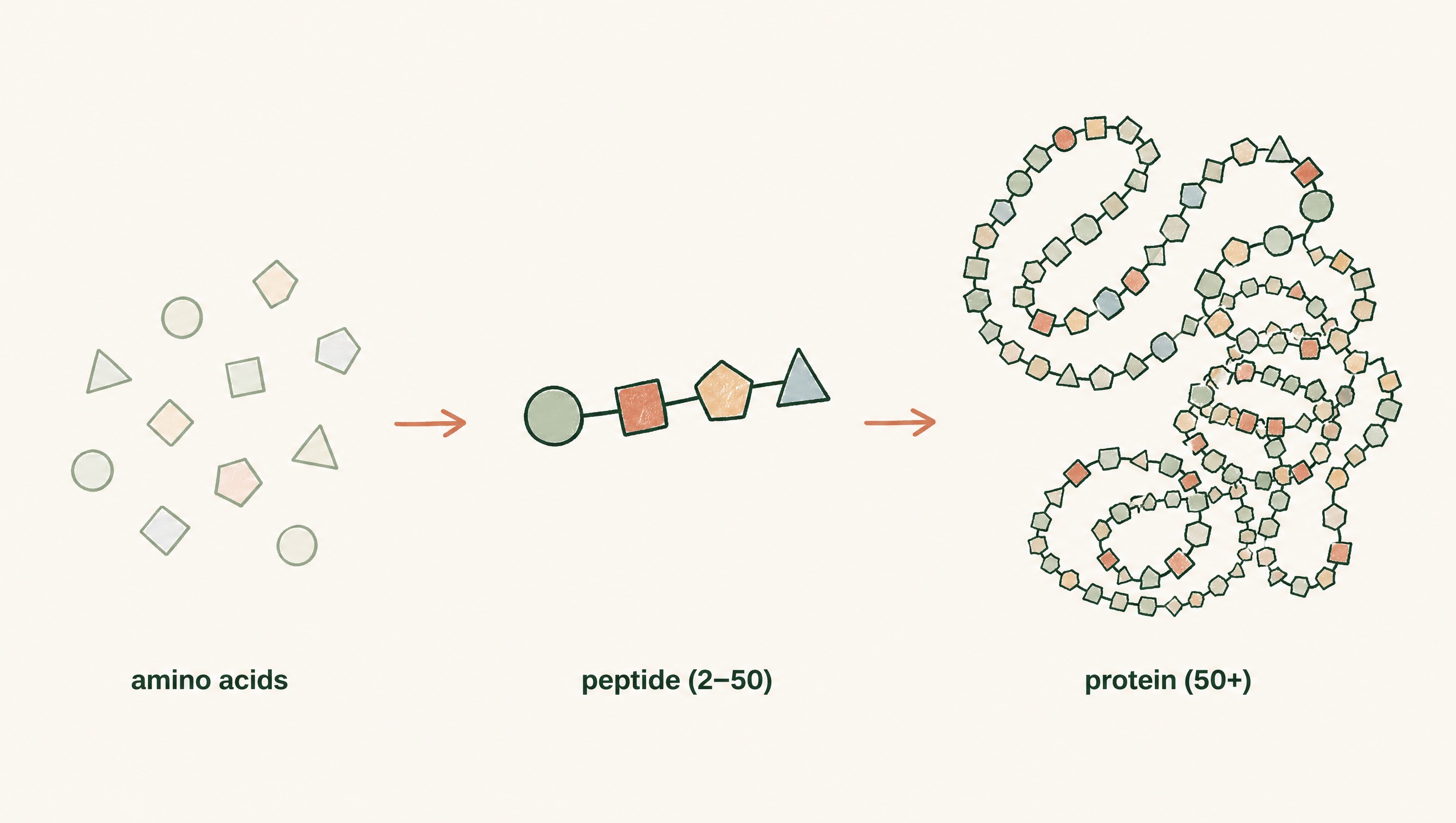
Amino acids link into short peptides or longer proteins based on chain length alone.
- Chains of roughly 2 to 50 amino acids are called peptides (StatPearls, NBK562260).
- Once a chain runs past about 50, it usually earns the name protein instead.
- Peptide hormones specifically span a wide range, from 3 to 200 amino acids in length (StatPearls, NBK541112).
None of that says anything about where the peptide came from. A 9-amino-acid chain is a peptide whether your brain released it or a machine assembled it. If you want the deeper family comparison, we covered how peptides differ from steroids in a separate piece.
Which Peptides Does Your Body Make Naturally?
Your body manufactures thousands of peptides on its own, and some of them are the most important signalling molecules you have. Long before any lab got involved, your cells were writing these short chains to carry messages from one organ to another.
Picture your bloodstream as a postal network and peptides as the short, specific notes moving through it. Each one is cut to a precise length so it fits exactly one receptor, like a key shaped for a single lock.
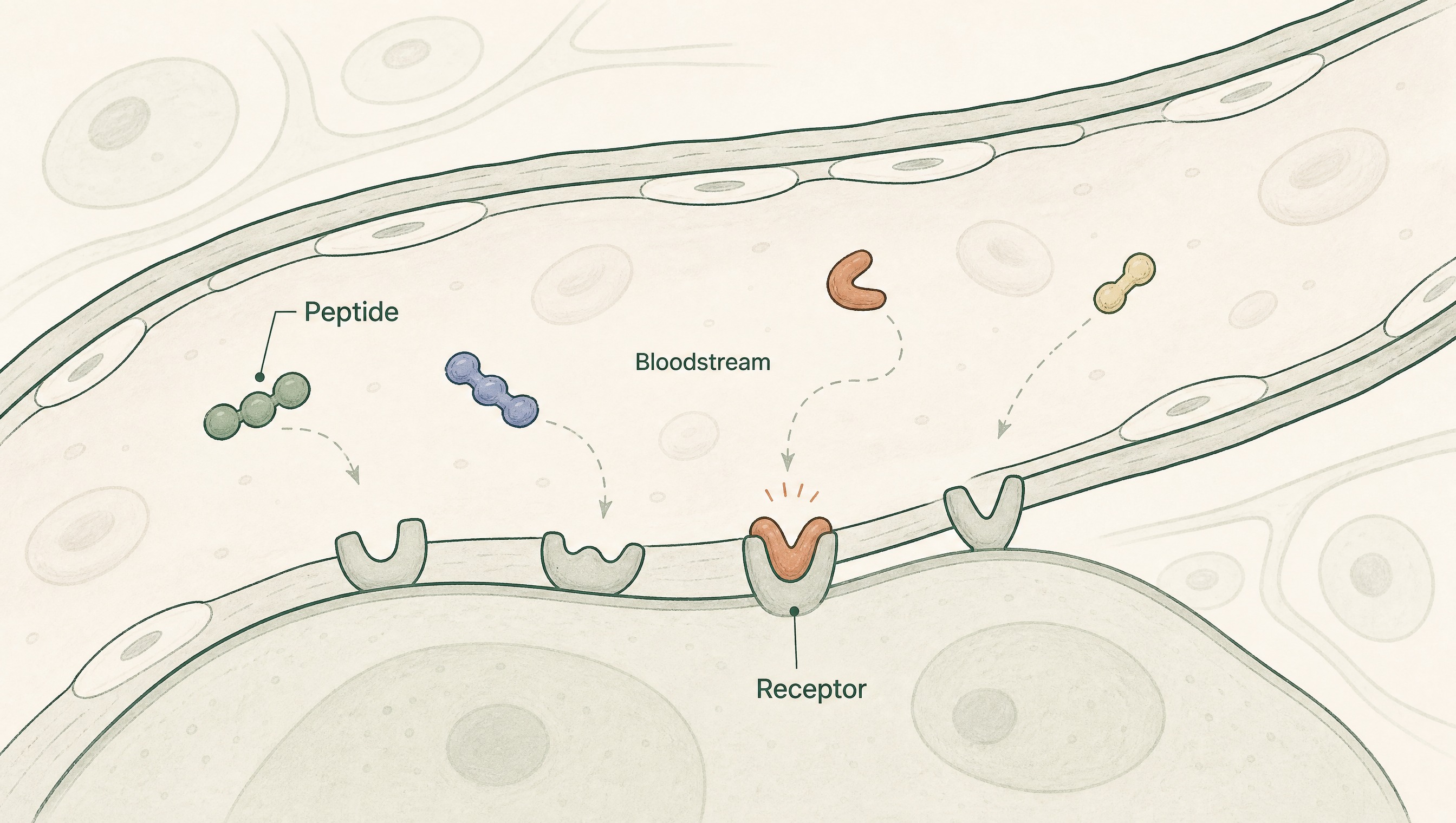
Peptides moving through your bloodstream fit precisely into their matching receptors like keys into locks.
Here are three you've almost certainly heard of, all made inside you:
- Insulin: 51 amino acids across two linked chains, the hormone that manages your blood sugar (UniProt P01308).
- Glucagon: 29 amino acids, insulin's counterpart that raises blood sugar when it dips (UniProt P01275).
- Oxytocin: just 9 amino acids, one of the shortest signalling peptides your body makes (UniProt P01178).
And these three are a rounding error next to the total. Research suggests your body carries roughly 7,000 different peptides at any given moment (McGill OSS). By any reasonable definition, peptides are as natural as biology gets.
Are There Peptides in the Food You Eat?
Yes, the food on your plate is full of peptides, and your gut makes even more as it digests protein. Every time you eat a steak or drink a glass of milk, you're taking in and generating short amino-acid chains.
Think of digestion as a pair of scissors. A long food protein goes in, and your gut enzymes snip it into smaller and smaller pieces, many of which are peptides.
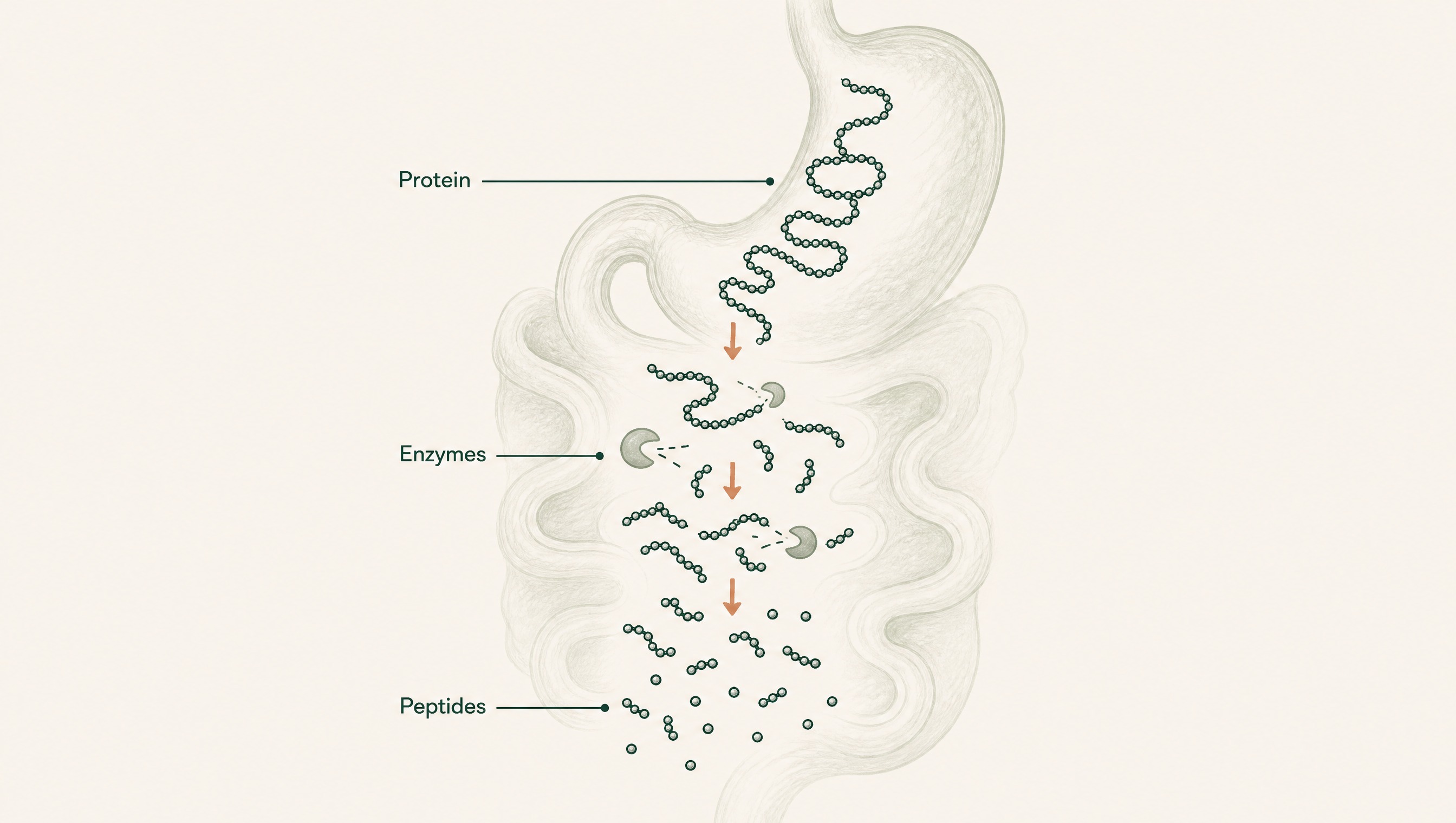
Digestive enzymes break long food proteins into smaller peptide chains as they move through your gut.
Dairy is the best-catalogued example we have:
- A 2025 systematic review pulled from 192 studies and collectively reported over 3,200 distinct peptides from dairy products (MDPI Dairy, 2025).
- Lactoferricin, a well-known milk peptide, is a chain of exactly 25 amino acids (PMC4726964).
- The MilkAMP database alone holds 111 peptides, a mix of natural, synthetic, and modified entries (PMC4726964).
Collagen peptides, the kind sold in tubs for skin and joints, are the same idea: long collagen protein broken into short, absorbable fragments. So if you've ever wondered whether you already consume peptides, you do, every single day.
So What Makes a Peptide "Synthetic"?
A synthetic peptide is one built in a lab instead of by a living cell, usually by chaining amino acids together one at a time. The sequence can be an exact copy of something natural; what makes it "synthetic" is the factory, not the formula.
Compare it to a pearl necklace. Your body's cells string the beads on a biological assembly line, while a chemist can build the same necklace bead by bead on a bench. The finished string can be identical either way.
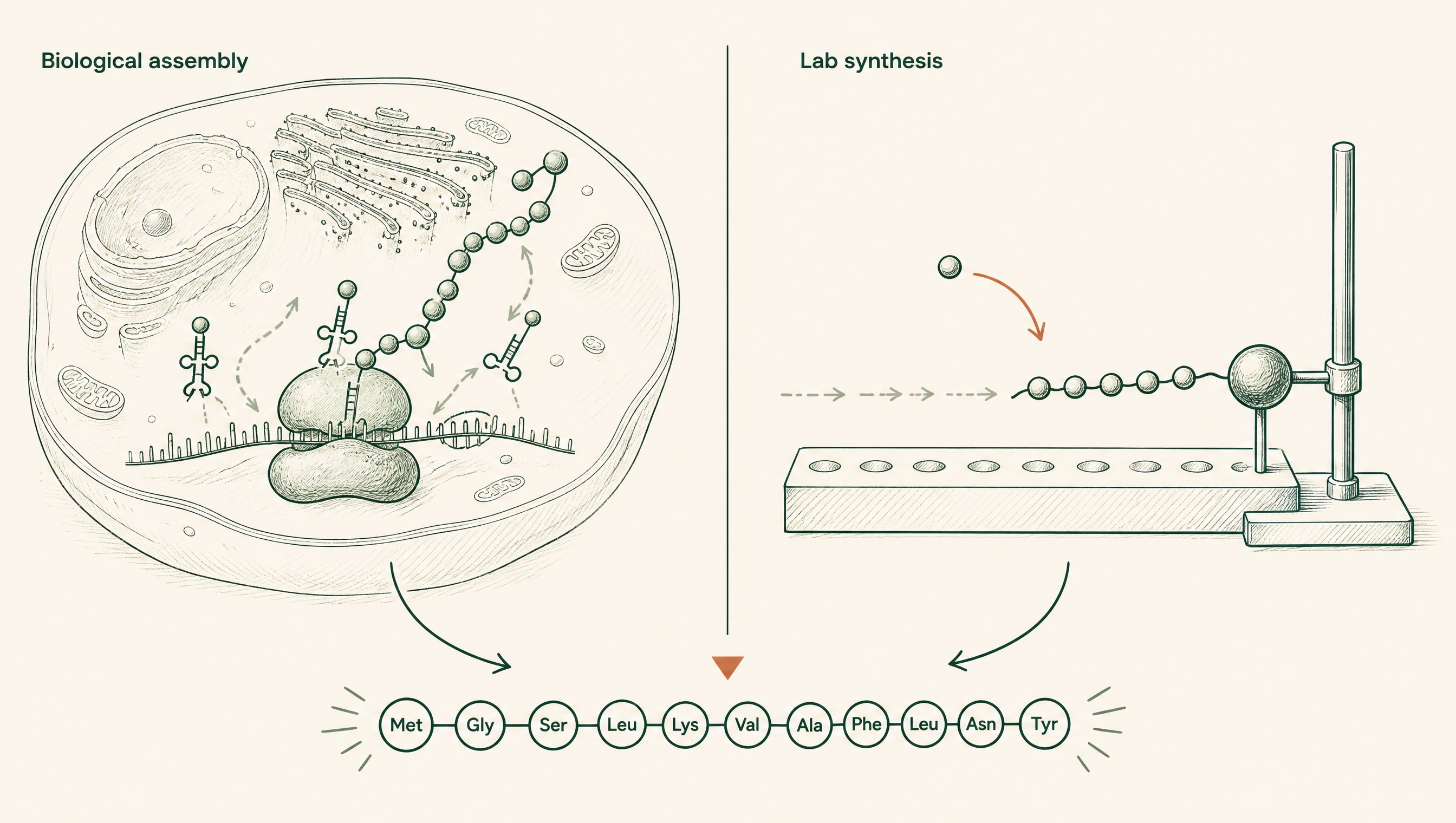
Cells and chemists both build peptides by linking amino acids in sequence, producing identical results.
The lab method behind most of them has a clear history:
- 1963: chemist Bruce Merrifield published solid-phase peptide synthesis, a way to build a peptide by anchoring it to a bead and adding amino acids in sequence (PubMed, Merrifield).
- 1984: Merrifield received the Nobel Prize in Chemistry for that method (Rockefeller University).
- 1982: the FDA cleared Humulin, the first biosynthetic human insulin and the first medical product of any kind derived from recombinant-DNA technology (NSF).
That 1982 milestone is the key one for this question. The insulin in Humulin has the same sequence your pancreas makes; it's simply grown in engineered cells rather than harvested from an animal. Synthetic origin, natural blueprint.
Is a Lab-Made Peptide Different From a Natural One?
Chemically, a synthetic peptide with the same amino-acid sequence is identical to the one your body makes. A peptide is defined by its sequence, so if the order of amino acids matches, your receptors can't tell the copy from the original.
Here's the analogy that holds up: two keys cut from the same blueprint open the same lock, and the lock doesn't care which machine cut them. Sequence is identity.
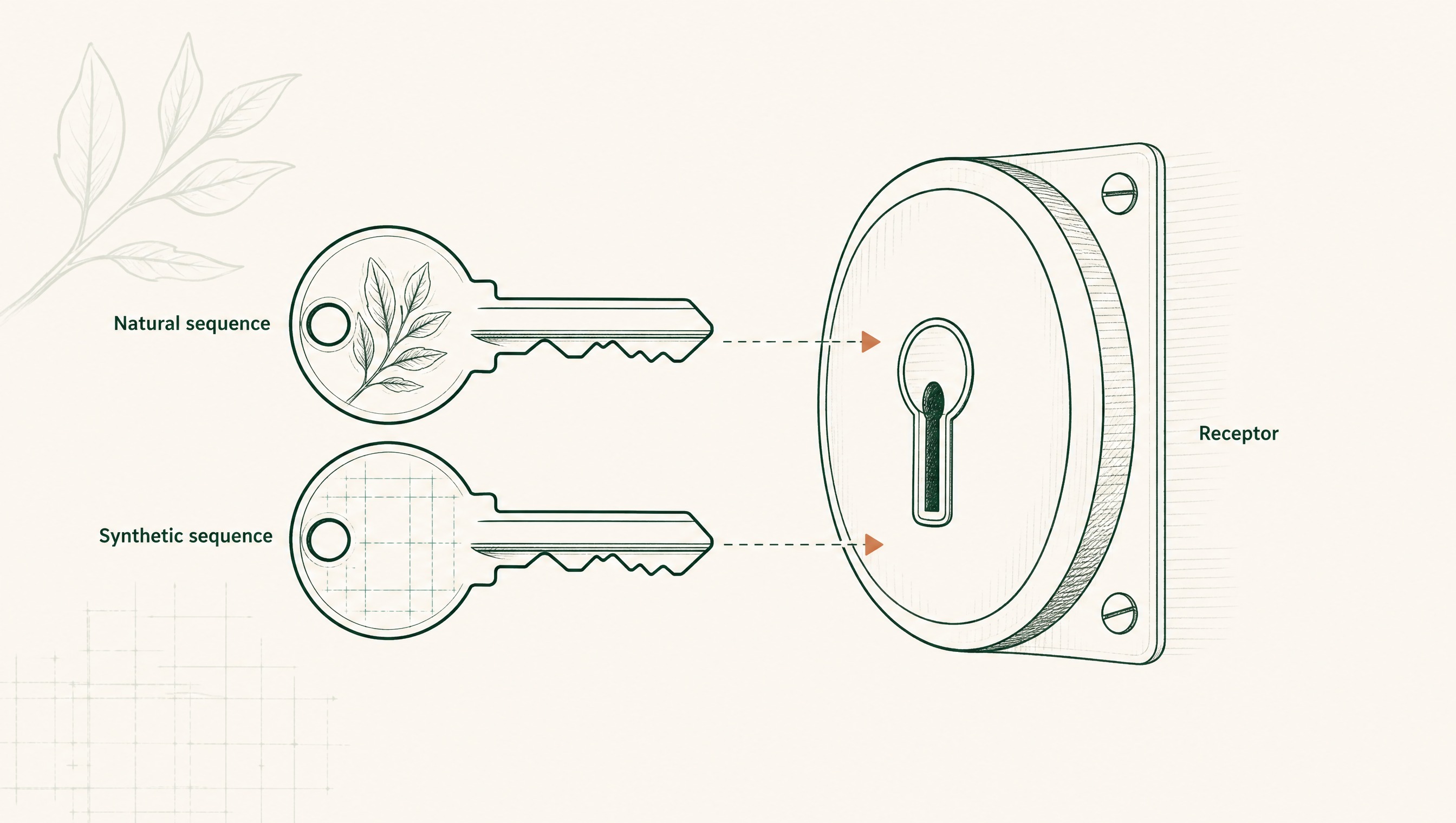
Two keys with identical cuts open the same lock, regardless of how they were made.
The clearest proof sits in the pharmacy:
- Teriparatide, a synthetic drug, consists of the first 34 amino acids of human parathyroid hormone, and its sequence is identical to that stretch of the natural hormone (PMC12722964).
- Roughly 120 peptide medicines are on the market today, most made synthetically even when they copy a natural sequence (PMC11945313).
- Between 2016 and 2023, the FDA approved 47 new peptide-and-oligonucleotide drug entities, a category that reached 16% of all approvals in 2023 (PMC10893093).
In our protocol design, the question we weigh most heavily isn't "natural or synthetic" on a label. It's whether a given sequence is faithfully reproduced and whether the molecule can survive the trip to the receptor it's meant to reach, because a mislabelled or degraded copy signals nothing. That's a manufacturing-and-delivery question, not a philosophy question.
Where Do Research Peptides Like BPC-157 Fit In?
Research peptides like BPC-157 sit in a middle zone: a synthetic molecule based on a sequence that traces back to the human body. This is the category most people are actually asking about when they type "are peptides natural," because it's the grey area.
Start with where it comes from, not the chemistry. BPC-157 was identified as a fragment of a protective protein found in human gastric juice, the fluid your own stomach produces. It's then reproduced synthetically for study.
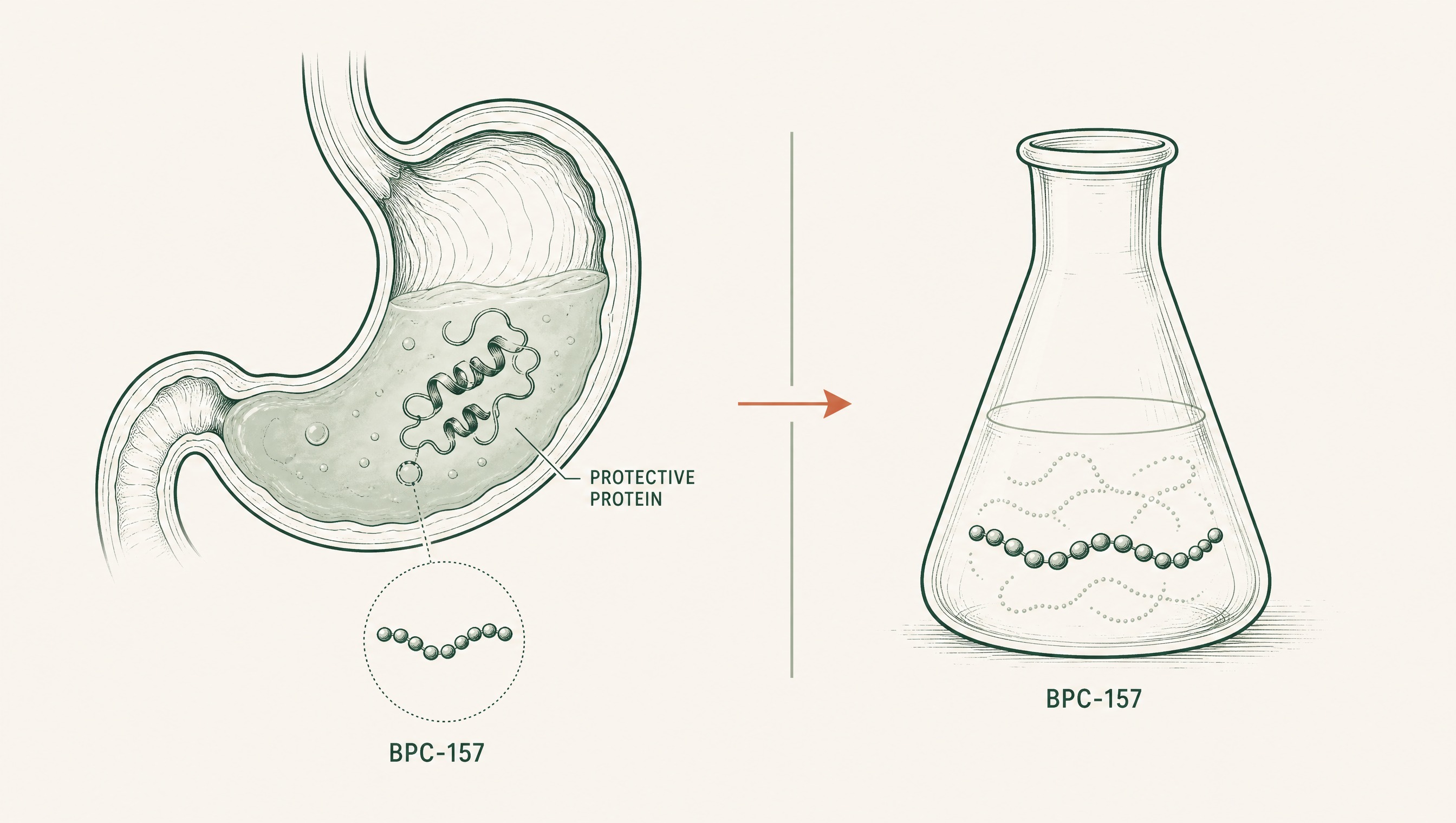
BPC-157 originates in stomach fluid, then is recreated identically in a laboratory.
The specifics, from a 2025 literature review:
- BPC-157 is a 15-amino-acid peptide (a pentadecapeptide) with a molecular weight of 1,419.55 daltons (PMC11859134).
- Its sequence was isolated as part of a peptide from human gastric juice, then made in the lab (PMC11859134).
- It "has not been approved for use in standard medicine by the FDA and other global regulatory authorities due to the absence of sufficient and comprehensive clinical studies" (PMC11859134).
So is BPC-157 natural? Its sequence has a natural origin, but the product in any vial is a synthetic copy sold strictly for research. That "derived from nature, made in a lab, not FDA-approved" status is exactly why we cover BPC-157's regulatory standing on its own. Users report finding this the most confusing corner of the whole topic, and honestly, that's fair.
Does "Natural" Even Mean "Safe" or "Better"?
Natural is not a safety rating, and synthetic is not a warning label. This is the part the marketing usually gets backwards, and it's worth saying plainly.
Consider that plenty of natural things are hazardous (snake venom is entirely natural) while plenty of synthetic things are life-saving (that recombinant insulin from 1982 keeps millions alive). "Natural" tells you about origin, not safety.
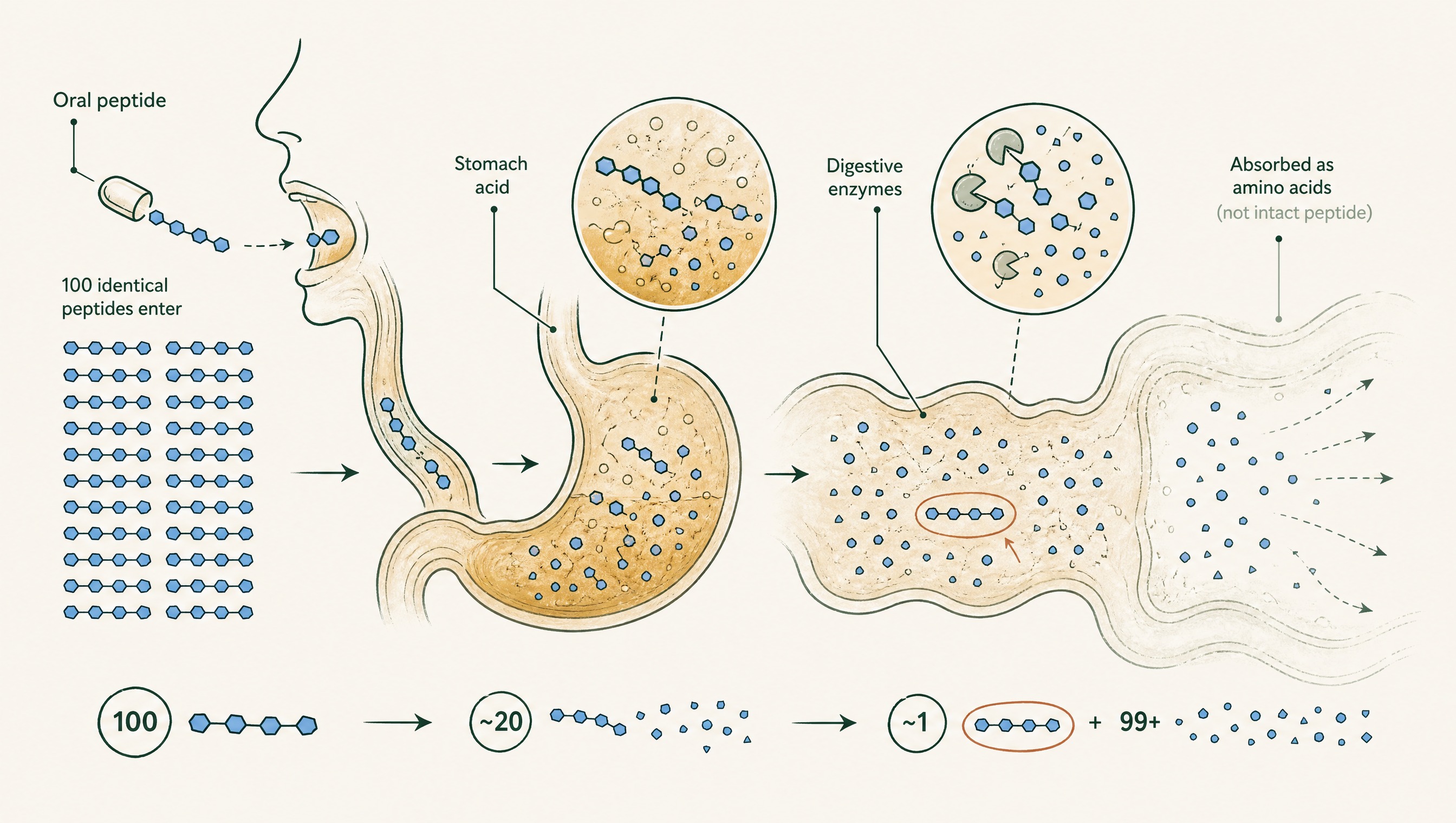
Why swallowing a peptide pill destroys 99% of it before it enters your bloodstream.
For peptides, the practical issue isn't the natural-versus-synthetic label at all. It's whether the molecule reaches your bloodstream:
- Swallowed as a pill, peptides get shredded like ordinary food protein, which is why oral bioavailability (how much of what you swallow actually reaches your blood) commonly runs below 1%, and sometimes under 0.1% (PMC12030352).
- Out of every 100 milligrams in a capsule, more than 99 can be destroyed before doing anything, which is the whole peptide-pill absorption problem.
- Delivery routes that bypass the gut, like sublingual (under-the-tongue) or injection, sidestep that shredding entirely.
This is where a natural sequence still needs engineering to be useful. VERO's VERISORB sublingual matrix exists to solve that absorption gap, and it's why a fragile peptide in the RESTORE Protocol is formulated for under-the-tongue delivery rather than a swallow-it capsule. Members experience that difference as onset and consistency, not as a line on a lab report. The class question and the "will this even absorb" question turn out to be linked.
Frequently Asked Questions
Are peptides natural or man-made? Both. Peptides are a naturally occurring class of molecule, and your body holds an estimated 7,000 of them at any time (McGill OSS). Individual peptide products can be natural, synthetic, or a synthetic copy of a natural sequence.
Does the body make peptides on its own? Yes. Insulin (51 amino acids), glucagon (29), and oxytocin (9) are all peptides your body produces naturally (UniProt P01308). They act as signalling molecules between organs.
Is a synthetic peptide the same as a natural one? If the amino-acid sequence matches, then chemically yes. Teriparatide, for example, is a synthetic peptide whose sequence is identical to the first 34 amino acids of natural human parathyroid hormone (PMC12722964).
Is BPC-157 a natural peptide? Its 15-amino-acid sequence traces back to a protein found in human gastric juice, but the product itself is made synthetically and is not FDA-approved (PMC11859134). It is sold for research purposes only.
Are peptides in food? Yes. A 2025 review catalogued over 3,200 distinct peptides from dairy alone (MDPI Dairy, 2025), and your gut generates more peptides every time it digests protein.
References
- StatPearls / NCBI Bookshelf. Biochemistry, Peptide. https://www.ncbi.nlm.nih.gov/books/NBK562260/. Retrieved 2026-08-04.
- StatPearls / NCBI Bookshelf. Biochemistry, Hormones. https://www.ncbi.nlm.nih.gov/books/NBK541112/. Retrieved 2026-08-04.
- McGill University Office for Science and Society. There is Much Pep in Peptide Research. https://www.mcgill.ca/oss/article/medical-did-you-know/there-much-pep-peptide-research. Retrieved 2026-08-04.
- UniProt Consortium. Insulin, human (P01308). https://www.uniprot.org/uniprotkb/P01308/entry. Retrieved 2026-08-04.
- UniProt Consortium. Glucagon, human (P01275). https://www.uniprot.org/uniprotkb/P01275/entry. Retrieved 2026-08-04.
- UniProt Consortium. Oxytocin-neurophysin 1, human (P01178). https://www.uniprot.org/uniprotkb/P01178/entry. Retrieved 2026-08-04.
- Nishimura et al. (2025). Bioactive peptides from dairy products: a systematic review of advances and functional potential. Dairy (MDPI). https://www.mdpi.com/2624-862X/6/6/65. Retrieved 2026-08-04.
- Mohanty et al. (2016). Bioactive peptides in milk and dairy products: a review. PMC / NIH. https://pmc.ncbi.nlm.nih.gov/articles/PMC4726964/. Retrieved 2026-08-04.
- Merrifield, R.B. (1969). Solid-phase peptide synthesis: method overview. Advances in Enzymology. PubMed. https://pubmed.ncbi.nlm.nih.gov/4307033/. Retrieved 2026-08-04.
- The Rockefeller University. R. Bruce Merrifield: 1984 Nobel Prize in Chemistry. https://www.rockefeller.edu/our-scientists/r-bruce-merrifield/2398-nobel-prize/. Retrieved 2026-08-04.
- National Science Foundation. Biotech Pioneers: rDNA and Insulin. https://www.nsf.gov/impacts/rdna-insulin. Retrieved 2026-08-04.
- Al Musaimi et al. (2024). 2023 FDA TIDES (peptides and oligonucleotides) harvest. PMC / Pharmaceuticals. https://pmc.ncbi.nlm.nih.gov/articles/PMC10893093/. Retrieved 2026-08-04.
- Al Musaimi et al. (2025). 2024 FDA TIDES (peptides and oligonucleotides) harvest. PMC / Pharmaceuticals. https://pmc.ncbi.nlm.nih.gov/articles/PMC11945313/. Retrieved 2026-08-04.
- Immunogenicity risk assessment of peptide-related impurities in generic teriparatide products (2025). PMC / NIH. https://pmc.ncbi.nlm.nih.gov/articles/PMC12722964/. Retrieved 2026-08-04.
- Oral peptide and protein therapeutics delivery: barriers and strategies (2025). PMC / NIH. https://pmc.ncbi.nlm.nih.gov/articles/PMC12030352/. Retrieved 2026-08-04.
- Multifunctionality and possible medical application of the BPC 157 peptide: literature and patent review (2025). PMC / NIH. https://pmc.ncbi.nlm.nih.gov/articles/PMC11859134/. Retrieved 2026-08-04.
Curious how a natural peptide sequence is engineered to actually reach your bloodstream? Explore the RESTORE Protocol →
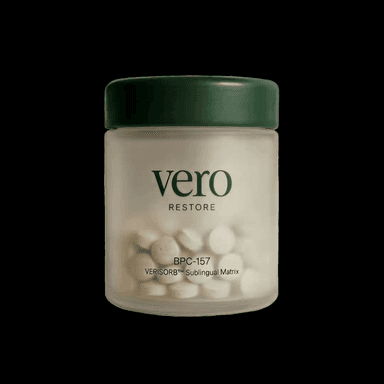
RESTORE™
BPC-157Engineered around 0.5mg BPC-157 (arginate salt). Accelerates deep tissue and joint recovery
Clinical Context
Important Notice: VERO protocols are nutritional and systemic optimisation formats. They are not intended to diagnose, treat, cure, or prevent any medical condition. These statements have not been evaluated by the Food and Drug Administration.