
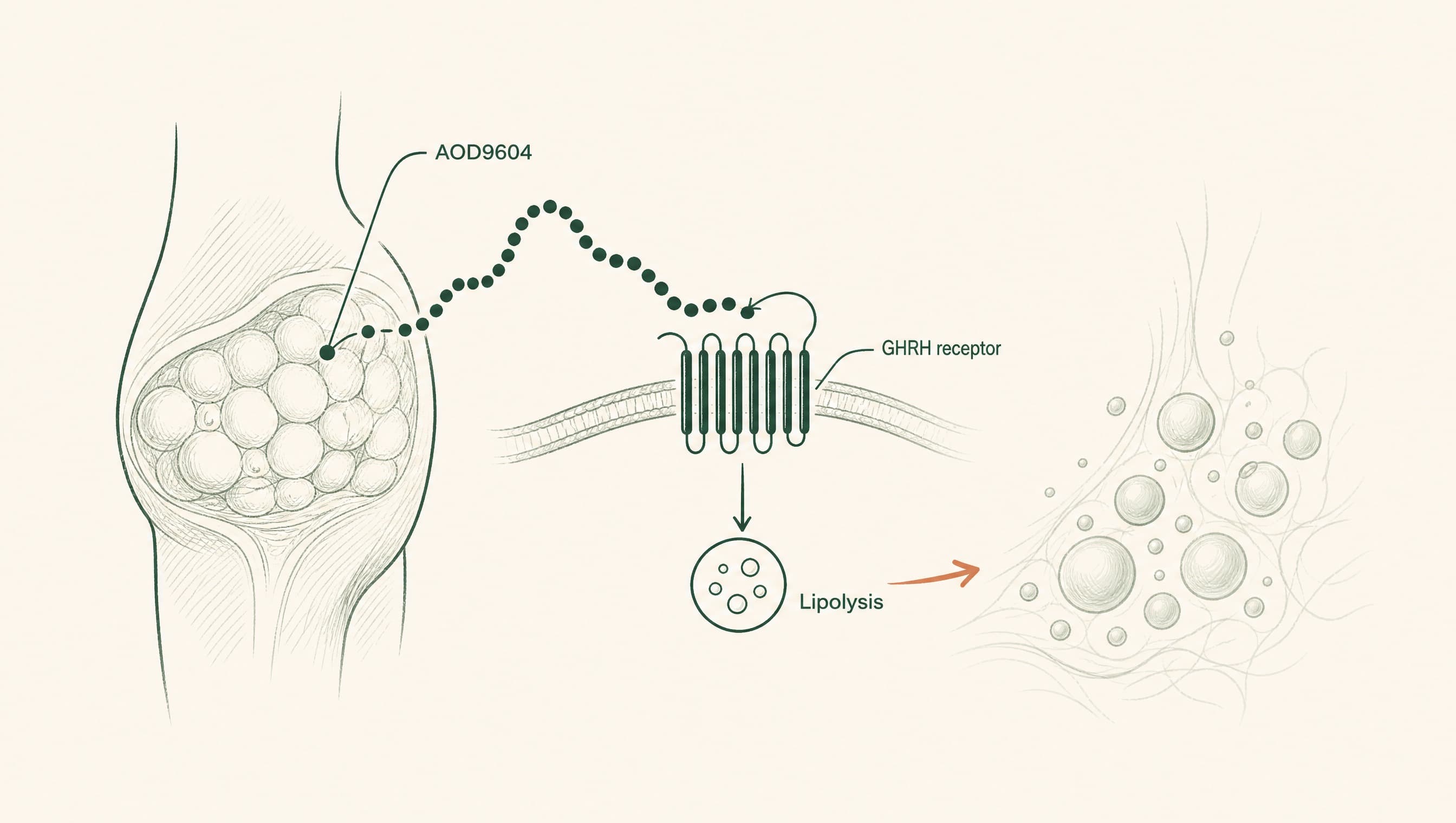
AOD9604 is a growth-hormone fragment studied for fat loss. Here's what the animal research, the failed human trial and 2026 regulators actually say.
Most experts agree on one thing about AOD9604: on paper, it's a clever idea. It's a tiny piece of your own growth hormone, the part that seems to deal with fat, snipped away from the parts that make you grow. The pitch writes itself: burn fat like growth hormone does, skip the side effects.
This is where most pages selling it go quiet. The animal research looked promising. The human research did not. When a company spent years and tens of millions of dollars testing it in real people, it never delivered the weight loss it promised, and the program was shut down in 2007. This article is for research purposes only, and it walks through exactly what the science shows, so you can judge the peptide on evidence instead of marketing.
If your actual goal is metabolic support and body composition, it's worth understanding why the field moved on from AOD9604 before you spend a penny chasing it.
Key Takeaways
- AOD9604 is a 16-amino-acid fragment of human growth hormone (residues 176 to 191, plus a tyrosine added at the front) built to copy growth hormone's fat-handling signal without its growth signal.
- In animal models, AOD9604 has been observed to lower fat gain and raise fat burning, and research suggests it does this without the blood-sugar problems seen with full growth hormone.
- Human trials tell a harder story: across roughly 900 adults it looked safe, but the larger weight-loss trial failed to beat placebo, and development stopped in 2007.
- As of 2026 AOD9604 is not FDA-approved for anything; the FDA placed it in a "significant safety concerns" category in 2023 and declined to add it to the compounding list in December 2024.
- AOD9604 is banned by WADA in sport at all times, so any athlete using it risks a doping violation.
References
- Ng FM, et al. (2000). Metabolic studies of a synthetic lipolytic domain of human growth hormone. Hormone Research. https://pubmed.ncbi.nlm.nih.gov/11146367/ Retrieved 2026-08-30.
- Heffernan MA, et al. (2001). Lipid-metabolism effects of a growth-hormone C-terminal fragment in obese and beta3-receptor knock-out mice. Endocrinology. https://pubmed.ncbi.nlm.nih.gov/11713213/ Retrieved 2026-08-30.
- Heffernan MA, et al. (2001). Fat oxidation and weight change in obese mice given a modified growth-hormone C-terminal fragment. International Journal of Obesity. https://pubmed.ncbi.nlm.nih.gov/11673763/ Retrieved 2026-08-30.
- Stier H, Vos E, Kenley D. (2013). Safety and tolerability of the hexadecapeptide AOD9604 in humans. Journal of Endocrinology and Metabolism. https://www.jofem.org/index.php/jofem/article/view/157/194 Retrieved 2026-08-30.
- Moré MI, Kenley D. (2014). Safety and metabolism of AOD9604 as a nutraceutical ingredient. Journal of Endocrinology and Metabolism. https://jofem.org/index.php/jofem/article/view/213/278 Retrieved 2026-08-30.
- Cox HD, et al. (2015). Detection and in-vitro metabolism of AOD9604. Drug Testing and Analysis. https://pubmed.ncbi.nlm.nih.gov/25208511/ Retrieved 2026-08-30.
- U.S. Food and Drug Administration. (2024). Pharmacy Compounding Advisory Committee notice: bulk drug substances nominated for the 503A list. Federal Register. https://www.federalregister.gov/documents/2024/10/25/2024-24828/pharmacy-compounding-advisory-committee-notice-of-meeting-establishment-of-a-public-docket-request Retrieved 2026-08-30.
- Snow CD, Palmer KL. (2026). FDA peptide compounding update: what compounders and industry need to know. FDA Law Blog, Hyman, Phelps & McNamara. https://www.thefdalawblog.com/2026/04/fdas-peptide-rally-what-compounders-and-industry-need-to-know-post-1-of-2/ Retrieved 2026-08-30.
What is AOD9604, and where does it come from?
AOD9604 is a lab-made fragment of human growth hormone, designed in Australia in the late 1990s to target fat without triggering growth. Think of growth hormone as a long instruction manual with many chapters. AOD9604 is one photocopied page: the "burn fat" chapter, torn out and used on its own.
The specifics are well documented in the research record:
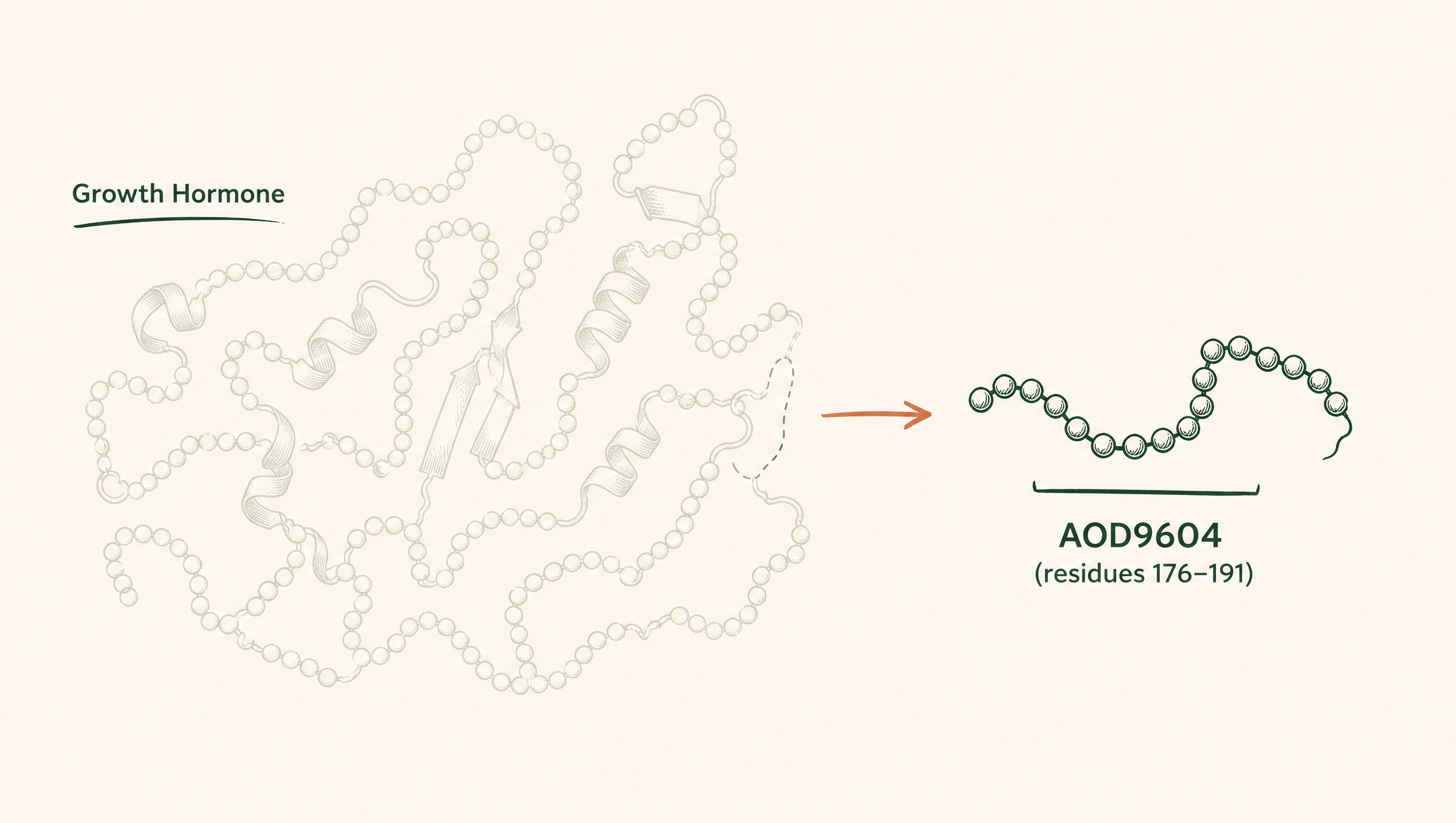
AOD9604 is a 16-amino-acid fragment extracted from the tail end of human growth hormone.
- It's a 16-amino-acid peptide (a short chain of the building blocks that make proteins) copied from the tail end of growth hormone, the stretch scientists label residues 176 to 191, with a single tyrosine added at the front to make it more stable, as described in the foundational work by Ng and colleagues (2000).
- It was developed by an Australian company, Metabolic Pharmaceuticals, and studied under the goal of treating obesity.
- Its nickname, the "lipolytic fragment," just means the fat-splitting piece. Lipolysis is your body breaking stored fat back down into fuel.
That's the whole idea in one sentence: keep growth hormone's fat message, drop everything else. Whether that idea survived contact with real human bodies is the rest of this story.
What does AOD9604 actually do in research?
In animal studies, AOD9604 has been observed to reduce fat gain and increase fat burning, without the blood-sugar downsides that come with full growth hormone. That last part is the interesting bit, and it's the reason the peptide got attention in the first place.
Here's the picture from the preclinical work, all of it in rodents or cells:
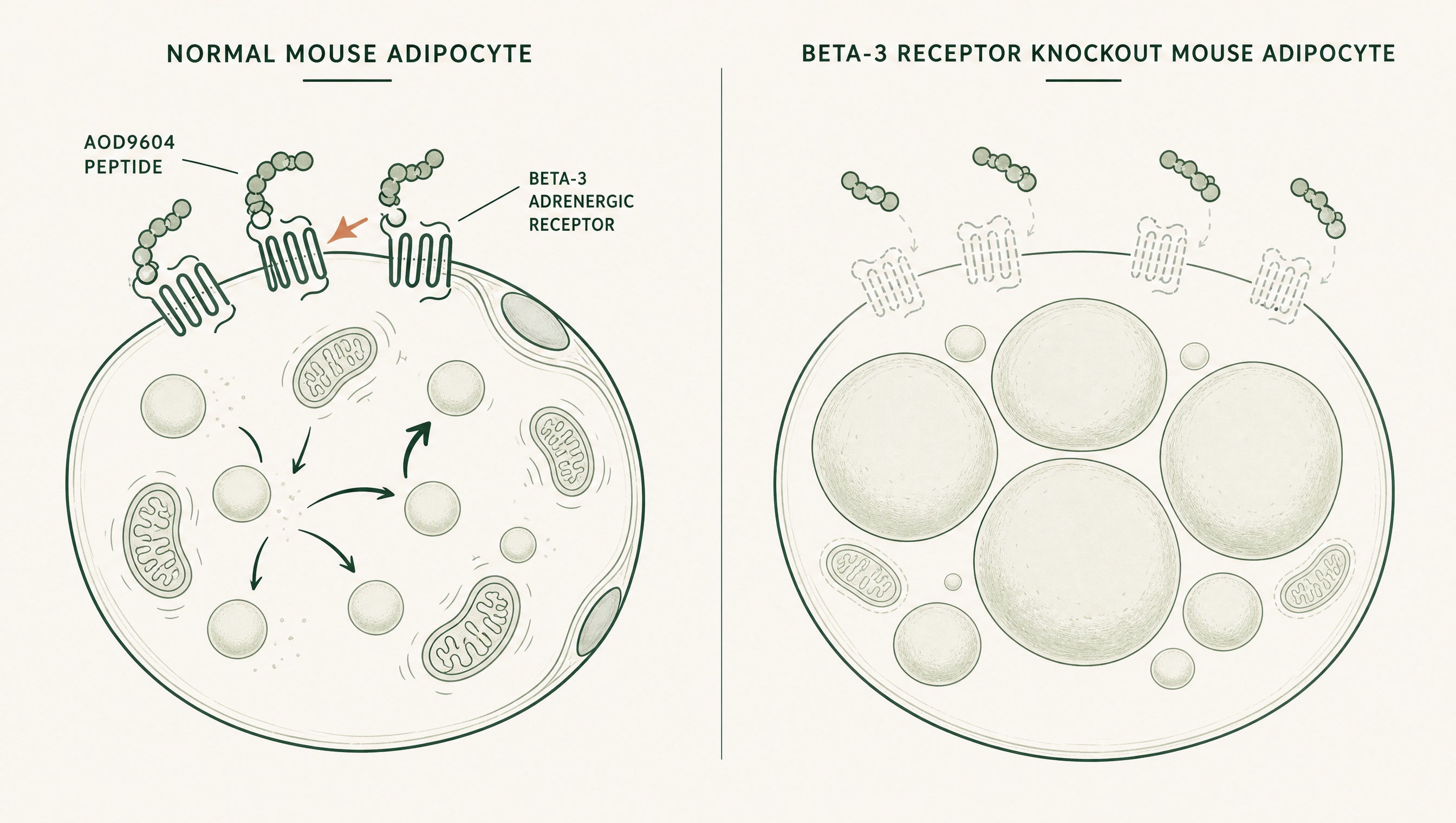
AOD9604 only triggers fat burning in mice that have a specific receptor on their fat cells.
- In obese Zucker rats (a strain bred to overeat), daily oral AOD9604 was observed to cut weight gain by more than half versus untreated animals, per Ng and colleagues (2000).
- In obese mice, the fat-loss effect depended on a specific switch called the beta-3 adrenergic receptor: mice bred without that switch lost the response entirely, which pinned down how the peptide is thought to work (Heffernan et al., 2001).
- Unlike growth hormone, AOD9604 did not lock onto the growth-hormone receptor or push cells to multiply in lab assays, and it did not raise glucose or insulin in those animals (Heffernan et al., 2001).
Every one of those findings comes from a rat, a mouse, or a dish of cells. None of it, on its own, tells you what happens in a person.
In our protocol design, the question we weigh most heavily is exactly that jump: does an elegant animal mechanism reproduce in humans, or does it evaporate? With AOD9604 the honest answer from the human data is sobering, and it's the part the marketing tends to skip. A clean mechanism in a mouse is a hypothesis, not a result.
Did AOD9604 work for weight loss in human trials?
No. When AOD9604 was tested in a full human weight-loss trial, it failed to beat a placebo, and the development program was discontinued in 2007. This is the single most important fact about the peptide, and it's the one buried deepest on the pages that sell it.
The human record is not tiny, which is what makes the result so telling:
- Across six randomized, placebo-controlled trials totalling roughly 900 obese adults, AOD9604's safety and tolerability were "indistinguishable from placebo," and it did not raise IGF-1 (a growth marker) the way growth hormone does, according to a pooled analysis by Stier and colleagues (2013).
- That same body of work is a safety story, not a success story: the pooled paper reports how well people tolerated the peptide, not that it melted fat.
- After an early smaller study hinted at a fat-loss signal, the larger pivotal trial did not reproduce it, and the sponsor ended the obesity program in 2007.
So what do you do with a compound that's safe but doesn't clearly work? Some users report a subjective sense of easier fat loss, but subjective reports from an uncontrolled setting are exactly what a placebo-controlled trial exists to check, and here the trial did the checking. Safe and ineffective is still ineffective.
Is AOD9604 legal or FDA-approved in 2026?
AOD9604 is not FDA-approved for any use in 2026, and recent regulatory moves have pushed it further from approval, not closer. If a seller implies otherwise, that's your signal to walk.
The current regulatory reality is unusually well dated:

Is AOD9604 legal or FDA-approved in 2026?
- No company has ever had AOD9604 approved as a drug by the FDA for obesity or anything else.
- In September 2023 the FDA placed AOD9604 in Category 2, its bucket for compounding substances with "significant safety concerns," citing issues like immunogenicity and limited human data, as summarized in an April 2026 analysis by FDA regulatory attorneys Snow and Palmer.
- The FDA's compounding advisory committee formally reviewed AOD9604 for its 503A "bulk drug substances" list at a meeting on December 4, 2024, per the official Federal Register notice, and it was not added.
You'll also see AOD9604 marketed as "GRAS," which sounds like an FDA seal of approval. It isn't. "GRAS" here means a company-convened panel declared it generally recognized as safe for use in foods; research suggests no FDA-issued GRAS notice number exists for it in the public inventory, so the label reflects the sponsor's own experts, not an FDA review.
Is AOD9604 banned in sport?
Yes. AOD9604 is prohibited by the World Anti-Doping Agency at all times, in and out of competition. If you compete in any tested sport, using it counts as a doping violation, no exceptions.
The anti-doping science is explicit on this point:
- Researchers built a urine test that can spot AOD9604 down to 50 picograms per millilitre (a picogram is a trillionth of a gram, so this is a very sensitive test), and their paper states plainly that the peptide "is prohibited by WADA as a potential performance-enhancing agent" (Cox et al., 2015).
- That same test tracks a leftover fragment of the peptide, which extends the window in which a test can catch it.
- It sits in WADA's peptide-hormone and growth-factor category, the same family that covers growth hormone itself.
The practical takeaway is short: no tested athlete should go near it.
Can you even take AOD9604 as a pill?
Barely, and that's a core problem for any oral peptide, not just this one. Most experts agree that swallowed peptides are largely destroyed before they reach your blood, and AOD9604 is no exception.
Picture your gut as a security checkpoint built to shred proteins into scraps for digestion. A peptide swallowed as a pill walks straight into that shredder.
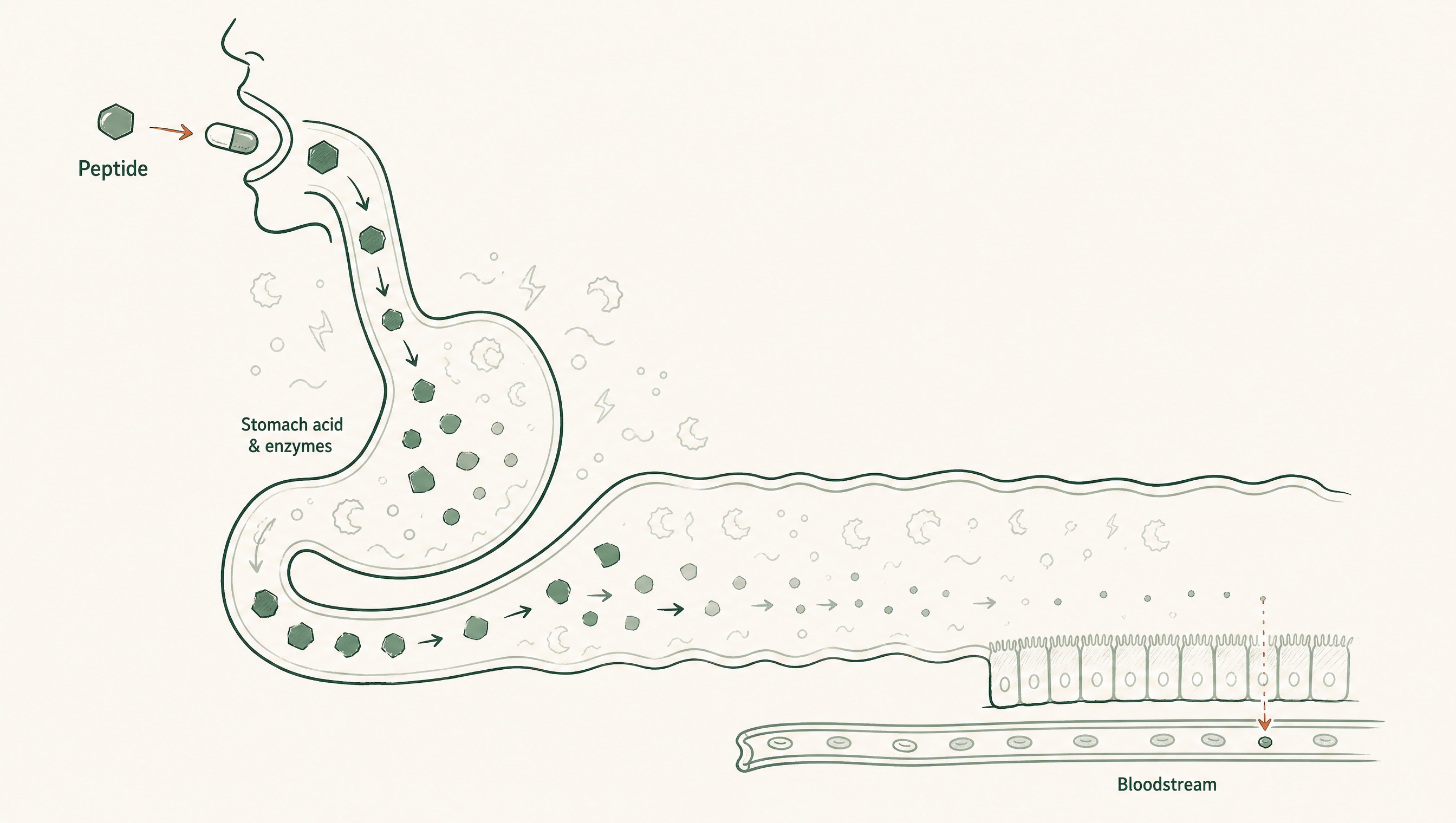
Most swallowed peptides are broken down by stomach acid before reaching your blood.
- Standard oral peptides typically deliver only a low-single-digit percentage of the dose into your bloodstream intact, which is why so much of what you swallow simply never arrives.
- The original AOD9604 trials used oral tablets, and pairing a weak signal in humans with poor oral delivery is a tough combination to overcome.
- This is the same delivery wall that shapes how VERO thinks about absorption: the VERISORB sublingual matrix (a formulation designed to be absorbed under the tongue rather than swallowed) exists precisely because the gut is such a hostile route for peptides.
If you want the deeper version of why swallowing peptides wastes most of the dose, our explainer on peptide pill bioavailability walks through the numbers.
How does AOD9604 compare to today's weight-loss peptides?
AOD9604 has been outrun by the field. The peptides that actually move the needle on weight in humans work through a completely different pathway, and they have the human trial data AOD9604 never produced.
A quick, honest comparison:
- The modern weight-loss peptides people talk about act on appetite and blood-sugar signalling, a different mechanism from AOD9604's fat-splitting idea, and what members experience with them is backed by large human trials rather than rodent studies alone.
- AOD9604's human evidence tops out at safety data plus one failed efficacy trial, which is why no regulator treats it as a weight-loss drug.
- If you're comparing options seriously, our best injectable peptide for weight loss guide lays out what the human evidence actually supports right now.
Put simply: AOD9604 is a historical footnote in fat-loss research, not a front-runner. That's not a knock on the original science, it's just where the evidence landed.
Frequently Asked Questions
Is AOD9604 a steroid? No. AOD9604 is a peptide (a short chain of amino acids) copied from growth hormone, not a steroid hormone. It works, in animal research, through a different pathway entirely.
Does AOD9604 raise growth hormone or IGF-1? In the human safety data, AOD9604 did not raise IGF-1 the way full growth hormone does, per Stier et al. (2013). That was one of its intended design features.
Why did AOD9604 development stop? Because the larger human weight-loss trial did not reproduce the fat-loss signal seen in a smaller earlier study, and the sponsor ended the obesity program in 2007. Safety was never the issue; efficacy was.
Can I legally buy AOD9604? It's sold widely as a "research chemical," but it's not FDA-approved for human use, it was declined for the FDA compounding list in December 2024, and it's banned in sport by WADA. Treat any human-use marketing with heavy skepticism.
Is AOD9604 safe? In trials it was tolerated about as well as placebo across roughly 900 adults, but "well tolerated in a short trial" is not the same as "proven safe for long-term self-use," and the FDA has flagged open safety questions. This is educational content, not medical advice.
Curious what the human evidence actually supports for metabolism and body composition? Browse VERO's range at /protocols. This article is for research and educational purposes only and is not medical advice.
Clinical Context
Important Notice: VERO protocols are nutritional and systemic optimisation formats. They are not intended to diagnose, treat, cure, or prevent any medical condition. These statements have not been evaluated by the Food and Drug Administration.