
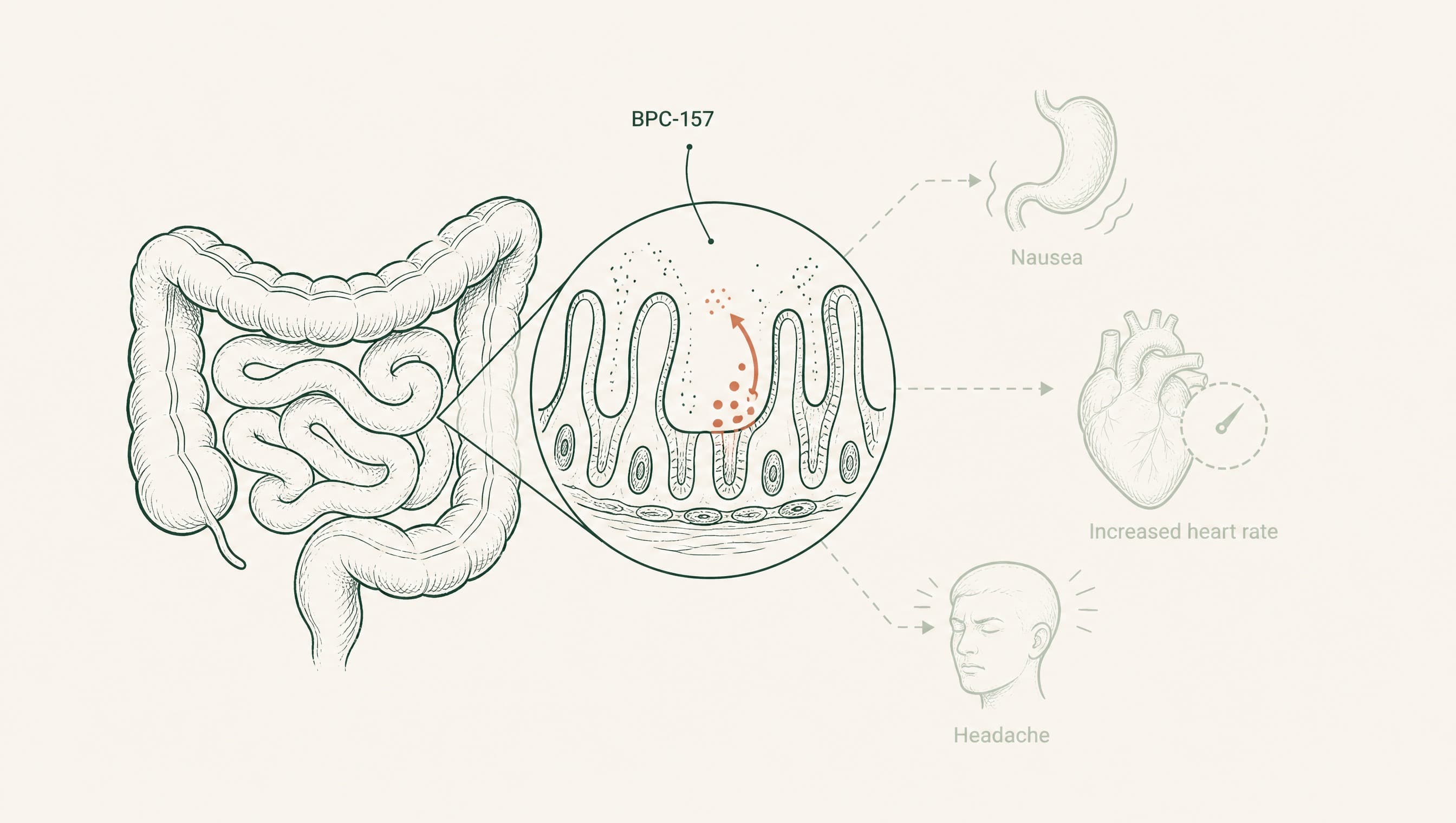
BPC-157 side effects, honestly graded: what animal toxicology and the three human pilot studies show, plus the cancer and blood-thinner questions that stay open.
The side effects people report most from BPC-157 are mild and short-lived: injection-site soreness, nausea, headache, dizziness, and tiredness. The catch is that almost none of that comes from controlled human trials. It comes from animal studies and from what people using it say about themselves, which is a much weaker kind of evidence.
This guide walks through what the research on BPC-157 side effects actually shows, where the real safety questions sit, and who has good reason to steer clear. If you want the upside instead, our BPC-157 benefits guide covers that separately. Everything here is published for research purposes only, and a structured approach like the RESTORE protocol exists precisely because this safety picture rewards caution over hype.
The short version is easy to hold in your head. The animal safety record looks clean, the human record is tiny, and two questions stay wide open.
Key Takeaways
- In animal toxicology, no lethal dose of BPC-157 has ever been reached, even at doses far above what any person would use.
- The entire human safety record is three small pilot studies, one of them an intravenous test in just two people.
- Reported side effects (injection-site soreness, nausea, headache, dizziness, fatigue) are mostly mild and come from user reports, not controlled trials.
- Two open questions matter most: a theoretical cancer concern tied to blood-vessel growth, and untested interactions with blood thinners.
- BPC-157 is banned in sport (WADA category S0) and sat in the FDA's restrictive Category 2 for compounding from September 2023, with a formal reconsideration set for July 2026.
What Are the Actual Side Effects People Report?
The side effects tied to BPC-157 are mostly mild, short-lived, and self-reported rather than measured in a lab. Think of the difference between a friend telling you a coffee gave them the jitters and a trial that counts exactly how many people it happened to. Almost all the BPC-157 side-effect list is the first kind.
Here's what shows up most often in user reports:
- Injection-site reactions: redness, itching, or soreness where a needle went in
- Nausea or an upset stomach, more common with oral use or higher amounts
- Dizziness or lightheadedness, often early on
- Headache, usually mild
- Fatigue, vivid dreams, or changes in sleep and mood
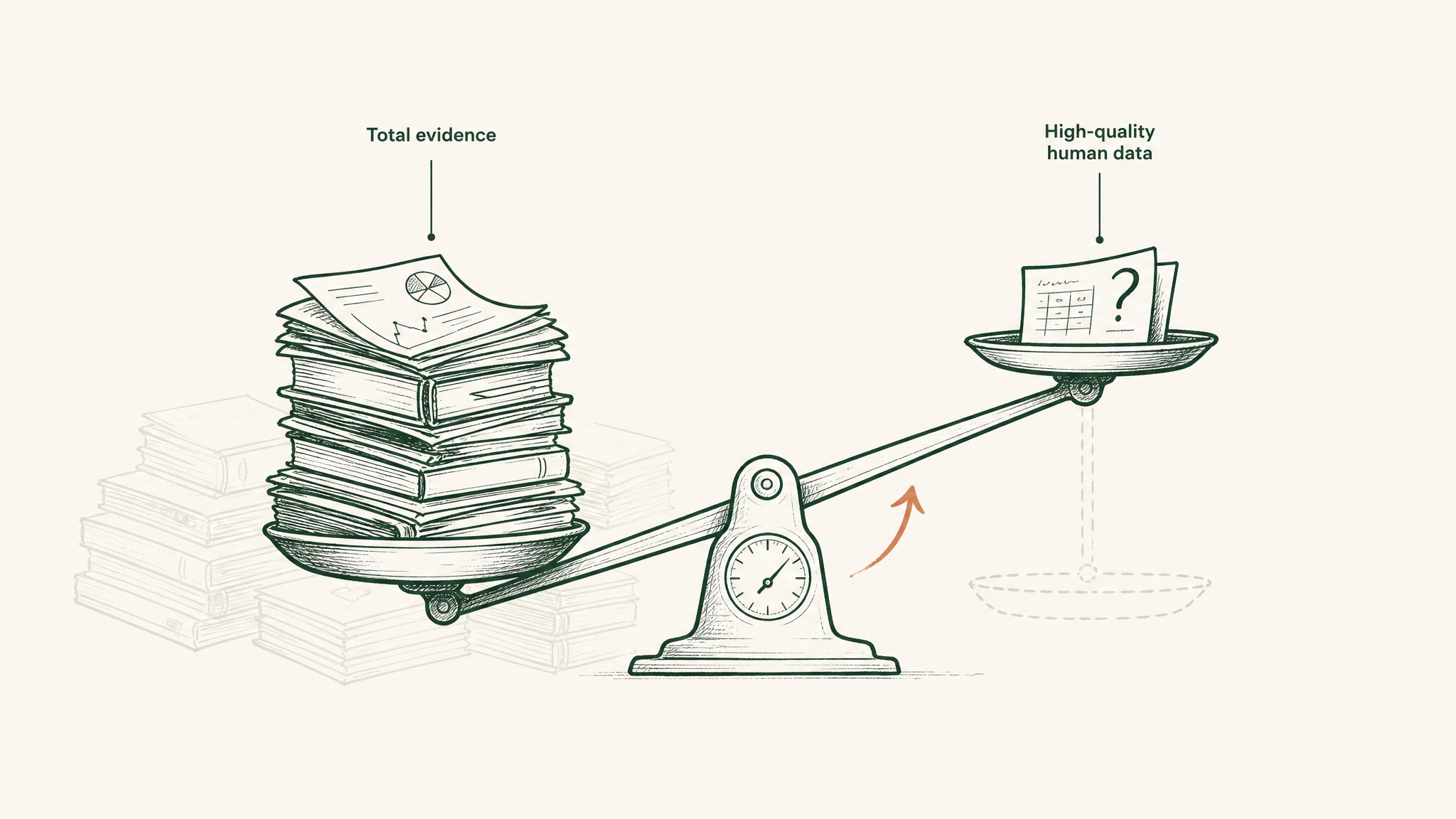
The honest problem is that nobody has counted these properly. A 2025 review in Current Reviews in Musculoskeletal Medicine found the whole human evidence base is three pilot studies, so injection-site reaction rates have never been formally quantified in a controlled trial. When users report a side effect, that's a signal worth respecting, not a statistic you can trust to a percentage. Any round number you see online (like "15 to 25% of users") has no study behind it.
How Safe Is BPC-157 in Animal Toxicology?
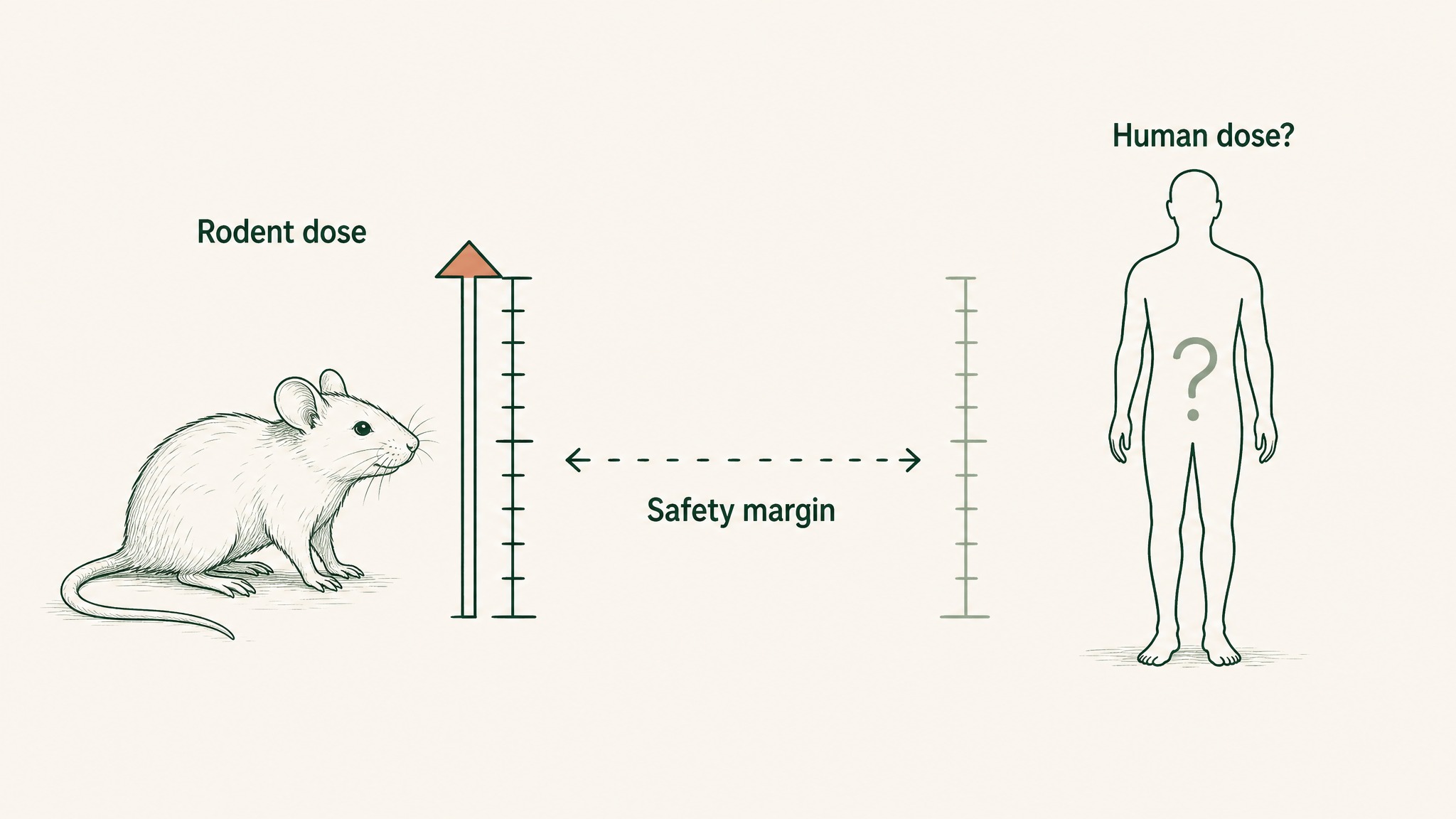
In animal toxicology, BPC-157 has one of the cleaner records you'll see for a research peptide: no lethal dose has ever been established. A 2021 review in Frontiers in Pharmacology reports that a lethal dose 1, the amount expected to kill 1% of animals, could not be obtained across the toxicology work. That's unusual, and it's the single strongest thing the safety data has going for it.
A few concrete anchors from the animal studies:
How Safe Is BPC-157 in Animal Toxicology?
- A formal preclinical safety evaluation in mice, rats, rabbits, and dogs found the peptide well tolerated, with no serious toxicity and no genotoxicity or embryo-fetal harm.
- In that dog study, the one measurable blip was a drop in creatinine (a kidney marker), which resolved on its own after a two-week washout.
- A 2025 commentary noted that the complete absence of toxic effects at very high doses, a genuinely huge dose, was "surprising."
That word "surprising" is worth sitting with. Clean animal data is reassuring, but a result that looks too clean is also a nudge to keep asking questions rather than declare victory. Animal safety is not the same as human safety, and BPC-157 is a textbook case of that gap.
What Does the Human Safety Data Actually Show?
Here's the part most articles skate past: the entire human safety record for BPC-157 is three small pilot studies. Not three thousand people. Three studies. A 2025 review counts them precisely as tests for intra-articular knee pain, interstitial cystitis, and intravenous safety.
The most-cited of those is smaller than you'd guess:
What Does the Human Safety Data Actually Show?
- A 2025 intravenous safety pilot dosed just two healthy adults with a test dose, and reported no adverse effects and no abnormal heart, liver, kidney, thyroid, or blood-sugar readings.
- A registered phase 1 trial, NCT02637284, was cancelled with its status unknown, so no larger human safety dataset came out of it.
- Because no long-term human trial has run, nothing is known about what repeated or extended human use does over months or years.
Two people is a signal, not a safety guarantee. Research suggests BPC-157 is well tolerated at the doses tested, but "tested" here means a handful of volunteers over a few days. That's the difference between "no fires reported" and "we checked the wiring." The wiring has not been checked at scale.
Can BPC-157 Interact With Blood Thinners?
The blood-thinner question is real, unresolved, and not what most people assume. The intuition is that a repair peptide might raise bleeding risk. The animal data actually points the other way, which is its own kind of complication.
In a 2015 rat study in PLOS ONE, BPC-157 was observed to reduce bleeding time and counteract low platelet counts in animals given heparin and warfarin, two common blood thinners. In plain terms, in those rats it pushed against the thinner rather than adding to it. That could matter if you rely on a blood thinner doing its job.
Two cautions before anyone reads that as reassuring:
- This is a rat finding, and no human interaction study has ever been run, so the effect in a person on warfarin or heparin is genuinely unknown.
- A peptide that nudges clotting in either direction is exactly the kind of thing you'd want a prescriber watching if you're on anticoagulants.
If you take a blood thinner, this is a conversation for the doctor who manages it, not a footnote.
Does BPC-157 Cause Cancer?
There's no evidence that BPC-157 causes cancer, and there's still a specific reason to be careful. The concern isn't that it starts tumours. It's about what it might do to one that already exists but hasn't been found yet.
BPC-157 works partly through angiogenesis, the growing of new blood vessels. In rats with restricted hind-limb blood flow, it was observed to increase expression of the VEGFR-2 receptor, a switch involved in new-vessel growth. The catch is that tumours also need new blood vessels to grow, and the same VEGF signalling system shows up in roughly half of the human cancers that have been studied.
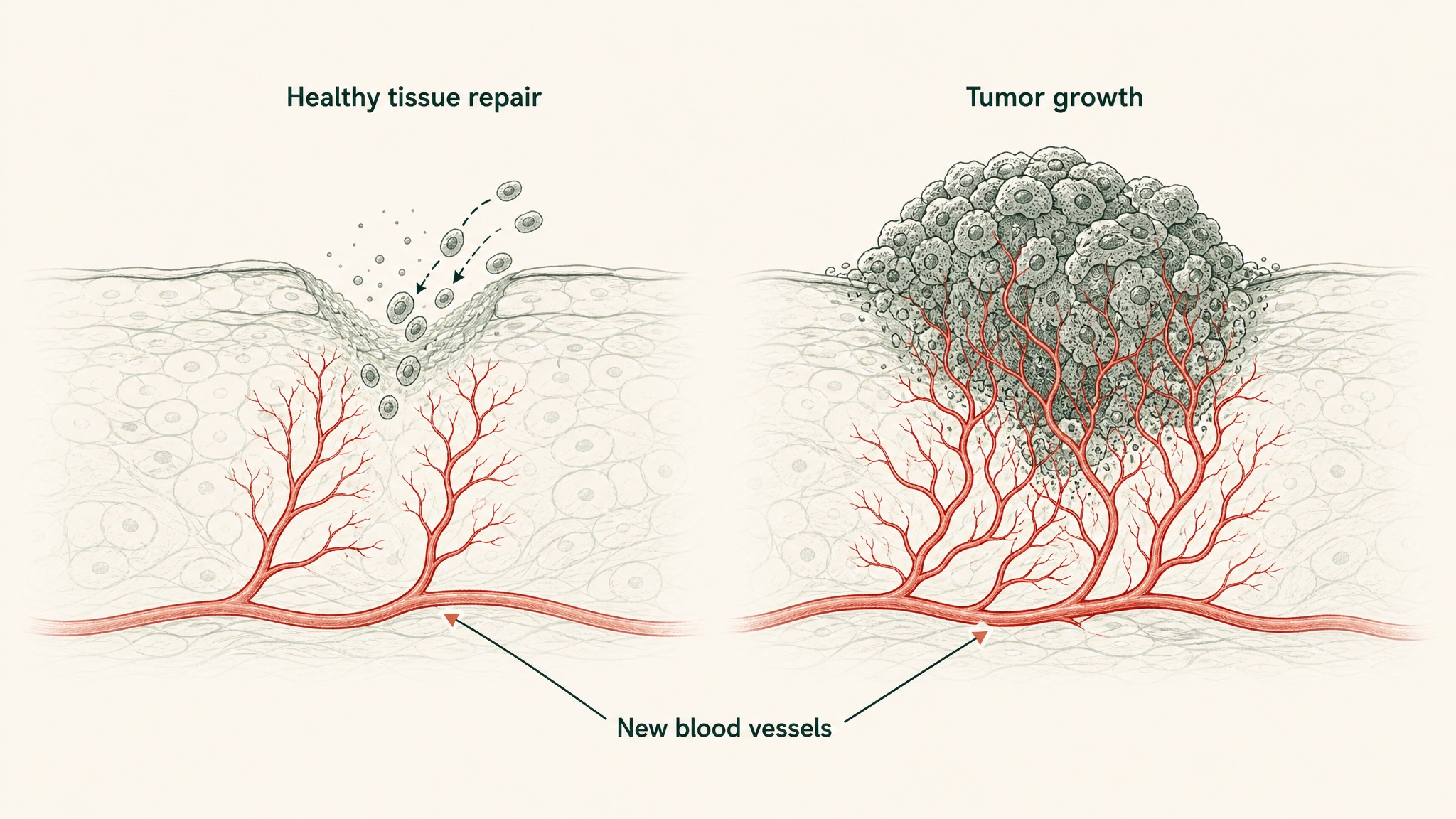
How new blood vessel growth feeds both, tissue and undetected tumors.
In our protocol design, the question we weigh most heavily is exactly this one: not what a compound does for a healthy tissue, but what it might do for a tissue you don't yet know is there. That's why the cautious reading, and the one the 2025 review authors take, is that BPC-157 "may not be the right choice" in anyone who could be carrying undiagnosed cancer cells. It's a theoretical risk, not a proven one, but it's the right kind of caution for a compound with almost no long-term human data.
Why Does Delivery Route Change the Side-Effect Picture?
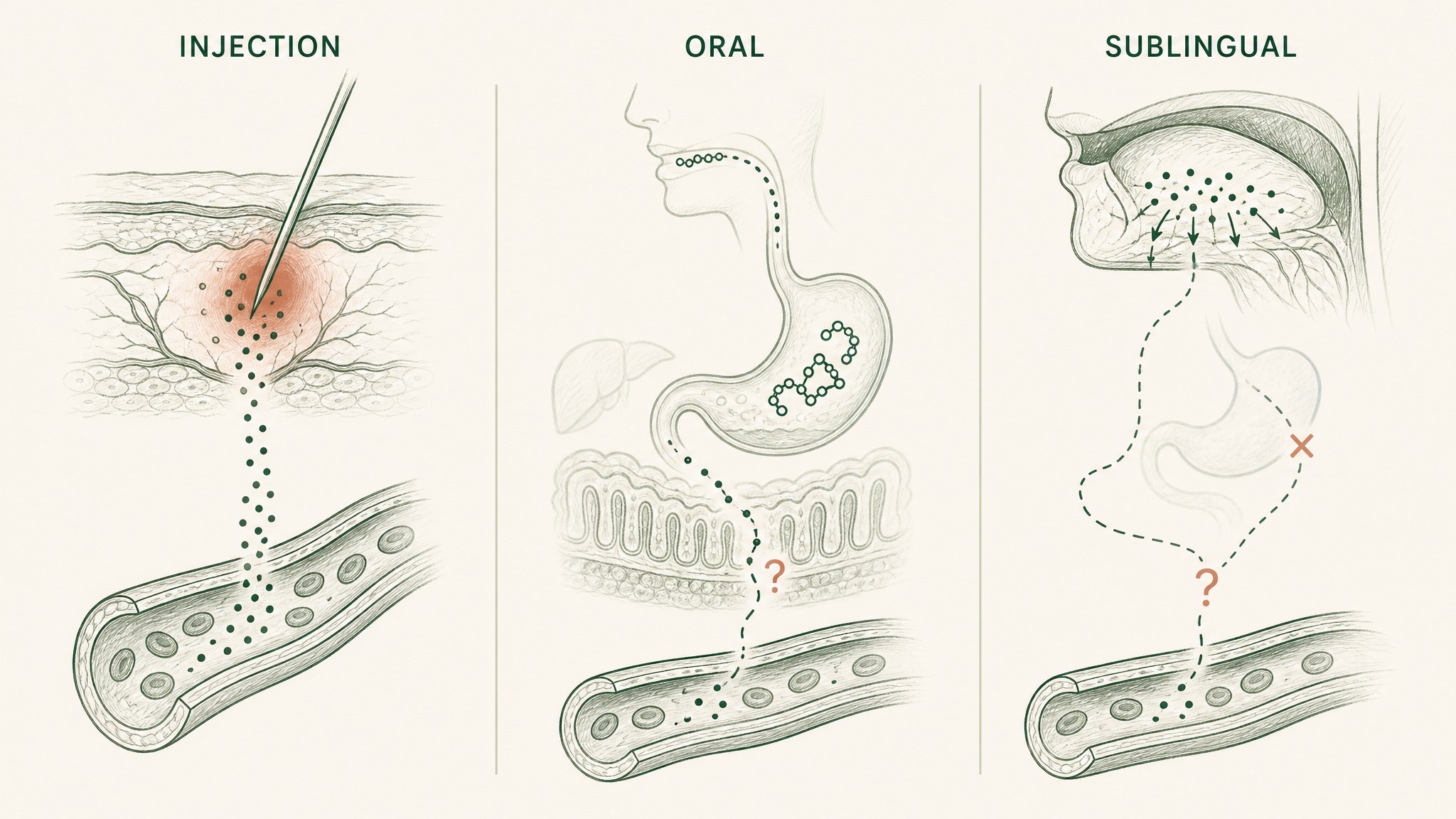
How you take BPC-157 shapes both the side effects and how much of it reaches your bloodstream. Picture your stomach as a shredder: swallow a peptide in a plain capsule and most of it gets torn apart before it does anything. That's why injections dominate the research, and it's also where injection-site reactions come from in the first place.
The absorption numbers make the point:
Oral peptides are destroyed by stomach acid; sublingual delivery bypasses digestion entirely.
- In animal pharmacokinetics, BPC-157's bioavailability (how much of a dose reaches the bloodstream intact) was measured in rats and dogs, with an elimination half-life under 30 minutes.
- A needle means sterile technique matters: non-sterile injecting is a real infection risk that has nothing to do with the molecule itself.
This is where a sublingual (under-the-tongue) route earns its keep. It skips the shredder without a needle, which removes the injection-site problem entirely. It's the reason members experience VERO's RESTORE protocol through the VERISORB sublingual matrix rather than a vial and syringe, since absorption is what makes a non-injected route worth using at all. For the dosing side of this, our BPC-157 dose guide breaks down amounts by route.
Who Should Be Most Cautious With BPC-157?
Some people carry more risk than the mild side-effect list suggests, and they're easy to name. The thin human evidence base means "we don't know" applies more heavily to anyone already in a fragile spot. Caution here isn't fear, it's matching the decision to how little is actually known.
The groups with the clearest reasons to avoid it:
- Anyone with a personal or family cancer history, given the angiogenesis question above
- Anyone on blood thinners, until a prescriber has weighed the interaction
- Pregnant or breastfeeding people, since no human safety data exists for them
- Competing athletes, because it's banned and can end a career (more below)
- Anyone who can't guarantee a sterile source and clean technique for an injectable
None of that is a moral judgment on the compound. It's just that "no long-term human data" lands hardest on people who already have something to protect.
What Is the Regulatory and Anti-Doping Status in 2026?
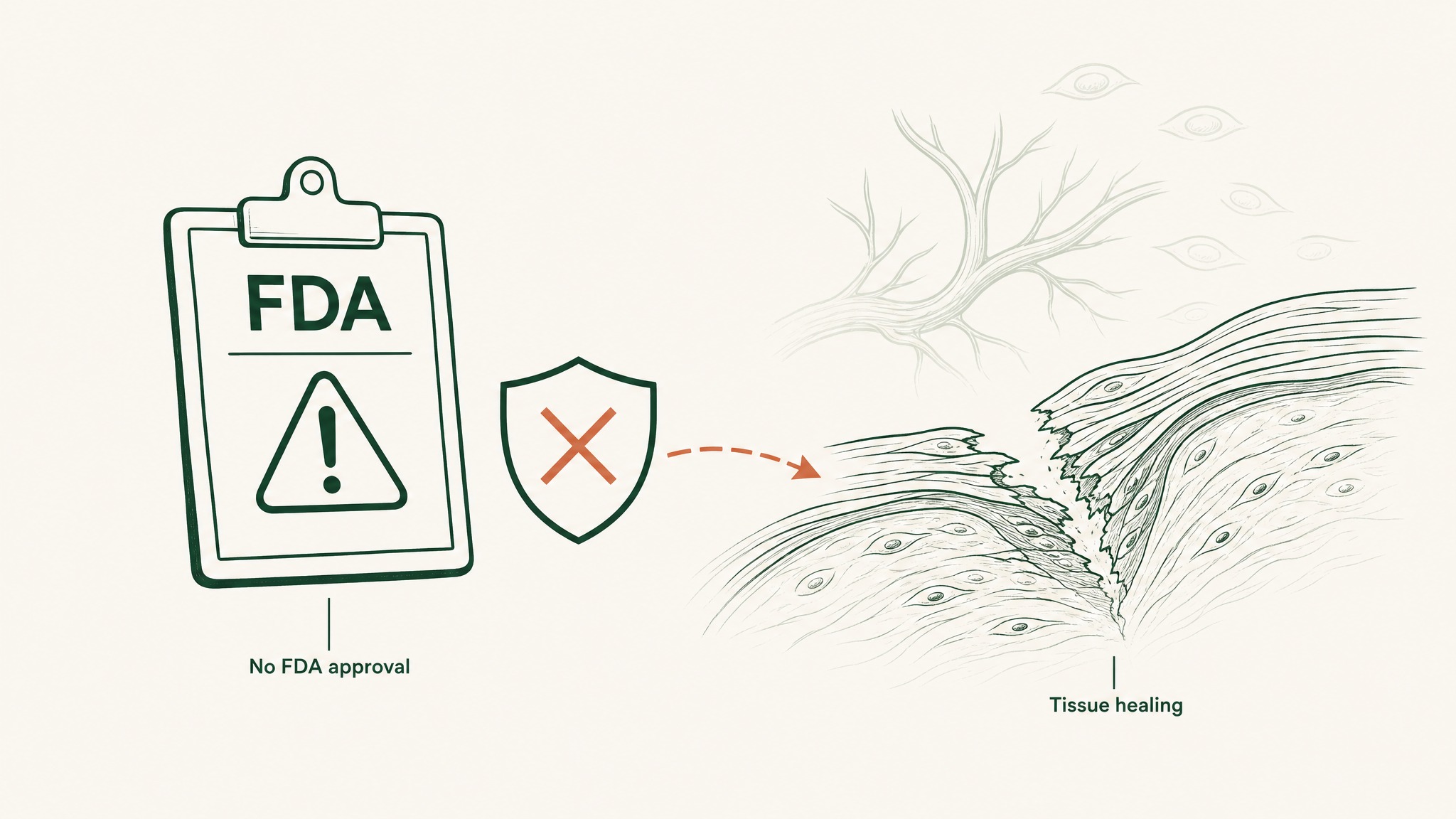
BPC-157 is not an approved medicine anywhere, and its rules tightened sharply before starting to shift again. A 2025 review is blunt about the bottom line: "BPC-157 should be considered investigational, and its use approached with caution," per the authors. That single sentence captures the regulatory mood better than any status label.
The key dates, in order:
What Is the Regulatory and Anti-Doping Status in 2026?
- In 2022, the World Anti-Doping Agency banned BPC-157 under category S0, its bucket for non-approved substances, with therapeutic-use exemptions unlikely to be granted to athletes.
- In September 2023, the FDA placed it in Category 2 for compounding, citing impurity and characterization concerns, which effectively kept it out of compounded medicines.
- The FDA scheduled a compounding advisory committee to reconsider BPC-157 and several other peptides on July 23 to 24, 2026, so the status is actively in motion rather than settled.
USADA puts the safety gap plainly: because BPC-157 hasn't been studied much in humans, it's unknown whether there's a safe dose at all. For the full regulatory story and what the 2026 committee vote actually changed, see our BPC-157 FDA regulatory status explainer.
Frequently Asked Questions
What are the most common BPC-157 side effects?
The most commonly reported are injection-site soreness, nausea, headache, dizziness, and fatigue, and they tend to be mild and short-lived. These come from user reports, not controlled trials, so no reliable percentage exists for how often each happens.
Is BPC-157 dangerous?
Animal toxicology has never found a lethal dose, even at very high amounts, which is reassuring as far as it goes. The real limitation is that human safety rests on only three small pilot studies, so long-term and rare risks in people are genuinely unknown.
Can BPC-157 cause cancer?
There's no evidence it causes cancer. The theoretical concern is that it supports new blood-vessel growth, which tumours also rely on, so the cautious view is to avoid it if you might carry undiagnosed cancer cells.
Does BPC-157 interact with blood thinners?
In rats, BPC-157 was observed to reduce bleeding time even alongside heparin and warfarin, suggesting it could work against a blood thinner. No human interaction study exists, so anyone on anticoagulants should raise this with the prescriber who manages it.
Is BPC-157 safe to take orally?
Plain oral capsules are broken down heavily in the gut, so most of the dose never reaches the bloodstream. Sublingual delivery under the tongue avoids that loss without a needle, which also removes injection-site side effects.
Is BPC-157 banned or legal?
BPC-157 is not FDA-approved for any condition and is prohibited in sport under WADA category S0. It sat in the FDA's Category 2 for compounding from September 2023, with a formal reconsideration scheduled for July 2026.
References
- Seiwerth S, et al. Stable gastric pentadecapeptide BPC 157 and wound repair: mechanistic review. Frontiers in Pharmacology, 2021. https://pmc.ncbi.nlm.nih.gov/articles/PMC8275860/. Retrieved 2026-08-28.
- Xu C, et al. Preclinical safety evaluation of body protective compound-157 across four species. Regulatory Toxicology and Pharmacology, 2020. https://doi.org/10.1016/j.yrtph.2020.104665. Retrieved 2026-08-28.
- He L, et al. Pharmacokinetics, distribution, metabolism and excretion of body-protective compound 157 in rats and dogs. Frontiers in Pharmacology, 2022. https://pmc.ncbi.nlm.nih.gov/articles/PMC9794587/. Retrieved 2026-08-28.
- Stupnisek M, et al. Pentadecapeptide BPC 157 and bleeding, thrombocytopenia and anticoagulant response after amputation in rats. PLOS ONE, 2015. https://journals.plos.org/plosone/article?id=10.1371/journal.pone.0123454. Retrieved 2026-08-28.
- Józwiak M, et al. Multifunctionality and possible medical application of the BPC 157 peptide: literature and patent review. Pharmaceuticals (Basel), 2025. https://pmc.ncbi.nlm.nih.gov/articles/PMC11859134/. Retrieved 2026-08-28.
- Józwiak M, et al. Reply on BPC 157 angiogenesis, nitric oxide and toxicology commentary. Pharmaceuticals (Basel), 2025. https://pmc.ncbi.nlm.nih.gov/articles/PMC12567171/. Retrieved 2026-08-28.
- Lee E, Burgess K. Safety of intravenous infusion of BPC157 in humans: a pilot study. Alternative Therapies in Health and Medicine, 2025. https://pubmed.ncbi.nlm.nih.gov/40131143/. Retrieved 2026-08-28.
- McGuire FP, et al. Regeneration or risk? A narrative review of BPC-157 for musculoskeletal research. Current Reviews in Musculoskeletal Medicine, 2025. https://pmc.ncbi.nlm.nih.gov/articles/PMC12446177/. Retrieved 2026-08-28.
- USADA. BPC-157: experimental peptide and anti-doping risk for athletes. https://www.usada.org/spirit-of-sport/bpc-157-peptide-prohibited/. Retrieved 2026-08-28.
- BioSpace. FDA mulls compounding for peptides previously flagged over safety risks. https://www.biospace.com/fda/fda-mulls-compounding-for-peptides-previously-flagged-over-safety-risks. Retrieved 2026-08-28.
Researching tissue-repair peptides the careful way? See the RESTORE protocol →
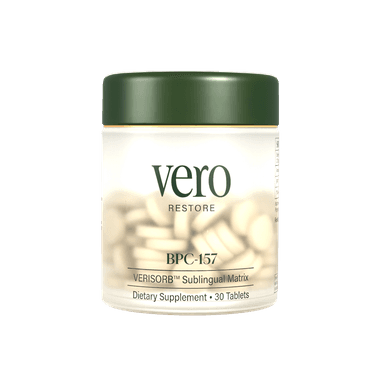
RESTORE™
BPC-157Engineered around 0.5mg BPC-157 (arginate salt). Accelerates deep tissue and joint recovery
Clinical Context
Important Notice: VERO protocols are nutritional and systemic optimisation formats. They are not intended to diagnose, treat, cure, or prevent any medical condition. These statements have not been evaluated by the Food and Drug Administration.