
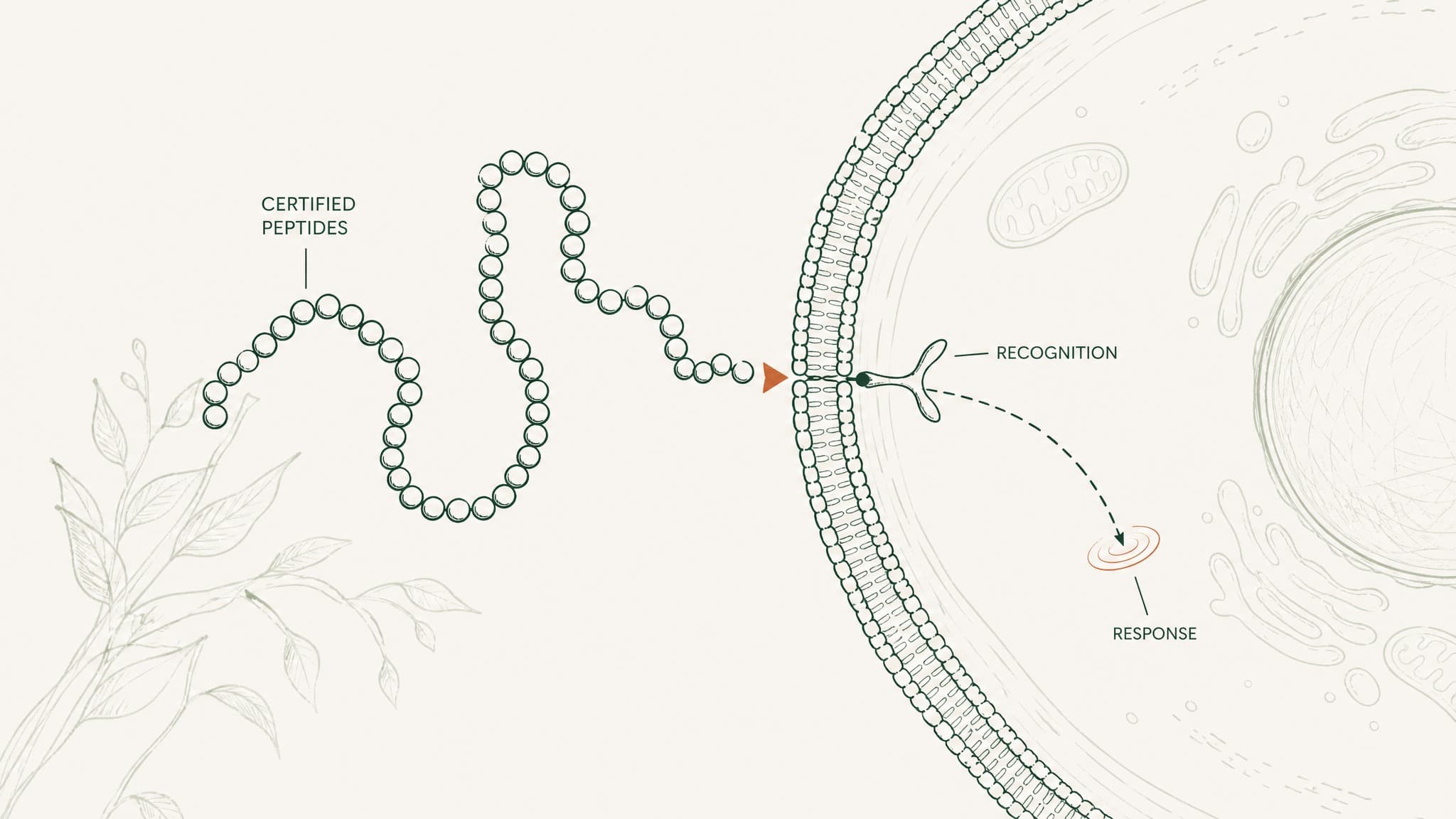
'Certified peptides' is a quality claim, not an FDA approval. Here's what a real Certificate of Analysis shows, and how to check one before you trust it.
"Certified peptides" is a quality claim, not a government seal. It usually isn't, at least not in the way most people assume. When a seller calls a peptide "certified," they almost always mean it comes with quality paperwork, most often a Certificate of Analysis (a lab report on one specific batch), not that any government agency has signed off on it.
That distinction matters more than any marketing badge. A certificate tells you what a lab found in a sample. It says nothing about whether the compound is cleared for use in people, and research peptides are sold for research purposes only.
So the useful question isn't "is this certified?" It's "certified by whom, testing what, and does the paperwork match the exact bottle in front of me?" That is the same batch-level documentation a research brand like VERO publishes for a protocol such as RESTORE, and it's what this guide teaches you to read.
Key Takeaways
- "Certified" is a quality claim, not a regulatory approval. Research peptides are sold for research use only, and BPC-157 remains unapproved for human use by the FDA and other regulators (Józwiak et al. 2025, PMC11859134).
- A real Certificate of Analysis is batch-specific and reports identity, purity by HPLC, and contaminant screens. USP peptide reference standards are held to a window of 95.0 to 105.0 percent of labeled value (McCarthy et al. 2023, PMC10338602).
- Label and reality can diverge. In one analysis of the same peptide from 5 suppliers, 1 was a completely different compound and two-thirds of the rest fell below 95 percent purity or carried impurities above 1 percent (Bagnato et al. 2008, PubMed 18342612).
- Contamination is uneven, not universal. In one testing lab's self-reported set of 140 endotoxin tests on gray-market peptides, about 8 percent exceeded the lab's limit (Finnrick, accessed 2026).
- The safest check is simple: demand a batch-matched, third-party COA, and treat "certified" with no document behind it as marketing.
What Does "Certified Peptides" Actually Mean?
"Certified peptides" is an industry quality claim, not a legal category or a government seal. Most of the time it means what the wider industry means by it: research peptides sold with batch documentation and third-party testing. That is the consensus, and it's broadly correct.
Here's where it gets slippery. "Certified" has no fixed definition, so two sellers can use the word to mean very different things:
- A batch-specific Certificate of Analysis from an outside lab (the strong version).
- A generic, undated purity claim the seller wrote themselves (the weak version).
- ISO or GMP language about the facility, which describes the factory's process, not the vial you received.
- Nothing testable at all, just the word printed on a page.
The word does no work on its own. What matters is the document behind it, who produced that document, and whether it names your exact batch number. Research suggests the gap between a real certificate and a decorative one is where most buyers get misled.
Is "Certified" the Same as FDA-Approved?
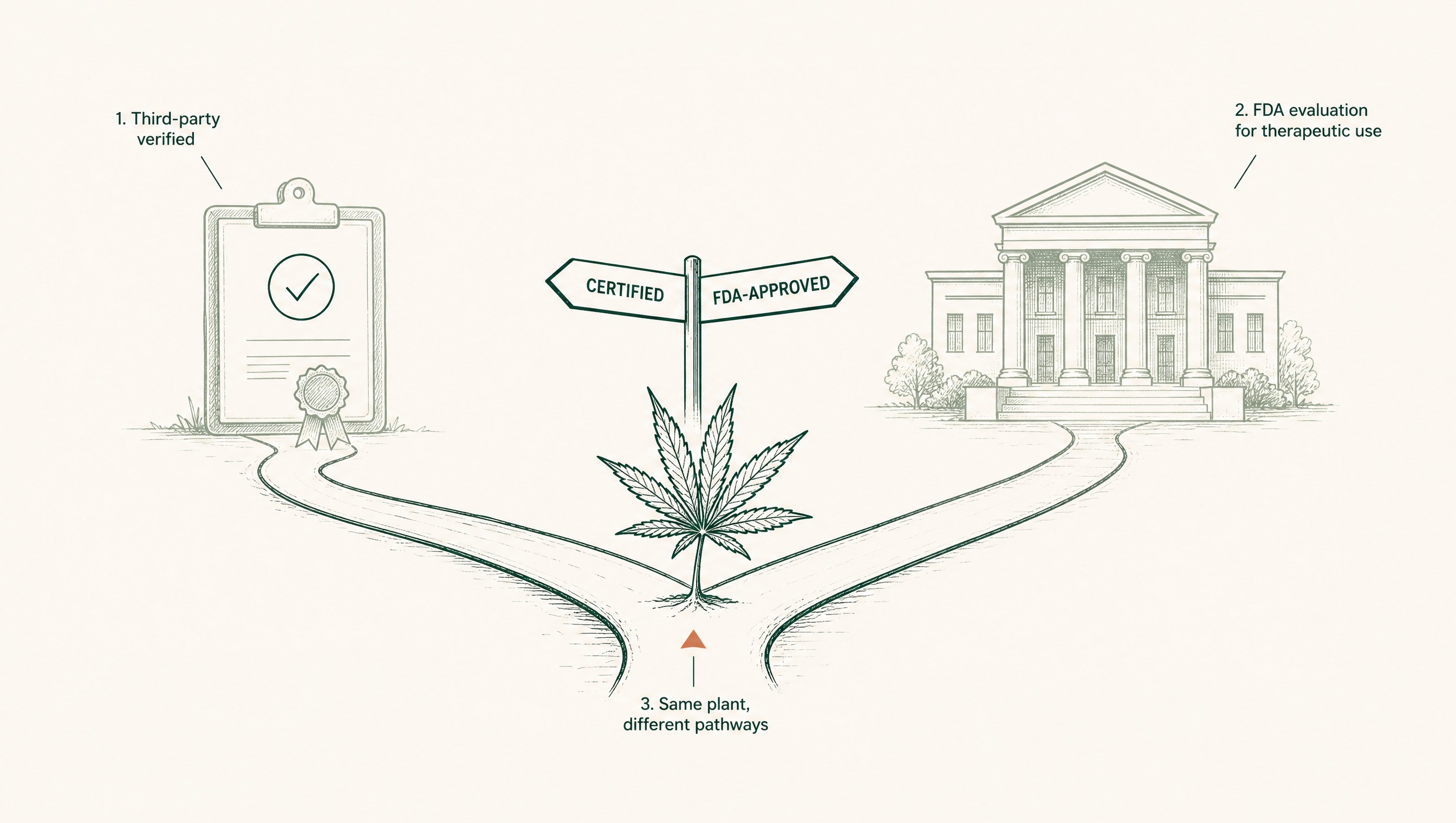
No. A certificate tells you what's in the bottle; FDA approval tells you a compound is considered safe and effective enough to be sold as a medicine. Those are different questions, and most research peptides answer only the first.
Take BPC-157, the most talked-about example. A 2025 peer-reviewed review states plainly that BPC-157 "has not been approved for use in standard medicine by the FDA and other global regulatory authorities due to the absence of sufficient and comprehensive clinical studies" (Józwiak et al. 2025, PMC11859134). Certified or not, that status is unchanged.
Is "Certified" the Same as FDA-Approved?
The regulatory picture has actually moved a lot, which is exactly why "certified" can mislead:
- September 2023: the FDA placed BPC-157 and other peptides in a compounding "Category 2," flagging significant safety questions (FDA compounding policy).
- April 2026: the FDA removed BPC-157 and other peptides from that category.
- July 2026: an FDA advisory committee voted to recommend 6 of 7 reviewed peptides for a compounding list (NPR/KUNC 2026).
Notice what never happened in that timeline: none of these peptides became FDA-approved. The status shifted three times, and "approved for human use" was never one of the outcomes. A certificate cannot grant an approval the compound does not have.
What Should a Real Certificate of Analysis Show You?
A real Certificate of Analysis is a batch-specific lab report that confirms a peptide's identity, measures its purity, and screens for contaminants. Think of it as a nutrition label written by an outside lab, tied to one specific production run, not to the brand's marketing team.
The numbers on a serious certificate have real reference points behind them. USP peptide reference standards, the yardsticks labs calibrate against, are held to a window of 95.0 to 105.0 percent of the labeled value (McCarthy et al. 2023, PMC10338602). For synthetic peptide drug applications, FDA guidance expects sponsors to identify and control individual impurities down to fractions of a percent (FDA / Federal Register 2021).
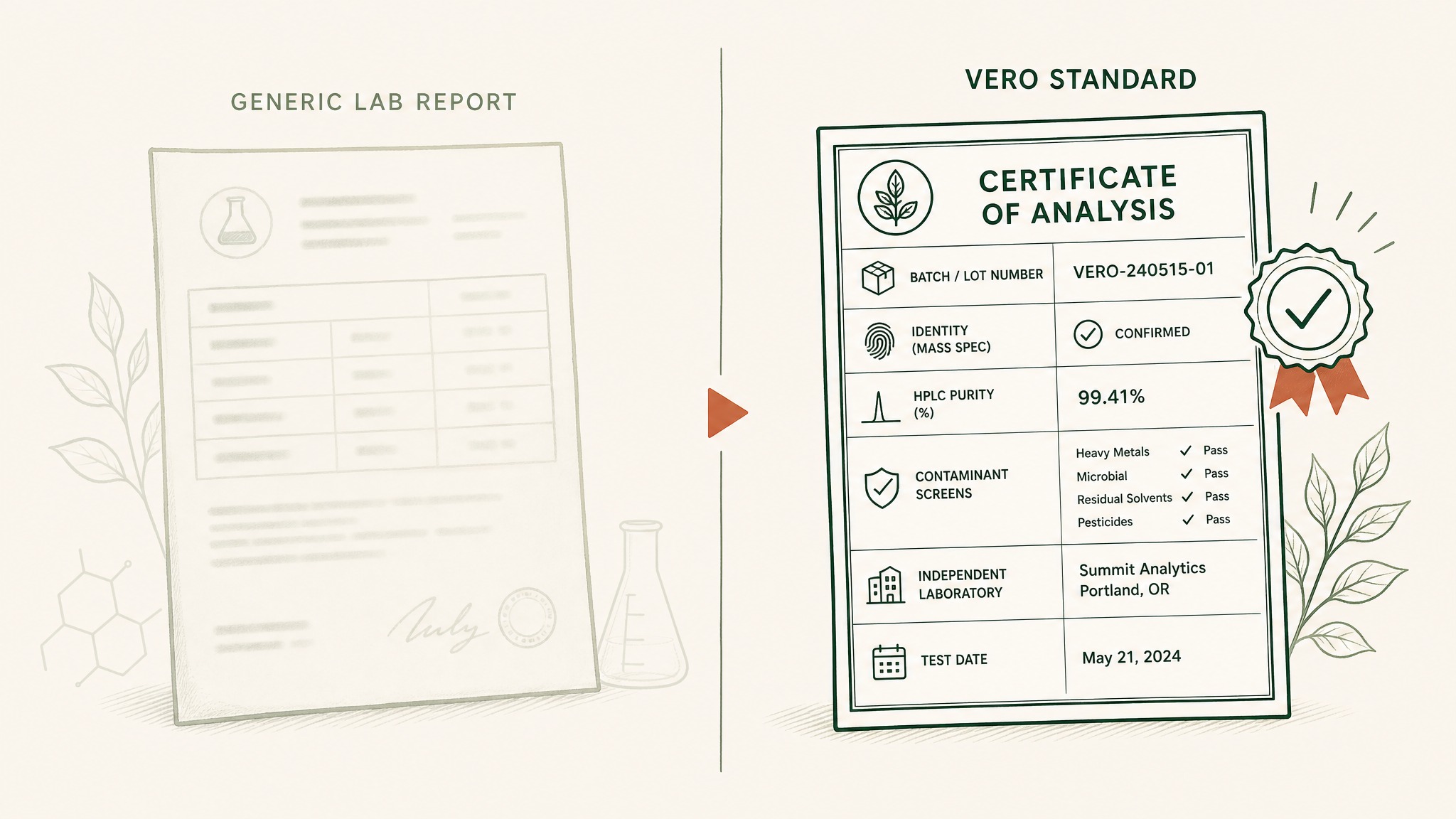
A real Certificate of Analysis lists your batch number, purity percentage, and independent lab name, not generic claims.
A certificate worth trusting names most of these:
- The exact batch or lot number, matching your bottle.
- Identity confirmation, usually mass spectrometry (a chemical fingerprint of the molecule).
- Purity by HPLC, reported as a percentage, not a vague "high purity."
- Contaminant screens: heavy metals, bacterial endotoxin, residual solvents.
- The name of an independent, accredited lab, plus the test date.
Here's the difference laid out plainly:
| What you're checking | "Certified" on its own | A real batch COA |
|---|---|---|
| Regulatory approval | None implied | None (research use only) |
| Batch-specific | Usually not | Yes, names your lot |
| Purity | Vague claim | HPLC percentage |
| Contaminant screening | Rarely shown | Heavy metals, endotoxin, solvents |
| Independent lab | Often self-reported | Named, accredited third party |
In our protocol design, the question we weigh most heavily is whether the certificate belongs to the exact lot in the bottle you receive, not a flattering sample from a different run. A generic certificate that never changes batch to batch is telling you the brand tests an idea of the product, not the product itself. It's the standard a research brand should hold every batch to, including our own RESTORE Protocol.
How Often Do Unregulated Peptides Miss What's on the Label?
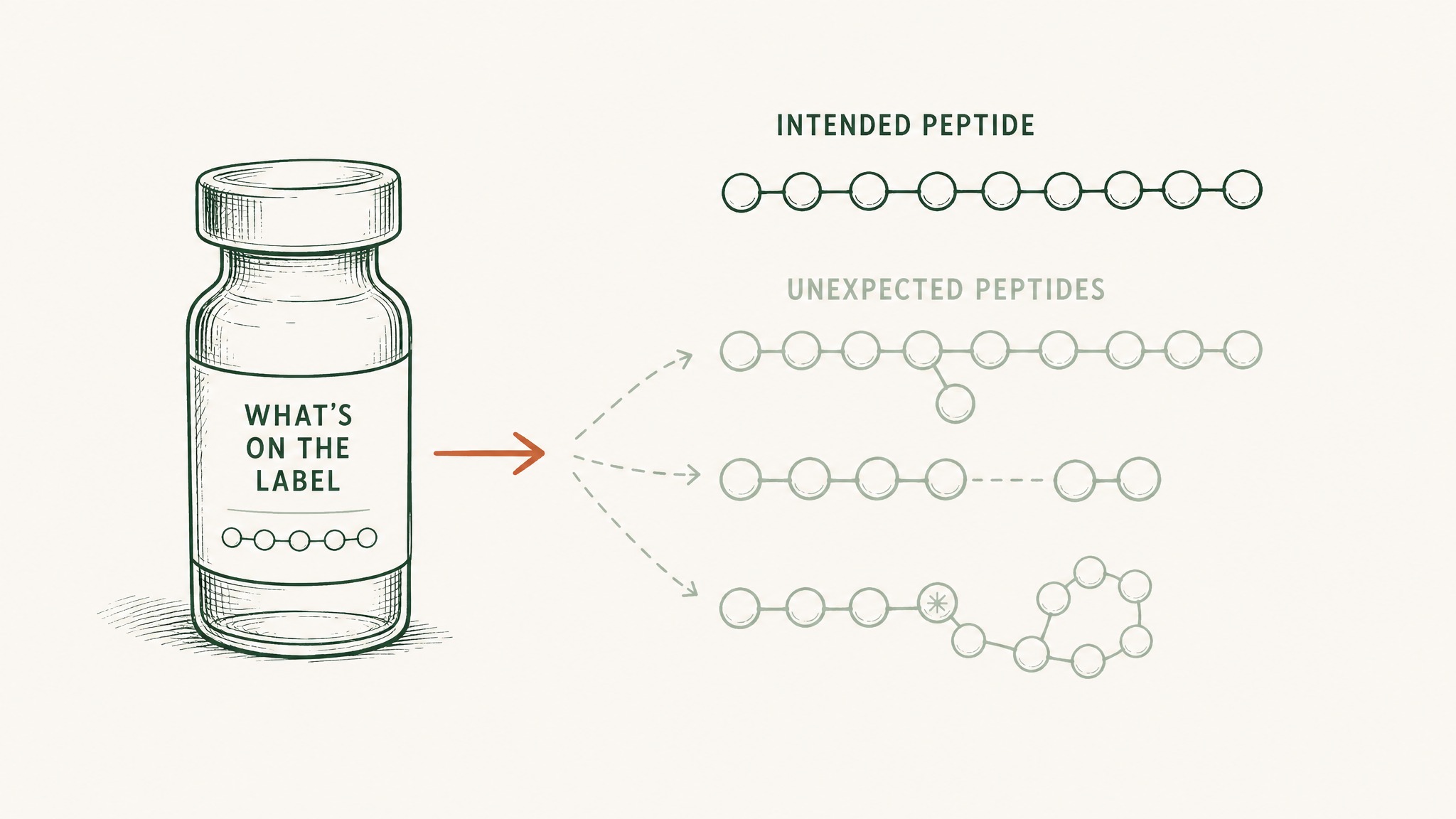
Label claims and lab reality can diverge sharply once you leave the regulated supply chain, and this is not a new discovery. In a foundational 2008 analysis, researchers bought the same peptide (obestatin) from 5 different commercial suppliers and tested each one. One of the 5 turned out to be an entirely different peptide, and two-thirds of the rest came in below 95 percent purity or carried individual impurities above 1 percent (Bagnato et al. 2008, PubMed 18342612).
One in five samples in that study was not even the advertised peptide.
How Often Do Unregulated Peptides Miss What's on the Label?
That study is old on purpose here: it shows the gap between label and content is a long-standing structural problem, not a one-off scandal.
Contamination is a separate axis from purity, and it's uneven rather than universal. One peptide-testing organization reported that across 140 endotoxin tests it commissioned on gray-market samples, roughly 63 percent showed no detectable endotoxin, about 29 percent showed trace levels, and around 8 percent exceeded the lab's limit (Finnrick, accessed 2026). Treat that as one lab's self-reported dataset, not an industry census, since it doesn't disclose which vendors were sampled.
The honest takeaway: most samples in that set were clean, but a meaningful slice were not, and without a batch COA you can't tell which bottle you're holding. Users report wide swings in quality between suppliers, which is exactly what patchy testing would produce.
Why Won't Regulators Just Certify These Peptides?
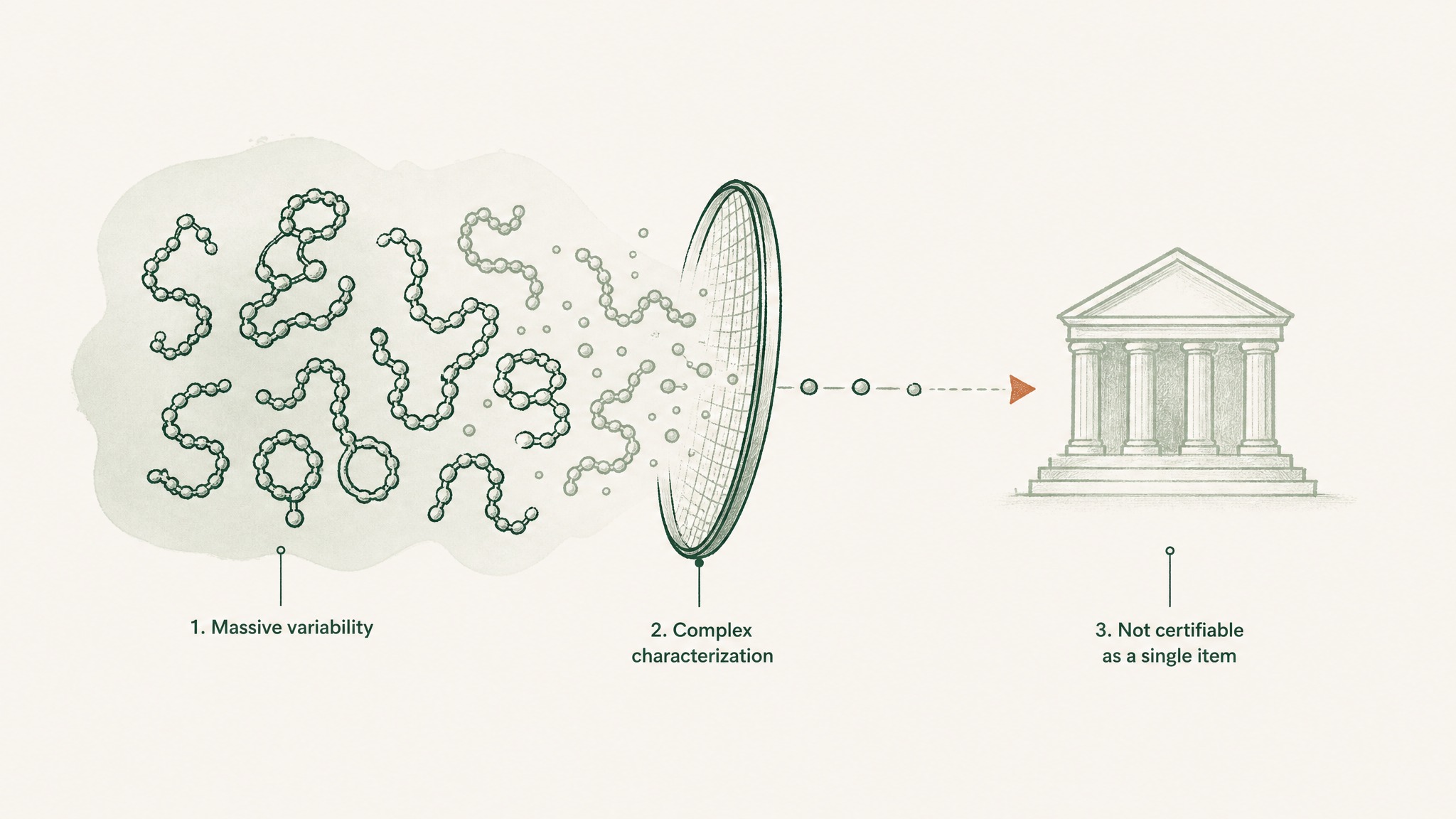
Regulators can't certify what they can't first define, and that is the core reason gray-market peptides sit outside the approval system. Before anyone can set a purity standard, they have to pin down exactly what the substance is: its precise structure, its impurity profile, its manufacturing route.
That is not a guess about the FDA's thinking. Russell Wesdyk, an FDA drug-quality official, put it directly at a July 2026 advisory meeting: "We can't create quality standards until we actually know what it is" (NPR/KUNC 2026). Peptides sold under the same name, he explained, can arrive in many different chemical forms.
Why Won't Regulators Just Certify These Peptides?
The practical consequences for you as a reader:
- "Certified" fills a vacuum that regulation hasn't. It is a private stand-in for a public standard that doesn't exist yet.
- Because there's no single official identity for many of these peptides, one seller's "99 percent pure" and another's may be measured against different assumptions.
- A third-party COA is the closest thing to an objective anchor while the regulatory picture is still forming.
This is why the paperwork carries so much weight. In a market without an official yardstick, the certificate, and the independence of the lab behind it, is doing the job a regulator normally would. Members experience that gap directly whenever two "certified" products look nothing alike on their certificates.
How Can You Tell If a Peptide Is Genuinely Certified?
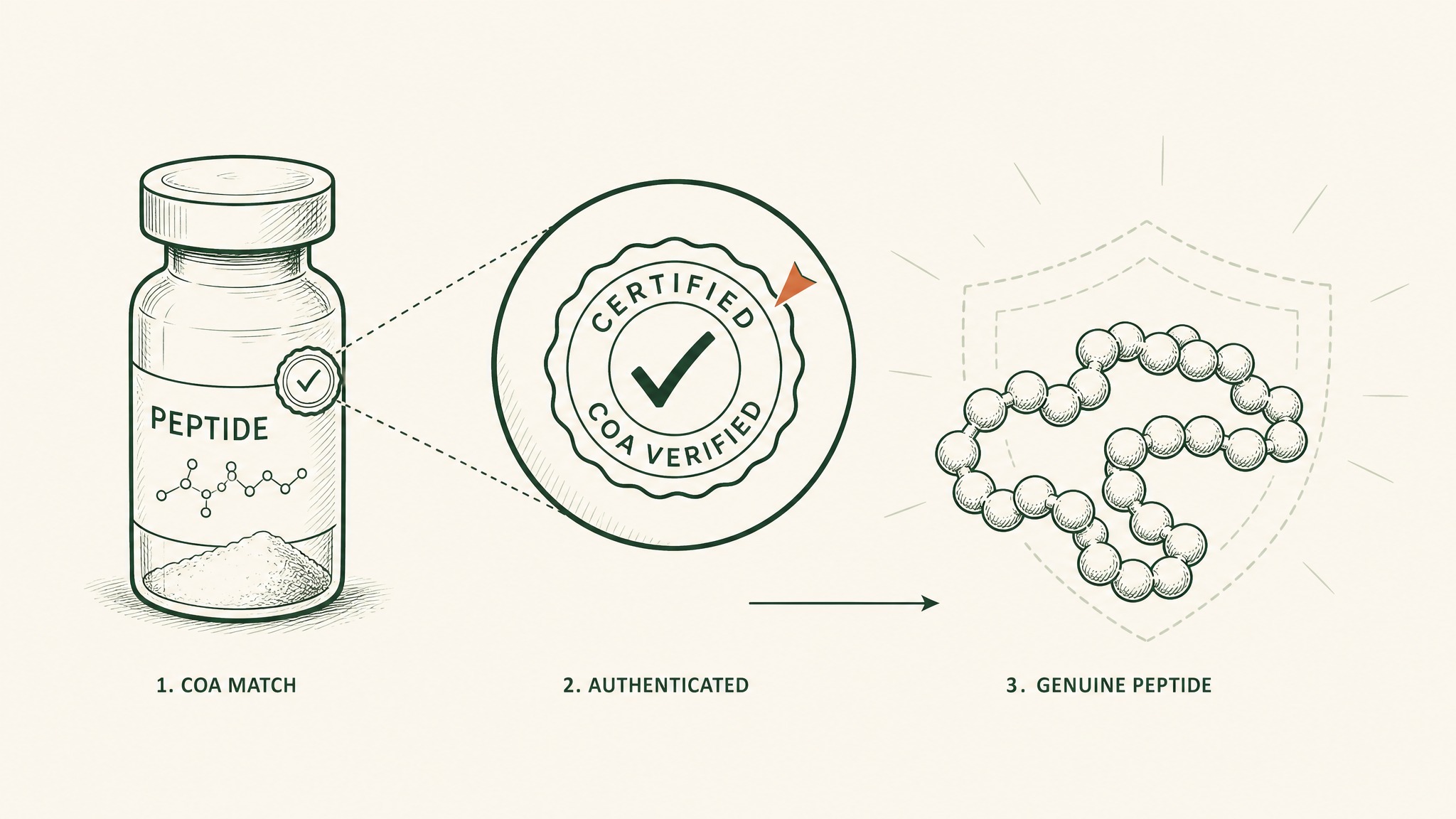
You verify a "certified" peptide by reading the document, not trusting the badge. The single strongest signal is a batch-matched Certificate of Analysis from an independent, accredited lab, dated and specific to your lot.
Regulators are actively policing the softer version of "certified." In December 2024 the FDA sent warning letters to several peptide sellers for marketing "research use only" products that were, in practice, aimed at human use, treating the disclaimer as legally insufficient (FDA warning letter, 2024). "Certified" language does not shield a product from that scrutiny.
How Can You Tell If a Peptide Is Genuinely Certified?
Run through this quick checklist before you trust any "certified" claim:
- Does a COA exist, and does its batch number match your bottle? No match, no trust.
- Is the testing lab independent and named, or is the brand grading its own homework?
- Does it report an actual HPLC purity percentage and contaminant screens, not just the word "pure"?
- Is the certificate dated and tied to a real, recent production run?
- Do the product's claims stay in research framing, or drift into promises a regulator would flag?
If you want the deeper version of these red flags, our guide on whether peptide pills are a scam and the explainer on whether peptides are legal both go further. The short version: a certificate you can't verify is just a nicer word for a promise.
Frequently Asked Questions
Are "certified peptides" FDA-approved?
No. "Certified" refers to quality documentation like a Certificate of Analysis, not regulatory approval. Research peptides are sold for research purposes only, and compounds such as BPC-157 remain unapproved for human use by the FDA (Józwiak et al. 2025, PMC11859134).
What is a Certificate of Analysis (COA)?
A COA is a batch-specific lab report showing a peptide's identity, its purity (usually by HPLC), and contaminant screens such as heavy metals and endotoxin. The strongest COAs come from an independent, accredited lab and name the exact lot number in your bottle.
Does "third-party tested" mean the peptide is safe?
Not by itself. Third-party testing means an outside lab, not the seller, ran the analysis, which is more trustworthy than self-testing. It still only describes what was in the tested sample, and quality varies widely between suppliers and even between batches.
Why isn't there an official "certified peptide" standard?
Because regulators must first define exactly what a substance is before setting a quality standard for it, and many gray-market peptides come in inconsistent forms. As one FDA official put it, "we can't create quality standards until we actually know what it is." Until that identity work is done, private certificates fill the gap.
How can I read a peptide COA myself?
Check that the batch number matches your product, look for an HPLC purity figure (reputable reference standards target 95 to 105 percent of label), confirm contaminant screens are present, and verify the lab is independent and the certificate is dated. For more context on the numbers, see our peptide research statistics roundup. This content is published for research purposes only and is not medical advice.
References
- Józwiak, M., Bauer, M., Kamysz, W., Kleczkowska, P. (2025). Multifunctionality and Possible Medical Application of the BPC 157 Peptide: Literature and Patent Review. Pharmaceuticals (Basel). https://pmc.ncbi.nlm.nih.gov/articles/PMC11859134/. Retrieved 2026-09-04.
- McCarthy, B., Han, X., Carrick, K., Schmidt, R., Workman, M., Matejtschuk, P., Duru, C., Atouf, F. (2023). Reference Standards to Support Quality of Synthetic Peptide Therapeutics. Pharmaceutical Research. https://pmc.ncbi.nlm.nih.gov/articles/PMC10338602/. Retrieved 2026-09-04.
- Bagnato, C., et al. (2008). Impurity profiling quality control testing of synthetic peptides: the obestatin case. Analytical Biochemistry. https://pubmed.ncbi.nlm.nih.gov/18342612/. Retrieved 2026-09-04.
- NPR / KUNC. (2026). FDA panel supports broadening access to peptides popular on the gray market. https://www.kunc.org/npr-news/2026-07-23/fda-panel-supports-broadening-access-to-peptides-popular-on-the-gray-market. Retrieved 2026-09-04.
- Finnrick. Why Endotoxin Testing Matters for Peptides. https://www.finnrick.com/blog/why-endotoxin-testing-matters-for-peptides. Retrieved 2026-09-04.
- U.S. Food and Drug Administration. Interim Policy on Compounding Using Bulk Drug Substances (503A category classifications). https://www.fda.gov/media/174456/download. Retrieved 2026-09-04.
- U.S. FDA / Federal Register. (2021). ANDAs for Certain Highly Purified Synthetic Peptide Drug Products (impurity guidance). https://www.federalregister.gov/documents/2021/05/20/2021-10603. Retrieved 2026-09-04.
- U.S. Food and Drug Administration. (2024). Warning Letter: Summit Research Peptides (695607). https://www.fda.gov/inspections-compliance-enforcement-and-criminal-investigations/warning-letters/summit-research-peptides-695607-12102024. Retrieved 2026-09-04.
Want quality documentation you can actually check, batch by batch? Explore VERO's protocols →
RESTORE™
BPC-157Engineered around 0.5mg BPC-157 (arginate salt). Accelerates deep tissue and joint recovery
Clinical Context
Important Notice: VERO protocols are nutritional and systemic optimisation formats. They are not intended to diagnose, treat, cure, or prevent any medical condition. These statements have not been evaluated by the Food and Drug Administration.