

Semaglutide, tirzepatide and retatrutide lead the injectable weight-loss peptides by trial evidence. See how they compare, plus the delivery-route research.
The best injectable peptide for weight loss, judged purely on the size and quality of the human trials, is a GLP-1 class drug: semaglutide has the deepest track record, tirzepatide posts the largest approved effect, and retatrutide shows the biggest early numbers while still investigational. That is the honest headline most ranked lists dress up. Everything below is written for research purposes only, and one thing up front so you can trust the rest: VERO does not manufacture or sell any injectable peptide, which is exactly why this page can rank them without a thumb on the scale. What we do study is the part every competitor skips, how much of a peptide actually survives the route it's taken by, and that turns out to change the whole question.
Most people typing this already know the names. What they want is a map: which injectables have real weight-loss trials behind them, which are riding on mechanism and hype, and which come with trade-offs nobody mentions until the sharps bin is full.
So this is a ranked, evidence-graded guide, not a hype reel. Research suggests the gap between "has a big trial" and "has a big reputation" is where most of the confusion lives.
Key Takeaways
- The best injectable peptide for weight loss by trial evidence is a GLP-1 drug. Semaglutide, tirzepatide and retatrutide sit at the top; the growth-hormone peptides (CJC-1295, ipamorelin) have no human weight-loss trial at all.
- In head-to-head data, tirzepatide out-performed semaglutide: a mean 20.2% vs 13.7% weight change at 72 weeks in the 2025 SURMOUNT-5 trial.
- Retatrutide shows the largest early effect (a mean 24.2% at 48 weeks in phase 2) but is still investigational, not an approved option.
- "Injectable" hides a real burden: reconstitution, cold-chain storage, sharps disposal and injection-site reactions are decision factors, not footnotes.
- The research question few pages ask is about the route itself. Peptides absorb poorly by mouth, which is why absorption science and needle-free delivery are an active area, not a marketing slogan.
Which injectable peptides have the strongest weight-loss evidence?
Three GLP-1 class injectables carry by far the strongest weight-loss evidence: semaglutide, tirzepatide and retatrutide. The next tier (liraglutide, tesamorelin) is either older-and-milder or approved for a different job entirely, and the growth-hormone peptides at the bottom have no direct human weight-loss trial to stand on.
Here is the honest nuance the "best of" tables skip:
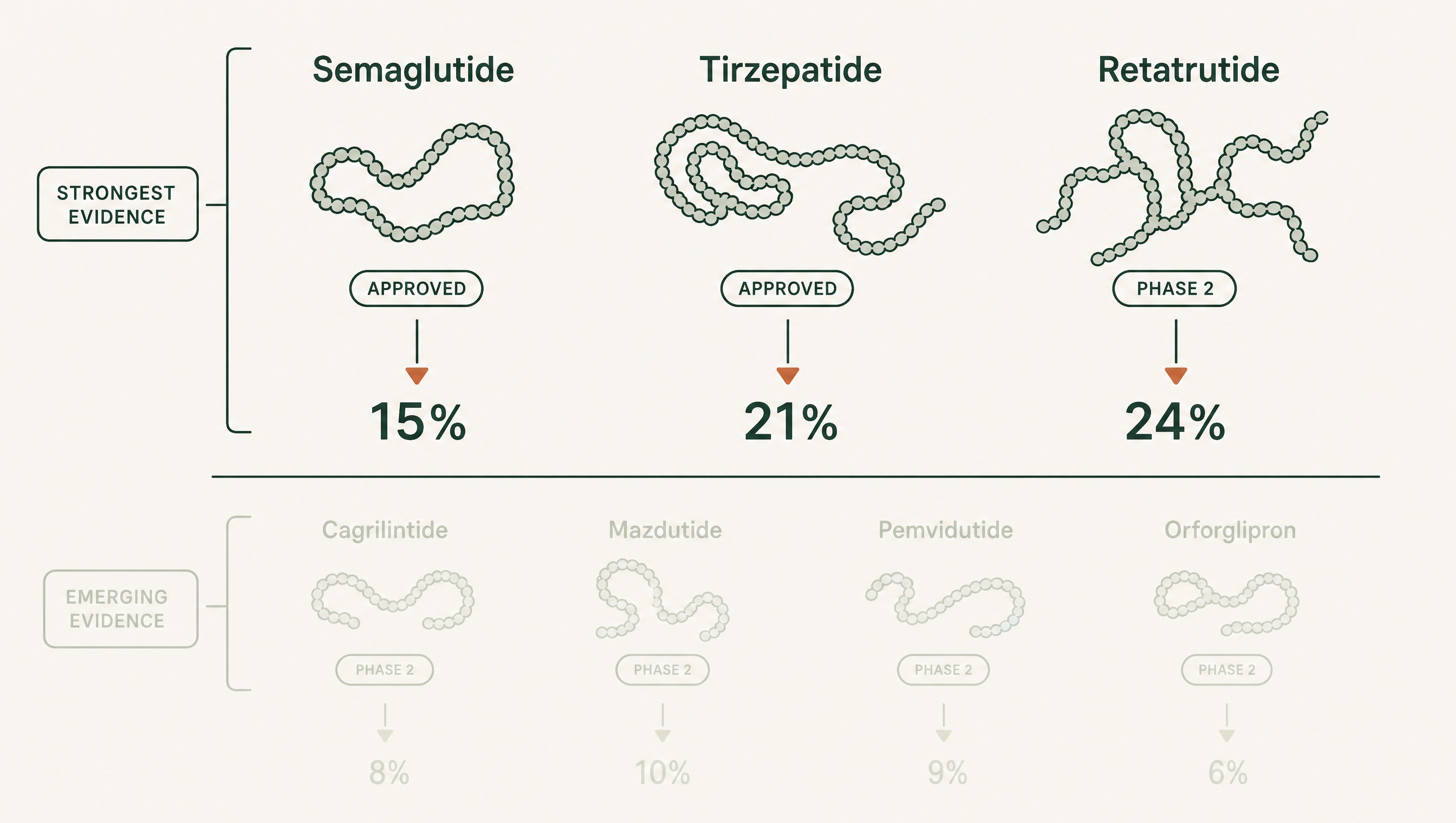
Three GLP-1 peptides show the strongest weight-loss results: semaglutide, tirzepatide, and retatrutide.
- Approved and proven means a large randomized trial plus an FDA sign-off for weight management. Only semaglutide, tirzepatide and liraglutide clear that bar.
- Big number, early data describes retatrutide: the largest effect on this page, from a mid-stage trial, with no approval yet.
- Studied for something else covers tesamorelin, whose trial was in HIV-related belly fat, not general weight loss.
The column most guides leave out is "delivery reality," because an injectable you reconstitute and refrigerate and one you might absorb another way are not competing on the same terms. Here is the at-a-glance version.
| # | Peptide | Class | Weight-loss evidence | What the trials studied | Delivery |
|---|---|---|---|---|---|
| 1 | Semaglutide | GLP-1 receptor agonist | High (approved) | ~15% mean body-weight change, 68 wks | Weekly injection |
| 2 | Tirzepatide | GIP/GLP-1 dual agonist | High (approved) | Up to ~21% mean change, 72 wks | Weekly injection |
| 3 | Retatrutide | GGG triple agonist | Moderate (phase 2) | ~24% mean change, 48 wks | Weekly injection |
| 4 | Liraglutide | GLP-1 receptor agonist | High but modest (approved) | ~8% mean loss, 56 wks | Daily injection |
| 5 | Tesamorelin | GHRH analog | Moderate, wrong target | Visceral fat in HIV, not weight | Daily injection |
| 6 | CJC-1295 + Ipamorelin | GH secretagogues | Low (no human weight trial) | GH/IGF-1 signalling only | Injection |
| 7 | AOD-9604 | GH fragment | Weak (failed trial) | Obesity trial did not beat placebo | Injection |
"Weight-loss evidence" is asking one blunt question: has this been tested in people for weight, or are we borrowing a mechanism and hoping? The label dose and the bloodstream dose are not the same number, and neither is a tidy mechanism and a measured human result.
How did we rank these peptides?
We ranked every peptide here on five fixed criteria, and applied the same rubric to all of them, no favourites. Rankings without a stated method are just opinions in a table, and since the June 2026 spam update, unexplained "best of" lists get flagged for exactly that.
Here is the rubric:
- Human-evidence tier. Is there a randomized human weight-loss trial, and how big? Human data outranks animal or mechanism data every single time.
- Measured effect size. The actual mean body-weight change recorded in that trial, not a marketing percentage.
- Regulatory status. FDA-approved for weight management, investigational, or research-use only.
- Delivery and practical burden. Reconstitution, storage, injection frequency, and the real-world friction of self-injecting.
- Safety signal. The side effects and monitoring the trials actually reported.
One disclosure worth repeating, because it is the whole reason this ranking can be neutral: VERO sells none of the injectables on this list. Our work is in sublingual delivery, so we have nothing to push up the table. Judge the rubric on its own terms.
The injectable peptides for weight loss, ranked by evidence
Here is each compound, graded on the rubric above. Read the evidence label first; it tells you whether you're looking at a result or a hypothesis.
1. Semaglutide (GLP-1 receptor agonist) · evidence: High
Semaglutide has the deepest weight-loss trial record of any injectable peptide, which is why it's often cited as the best injectable peptide for weight loss by sheer trial volume. In the STEP 1 trial, 1,961 adults with overweight or obesity were followed for 68 weeks, and the investigators reported a mean change of "−14.9% in the semaglutide group as compared with −2.4% with placebo" on the 2.4 mg weekly dose (Wilding et al., NEJM 2021). The FDA cleared semaglutide 2.4 mg (brand Wegovy) for chronic weight management in June 2021.
Think of a GLP-1 receptor agonist as a key cut to fit a lock your gut already uses: it mimics a hormone your body releases after eating, the one that tells your brain you're full and slows how fast your stomach empties. That's the mechanism behind reduced appetite on these weight loss peptide injections.
- How it's studied: weekly subcutaneous injection, dose titrated up over weeks to limit nausea.
- The honest con: gastrointestinal side effects (nausea, constipation) are common early on, and a meaningful share of the weight lost is lean muscle, not just fat.
2. Tirzepatide (GIP/GLP-1 dual agonist) · evidence: High
Tirzepatide posts the largest weight-loss effect of any FDA-approved injectable peptide. In SURMOUNT-1, a 72-week trial of 2,539 adults, mean body-weight change reached −15.0%, −19.5% and −20.9% on the 5, 10 and 15 mg doses versus −3.1% on placebo (Jastreboff et al., NEJM 2022). It was cleared by the FDA (brand Zepbound) for chronic weight management in November 2023.
Where semaglutide pulls one lever, tirzepatide pulls two: it hits both the GLP-1 and the GIP receptor, a second gut hormone involved in how you handle food and fat. In the 2025 SURMOUNT-5 head-to-head of 751 adults, tirzepatide beat semaglutide directly, a mean 20.2% versus 13.7% weight change at 72 weeks (Aronne et al., NEJM 2025).
- How it's studied: weekly injection, same slow dose titration to manage nausea.
- The honest con: the side-effect profile mirrors semaglutide, and the muscle-loss caveat applies here too, roughly a quarter of the weight lost in the trials was lean tissue.
3. Retatrutide (triple agonist) · evidence: Moderate, investigational
Retatrutide shows the largest early weight-loss number on this page, but it is still investigational and not approved for anything. In a 48-week phase 2 trial of 338 adults with obesity, the 12 mg dose was linked to a mean 24.2% change in body weight versus 2.1% on placebo (Jastreboff et al., NEJM 2023). No FDA approval exists for retatrutide as of mid-2026.
If tirzepatide pulls two levers, retatrutide pulls three: it adds a glucagon receptor to the GLP-1 and GIP targets, which is why it's nicknamed the "triple G." That extra target is the leading theory for the bigger early effect, though searches for retatrutide weight loss data should note this is one mid-stage trial, not a finished story.
- How it's studied: weekly injection in phase 2 and ongoing phase 3 research.
- The honest con: it's not approved, long-term safety data is still being gathered, and a phase 2 number can shrink in larger trials.
4. Liraglutide (GLP-1 receptor agonist) · evidence: High but modest
Liraglutide is the older, gentler GLP-1: approved and well-studied, with a smaller effect than the newer options. In the SCALE trial of 3,731 adults without diabetes, liraglutide 3.0 mg produced mean weight loss of about 8.4 kg (roughly 8% of body weight) versus 2.8 kg on placebo at 56 weeks (Pi-Sunyer et al., NEJM 2015). The FDA cleared liraglutide 3.0 mg (brand Saxenda) for chronic weight management in December 2014.
Same key, same lock as semaglutide, it's a GLP-1 receptor agonist, but the older design means a shorter action window.
- How it's studied: a daily injection, not weekly, which is a real adherence difference over a year.
- The honest con: smaller average effect than semaglutide or tirzepatide, and daily dosing is more to keep up with.
5. Tesamorelin (GHRH analog) · evidence: Moderate, but the wrong target
Tesamorelin is FDA-approved and effective, just not for general weight loss. Its 26-week registration trial in 412 people with HIV-associated fat changes reported that visceral belly fat "decreased by 15.2% in the tesamorelin group and increased by 5.0% in the placebo group" (Falutz et al., NEJM 2007). The approved use (brand Egrifta) is HIV-associated lipodystrophy, not weight management in the general population.
Tesamorelin works one level up the chain from the GLP-1 drugs: it's a growth-hormone-releasing hormone analog, nudging your pituitary to release more of its own growth hormone, which the research links to visceral fat specifically.
- How it's studied: a daily injection, in a very specific patient population.
- The honest con: the evidence is about a narrow clinical group, so borrowing it as a general fat-loss claim overreaches the data.
6. CJC-1295 + Ipamorelin · evidence: Low (no human weight trial)
This popular stack has no human weight-loss trial behind it at all, only growth-hormone signalling data. The one human CJC-1295 study measured GH and IGF-1 output, not weight or fat mass (Teichman et al., JCEM 2006), and ipamorelin's foundational pharmacology was done in rats and pigs, never in a human weight study (Raun et al., Eur J Endocrinol 1998).
The idea is indirect: raise growth hormone, and body composition might follow. That's a hypothesis borrowed from GH physiology, not a measured weight-loss result. In preclinical and single-endpoint human pharmacology work, these compounds have been observed to raise GH and IGF-1 signalling, which is a very different claim from moving the number on a scale.
- How it's studied: injection, typically as a combined pulse, in research settings.
- The honest con: no direct human weight-loss evidence exists, so any fat-loss framing is inference, not data, and grey-market purity is a genuine risk.
7. AOD-9604 (GH fragment) · evidence: Weak (failed trial)
AOD-9604 is the cautionary tale of the group: its main obesity trial did not beat placebo, and it was never published in a peer-reviewed journal or advanced to phase 3. The sponsor's own trial updates reported that the phase 2b obesity program failed to separate from placebo on its primary weight endpoint. Earlier proof-of-concept lab work on the fragment exists (Ng et al., Horm Res 2000), but that is mechanism research, not the failed human trial, and the two shouldn't be conflated.
- How it's studied: it isn't, meaningfully, for weight loss anymore, the development program stalled.
- The honest con: the best human test it got, it failed. That's the most honest thing anyone can say about it.
How do these peptides actually work in the body?
They split into two mechanism families, and the split explains the entire evidence gap. The GLP-1 group works on your gut-brain appetite signalling, which is easy to measure as weight; the growth-hormone group works on your pituitary, which is not.
The first family, GLP-1 peptide injections, borrow a hormone your gut releases after a meal:
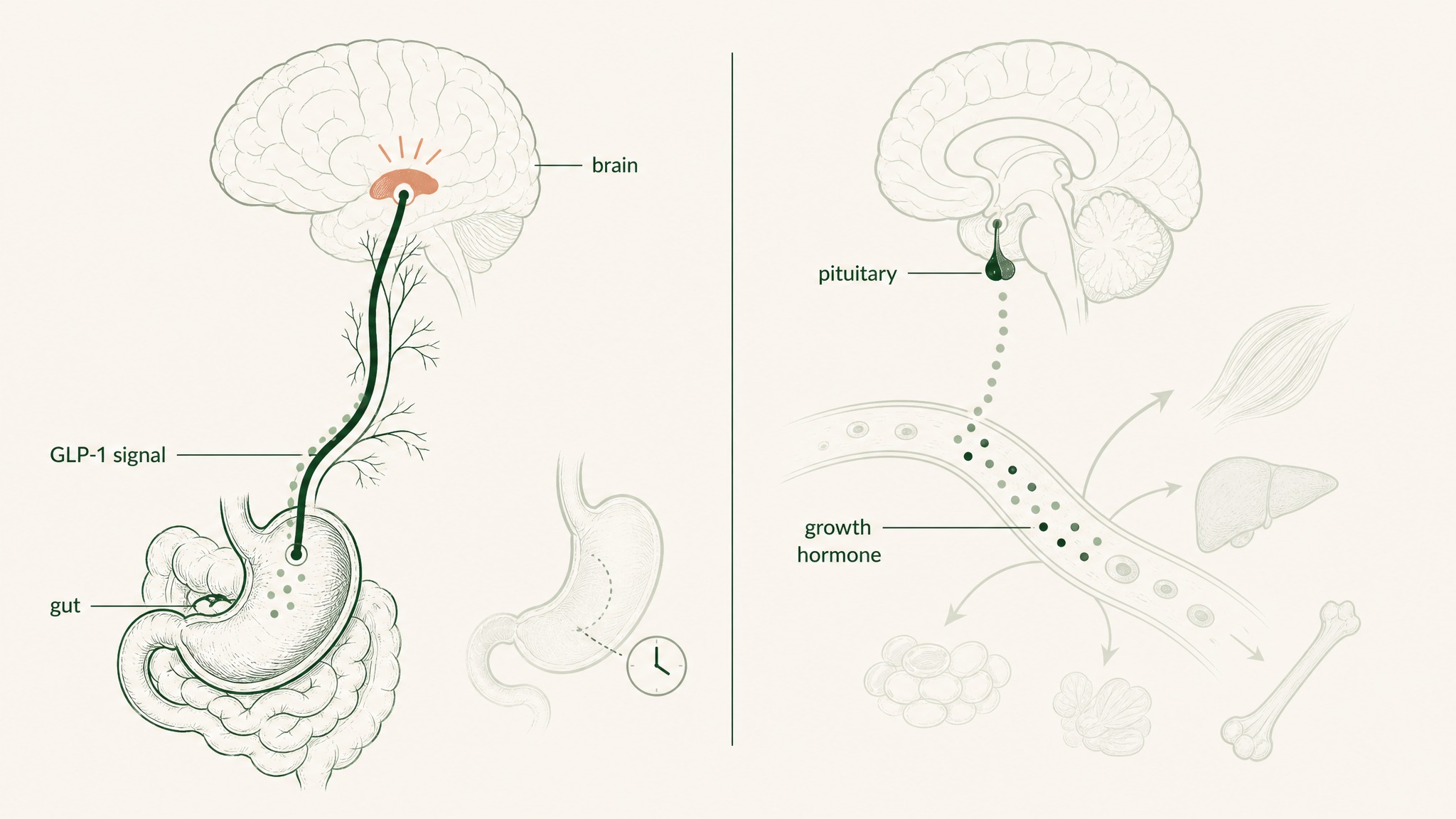
GLP-1 peptides signal directly from gut to brain; growth-hormone peptides work through the pituitary gland.
- It tells your brain you're satisfied, so you eat less.
- It slows stomach emptying, so you feel full longer.
- The dual and triple agonists (tirzepatide, retatrutide) add GIP and glucagon targets on top, which the research ties to bigger effects.
The second family (tesamorelin, CJC-1295, ipamorelin) nudges your pituitary to release more of your own growth hormone. That's a real mechanism, but growth hormone's link to general weight loss in healthy adults is thin. It's the difference between a lever wired directly to appetite and a lever wired to a hormone that only sometimes moves fat.
The strongest weight-loss evidence clusters entirely in the appetite-signalling family, because that's the mechanism that reliably shows up on a scale.
What are the side effects and practical realities of the injections?
The side effects of these weight loss peptide injections fall into two buckets: what the drug does inside you, and what the injection itself demands of you. The trials measured the first; the second is the part readers underestimate until they're living it.
On the drug side, the GLP-1 class shares a consistent profile. In the STEP and SURMOUNT programs, gastrointestinal effects were the most commonly reported, and body-composition analyses flagged lean-mass loss as a real trade-off (tirzepatide body-composition analysis, Look et al. 2025). Outside the trial data, users report the first few weeks of nausea as the hardest part to push through.
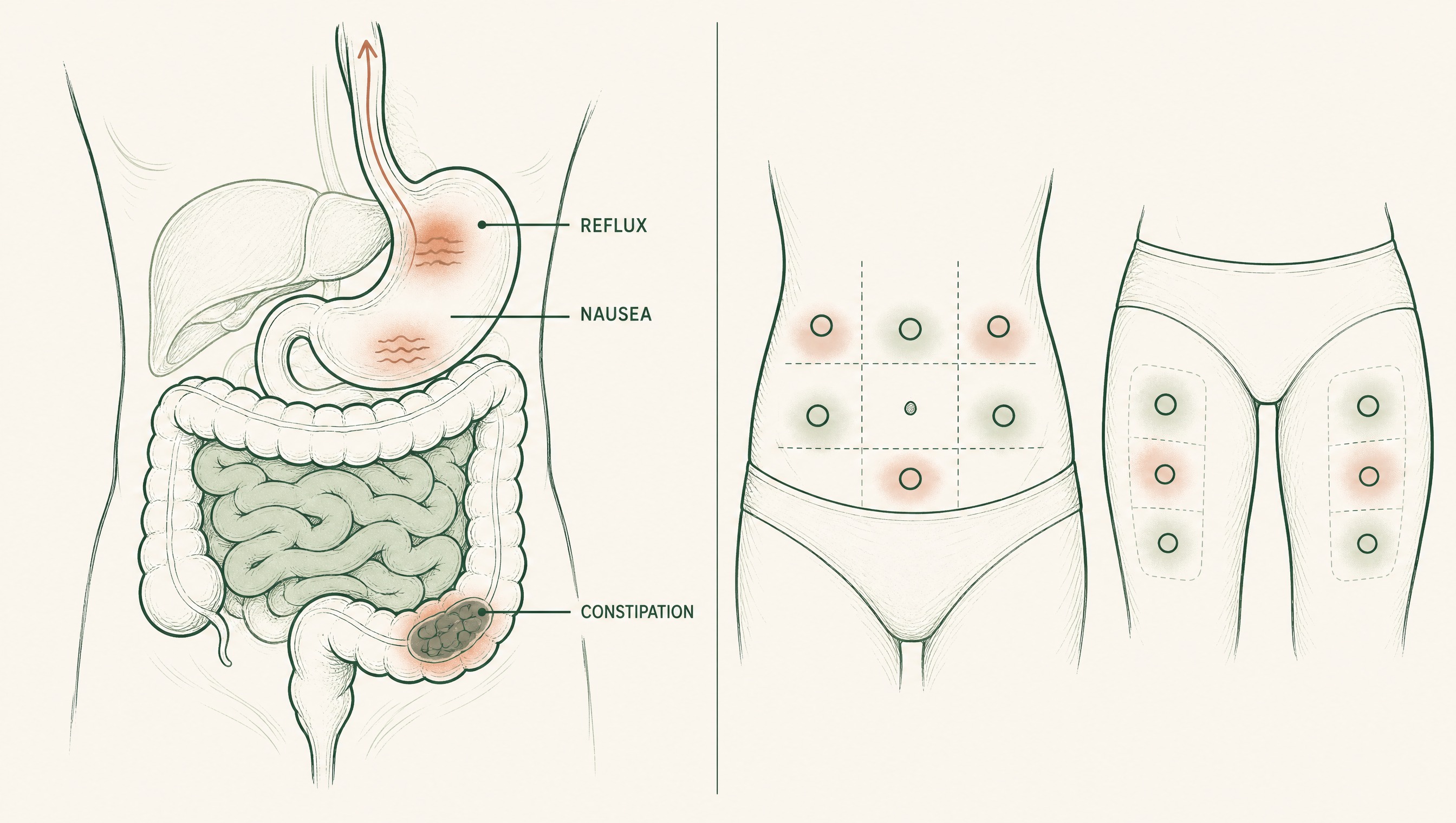
Where GLP-1 side effects happen in your body and how injection-site rotation spreads the physical burden.
| Reality | What it involves | Why it matters |
|---|---|---|
| GI side effects | Nausea, constipation, reflux | Most common reason people stop early |
| Lean-mass loss | ~25% of weight lost can be muscle | Preservation needs a separate plan |
| Reconstitution | Mixing powder with sterile water | An error changes your real dose |
| Cold-chain storage | Refrigeration, careful transport | A warm weekend can degrade it |
| Injection-site reactions | Redness, lumps, bruising | Rotating sites is a weekly chore |
| Sharps disposal | Safe needle disposal | A logistics tail nobody advertises |
The practical burden is not a reason to avoid a supervised, approved medication if it's right for you. It's a reason to be honest that "peptide" and "easy" are not synonyms, and that the delivery route is doing more work than the marketing admits.
Does the delivery method change the research question?
Yes, and this is the section every competing ranked list leaves out. The consensus is settled and worth stating plainly: peptides absorb poorly when you swallow them, which is exactly why the strongest options are injectable in the first place. The open research question is whether the route can be improved without a needle, and that's a real pharmacology topic, not a product slogan.
Here's the plain-English version of why swallowing a peptide barely works. Your gut is a security checkpoint built to break protein down into scraps, so a peptide taken by mouth runs a gauntlet before it can do anything:
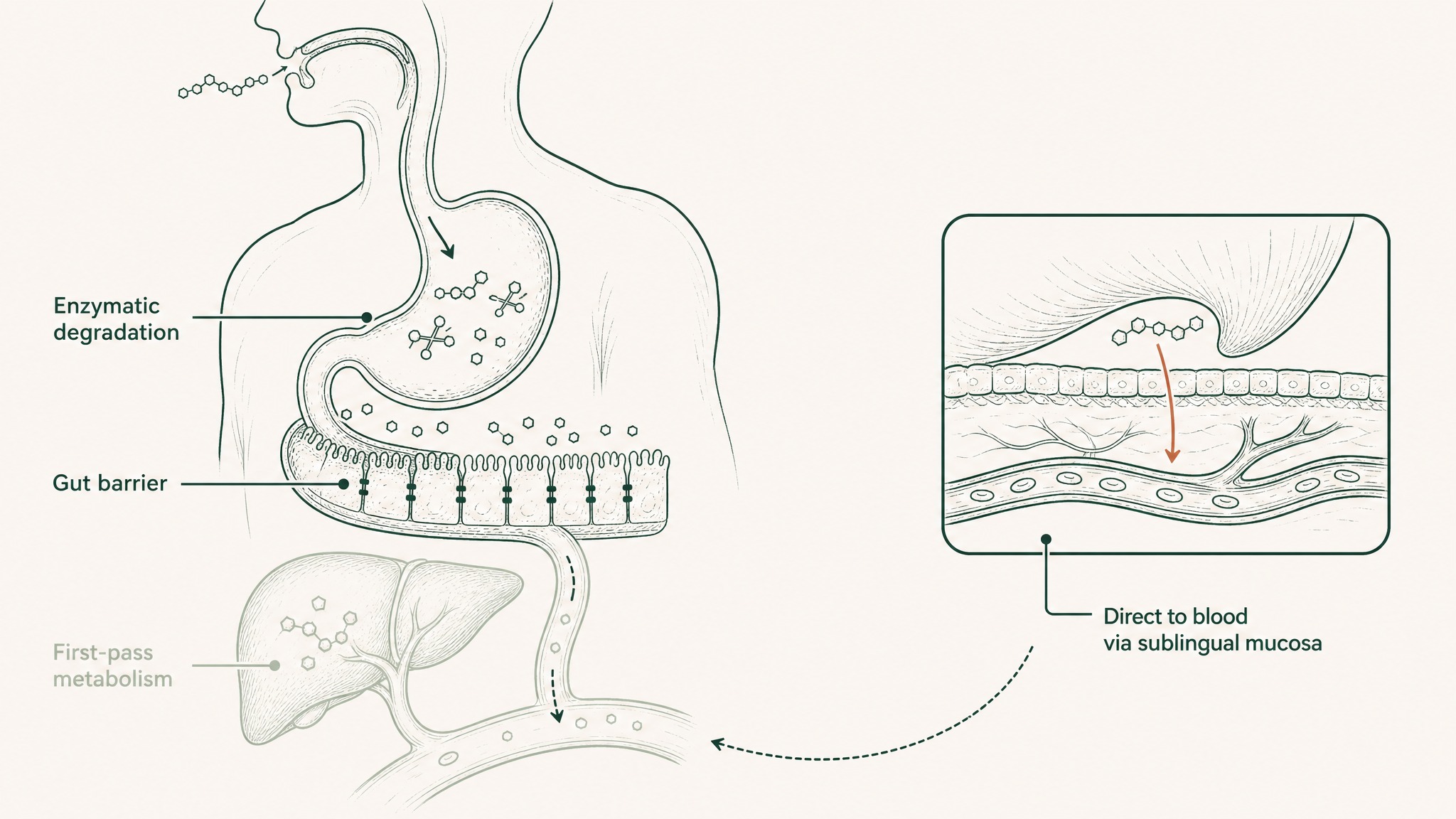
Why swallowed peptides are broken down before reaching your bloodstream.
- Digestive enzymes chew it up before it's absorbed.
- The gut wall is a poor gate for large peptide molecules.
- Whatever slips through hits your liver first, which filters much of it out before it reaches circulation.
That last step is called first-pass metabolism, your liver taxing the dose before it ever reaches your blood. A 2021 peptide-delivery review summed up the barriers as "poor cellular membrane permeability at the GIT site, enzymatic degradation (various proteases), and first-pass hepatic metabolism" (oral peptide delivery review, 2021). It's the same problem a broader 2025 review of oral peptide delivery lays out in detail (Baral & Choi, Pharmaceutics 2025).
The tissue under your tongue tells a different story. Sublingual peptide absorption uses a mucosa that's thin and richly supplied with blood, so a molecule placed there can enter circulation directly and skip that first liver pass, which is why buccal and sublingual routes are an active research area for a needle-free peptide delivery alternative.
In our protocol design, the question we weigh most heavily is not which molecule posts the biggest number in a trial, but how much of any peptide actually survives the route it's taken by, because an unabsorbed dose is a zero no matter how elegant the mechanism. That's the reasoning behind VERO's VERISORB sublingual matrix and our reference work on sublingual peptide bioavailability. To be clear about what this is not: none of that makes a sublingual tablet equivalent to an approved GLP-1 injection for weight loss, and we don't claim it does. It's a delivery-science distinction, framed for research purposes only.
Who reaches for injectables, and who looks for a needle-free alternative?
The split usually comes down to supervision and tolerance for the injection itself, not the molecule. People who reach for approved injectables tend to have clinical access and a reason the biggest measured effect matters most to them.
- Access to supervision. An FDA-approved GLP-1 through a prescriber comes with monitoring, which matters for a drug with real side effects.
- Comfort with self-injection. Weekly needles, reconstitution and sharps disposal are fine for some and a hard no for others.
- Storage and travel. Cold-chain is easy at home and a genuine hassle on the road.
People who look for a non-injectable peptide alternative are usually weighing the friction, not chasing a bigger number. Some VERO members experience the practical side of that trade-off directly, which is why the delivery question, not just the compound question, is where a lot of the real decision-making happens. If you're comparing routes, our supplement-versus-injection breakdown walks the same logic on a different compound.
Are these injectable peptides FDA-approved?
Only some are, and the difference is the single most important line in this whole guide. Semaglutide, tirzepatide and liraglutide carry FDA approval for chronic weight management; tesamorelin is approved for a different indication; retatrutide, CJC-1295, ipamorelin and AOD-9604 are not approved for weight loss at all.
Here's the regulatory reality in plain terms:
- Approved for weight management: semaglutide (2021), tirzepatide (2023), liraglutide (2014).
- Approved, different indication: tesamorelin, for HIV-associated fat changes.
- Investigational: retatrutide, in active trials, not yet approved.
- Research-use only: CJC-1295, ipamorelin, AOD-9604, sold in a grey market where purity and dosing aren't guaranteed.
This isn't sourcing or prescribing advice, and nothing here is a recommendation to buy or self-administer anything. It's the compliance backbone of an honest comparison: an approved medication with a monitoring plan and a grey-market vial are not the same risk, even when the molecule sounds similar. Peptide legality and regulatory status is its own topic worth reading before you go further.
Frequently Asked Questions
What is the strongest injectable peptide for weight loss? By measured effect in human trials, tirzepatide is the strongest FDA-approved option (up to a mean ~21% body-weight change in SURMOUNT-1), and it beat semaglutide head-to-head in the 2025 SURMOUNT-5 trial. Retatrutide showed a larger early number (~24% in phase 2) but remains investigational.
Is there a non-injectable alternative to weight-loss peptides? The approved weight-loss peptides are injectable because peptides absorb poorly by mouth. Needle-free routes such as sublingual delivery are an active research area for bypassing first-pass metabolism, but no sublingual product is equivalent to an approved GLP-1 injection for weight loss, and any suggestion otherwise would overstate the evidence.
How long do injectable peptides take to work? In the major GLP-1 trials, weight came off gradually over 56 to 72 weeks, with doses titrated up slowly over the first weeks to limit nausea. These are long-horizon research protocols, not fast fixes.
What's the difference between semaglutide and tirzepatide? Semaglutide targets one gut-hormone receptor (GLP-1); tirzepatide targets two (GIP and GLP-1). In the 2025 SURMOUNT-5 head-to-head, tirzepatide produced a larger mean weight change (20.2% vs 13.7% at 72 weeks).
Do these peptides cause muscle loss? Body-composition analyses of the GLP-1 trials found that a meaningful share of the weight lost, roughly a quarter, was lean tissue rather than fat, which is why muscle-preservation strategies come up so often alongside them.
Are CJC-1295 and ipamorelin good for weight loss? There's no human weight-loss trial for either. The available research measured growth-hormone and IGF-1 signalling, not weight or fat mass, so any fat-loss claim is inference from mechanism, not a measured result.
Does BPC-157 help with weight loss? No human trial supports it; BPC-157 is studied as a tissue-repair peptide, not a fat burner. We cover this in detail in does BPC-157 help with weight loss.
References
- Wilding JPH, Batterham RL, Calanna S, et al. (2021). Once-weekly semaglutide in adults with overweight or obesity (STEP 1 trial). New England Journal of Medicine. https://pubmed.ncbi.nlm.nih.gov/33567185/ Retrieved 2026-08-02.
- Jastreboff AM, Aronne LJ, Ahmad NN, et al. (2022). Tirzepatide once weekly in the management of obesity (SURMOUNT-1 trial). New England Journal of Medicine. https://pubmed.ncbi.nlm.nih.gov/35658024/ Retrieved 2026-08-02.
- Aronne LJ, Horn DB, le Roux CW, et al. (2025). Tirzepatide versus semaglutide head-to-head weight outcomes (SURMOUNT-5 trial). New England Journal of Medicine. https://pubmed.ncbi.nlm.nih.gov/40353578/ Retrieved 2026-08-02.
- Jastreboff AM, Kaplan LM, Frías JP, et al. (2023). Triple-hormone-receptor agonist retatrutide in obesity: a phase 2 trial. New England Journal of Medicine. https://pubmed.ncbi.nlm.nih.gov/37366315/ Retrieved 2026-08-02.
- Pi-Sunyer X, Astrup A, Fujioka K, et al. (2015). Liraglutide 3.0 mg for weight management in adults without diabetes (SCALE trial). New England Journal of Medicine. https://pubmed.ncbi.nlm.nih.gov/26132939/ Retrieved 2026-08-02.
- Falutz J, Allas S, Blot K, et al. (2007). A growth-hormone-releasing factor and visceral-fat outcomes in patients with HIV. New England Journal of Medicine. https://pubmed.ncbi.nlm.nih.gov/18057338/ Retrieved 2026-08-02.
- Teichman SL, Neale A, Lawrence B, et al. (2006). CJC-1295 and prolonged growth-hormone and IGF-I elevation in healthy adults: a single-dose human study. Journal of Clinical Endocrinology & Metabolism. https://pubmed.ncbi.nlm.nih.gov/16352683/ Retrieved 2026-08-02.
- Raun K, Hansen BS, Johansen NL, et al. (1998). Ipamorelin as a selective growth-hormone secretagogue: preclinical characterisation. European Journal of Endocrinology. https://pubmed.ncbi.nlm.nih.gov/9849822/ Retrieved 2026-08-02.
- Ng FM, Sun J, Sharma L, et al. (2000). Metabolic studies of a synthetic lipolytic domain (AOD9604) of human growth hormone. Hormone Research. https://pubmed.ncbi.nlm.nih.gov/11146367/ Retrieved 2026-08-02.
- Look M, Bays HE, Batterham RL, et al. (2025). Body-composition change during weight reduction with tirzepatide in the SURMOUNT-1 study. Diabetes, Obesity and Metabolism. https://dom-pubs.onlinelibrary.wiley.com/doi/10.1111/dom.16275 Retrieved 2026-08-02.
- Verma et al. (2021). Challenges of peptide and protein drug delivery by the oral route: current strategies to improve bioavailability. Drug Development Research. https://pubmed.ncbi.nlm.nih.gov/33988872/ Retrieved 2026-08-02.
- Baral KC, Choi KY. (2025). Barriers and strategies for oral peptide and protein delivery: a clinical update. Pharmaceutics. https://pmc.ncbi.nlm.nih.gov/articles/PMC12030352/ Retrieved 2026-08-02.
Weighing the delivery question for yourself? Explore VERO's VERISORB sublingual technology or compare the full VERO protocol range →. Written for research purposes only; not medical advice.
Clinical Context
Important Notice: VERO protocols are nutritional and systemic optimisation formats. They are not intended to diagnose, treat, cure, or prevent any medical condition. These statements have not been evaluated by the Food and Drug Administration.