

Which peptide stacks aim to build muscle while cutting fat, compared by evidence strength and delivery route. A research-purposes-only guide for 2026.
If you are hunting for the best peptide stack for muscle growth and fat loss, start with the honest headline every ranked list buries: no single stack does both jobs maximally, and most of the popular ones only work by needle. Building lean tissue and mobilising fat are two different signals, so a real recomposition plan layers them, then lives or dies on how much of any compound actually reaches your blood. That absorbed-dose problem is exactly where a research-graded, sublingual approach like RESTORE, VERO's BPC-157 recovery protocol, enters the conversation. Everything below is written for research purposes only.
Most people typing this already know what a peptide is. What they want is a map: which combinations research links to the muscle side, which to the fat side, and which are practical to run at all.
So this is a ranked, evidence-graded guide, not a hype reel. And it answers the question the whole search is really asking, which no competitor answers directly: can you chase both goals at once, and which stack is built for it?
Key Takeaways
- The best peptide stack for muscle growth and fat loss is not one product. Research points to a growth-hormone-axis pair for the lean-tissue side (CJC-1295 with Ipamorelin) layered with a separate fat-mobilising or muscle-sparing element, because the two goals pull in opposite directions.
- A large share of weight lost on GLP-1 drugs is lean mass. In a tirzepatide sub-study, roughly a quarter of the weight lost was lean tissue, which is why muscle preservation, rather than raw fat burning, is the real recomposition problem.
- Delivery route decides everything. Standard oral peptide capsules deliver under 1 to 2% of the label dose to your blood, so a stack is only as good as what survives the route it is taken by.
- Recovery is a growth lever hiding in plain sight. Repair peptides do not build muscle directly; research suggests they support the training volume that protects lean mass during a deficit.
- Every compound here is research-use only, not an approved muscle or fat-loss product, and grey-market purity is a genuine risk. Third-party testing is non-negotiable.
Which peptide stack is best for muscle growth and fat loss?
There is no single best peptide stack for muscle growth and fat loss, because no one compound reliably does both at a maximum. The combination the evidence points to is a growth-hormone-axis pair (CJC-1295 with Ipamorelin) for the lean-tissue side, layered with a separate fat-focused element such as tesamorelin, and, increasingly, a muscle-sparing strategy wrapped around a GLP-1.
Here is the honest nuance most guides skip:
- The muscle side and the fat side are different signals, so you layer them rather than expecting one peptide to cover both.
- What turns a fat-loss plan into a recomposition plan is muscle preservation, not the size of the fat burn.
- None of these are approved recomposition products; they sit at very different tiers of evidence, and most were only ever studied by injection.
How do the top recomposition stacks compare?
Here is the at-a-glance version. The column that matters most, and that no competing guide includes, is "delivery reality", because a stack that only works by injection and one you might absorb under your tongue are not competing on the same terms.
| Stack | Primary goal | Human-evidence strength | Delivery reality | Key caveat |
|---|---|---|---|---|
| CJC-1295 + Ipamorelin | Muscle (GH axis) | Low (single-component PK) | Injection-default | Raises a hormone, not proven to raise visible muscle |
| Sermorelin + Ipamorelin | Muscle (GH axis) | Low | Injection-default | Gentler pulse, same evidence gap |
| Tesamorelin | Fat (visceral) | Moderate, but HIV population | Injection-only | Approved indication is not general fat loss |
| MK-677 (ibutamoren) | Muscle-lean support | Moderate (oral human RCT) | Oral-active | Water retention, appetite, insulin-sensitivity flags |
| AOD-9604 | Fat (mobilisation) | Weak in humans | Injection-default | Human obesity development was discontinued |
| GLP-1 + muscle-sparing layer | Fat, with lean defence | High for fat loss (drug-grade) | Injection or oral drug | GLP-1s cost lean mass without a preservation plan |
| BPC-157 + TB-500 (recovery) | Recovery / muscle-sparing | Very low (mostly animal) | Sublingual option exists | A recovery hypothesis, not a hypertrophy claim |
| VERO RESTORE (BPC-157, sublingual) | Recovery / muscle-sparing | Very low (animal) | Sublingual (VERISORB) | Our own protocol; ranked on the same rubric |
"Human-evidence strength" just asks: has this been tested in people, or only in rats and dishes? A gorgeous mechanism with zero human trials is a hypothesis, not a result. The label dose and the bloodstream dose are not the same number, and neither is the mechanism promise and the human outcome.
How did we rank these stacks?
Rankings without a stated method are just opinions in a table, and since the June 2026 spam update, unexplained "best of" lists get flagged for exactly that. So here is the rubric. Every stack, including our own, was held to the same five criteria.
- Recomposition fit. Does the biology point at lean tissue, at fat, or at the recovery that protects muscle during a cut?
- Human-evidence tier. Each claim is graded High, Moderate, Low, or Very Low, with human data weighted over animal data every time.
- Delivery and absorbed dose. How much of the compound actually reaches circulation by its usual route?
- Practical accessibility. Can you source a tested version, or is it grey-market injectable-only?
- Safety and regulatory footing. Reported side effects, purity risk, and where the compound sits with the FDA and anti-doping bodies.
One disclosure up front. VERO produces the RESTORE protocol, which uses BPC-157 and appears in this list. RESTORE is our own protocol, and it was graded on the identical rubric rather than parked at the top. Judge the rubric for yourself.
What are the best peptide stacks for muscle growth and fat loss, ranked?
Each entry gets the same treatment: what it is, what the research actually shows, one honest limitation, and who it suits. No entry here is a finished recomposition product with human proof. They are research combinations at very different tiers of evidence.
1. CJC-1295 + Ipamorelin (the growth-hormone-axis pair)
Two peptides nudge your pituitary to release growth hormone through two different doors at once.
This is the combination most people mean by "peptide stack for lean muscle". In a small human study, CJC-1295 was observed to raise growth-hormone and IGF-1 levels for several days after a single dose (Teichman et al. 2006). In preclinical research, ipamorelin has been characterised as a selective growth-hormone secretagogue that left cortisol and prolactin largely untouched in animal models (Raun et al. 1998).
The honest limitation: raising growth hormone on a blood test is not the same as building muscle you can see, and it does little directly for fat. It is injectable-default, research-only, and banned in tested sport.
Who it suits: researchers who want the most growth-hormone-specific mechanism and accept the human muscle proof is not there yet.
2. Tesamorelin (the fat-loss peptide with a real regulatory footprint)
The one peptide here with an actual FDA approval, though not for the goal you are searching.
Tesamorelin is a growth-hormone-releasing-factor analog. In a human trial in people living with HIV-associated fat redistribution, tesamorelin was associated with a roughly 15% reduction in visceral (deep abdominal) fat over 26 weeks versus a rise on placebo (Falutz et al. 2007). It is FDA-approved specifically to reduce excess abdominal fat in that population (EGRIFTA WR label).
The honest limitation: that approval is for a specific clinical group, not general body recomposition, and extrapolating to a lean gym-goer is a leap the label does not support.
Who it suits: researchers focused on the visceral-fat mechanism who respect the population gap.
3. BPC-157 + TB-500 (the recovery and muscle-sparing layer)
You do not grow, or hold muscle, in the gym; you do it in the recovery between sessions.
This is the lane VERO's catalogue actually plays in, so read what follows as disclosed. In preclinical research, BPC-157 has been observed to support tendon, ligament, and muscle repair in rodent models, though a 2019 review noted the effect is yet to be confirmed in humans and most work traces to a single research group (Gwyer et al. 2019). Thymosin beta-4, the parent molecule of the TB-500 fragment, has been studied in animal models for wound repair and new blood-vessel formation (Goldstein et al. 2005).
The honest limitation: none of this is a hypertrophy claim. It is a recovery hypothesis with mostly animal support and a real human-data gap. Users report pairing the two, but that is anecdote, not evidence.
Who it suits: researchers treating recovery as the way to protect muscle during a cut, and anyone wanting a non-injectable route via RESTORE.
4. Sermorelin + Ipamorelin (the gentler GH-axis entry)
The elder statesman of this list, with a longer paper trail than most.
Sermorelin is a shortened growth-hormone-releasing-hormone fragment that was studied and marketed as a growth-hormone agent before being pulled from that market (Prakash & Goa 1999). Paired with ipamorelin, the pitch is a softer, more physiological growth-hormone bump than the CJC-1295 version.
The honest limitation: it faces the same wall as the whole GH-axis camp. Research suggests you can move the hormone without reliably moving muscle, and it does little for fat directly.
Who it suits: researchers who prefer a gentler mechanism with more regulatory history.
5. MK-677 / ibutamoren (the oral GH secretagogue)
A rare peptide-adjacent compound that is actually active by mouth.
MK-677 is an orally active ghrelin mimetic. In a two-year human RCT in healthy older adults, MK-677 was associated with an increase in fat-free mass and a return of growth-hormone and IGF-1 toward younger-adult levels, but also with higher fasting glucose, reduced insulin sensitivity, and frequent appetite increase and lower-leg fluid retention (Nass et al. 2008).
The honest limitation: the water retention and appetite spike work directly against a clean cut, and the insulin-sensitivity signal is a real metabolic flag.
Who it suits: researchers who value oral activity and are watching glucose and water balance closely.
6. GLP-1 + a muscle-sparing layer (the modern fat-loss reality)
The biggest fat-loss story of the decade, with a lean-mass catch nobody advertises.
GLP-1 drugs like semaglutide and tirzepatide drive large fat loss in human trials, which is why they belong in any honest 2026 recomposition guide. The catch, covered in full below, is that a meaningful share of the weight lost is muscle, so the "stack" here is really the GLP-1 plus resistance training, protein, and a lean-protecting peptide layer.
The honest limitation: on its own a GLP-1 is a body-weight tool, not a body-composition tool, and lean loss is the price without a preservation plan.
Who it suits: readers already on or considering a GLP-1 who want to defend the muscle they have.
7. AOD-9604 and MOTS-c (the fat-signal long shots)
Two fat-metabolism ideas with far more mechanism story than human proof.
AOD-9604 is a modified fragment of growth hormone. In preclinical research it showed a fat-mobilising (lipolytic) signal in obese-rat studies (Ng et al. 2000), but its human obesity development was later discontinued after trials reportedly failed to replicate that promise. MOTS-c is a mitochondrial-derived peptide; in mouse studies it was associated with better metabolic control and resistance to diet-induced weight gain (Lee et al. 2015), with essentially no human efficacy data yet.
The honest limitation: both are early-stage. The human evidence for AOD-9604's fat loss is weak, and MOTS-c is animal-only.
Who it suits: honestly, these are research-curiosities, not practical anchors for a stack.
Can you really build muscle and lose fat at the same time?
Short answer: sometimes, and it is hardest for exactly the people most likely to be reading this. Building muscle wants a calorie surplus; losing fat wants a deficit. Body recomposition is the tightrope walk of doing both from roughly the same energy budget.
Think of it like renovating a house on a fixed budget: you are demolishing one room while building another, and the resources have to stretch across both jobs.
- Novices and heavier or detrained people have the most room to do both, because untrained muscle responds fast and there is ample fat to draw on. A 2020 review framed recomposition as most achievable in these groups (Barakat et al. 2020).
- Lean, trained people find it much harder and slower, because the easy adaptations are already spent.
- The levers that decide it are the growth-hormone and IGF-1 axis on the building side, fat mobilisation on the cutting side, and, underneath both, enough recovery and protein to protect the muscle you have.
This is why "which peptide stack is best for muscle growth and fat loss" is really a question about balance, not about one magic molecule. The stack has to push building while defending against loss.
Do GLP-1s like semaglutide cause muscle loss?
This is the differentiator no competing page connects, so here it is plainly: yes, a real fraction of the weight lost on GLP-1 drugs is lean mass rather than fat alone. That is not a reason to fear them; it is the reason a muscle-preservation plan matters if one is in your picture.
The human numbers are specific:
- In a body-composition sub-study of the STEP 1 semaglutide trial, both fat mass and lean mass fell; total lean body mass dropped by roughly 10% in absolute terms even as fat fell further and lean rose as a share of body weight (Wilding et al. 2021).
- In the SURMOUNT-1 tirzepatide DXA sub-study, about three-quarters of the weight lost was fat and roughly a quarter was lean tissue over 72 weeks (Look et al. 2025).
- A retatrutide sub-study reported a similar lean-to-fat loss ratio, though that analysis was in people with type 2 diabetes rather than general obesity, so read it with that population caveat (Coskun et al. 2025).
Losing a quarter of your hard-won muscle alongside the fat is the difference between looking smaller and looking recomposed.
So the reframe: on a GLP-1, the job is not more fat loss, it is defending lean mass while it happens. That means resistance training, adequate protein, and interest in the muscle-sparing peptide layer rather than piling on more fat-burning signals. This is the exact pivot from a generic fat-burner list to a recomposition strategy.
Why is recovery the hidden lever for keeping muscle while cutting?
Every other guide chases the growth or fat signal. Almost none names the boring truth: in a calorie deficit, the thing most likely to cost you muscle is under-recovery, not under-signalling. If you recover well, you can keep training hard, and training is what tells the body to hold onto lean tissue while fat comes off.
That is the entire reason repair peptides belong on a recomposition page at all.
- You break tissue down in training.
- You rebuild, and defend, during recovery.
- Anything that supports the rebuild supports muscle retention, indirectly.
In our protocol design at RESTORE, the question we kept returning to was not "how do we force a bigger growth signal" but "how do we help the body recover enough to keep training through a deficit". When you frame muscle retention as a recovery problem rather than a signalling problem, the repair peptides stop looking like a side quest and start looking like the main lever. That is why our research work centres on BPC-157 and how to actually deliver it, not on chasing the growth-hormone axis.
In preclinical models, BPC-157 and thymosin beta-4 have both been observed to support connective-tissue and early muscle repair in animals (Gwyer et al. 2019; Goldstein et al. 2005), which is a recovery story, not a hypertrophy claim. In practice, members experience VERO's version of this as the sublingual RESTORE recovery protocol, built around absorbed-dose logic rather than needles. If you want the muscle-only companion to this guide, see our breakdown of the best peptide stacks for muscle growth.
Why does delivery route decide whether any stack works?
This is the variable every other guide silently ignores, and it is the single most important thing on this page. You can pick the perfect recomposition stack on paper and still get almost nothing into your bloodstream if the route is wrong. A dose is not a dose until it is absorbed.
Picture your gut as a security checkpoint that flags every peptide as a threat: stomach acid, digestive enzymes, and the intestinal wall each confiscate a share before anything reaches circulation.
- Oral capsule: for standard oral peptides, bioavailability, meaning how much of what you swallow reaches your blood, often sits under 1 to 2%, because the gut's degradation compounds at each step (Baral & Choi 2025; Renukuntla et al. 2013). Out of 100 mg swallowed, only a milligram or two may survive.
- Injection: subcutaneous injection skips the gut and is the reference route in most peptide research. It works, which is why every competitor quietly assumes it.
- Sublingual: the tissue under your tongue is thinner and more permeable than your digestive tract, and compounds absorbed there reach circulation before the liver filters them.
Why does this decide the ranking? Because a GH-axis stack that only works by needle and a recovery peptide you can absorb under your tongue are not the same proposition. Closing that gap is the entire reason VERISORB sublingual delivery exists. VERISORB is the delivery matrix VERO researches, not an ingredient of any formula. For the full route-by-route breakdown, see how peptide bioavailability changes by route.
How should you approach dosing and cycling?
A fair question, and one to answer carefully: the notes below describe patterns discussed in the research literature. They are not instructions, protocols, or recommendations, and nobody should read a range on a blog as a green light.
With that stated plainly, the general shapes researchers describe look like this:
- One change at a time. Kitchen-sink stacking makes it impossible to know what did what, or what caused a side effect. Research context favours adding a single variable and watching it.
- Cycle in blocks. Most reported protocols run in defined blocks rather than continuous year-round use, with breaks built in.
- Absorbed dose over label dose. A microgram figure means little without the route, because the route decides how much survives.
- Monitor the boring markers. Glucose and insulin sensitivity matter for GH-axis compounds and MK-677 especially, given the metabolic flags above.
The honest summary: much of the "dosing science" online is extrapolated from animal studies, not human dose-finding trials. View any confident, microgram-precise protocol with suspicion.
Are peptide stacks for muscle growth and fat loss safe and legal?
Short answer: none of these are approved recomposition products, and the safety picture is thinner than the forums suggest. This is the part that decides whether researching a stack is responsible at all.
This article is for research and educational purposes only and is not medical advice. It is not intended to diagnose, treat, cure, or prevent any disease. Consult a qualified clinician before making any change to your regimen.
With the disclaimer stated, the practical realities:
- Regulatory status: most of these sit in an unsettled research-use category. BPC-157 was placed in Category 2 of the FDA's interim 503A compounding list, and its status was still under active review by the agency's advisory committee in 2026 (FDA, Bulk Drug Substances). None of these stacks is FDA-approved for muscle growth or fat loss.
- Approved versus off-label: only a few compounds here, tesamorelin and the GLP-1 drugs, have any FDA approval, and each is approved for a specific clinical use, not general recomposition.
- Anti-doping: several of these peptides appear on the World Anti-Doping Agency Prohibited List. If you compete under testing, this is disqualifying.
- Purity risk: grey-market peptides are frequently mislabelled or contaminated. Independent testing has repeatedly found what is in the vial is not what is on the label.
The single most useful safety habit: never research a compound without a batch-specific Certificate of Analysis from a named lab.
Frequently asked questions
What is the best peptide stack for muscle growth and fat loss?
There is no single winner. Research points to a growth-hormone-axis pair (CJC-1295 with Ipamorelin) for the lean-tissue side, layered with a fat-focused element like tesamorelin, and a muscle-sparing plan if a GLP-1 is involved. All are research-use only, and human recomposition proof is limited.
Can peptides build muscle and burn fat at the same time?
The two goals pull against each other, so no peptide does both maximally. The realistic approach layers a building signal with a fat or muscle-sparing element, and body recomposition itself is most achievable in novices and heavier or detrained people (Barakat et al. 2020).
Do GLP-1 peptides like semaglutide cause muscle loss?
Yes, a real share of the weight lost is lean mass. In the SURMOUNT-1 tirzepatide sub-study, roughly a quarter of the weight lost was lean tissue (Look et al. 2025), which is why resistance training, protein, and muscle preservation matter on a GLP-1.
Can you take peptides without injections?
Standard oral peptide capsules are largely destroyed in the gut, with bioavailability often under 1 to 2% (Baral & Choi 2025). Sublingual delivery bypasses much of that degradation, which is the route VERO's VERISORB research targets. MK-677 is one of the few compounds active by mouth.
How long before a recomposition peptide stack shows results?
There is no reliable human timeline for peptide-driven recomposition specifically. Reported research protocols run in defined blocks, but any confident "results in X weeks" claim is marketing, not data.
Are peptide stacks legal to buy?
These peptides are sold and studied as research compounds, not approved recomposition products. Several are on the World Anti-Doping Agency Prohibited List, and regulatory status varies by compound and country. Third-party testing is essential given grey-market purity risk.
References
- Wilding JPH, Batterham RL, Calanna S, et al. (2021). Semaglutide and body-composition change in adults with overweight or obesity: an exploratory STEP 1 analysis. Journal of the Endocrine Society. https://pmc.ncbi.nlm.nih.gov/articles/PMC8089287. Retrieved 2026-07-22.
- Look M, Dunn JP, Kushner RF, et al. (2025). Body-composition changes with tirzepatide in SURMOUNT-1: a DXA sub-study. Diabetes, Obesity and Metabolism. https://pmc.ncbi.nlm.nih.gov/articles/PMC11965027. Retrieved 2026-07-22.
- Coskun T, Wu Q, Schloot NC, et al. (2025). Retatrutide and body composition in people with type 2 diabetes: a phase 2 sub-study. Lancet Diabetes & Endocrinology. https://pubmed.ncbi.nlm.nih.gov/40609566/. Retrieved 2026-07-22.
- Teichman SL, Neale A, Lawrence B, et al. (2006). CJC-1295 and prolonged growth-hormone and IGF-I elevation in healthy adults: a single-dose human study. Journal of Clinical Endocrinology & Metabolism. https://pubmed.ncbi.nlm.nih.gov/16352683/. Retrieved 2026-07-22.
- Raun K, Hansen BS, Johansen NL, et al. (1998). Ipamorelin as a selective growth-hormone secretagogue: preclinical characterisation. European Journal of Endocrinology. https://pubmed.ncbi.nlm.nih.gov/9849822/. Retrieved 2026-07-22.
- Falutz J, Allas S, Blot K, et al. (2007). Metabolic effects of a growth-hormone-releasing factor in patients with HIV. New England Journal of Medicine. https://pubmed.ncbi.nlm.nih.gov/18057338/. Retrieved 2026-07-22.
- EGRIFTA WR (tesamorelin) prescribing information. National Institutes of Health, DailyMed. https://dailymed.nlm.nih.gov/dailymed/drugInfo.cfm?setid=839334d3-8c1d-4c26-9036-2ab524a6ea75. Retrieved 2026-07-22.
- Prakash A, Goa KL. (1999). Sermorelin as a growth-hormone-releasing-hormone analog: a clinical review. BioDrugs. https://pubmed.ncbi.nlm.nih.gov/18031173/. Retrieved 2026-07-22.
- Nass R, Pezzoli SS, Oliveri MC, et al. (2008). An oral ghrelin mimetic and body-composition outcomes in healthy older adults: a randomized trial. Annals of Internal Medicine. https://pubmed.ncbi.nlm.nih.gov/18981485/. Retrieved 2026-07-22.
- Ng FM, Sun J, Sharma L, et al. (2000). Metabolic studies of a synthetic lipolytic domain (AOD9604) of human growth hormone. Hormone Research. https://pubmed.ncbi.nlm.nih.gov/11146367/. Retrieved 2026-07-22.
- Lee C, Zeng J, Drew BG, et al. (2015). MOTS-c, a mitochondrial-derived peptide: metabolic-homeostasis findings in mouse models. Cell Metabolism. https://pmc.ncbi.nlm.nih.gov/articles/PMC4350682. Retrieved 2026-07-22.
- Gwyer D, Wragg NM, Wilson SL. (2019). BPC-157 in musculoskeletal soft-tissue repair: a preclinical review. Cell and Tissue Research. https://pubmed.ncbi.nlm.nih.gov/30915550/. Retrieved 2026-07-22.
- Goldstein AL, Hannappel E, Kleinman HK. (2005). Thymosin beta-4 as an actin-sequestering protein in tissue-repair research. Trends in Molecular Medicine. https://pubmed.ncbi.nlm.nih.gov/16099219/. Retrieved 2026-07-22.
- Baral KC, Choi KY. (2025). Barriers and strategies for oral peptide and protein delivery: a clinical update. Pharmaceutics. https://pmc.ncbi.nlm.nih.gov/articles/PMC12030352. Retrieved 2026-07-22.
- Renukuntla J, Vadlapudi AD, Patel A, et al. (2013). Approaches for enhancing oral peptide and protein bioavailability: a review. International Journal of Pharmaceutics. https://pmc.ncbi.nlm.nih.gov/articles/PMC3680128/. Retrieved 2026-07-22.
- Barakat C, Pearson J, Escalante G, et al. (2020). Body recomposition in trained individuals: a narrative review. Strength and Conditioning Journal. https://doi.org/10.1519/SSC.0000000000000584. Retrieved 2026-07-22.
- Jäger R, Kerksick CM, Campbell BI, et al. (2017). International Society of Sports Nutrition position stand: protein and exercise. Journal of the International Society of Sports Nutrition. https://pmc.ncbi.nlm.nih.gov/articles/PMC5477153/. Retrieved 2026-07-22.
- U.S. Food and Drug Administration. Bulk drug substances used in compounding under section 503A. FDA. https://www.fda.gov/drugs/human-drug-compounding/bulk-drug-substances-used-compounding. Retrieved 2026-07-22.
- World Anti-Doping Agency. (2026). Prohibited List 2026. WADA. https://www.wada-ama.org/en/prohibited-list. Retrieved 2026-07-22.
Researching recomposition and recovery-focused peptides for yourself? Explore the evidence-graded RESTORE protocol → or compare the full VERO protocol range.
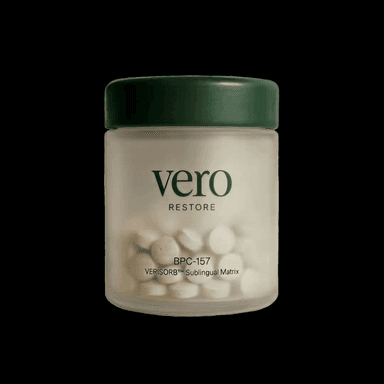
RESTORE™
BPC-157Engineered around 0.5mg BPC-157 (arginate salt). Accelerates deep tissue and joint recovery
Clinical Context
Important Notice: VERO protocols are nutritional and systemic optimisation formats. They are not intended to diagnose, treat, cure, or prevent any medical condition. These statements have not been evaluated by the Food and Drug Administration.