

Are peptides bad for you? It depends on the peptide, the delivery method, and whether it's approved or grey-market. Here's what the research actually shows.
Are peptides bad for you? The honest, consensus answer any pharmacist or doctor will give you is that it depends: on which peptide you mean, how it gets into your body, and whether it's an approved medicine or something sold from an unregulated website. That nuance is exactly what most articles skip.
They talk about "peptides" as if the whole category were one needle in a vial, when the real risk picture shifts completely depending on the delivery route, and on whether you're looking at a finished sublingual protocol or a grey-market injectable. This guide is published for research purposes only.
Here's the short version. A handful of peptides are among the most-studied, FDA-approved drugs on the market. A much larger cloud of "research" peptides sits outside any regulator's review, and that's where most of the genuine risk lives.
The difference that matters isn't the word "peptide." It's the paperwork behind the bottle, and the route the molecule takes to get inside you.
Key Takeaways
- "Are peptides bad for you" has no single answer: risk depends on the specific peptide, the delivery method, and whether it's FDA-approved or unregulated.
- More than 80 peptide drugs have reached the market worldwide, so the category as a whole is deeply mainstream medicine, not a fringe experiment (Muttenthaler et al. 2021).
- Delivery method changes the type of risk: injectables add contamination and injection-site risk, oral capsules mostly get destroyed in the gut, and sublingual absorption sidesteps both problems.
- Even approved peptides carry documented side effects. In Wegovy's trials, 44% of people reported nausea versus 16% on placebo (DailyMed label).
- Grey-market peptides are the real danger zone: one 2024 analysis of online semaglutide measured purity between 7.7% and 14.37%, against a 99% label claim (Venhuis et al. 2024).
Researching how peptides are formulated and delivered within the current safety picture? Explore the VERO protocols →
So, Are Peptides Bad for You, or Not?
For most people, the peptides worth worrying about are the unregulated ones, not the approved ones. That's the single most useful way to split the question. The word "peptide" covers everything from a century-old insulin injection to a vial of powder shipped from an anonymous website, and lumping them together is what makes the whole topic feel scary.
It helps to picture four different buckets the category falls into:
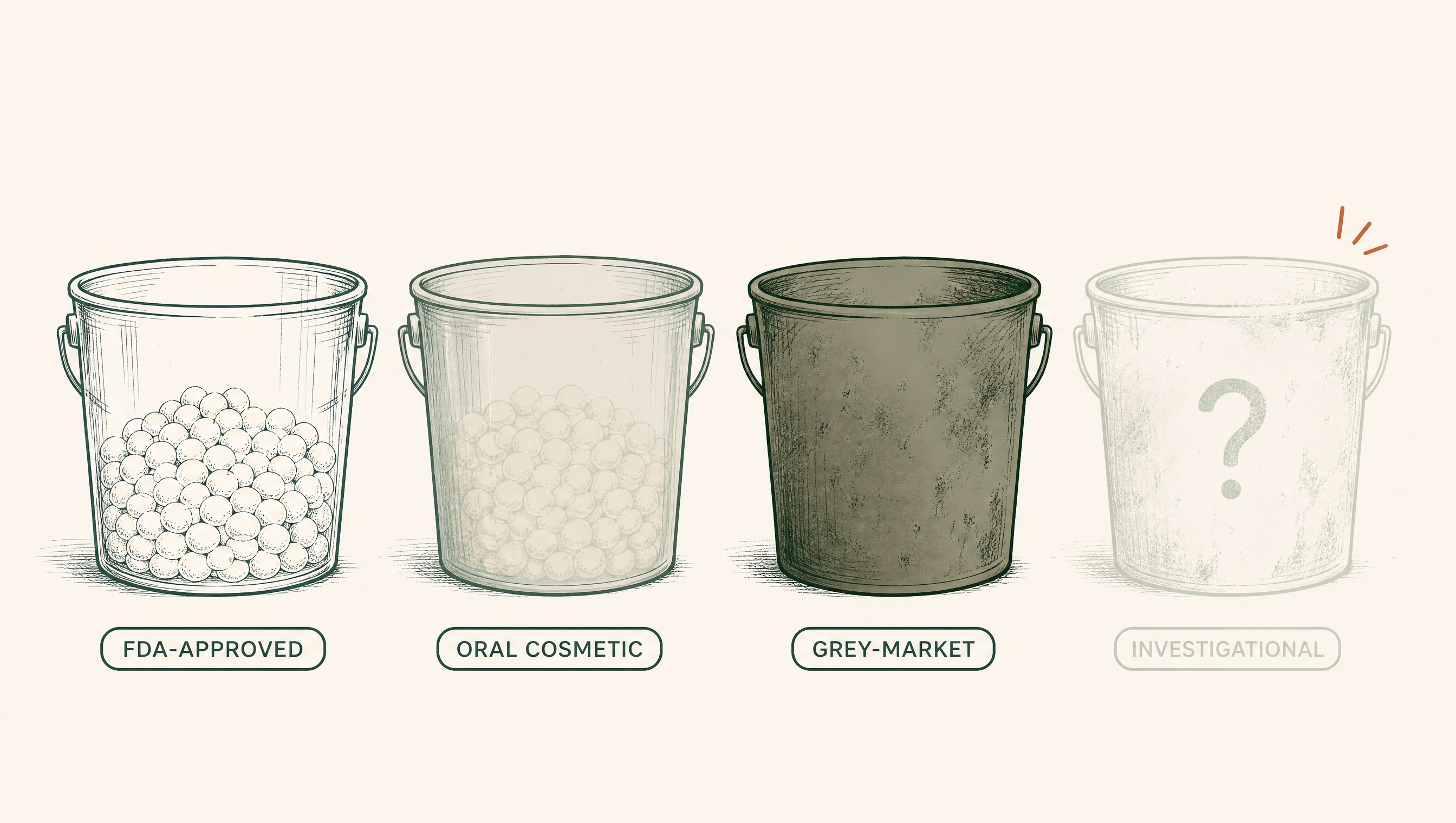
Four regulatory categories of peptides, from FDA-approved drugs to unregulated grey-market powders.
- FDA-approved peptide drugs (insulin, semaglutide, tirzepatide) that cleared full human trials.
- Oral cosmetic and food peptides (collagen powders) sold as everyday supplements.
- Grey-market "research" peptides (BPC-157, CJC-1295, various others) sold "not for human consumption."
- Investigational peptides still working their way through early studies.
The safety of one tells you almost nothing about the safety of another. An approved drug has a known side-effect profile printed on its label; a grey-market vial has no reviewed profile at all. So when someone asks whether peptides are bad for you, the useful reply is another question: which bucket, and delivered how?
What Are Peptides, in Plain Terms?
A peptide is just a short chain of amino acids, the same building blocks that make up the protein in your dinner. Think of a protein as a long freight train and a peptide as a handful of carriages uncoupled from it. Your body makes thousands of its own peptides to carry messages between cells, so these aren't foreign chemicals in principle.
Where it gets confusing is that "peptide" describes structure, not purpose. Insulin is a peptide. So is the collagen in a scoop of powder, and so is a lab-made compound with no approval behind it at all.

A protein is a long chain of amino acids; a peptide is just a few of those same building blocks linked together.
That's the whole reason a blanket safety verdict is impossible. You'd never ask "are liquids bad for you" and expect one answer that covers both water and bleach. Peptides are a similarly broad family, which is why the rest of this article sorts them by the things that actually change the risk.
Why Doesn't "Are Peptides Bad for You" Have One Answer?
The risk of any given peptide is set mostly by its regulatory category, because that category decides how much we actually know about it. An FDA-approved peptide has been through human trials with published safety data. A grey-market one usually hasn't, which means nobody can hand you its real side-effect profile.
Here's the same four buckets, now sorted by how much is genuinely known:
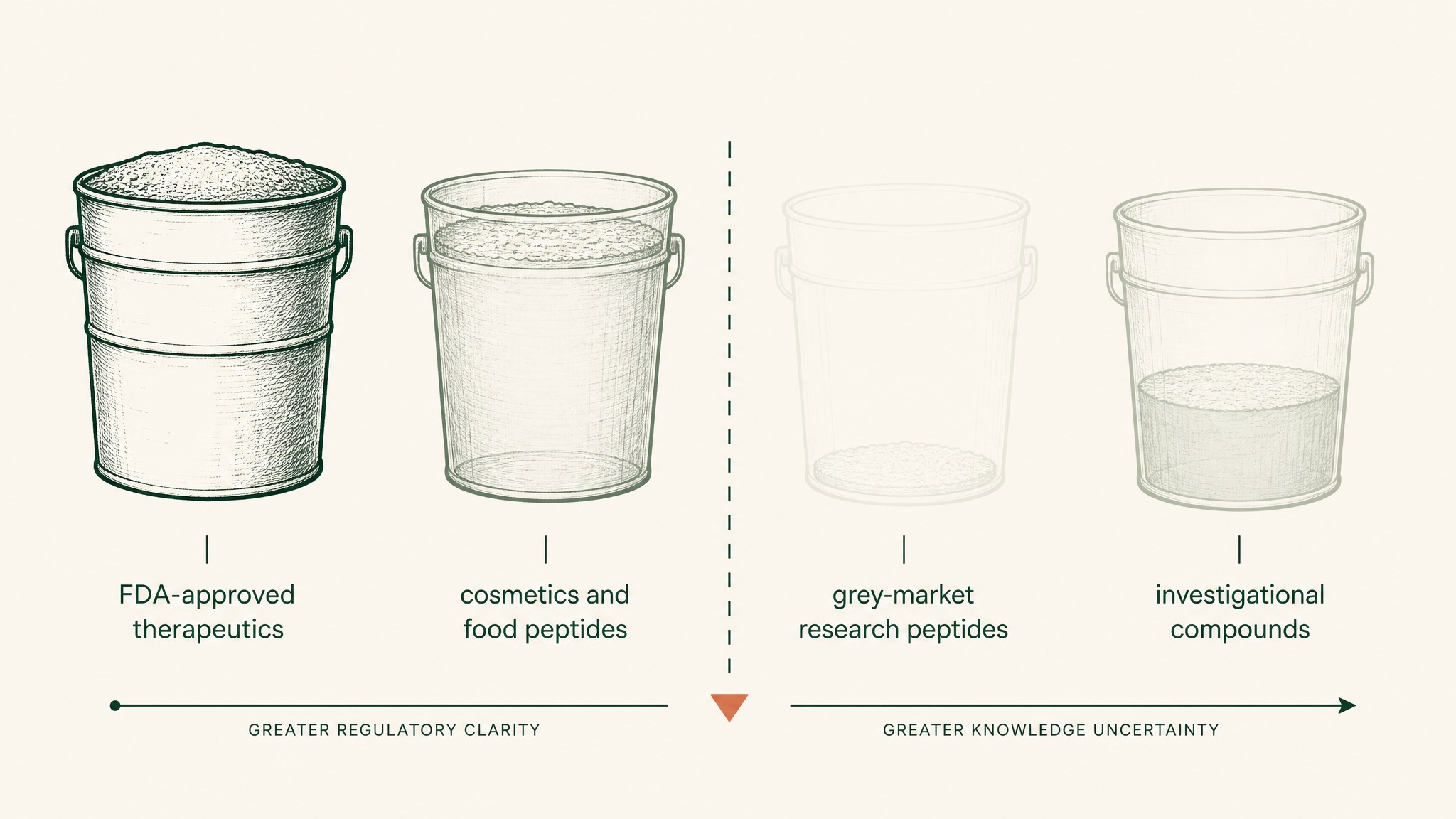
Four regulatory categories of peptides, ranked by how much safety data exists.
- Approved therapeutics (semaglutide, tirzepatide, insulin): human-trial data, a printed label, and a manufacturer accountable to regulators.
- Cosmetic and food peptides (collagen): sold under supplement rules, generally regarded as safe for healthy adults at normal amounts.
- Grey-market research peptides: no completed human trials, no approved dosing, no quality guarantee.
- Investigational compounds: under study, but conclusions aren't in yet.
The gap between bucket one and bucket three is enormous, and it's the gap most search results blur together.
More than 80 peptide drugs have already reached the market worldwide (Muttenthaler et al. 2021, Nature Reviews Drug Discovery), and peptide medicines are so mainstream that about one in eight US adults (12%) reported having taken a GLP-1 peptide drug in a 2024 national poll (KFF, 2024). The controversy online is really about that third bucket, not the whole class.
Does Delivery Method Change the Risk?
Yes, and this is the factor almost every guide skips: how a peptide gets into your body changes what you're actually risking, not just how well it works. An injection, a swallowed capsule, and a tablet held under your tongue face three completely different problems on the way in. Blend them together and you end up fearing the wrong thing.
Start with the gut, because it explains everything downstream. Your stomach is essentially a demolition chamber built to break protein apart, so a swallowed peptide mostly gets destroyed before it reaches your bloodstream.

How peptides take three different paths into your bloodstream depending on delivery method.
Oral peptide and protein drugs typically show bioavailability (how much of what you take actually reaches your blood) under 1%, and sometimes under 0.1% (Pharmaceutics review, 2025). Even a cleverly engineered oral peptide like Rybelsus lands at roughly 1% (same review).
Injecting the peptide solves the absorption problem by skipping the gut entirely. But it introduces a different one: whatever is in that vial goes straight past your body's defenses. If the liquid isn't sterile or the contents aren't what the label claims, there's no gatekeeper left to catch it.
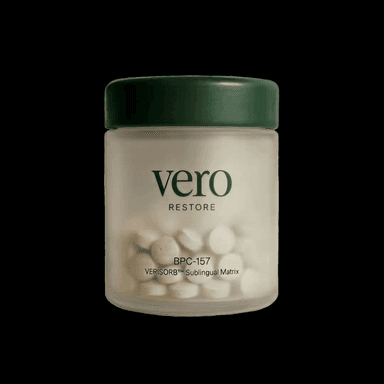
Sublingual delivery (letting a tablet dissolve under your tongue) threads between the two. The tissue under your tongue is rich with blood vessels, so a suitably formulated peptide can absorb there and bypass both the stomach's demolition and the first-pass filtering your liver does on anything swallowed. That's the logic behind VERO's VERISORB sublingual matrix: no needle, and no gut to fight through.
Here's the three routes side by side:
| Delivery route | How it's absorbed | Main risk type | What you're actually risking |
|---|---|---|---|
| Injectable | Straight into tissue or bloodstream | Contamination + injection-site | Sterility, mislabeled contents, abscess/infection |
| Oral capsule | Swallowed, fights the gut | Degradation + waste | Little reaches your blood; unpredictable dose |
| Sublingual | Absorbs under the tongue | Formulation quality | Depends on the matrix doing its job |
In our protocol design, the question we weigh most heavily is not "how strong is the dose" but "what does this route protect the reader from." A sublingual format can't fix a bad ingredient, but it removes the sterility and needle-hygiene variables that make unsupervised injecting the riskiest route of all. That's a research-context judgment about the delivery mechanism, not a claim about outcomes in any person.
What Side Effects Have Actually Been Documented?
The documented side effects of peptides fall into predictable groups, and they're far better understood for approved drugs than for grey-market ones. That asymmetry is the whole point: we can quote real numbers for the medicines and almost none for the research compounds.
Digestive and Injection-Site Reactions
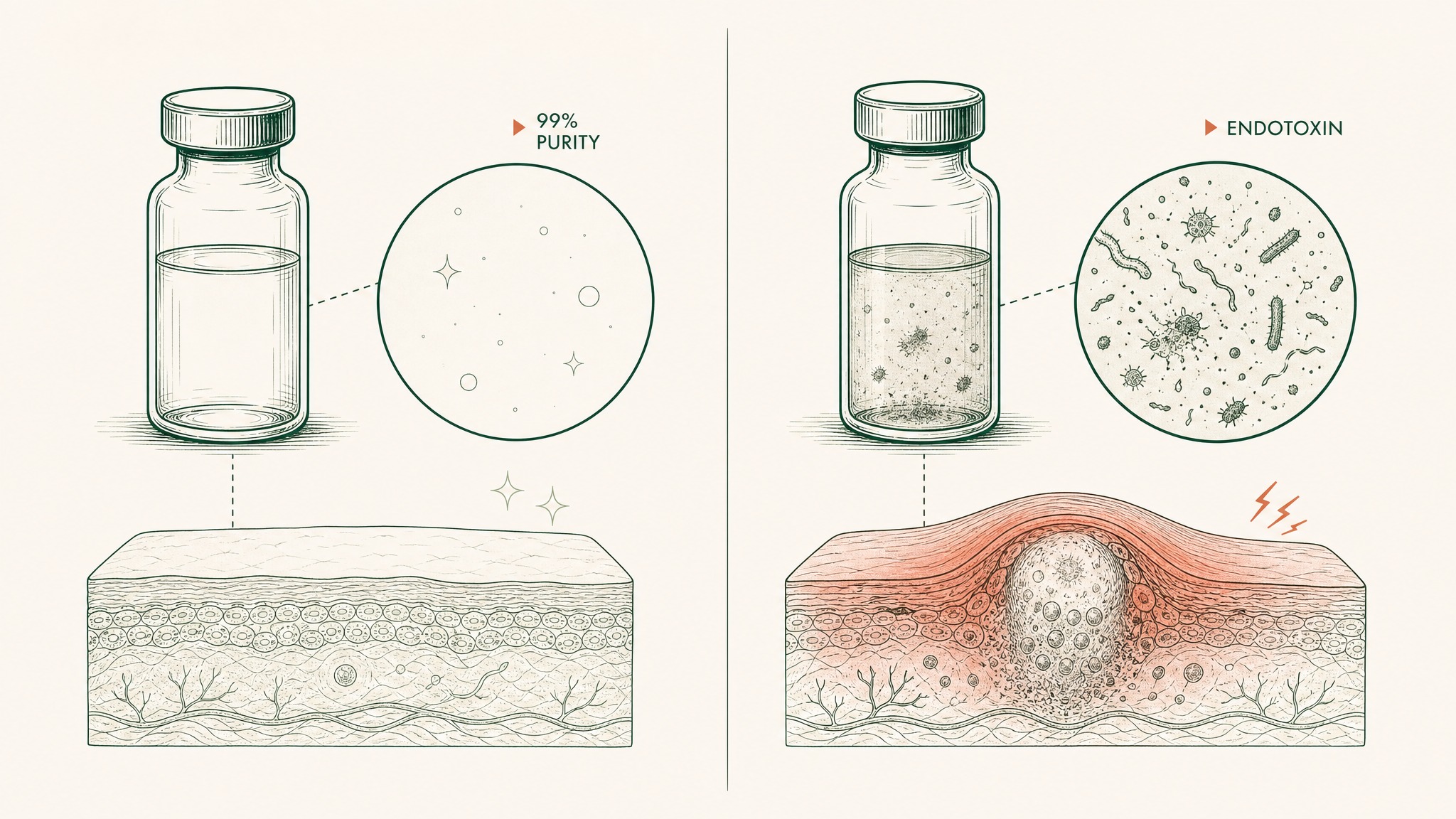
Pure pharmaceutical peptide versus contaminated grey-market product and its injection-site consequences.
Approved GLP-1 peptides have well-catalogued digestive effects. In Wegovy's trials, reported rates were nausea 44%, diarrhea 30%, vomiting 24%, and constipation 24%, versus 16%, 16%, 6% and 11% on placebo (DailyMed semaglutide label). Tirzepatide's label shows a similar pattern, with nausea around 25-29% depending on dose (DailyMed tirzepatide label).
Injectables also carry local reactions at the injection site, from irritation to, in unsterile cases, infection.
Hormonal and Endocrine Effects
Some peptides interact with hormone systems, which is exactly why they can't be treated as casual supplements. A compound that nudges growth-hormone or insulin signalling can affect blood sugar, fluid balance, or other tightly regulated systems. For approved drugs these interactions are mapped on the label; for grey-market compounds, they largely aren't.
The Bigger Problem: Contamination in Unregulated Products
This is where the real danger sits, and it's measurable. A 2024 analysis of semaglutide sold by online sellers without a prescription found measured purity between 7.7% and 14.37%, against the 99% claimed on the label, with bacterial endotoxin detected in every sample tested (Venhuis et al. 2024, JMIR). Endotoxin in an injected product is not a minor issue; it can trigger fever and immune reactions.
History shows how bad unregulated injectables can get. In a 1996 CDC-documented outbreak, 47 of 69 people (68%) who received an unapproved injectable product developed abscesses at the injection site, traced to Mycobacterium abscessus contamination (JAMA/CDC, 1996). That case is decades old, but it illustrates a risk category that never went away: when nobody guarantees sterility, you're the quality-control step.
What Does the Research Evidence Actually Support?
The evidence base is strong for approved peptide drugs and thin for most research peptides, and honest sourcing means saying so plainly. Agreeing with that consensus first is important, because the gap between animal studies and human proof is where a lot of marketing quietly cheats.
Take BPC-157, one of the most-hyped research peptides. In preclinical research, it has been studied in animal models for effects on tendon and gut tissue, but no completed Phase 1, 2, or 3 human trial has published results.
The one registered human study on record sits with an "unknown" status and no posted results (ClinicalTrials.gov, NCT02637284), and anti-doping authorities note it "is not approved for human clinical use by any global regulatory authority" (USADA). Animal-model promise is not human proof, and users report far more certainty online than the research supports. For the full regulatory picture, see our breakdown of BPC-157's FDA status.
Named experts make the same point about the caution the evidence demands. Harvard Health's 2026 review put it plainly: "We don't know enough about injectable peptides to say what kinds of effects they may have on long-term health or safety." Dr. Pieter Cohen of Harvard Medical School was blunter still, quoted directly in that piece: "As a clinician, I do not recommend injecting yourself with peptides" (Harvard Health, 2026). The through-line is simple: approved peptides have data; most others have hope.
FDA-Approved vs Grey-Market Peptides: What's the Difference?
An FDA-approved peptide has cleared human trials and carries an accountable manufacturer; a grey-market peptide has neither, and that's the whole distinction. One has been reviewed for safety and effectiveness by a regulator; the other is sold with a "research use only" or "not for human consumption" label precisely so the seller can sidestep that review.
Here's the split in practice:
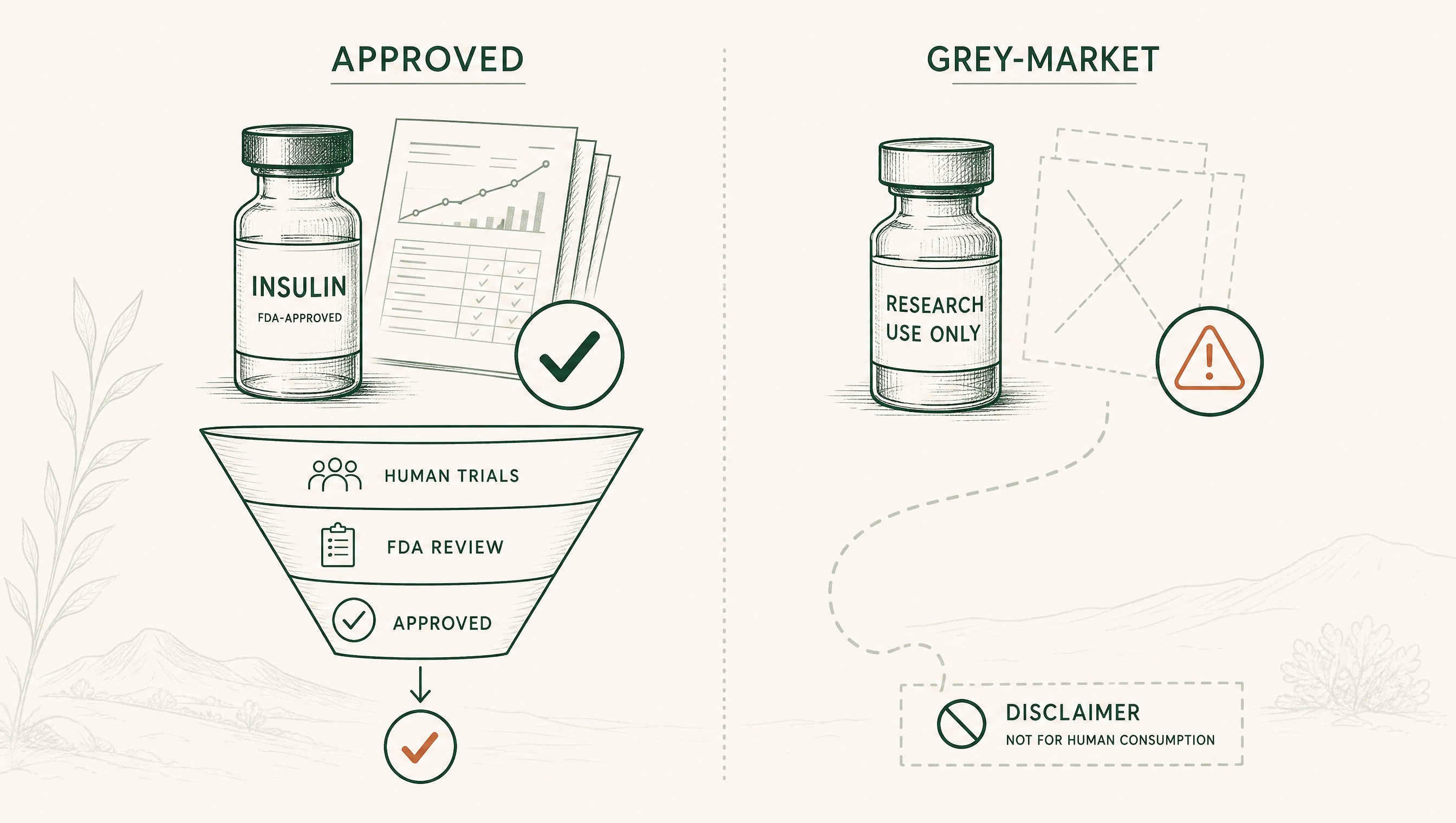
FDA-approved peptides pass human trials and safety review; grey-market peptides skip both and carry a research-only label.
- Approved peptide drugs: insulin, semaglutide (Ozempic, Wegovy), tirzepatide (Zepbound). Prescription-only, trial-backed, label-documented.
- Research and grey-market peptides: BPC-157, CJC-1295, and many others, sold online with a disclaimer that they're not for people.
The American Medical Association put the concern bluntly. "Unfortunately, many of these products have not been thoroughly tested or reviewed by the Food and Drug Administration, so we don't have data from trials," Dr. Anthony Tam told the AMA in April 2026, warning that "there's minimal evidence on the side effects or consequences of long-term or frequent dosing." (AMA, 2026). Research suggests the approved lane is well-understood; the grey-market lane, by design, is not.
How Do You Check If a Peptide Product Is Safe?
You can vet a specific peptide product yourself with a short checklist, without any medical training. This is the practical part almost no guide gives you: instead of "ask your doctor," here are the concrete signals that separate a serious product from a risky one.
Run any product through these five questions:
- Is there third-party testing? A legitimate seller publishes a certificate of analysis (COA) from an independent lab showing purity and contents. No COA is a red flag.
- Is the sourcing transparent? You should be able to see where and how it's made. "It's important to know exactly where your peptides come from and how they're manufactured," as the AMA's Dr. Tam put it (AMA, 2026).
- Is the delivery method disclosed and sensible? Injectable, oral, or sublingual, the format should be stated, and it shouldn't require you to sterilize and inject anything yourself.
- What's the regulatory category? Approved drug, compounded prescription, or "research use only"? The label's own wording tells you which lane you're in.
- Is there batch testing documentation? Reputable products test each batch, not just a one-time sample.
If a product can't answer the first two questions, take that as your answer. Third-party testing and clear sourcing are the difference between a company that expects scrutiny and one that hopes you won't look. It's the same standard VERO holds its own protocols to, and members experience it as the baseline, not a bonus.
Who Should Be Most Cautious?
Some people should be especially careful with any peptide and should talk to a doctor before starting one. This isn't diagnostic advice; it's about who has the most to lose if something in the product is off.
Be extra cautious if you're:
- Pregnant or breastfeeding
- Under 18
- Living with an endocrine or autoimmune condition
- Taking other hormone-affecting medication
- Managing kidney or liver conditions
For these groups, the unknowns of an unregulated compound carry more weight, and the sensible move is a conversation with a clinician who knows your history, not a purchase based on a forum thread.
Frequently Asked Questions
Are peptides bad for your liver or kidneys? Approved peptide drugs have documented safety profiles that account for organ effects, and your doctor can weigh them against your history. The real concern is grey-market products, where contaminants like the endotoxin found in unregulated semaglutide (Venhuis et al. 2024) create risks the label never discloses.
Are peptides bad for you long-term? For most research peptides, nobody can say, and that's the honest answer. As Harvard Health summarized the expert view in 2026, "we don't know enough about injectable peptides to say what kinds of effects they may have on long-term health or safety" (Harvard Health, 2026). Approved drugs have longer safety records; unregulated ones don't.
Are peptides the same as steroids? No. Peptides are short amino-acid chains that act as signalling molecules, while anabolic steroids are a different class of hormone. We cover the distinction fully in are peptides steroids.
Are peptides legal? It depends on the specific peptide and how it's sold. Some are FDA-approved prescriptions, some are compounded, and some are sold research-use-only. Full detail is in our guide on whether peptides are legal.
Do oral peptides carry the same risks as injections? No, and this is the key point. Oral peptides mostly get destroyed in the gut, with typical bioavailability under 1% (Pharmaceutics review, 2025), so the risk is wasted dose rather than contamination. Injecting carries sterility and injection-site risks that swallowing simply doesn't.
The Bottom Line
So, are peptides bad for you? Not as a class. The risk lives in specifics: an approved, trial-backed peptide drug taken under medical care is a world away from an unregulated vial bought online with a "not for human use" label.
Delivery method matters just as much as the molecule, because a needle, a capsule, and a sublingual tablet each carry a different kind of risk. Vet the product, not the buzzword: check for third-party testing, transparent sourcing, and a clearly stated regulatory category, and most of the fear resolves into a simple judgment about paperwork and quality.
References
- Muttenthaler M, King GF, Adams DJ, Alewood PF (2021). Trends in peptide drug discovery. Nature Reviews Drug Discovery (PMID 33536635). https://pubmed.ncbi.nlm.nih.gov/33536635/. Retrieved 2026-08-01.
- Pharmaceutics (2025). Barriers and strategies for oral peptide and protein therapeutics delivery: update on clinical advances. PMC12030352. https://pmc.ncbi.nlm.nih.gov/articles/PMC12030352/. Retrieved 2026-08-01.
- U.S. National Library of Medicine (DailyMed). WEGOVY (semaglutide) prescribing information. https://dailymed.nlm.nih.gov/dailymed/drugInfo.cfm?setid=f5e548d0-cc79-4c34-a3f5-e20a5b8b6564. Retrieved 2026-08-01.
- U.S. National Library of Medicine (DailyMed). ZEPBOUND (tirzepatide) prescribing information. https://dailymed.nlm.nih.gov/dailymed/drugInfo.cfm?setid=487cd7e7-434c-4925-99fa-aa80b1cc776b. Retrieved 2026-08-01.
- Venhuis BJ, et al. (2024). Multifactor quality and safety analysis of semaglutide products sold by online sellers without a prescription. Journal of Medical Internet Research (PMC11582493). https://pmc.ncbi.nlm.nih.gov/articles/PMC11582493/. Retrieved 2026-08-01.
- KFF (2024). Poll: about 1 in 8 US adults report having taken a GLP-1 drug. https://www.kff.org/health-costs/poll-1-in-8-adults-say-theyve-taken-a-glp-1-drug-including-4-in-10-of-those-with-diabetes-and-1-in-4-of-those-with-heart-disease/. Retrieved 2026-08-01.
- ClinicalTrials.gov. Phase 1 study record for PCO-02 (BPC-157), NCT02637284. https://clinicaltrials.gov/study/NCT02637284. Retrieved 2026-08-01.
- USADA. BPC-157: experimental peptide prohibited for athletes under the WADA Prohibited List (S0). https://www.usada.org/spirit-of-sport/bpc-157-peptide-prohibited/. Retrieved 2026-08-01.
- JAMA / CDC MMWR (1996). Infection with Mycobacterium abscessus associated with intramuscular injection of an unapproved adrenal cortex extract. https://jamanetwork.com/journals/jama/fullarticle/408944. Retrieved 2026-08-01.
- Harvard Health Publishing (2026). Peptides: what they are, potential benefits, and safety concerns. https://www.health.harvard.edu/medications-and-treatments/peptides-what-they-are-potential-benefits-and-safety-concerns. Retrieved 2026-08-01.
- American Medical Association (2026). What doctors want patients to know about injectable peptides. https://www.ama-assn.org/public-health/prevention-wellness/what-doctors-want-patients-know-about-injectable-peptides. Retrieved 2026-08-01.
Researching a peptide protocol built around sublingual delivery and third-party-tested sourcing? The RESTORE Protocol is where VERO members start. Explore RESTORE →
RESTORE™
BPC-157Engineered around 0.5mg BPC-157 (arginate salt). Accelerates deep tissue and joint recovery
Clinical Context
Important Notice: VERO protocols are nutritional and systemic optimisation formats. They are not intended to diagnose, treat, cure, or prevent any medical condition. These statements have not been evaluated by the Food and Drug Administration.