

BPC-157 is a tissue-repair peptide, not a fat burner. Here's what research shows about BPC-157 and weight loss, and which peptides are studied for it.
Short version, because you deserve it up front: there's no solid human evidence that BPC-157 helps you lose weight. It's a tissue-repair peptide, the kind of compound researchers look at for the gut lining and connective tissue, not a fat burner. If recovery is what you're actually chasing, a research-graded approach like RESTORE, VERO's BPC-157 protocol, is the honest home for it. Everything here is written for research purposes only.
Here's where the confusion starts. BPC-157 picked up a reputation online for sorting out everything from torn tendons to cranky guts, and somewhere in that hype, weight loss got tacked on too. Research suggests the reality is a lot narrower, and honestly, a lot less exciting.
So this guide does two things. It tells you what the BPC-157 research actually covers, and where it stops cold. Then it points you to the peptides that genuinely have human weight-loss data, so you don't waste months chasing the wrong molecule.
Key Takeaways
- No human trial has shown BPC-157 causes weight loss or fat loss. That claim is internet folklore, not data.
- BPC-157 is a 15-amino-acid fragment from stomach fluid, studied almost entirely in animals for gut and tissue repair, not metabolism.
- The peptides with real human weight-loss evidence are a totally different class: GLP-1 drugs like semaglutide and tirzepatide.
- Even those approved drugs come with a catch. Roughly a quarter to a third of the weight lost is lean muscle, not just fat.
- Swallowed peptides barely absorb, often under 1%, so any oral BPC-157 "weight loss" product hits a delivery wall before biology even matters.
So, does BPC-157 help with weight loss?
No. As of mid-2026, there is no published human trial showing that BPC-157 causes weight loss, fat loss, or appetite change.
The honest headline: BPC-157 is a repair peptide that wandered into a weight-loss conversation it was never studied for.
The evidence base tells a consistent story:
- Almost every BPC-157 study is done in rats or mice, not people.
- The animal work centres on wounds, tendons, and the gut lining, not body fat or metabolism.
- No study, animal or human, has used the measurements that would prove a weight-loss effect: body composition, energy burn, or appetite hormones.
That doesn't make BPC-157 useless. It just means "weight loss" is a claim someone bolted on later, and the research never backed it up.
What is BPC-157, and what's it actually for?
By the time people find BPC-157, they're usually nursing something: a stubborn tendon, a beat-up joint, a gut that's been unhappy for years. That's the lane it lives in. BPC-157 shows up in recovery research, not diet research.
Think of your body's repair system as a city's emergency dispatch. When tissue gets damaged, calls go out and crews get sent. In animal studies, BPC-157 seems to act like an extra dispatcher, nudging those repair signals along.
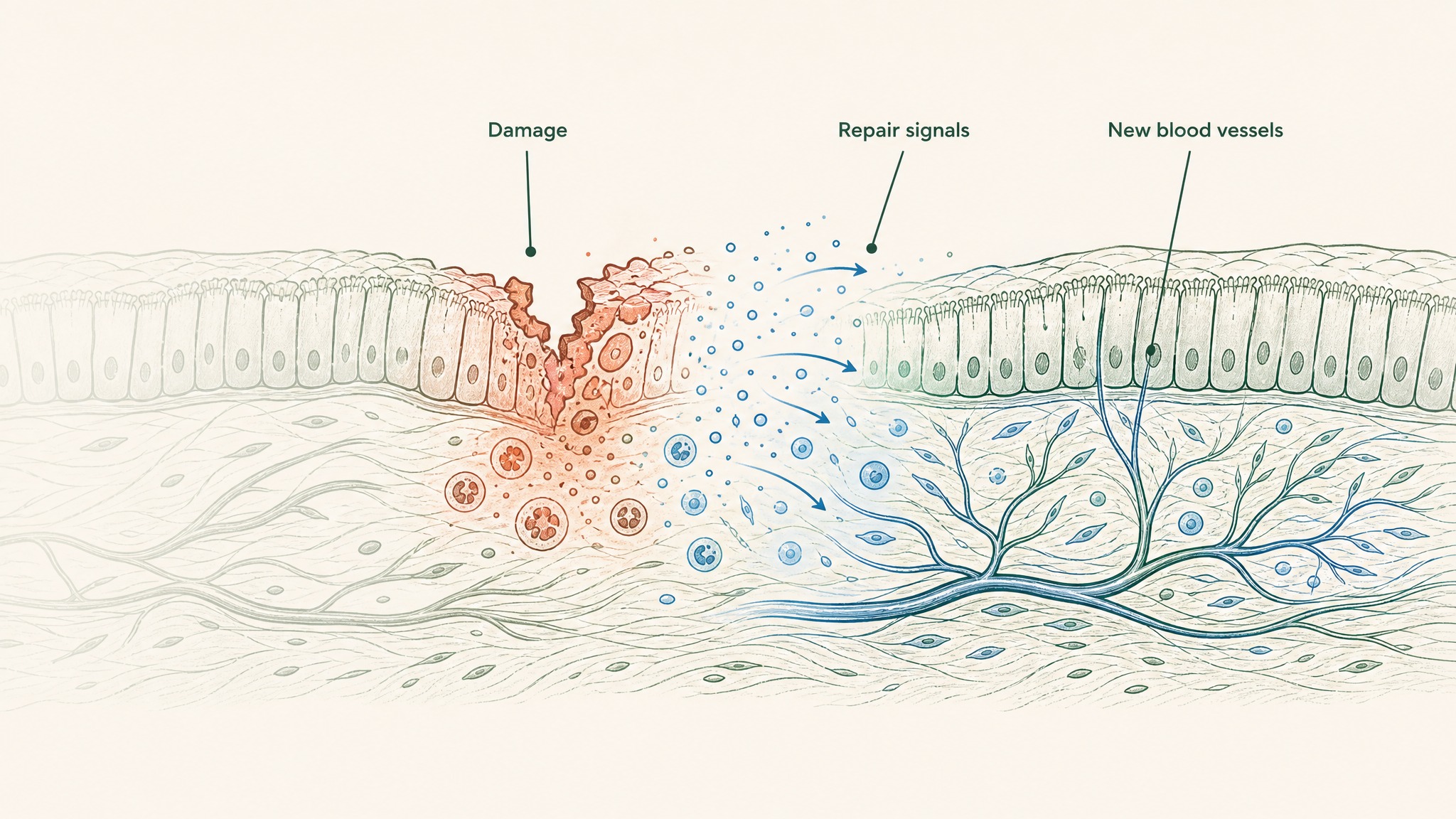
How BPC-157 may accelerate your body's natural tissue repair and blood vessel growth.
Only after that does the chemistry matter. BPC-157 is a pentadecapeptide, which just means a short chain of 15 amino acids (the building blocks that make up proteins). It's a fragment copied from a protein found in human gastric juice, the fluid in your stomach, and first described by a Croatian research group back in 1993 (Vukojević et al., 2020).
A few things worth knowing:
- BPC stands for Body Protection Compound, named for the gut-protection effects that first drew attention.
- The synthetic version is what every study uses, because your body only makes a trace of the natural one.
- It's not an approved medicine anywhere, and it's handled as a research compound, which is exactly why the RESTORE protocol frames it as research, not a fix-all.
In animal models, research suggests BPC-157 works through repair-related pathways like new blood-vessel growth and nitric oxide signalling, the same system that helps widen your blood vessels (Chang et al., 2020). None of that is a metabolic switch. It's plumbing and wiring, not fat burning.
Why do people think BPC-157 causes weight loss?
Every myth has a plausible origin, and this one has three. None of them survive a close look, but you can see how the game of telephone got started.
Here's how the weight-loss idea likely got attached:
- The gut connection. BPC-157 is studied for gut-lining recovery, and gut health is loosely linked to metabolism, so people assumed one leads to the other.
- The recovery halo. Recover faster, train harder, and yes, you might lean out, but that's the training doing the work, not the peptide melting fat.
- The do-everything reputation. Once a compound gets branded as fixing "everything," weight loss just gets swept into the pile.
Some users report feeling less bloated or bouncing back quicker between workouts, and it's genuinely easy to mistake that for fat loss. Feeling lighter and being lighter are not the same thing.
There's also plain confusion with GLP-1 peptides. People hear "peptide" plus "weight loss," picture Ozempic, and quietly assume every peptide plays that game. They don't.
What does the research on BPC-157 and fat actually show?
Picture two library shelves. One is stacked with BPC-157 papers on wounds, tendons, and gut lining. The other, labelled "body fat and metabolism," is empty. That's not a metaphor, that's the literature.
The strongest BPC-157 studies never once measured body weight or fat.
Look at what the actual research covered:
- In rats with limited blood flow to a limb, BPC-157 was linked to less tissue damage in the liver, kidney, and lung, a preclinical organ-protection finding with no body-weight measurement at all (Demirtaş et al., 2025).
- A 2023 review mapped a proposed gut-brain signalling route for BPC-157, built almost entirely on rodent data (Sikirić et al., 2023).
- A 2025 literature-and-patent review spelled out that BPC-157 isn't approved by the FDA or other regulators, that its evidence is mostly rats and mice, and that the one human safety trial from 2015 was cancelled and never published (Józwiak et al., 2025).
In the research cycles we've run at VERO, BPC-157 consistently lands in the recovery and gut-lining literature and never in the metabolic or body-composition work. That absence is the answer, not an oversight. If a repair peptide had a real fat-loss effect, someone would have measured it by now, and nobody has.
Could better gut health change your weight indirectly?
This is the one honest "maybe," so let's give it a fair hearing without overselling it. Your gut and your metabolism do talk to each other. The question is whether a peptide can turn that conversation into weight loss, and there the answer gets thin fast.
Here's the careful version:
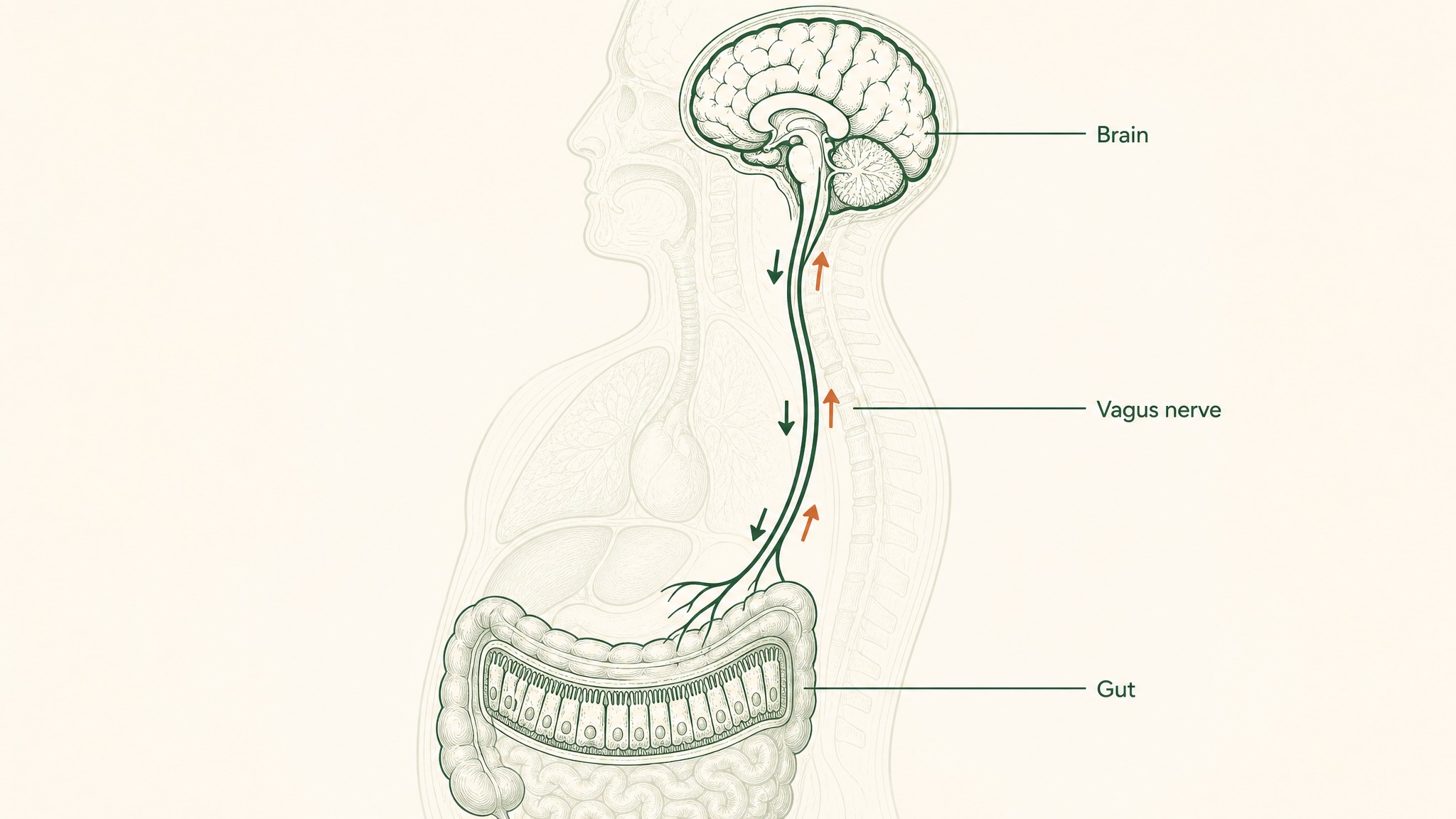
The gut-brain axis: a two-way signaling pathway between your digestive system and brain.
- Animal research suggests BPC-157 may interact with the gut-brain axis, the two-way signalling line between your digestive system and your brain (Sikirić et al., 2023).
- A healthier gut lining could, in theory, change how you absorb nutrients or how inflamed you run.
- But "in theory, in rats" is a long way from "loses weight, in humans," and no study has bridged that gap.
Read any gut-to-waistline claim as a hypothesis wearing a lab coat, not a result. It's the kind of mechanism worth studying, and it is emphatically not a reason to buy BPC-157 for weight loss today.
Which peptides are actually studied for weight loss?
If your real goal is fat loss, the good news is that a genuinely evidence-backed peptide class exists. The catch is that it's nothing like BPC-157. These are prescription GLP-1 drugs, run through large human trials, not research compounds you self-source.
GLP-1 stands for glucagon-like peptide-1, a hormone your gut releases after eating that tells your brain you're full. The weight-loss drugs are lab-made versions that stretch that "I'm full" signal out for a week at a time.
| Peptide | What the human trial showed | Trial | The catch |
|---|---|---|---|
| Semaglutide | About 15% of starting body weight lost over 68 weeks | STEP 1 (Wilding et al., 2021) | A meaningful share of that loss was lean muscle |
| Tirzepatide | Up to roughly 21% lost at the highest dose over 72 weeks | SURMOUNT-1 (Jastreboff et al., 2022) | About a quarter of the loss was lean mass |
| BPC-157 | No human weight-loss data exists | None | Wrong tool for the job |
To put the top number in human terms: losing 15 to 21% of your body weight is like a 200-pound person dropping 30 to 42 pounds. That's a real, measured, human result, which is exactly what BPC-157 doesn't have.
But read the "catch" column, because it matters. In an analysis of the semaglutide trial, a real chunk of the weight lost was lean tissue rather than fat (Wilding, Batterham, et al., 2021). A body-composition sub-study of tirzepatide found about three-quarters of the loss was fat and roughly a quarter was lean mass (Look et al., 2025). Losing muscle while you lose weight is the quiet downside nobody puts on the billboard.
Does it matter that oral peptides barely absorb?
Hugely, and this is the part that quietly sinks most "peptide in a capsule" products. Your gut is not a friendly doorway. It's more like an acid bath guarded by enzymes whose whole job is to shred proteins into scraps before they reach your blood.
Swallow a peptide, and most of it is destroyed before it does anything.
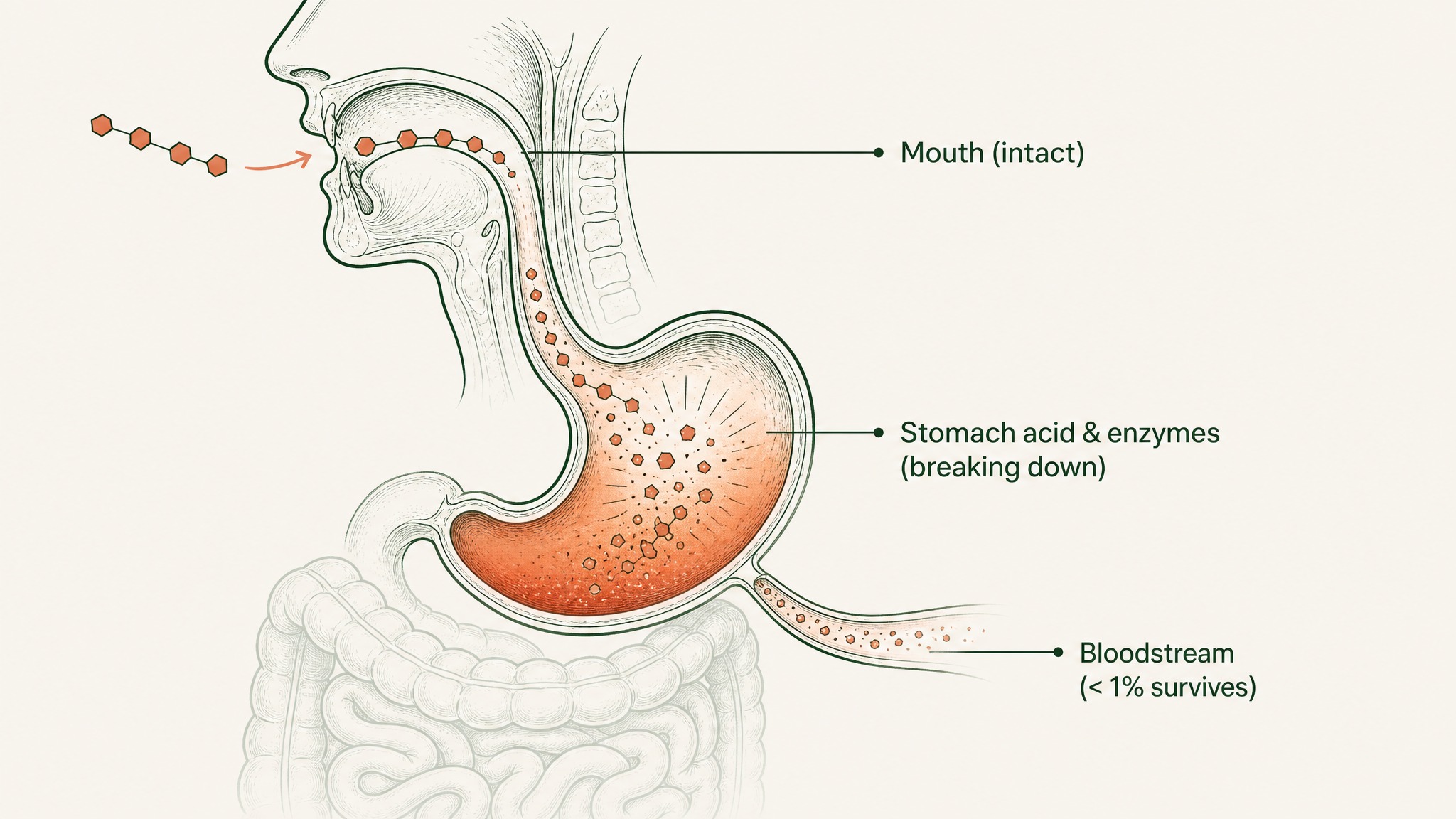
How stomach acid and enzymes destroy most swallowed peptides before they reach the bloodstream.
The numbers are brutal:
- Oral bioavailability for peptide drugs, meaning the fraction of what you swallow that actually reaches your bloodstream, is typically under 1%, and sometimes under 0.1% (Wang et al., 2025).
- So out of every 100 milligrams in a capsule, well under 1 milligram might survive the trip.
- Even oral semaglutide, a heavily engineered exception, only manages about 1%, and it only works because the molecule is extremely potent.
This is why delivery route is the whole ballgame, not an afterthought. VERO's answer is the VERISORB sublingual matrix, which is designed to let a compound absorb under the tongue and skip that gut gauntlet entirely. In VERO's protocol notes, members experience BPC-157 as a recovery tool through that sublingual route, which is a research framing, not a weight-loss promise. A swallowed BPC-157 "fat loss" pill, by contrast, faces a delivery problem before biology even gets a vote (see our deeper look at whether peptide pills are a scam).
Is BPC-157 legal or approved for weight loss?
No, and not for anything else either. There is no approved use of BPC-157 in standard medicine, which means "approved for weight loss" was never on the table.
The regulatory picture in plain English:
- In September 2023, the FDA placed BPC-157 on its 503A Category 2 list, substances it decided raise significant safety risks, which effectively blocks compounding pharmacies from making it (U.S. Food and Drug Administration, 2023).
- That status sits alongside the research gap: no completed, published human efficacy trials (Józwiak et al., 2025).
- Regulatory categories can move. An FDA advisory committee was reviewing peptide compounding substances in mid-2026, so check current FDA guidance before relying on any of this.
For the full breakdown, we've covered the BPC-157 FDA regulatory status separately. The short takeaway: this is a research compound, not a diet product, and no regulator classes it as one.
Frequently Asked Questions
Can BPC-157 burn belly fat? There's no research showing BPC-157 burns fat anywhere, belly or otherwise. Its studies are about tissue and gut repair in animals, and none measured body fat.
Will BPC-157 help me keep muscle while dieting? No human study has tested that. The muscle-preservation conversation belongs to a different set of compounds, and BPC-157 simply hasn't been measured for it.
Is BPC-157 like Ozempic? Not at all. Ozempic (semaglutide) is a GLP-1 drug with large human weight-loss trials behind it, while BPC-157 is a research-use repair peptide with no weight-loss data. Same word, "peptide," completely different worlds.
Does oral or sublingual BPC-157 do anything for weight loss? Route changes how much absorbs, not what the compound does. Even if a sublingual form absorbs well, BPC-157 still has no weight-loss evidence to deliver on.
Is BPC-157 safe to use for weight loss? Setting aside that it has no weight-loss benefit, its long-term human safety is simply unstudied, and the one human safety trial from 2015 was never completed. It remains a research compound, published for research purposes only.
References
- Vukojević et al. (2020). Stable gastric pentadecapeptide BPC 157, Robert's stomach cytoprotection, and Selye's stress-coping response. Current Neuropharmacology. https://pmc.ncbi.nlm.nih.gov/articles/PMC7096228/ Retrieved 2026-07-27.
- Chang et al. (2020). BPC-157 and the Src-Caveolin-1-endothelial nitric oxide synthase pathway in vasomotor tone: a rat-tissue and in-vitro study. Scientific Reports. https://pmc.ncbi.nlm.nih.gov/articles/PMC7555539/ Retrieved 2026-07-27.
- Demirtaş et al. (2025). BPC 157 and distant-organ outcomes in rats with experimental lower-extremity ischemia-reperfusion injury. Medicina (Kaunas). https://pmc.ncbi.nlm.nih.gov/articles/PMC11857380/ Retrieved 2026-07-27.
- Józwiak et al. (2025). Multifunctionality and possible medical application of the BPC 157 peptide: a literature and patent review. Pharmaceuticals. https://pmc.ncbi.nlm.nih.gov/articles/PMC11859134/ Retrieved 2026-07-27.
- Sikirić et al. (2023). Stable gastric pentadecapeptide BPC 157 and brain-gut and gut-brain axis function: a preclinical review. Pharmaceuticals. https://pmc.ncbi.nlm.nih.gov/articles/PMC10224484/ Retrieved 2026-07-27.
- U.S. Food and Drug Administration (2023). Certain bulk drug substances for use in compounding that may present significant safety risks (503A Category 2 listing, including BPC-157). FDA Human Drug Compounding. https://www.fda.gov/drugs/human-drug-compounding/certain-bulk-drug-substances-use-compounding-may-present-significant-safety-risks Retrieved 2026-07-27.
- Wang et al. (2025). Barriers and strategies for oral peptide and protein therapeutic delivery: an update on clinical advances. Pharmaceutics. https://pmc.ncbi.nlm.nih.gov/articles/PMC12030352/ Retrieved 2026-07-27.
- Wilding et al. (2021). Once-weekly semaglutide in adults with overweight or obesity (STEP 1 trial). New England Journal of Medicine. https://www.nejm.org/doi/full/10.1056/NEJMoa2032183 Retrieved 2026-07-27.
- Wilding, Batterham, et al. (2021). Semaglutide and body-composition change in adults with overweight or obesity: exploratory analysis of the STEP 1 study. Journal of the Endocrine Society. https://academic.oup.com/jes/article/5/Supplement_1/A16/6240360 Retrieved 2026-07-27.
- Jastreboff et al. (2022). Tirzepatide once weekly in the management of obesity (SURMOUNT-1 trial). New England Journal of Medicine. https://www.nejm.org/doi/full/10.1056/NEJMoa2206038 Retrieved 2026-07-27.
- Look et al. (2025). Body-composition change during weight reduction with tirzepatide in the SURMOUNT-1 study. Diabetes, Obesity and Metabolism. https://dom-pubs.onlinelibrary.wiley.com/doi/10.1111/dom.16275 Retrieved 2026-07-27.
BPC-157 is a recovery story, not a weight-loss one. If tissue repair is your actual goal, explore the RESTORE protocol or browse every VERO protocol →.
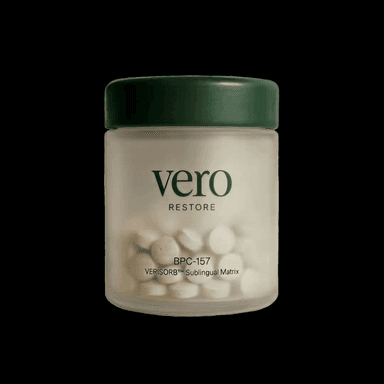
RESTORE™
BPC-157Engineered around 0.5mg BPC-157 (arginate salt). Accelerates deep tissue and joint recovery
Clinical Context
Important Notice: VERO protocols are nutritional and systemic optimisation formats. They are not intended to diagnose, treat, cure, or prevent any medical condition. These statements have not been evaluated by the Food and Drug Administration.