

Peptides are used for everything from diabetes medicine to weight loss to skincare to recovery research. Here's the full map of what peptides actually do, with real numbers.
Peptides are used for a huge range of jobs, and almost all of them come down to one thing: carrying messages between your cells. Some peptides are FDA-approved medicines you might already take. Others are cosmetic ingredients sitting in your bathroom cabinet. A growing group lives in the research-only lane, studied in labs but not cleared for the clinic.
Scientists have catalogued around 7,000 peptides in the human body, and roughly 100 peptide medicines have made it all the way through FDA approval (Stanford Medicine, 2026). That range, from a hormone your pancreas made this morning to a lab-built molecule under study, is exactly why the honest answer to "what are peptides used for" is "it depends which peptide."
This guide is shared for research purposes only, and it maps the real uses with real, sourced numbers. If you're weighing up the research peptides VERO formulates, the map below is the place to start.
Key Takeaways
- Peptides do three main jobs: they act as approved medicines (insulin, GLP-1 drugs), as cosmetic ingredients (collagen peptides), and as research-only compounds (BPC-157, thymosin beta-4).
- The global peptide therapeutics market was valued at about $52.59 billion in 2025, projected to reach $87.21 billion by 2035 (Precedence Research, 2026).
- GLP-1 peptide drugs such as semaglutide are FDA-approved for chronic weight management (Wilding et al., NEJM 2021).
- Research-only peptides like BPC-157 are not FDA-approved, and a 2025 review states so plainly (Pharmaceuticals, 2025).
- Delivery decides everything: swallowed as a pill, research suggests most peptides are broken down by digestion before absorption, which is why format matters more than most people realize (oral delivery review, 2025).
What Are Peptides Actually Used For?
Peptides are used for three broad jobs: as approved medicines, as cosmetic ingredients, and as research compounds. Sorting any peptide into one of those three lanes answers most of what people are really asking.
Think of it like the word "engine." A jet engine, a car engine, and a model-rocket engine are all engines, but you'd never use them interchangeably. Peptides are the same: one category, wildly different applications.
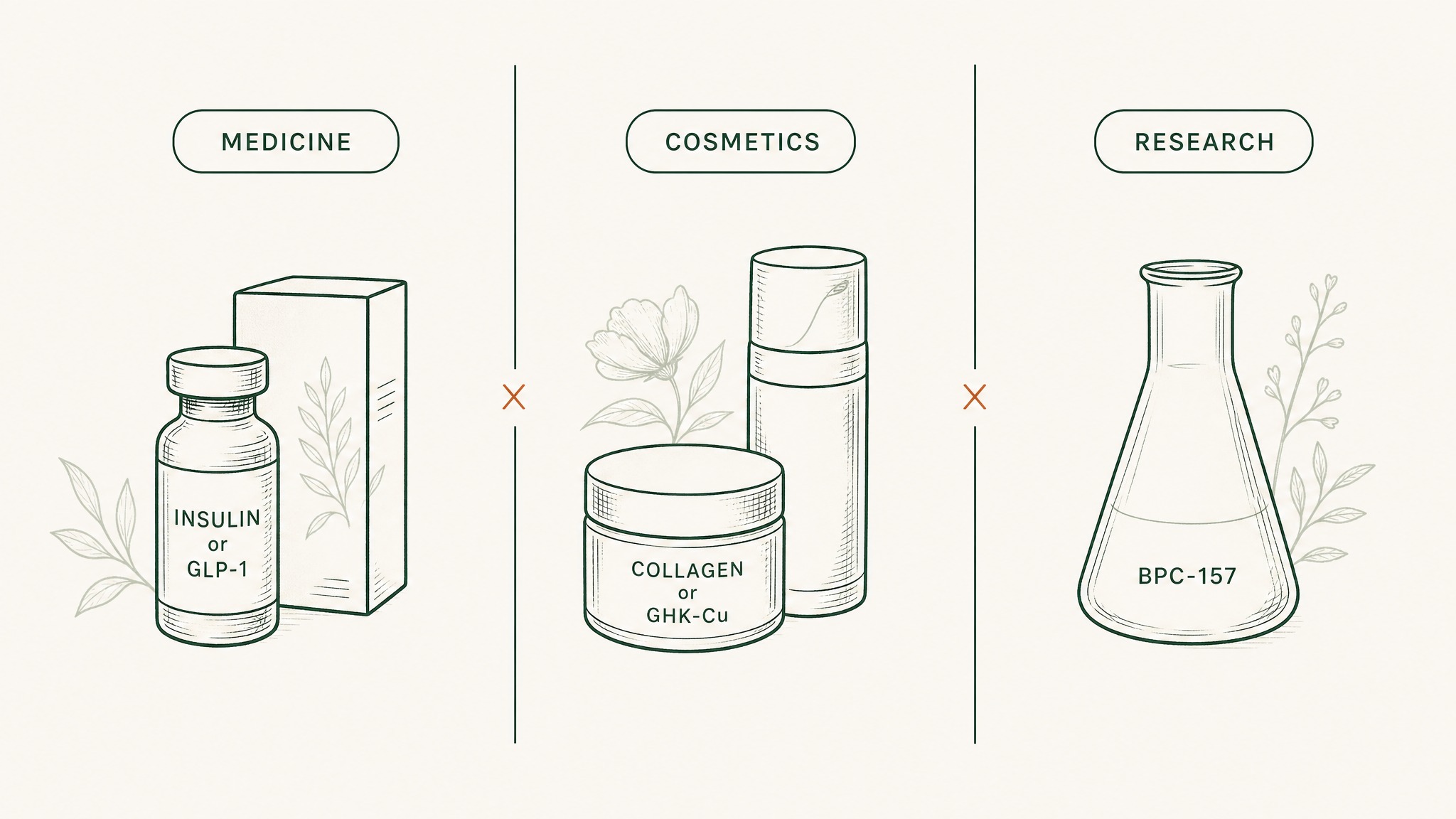
Peptides sorted into three distinct lanes: medicine, cosmetics, and research compounds.
Here's the split, by the numbers:
- Medicine: roughly 100 peptide therapeutics have cleared FDA approval, with about 120 peptide drugs on the market worldwide (Stanford Medicine, 2026; Pharmaceuticals, 2025).
- Cosmetics: peptides like collagen fragments are used to support skin structure, one of the few consumer categories with human trial data behind it.
- Research: compounds like BPC-157 and thymosin beta-4 are sold strictly for research purposes only, not cleared for human therapeutic use.
Here are the three lanes side by side:
| Lane | Example peptides | Status |
|---|---|---|
| Medicine | Insulin, semaglutide (GLP-1) | FDA-approved, about 100 therapeutics |
| Cosmetics | Collagen peptides | Sold as cosmetic ingredients |
| Research | BPC-157, thymosin beta-4 | Not FDA-approved, research use only |
The money behind all this is not small. The global peptide therapeutics market was valued at about $52.59 billion in 2025 and is projected to reach $87.21 billion by 2035 (Precedence Research, 2026). If you want the wider data set, we pulled 60-plus sourced peptide statistics into one reference.
Why Does Your Body Depend on Peptides in the First Place?
Before peptides were ever medicines, they were messengers, and your body is running on thousands of them right now. Peptides are short chains of amino acids (the same building blocks that make up the protein on your plate), and their main job is telling cells what to do.
Picture your bloodstream as a postal network. Each peptide is a short, specific note, cut to a precise length so it fits exactly one receptor, like a key shaped for a single lock.
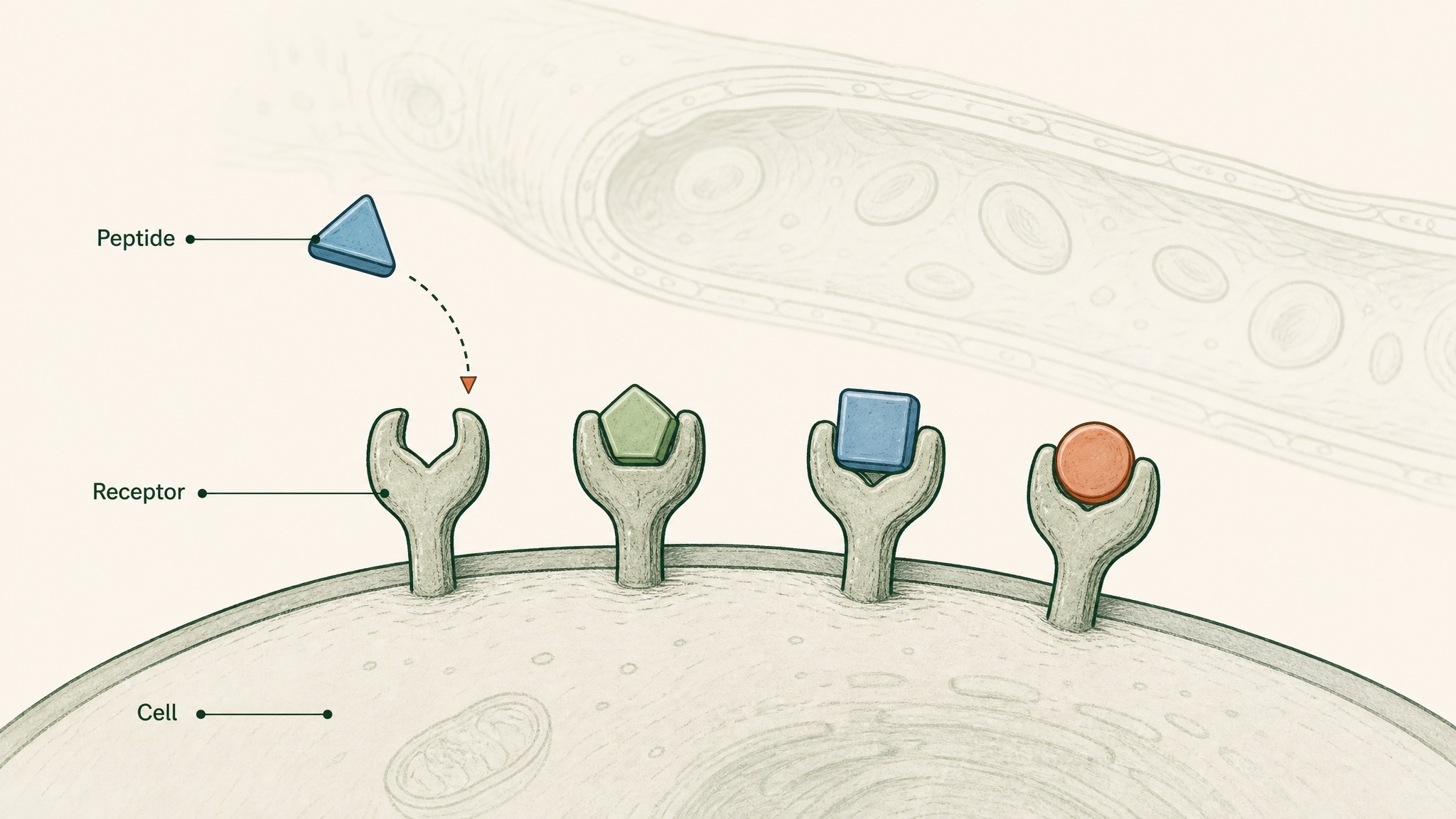
Peptide molecules dock onto cell receptors like keys fitting into locks.
A 2019 study in Cell described the peptide signalling system as "the most abundant network of ligand-receptor-mediated signaling in humans," and expanded the map of known peptide-receptor pairings from 348 to 407 (PMC6838683, 2019). Some of these messengers you already know by name:
- Insulin: 51 amino acids, the hormone that helps manage your blood sugar.
- Glucagon: 29 amino acids, insulin's counterpart that raises blood sugar when it dips.
- Oxytocin: just 9 amino acids, one of the shortest signalling peptides you make.
Research suggests your body holds roughly 7,000 different peptides at any given moment (Stanford Medicine, 2026). By any reasonable definition, peptides are as natural as biology gets, a point we unpack in are peptides natural.
How Are Peptides Used in Medicine Today?
Peptides are used in medicine to fill roles that small-molecule pills and large antibodies both struggle with, and insulin is the founding example. When your pancreas can't make enough of it, a lab-built copy steps in, and it has kept millions of people alive for a century.
The category has grown far past insulin. Peptide medicines are now approved for conditions spanning diabetes, obesity, osteoporosis, and rare genetic disorders.
By the numbers, the approvals keep coming:
- Roughly 100 peptide therapeutics have cleared FDA approval to date (Stanford Medicine, 2026).
- About 120 peptide drugs are on the market worldwide, with many more in development (Pharmaceuticals, 2025).
- In 2021 alone the FDA approved 8 new peptide drug entities, one of the strongest single years on record (PMC11820978, 2025).
Why peptides for these jobs? They're specific enough to hit one target cleanly, which often means fewer off-target effects than a broad small-molecule drug. That specificity is the whole reason the pharmaceutical industry keeps betting on them.
Can Peptides Really Be Used for Weight Loss?
Yes, and the weight-loss peptides are the reason peptides are suddenly a dinner-table topic. GLP-1 receptor agonists, a class of peptide-based drugs, are FDA-approved for both type 2 diabetes and chronic weight management, and the trial numbers are what put them on the map.
These are prescription medicines, not supplements, and the human trial data is unusually strong for this category:
- Semaglutide (the peptide in Wegovy and Ozempic) was studied in the large STEP 1 weight-management trial (Wilding et al., NEJM 2021).
- Tirzepatide (Mounjaro, Zepbound) was studied in the SURMOUNT-1 trial (Jastreboff et al., NEJM 2022).
Those are big, named human trials, which is why the numbers are trustworthy in a way most peptide marketing is not. VERO doesn't sell prescription GLP-1 drugs, but if you're comparing the injectable options, we broke down the best injectable peptides for weight loss by trial evidence. The short version: this is the one peptide-use category with blockbuster human data behind it.
What Are Peptides Used For in Skincare?
Peptides are used in skincare to support the collagen and elastin that give skin its structure, and it's one of the few consumer categories with human trial data rather than just marketing. As you age, your skin makes less of the signalling molecules that keep that maintenance work running, and cosmetic peptides aim at that gap.
Think of collagen as the scaffolding under your skin. Peptides are used as the tiny work orders that tell the scaffolding crew to keep building.
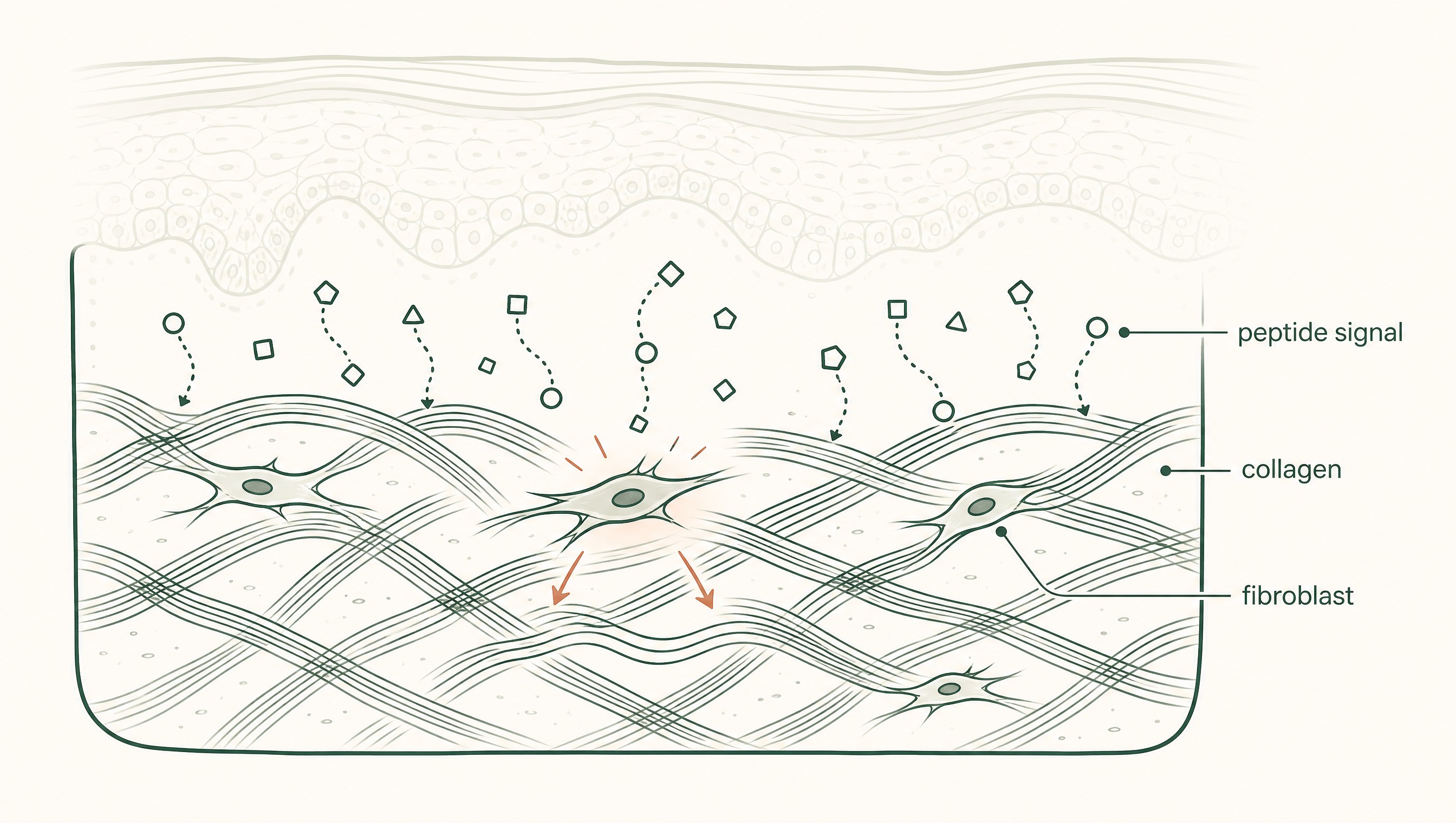
Peptides signal skin cells to maintain and rebuild the collagen scaffold that keeps skin firm.
Collagen peptides are the best-studied type on the shelf:
- A 2024 randomized controlled trial studied hydrolyzed collagen peptides and skin elasticity in women (J Clin Med, 2024).
The catch is delivery, which most serum brands skip over. A topical peptide has to survive the skin barrier to reach the dermis where collagen lives, and many don't. We go deeper on which compounds clear that bar in peptides and skin care.
How Are Peptides Used in Recovery and Tissue-Repair Research?
Peptides are used in recovery research to study how soft tissue like tendons and ligaments might repair faster, and this is the lane where BPC-157 and thymosin beta-4 live. Both are research-only compounds, which means the excitement runs ahead of the regulatory reality, and that gap matters.
Here's the honest status, stated up front:
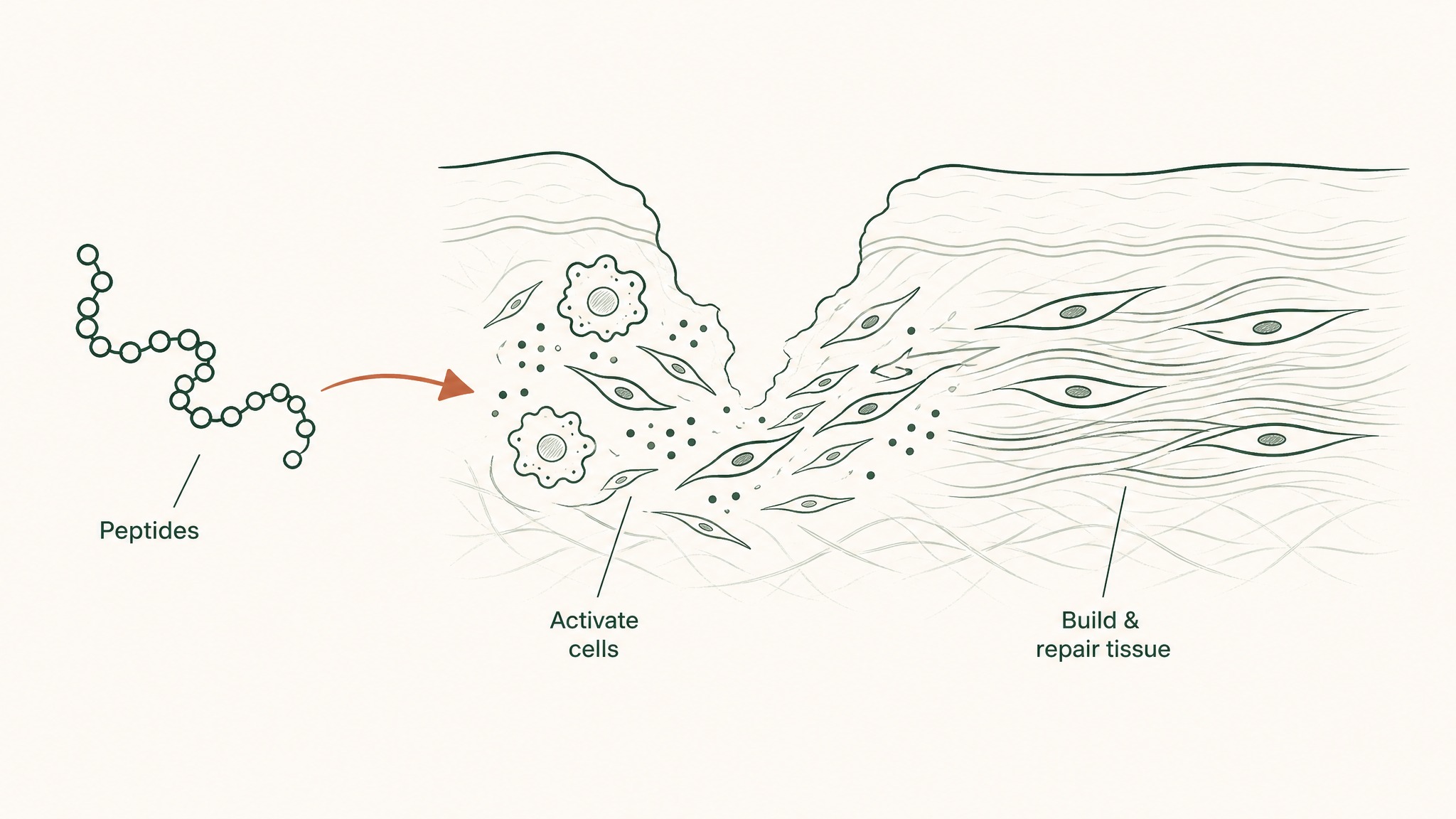
How Are Peptides Used in Recovery and Tissue-Repair Research?
BPC-157 and thymosin beta-4 are studied in animal models, not approved for human use, and there are no completed large human trials behind the recovery claims.
The research that exists is genuinely interesting but preclinical. In preclinical research, BPC-157 has been studied for its effects on tendon and soft-tissue models in animals, with the clearest signals in poorly-vascularized tissue that normally heals slowly. A 2025 review in Pharmaceuticals put the regulatory picture bluntly, noting that BPC-157 "has not been approved for use in standard medicine by the FDA and other global regulatory authorities due to the absence of sufficient and comprehensive clinical studies" (Pharmaceuticals, 2025). Thymosin beta-4 sits in the same research-only category, studied in animal models for cell migration and blood-vessel formation.
VERO's RESTORE protocol is built around BPC-157 and formulated for under-the-tongue delivery rather than a swallowed capsule. To compare options, see how to choose a peptide protocol. For the full picture, see what the published BPC-157 research shows and BPC-157's regulatory standing.
Why Does Delivery Decide Whether a Peptide Works?
The single biggest thing that decides whether a peptide does anything is how it gets into your bloodstream, and this is the part most peptide conversations skip entirely. A perfect molecule that never reaches your blood is a perfect molecule doing nothing.
Your digestive system handles a swallowed peptide exactly like it handles food: something to break down for parts, not something to absorb intact. That's why the route matters so much:
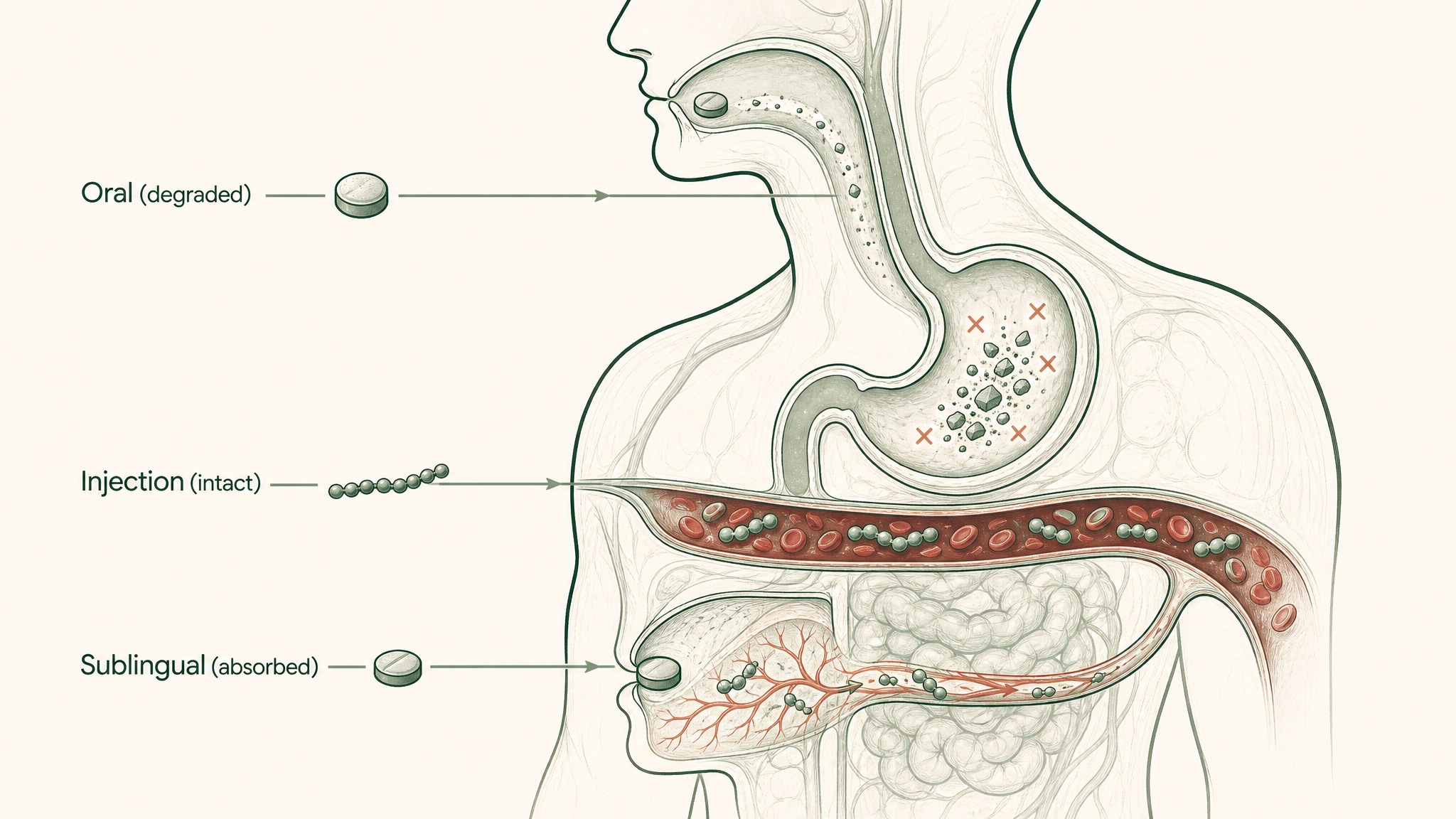
Why swallowed peptides break down in your stomach, but injected and sublingual routes reach your blood intact.
- Swallowed as a pill, most peptides get shredded like ordinary food protein, so oral bioavailability (how much of what you swallow actually reaches your blood) is often very low (oral delivery review, 2025).
- Injection bypasses the gut entirely, which is why nearly every approved peptide medicine, from insulin to GLP-1 drugs, is injected rather than swallowed.
- Sublingual (under-the-tongue) delivery uses blood-vessel-rich tissue to absorb a peptide directly and skip the first-pass trip through your liver.
In our protocol design, the question we weigh most heavily is whether a fragile peptide can survive the trip to the tissue it's meant to reach, because a molecule that degrades on the way signals nothing at all. That's a manufacturing-and-delivery question, not a marketing one. VERO's VERISORB sublingual matrix was engineered around that exact absorption gap, and members experience the difference as onset and consistency rather than a line on a lab report. If you want the underlying data, we covered the peptide-pill absorption problem on its own.
Frequently Asked Questions
What are peptides used for in simple terms? Peptides are used to send signals between cells, which is why they show up as medicines (insulin, GLP-1 drugs), cosmetic ingredients (collagen peptides), and research compounds (BPC-157). Roughly 100 peptide therapeutics have cleared FDA approval (Stanford Medicine, 2026).
Are peptides used for weight loss? Yes. GLP-1 peptide drugs like semaglutide and tirzepatide are FDA-approved for chronic weight management (Wilding et al., NEJM 2021).
Are peptides used in skincare? Yes. Collagen peptides are used to support skin structure, and a 2024 randomized trial studied collagen peptides and skin elasticity (J Clin Med, 2024).
Is BPC-157 approved for anything? No. A 2025 review confirms BPC-157 "has not been approved for use in standard medicine by the FDA and other global regulatory authorities due to the absence of sufficient and comprehensive clinical studies" (Pharmaceuticals, 2025). It is sold for research purposes only.
Why can't you just swallow peptides in a pill? Because your gut breaks most of them down before they reach your blood, oral bioavailability is commonly very low (oral delivery review, 2025). That's why approved peptide medicines are injected and why VERO uses sublingual delivery.
References
- Stanford Medicine. Peptides talk is everywhere: but what does the science say? https://med.stanford.edu/news/insights/2026/08/peptides-what-does-the-science-say.html. Retrieved 2026-08-18.
- Al Musaimi et al. (2025). 2024 FDA TIDES (peptides and oligonucleotides) harvest. Pharmaceuticals (PMC). https://pmc.ncbi.nlm.nih.gov/articles/PMC11945313/. Retrieved 2026-08-18.
- Wang et al. (2025). The pharmaceutical industry in 2024: an analysis of FDA drug approvals from the perspective of molecules. PMC. https://pmc.ncbi.nlm.nih.gov/articles/PMC11820978/. Retrieved 2026-08-18.
- Precedence Research. Peptide therapeutics market size and forecast. https://www.precedenceresearch.com/peptide-therapeutics-market. Retrieved 2026-08-18.
- Foster et al. (2019). Discovery of human signaling systems: pairing peptides to G protein-coupled receptors. Cell (PMC). https://pmc.ncbi.nlm.nih.gov/articles/PMC6838683/. Retrieved 2026-08-18.
- Wilding et al. (2021). Semaglutide in adults with overweight or obesity (STEP 1). New England Journal of Medicine. https://www.nejm.org/doi/full/10.1056/NEJMoa2032183. Retrieved 2026-08-18.
- Jastreboff et al. (2022). Tirzepatide for the management of obesity (SURMOUNT-1). New England Journal of Medicine. https://www.nejm.org/doi/full/10.1056/NEJMoa2206038. Retrieved 2026-08-18.
- Lim et al. (2024). Hydrolyzed collagen peptide supplementation and skin elasticity: a double-blind, randomized, placebo-controlled study. Journal of Clinical Medicine (PMC). https://pmc.ncbi.nlm.nih.gov/articles/PMC11432272/. Retrieved 2026-08-18.
- Multifunctionality and possible medical application of the BPC-157 peptide: literature and patent review (2025). Pharmaceuticals (PMC). https://pmc.ncbi.nlm.nih.gov/articles/PMC11859134/. Retrieved 2026-08-18.
- Oral peptide and protein therapeutics delivery: barriers and strategies (2025). PMC. https://pmc.ncbi.nlm.nih.gov/articles/PMC12030352/. Retrieved 2026-08-18.
This content is produced for educational and research purposes only. VERO products are not intended to diagnose, treat, cure, or prevent any disease. Compounds described are research chemicals and are not approved for human therapeutic use unless otherwise stated. Consult a qualified healthcare provider before making any health-related decisions.
Curious which peptide fits your research goal, and how to get it past your gut intact? Explore VERO's protocols →
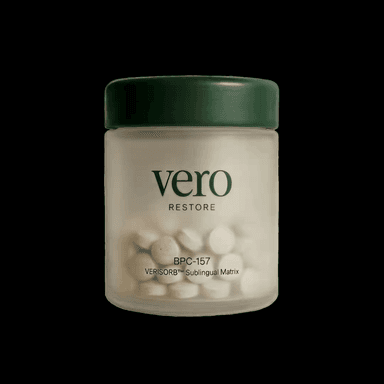
RESTORE™
BPC-157Engineered around 0.5mg BPC-157 (arginate salt). Accelerates deep tissue and joint recovery
Clinical Context
Important Notice: VERO protocols are nutritional and systemic optimisation formats. They are not intended to diagnose, treat, cure, or prevent any medical condition. These statements have not been evaluated by the Food and Drug Administration.