

The 'glow peptide' isn't one molecule. It's a marketing label for a GHK-Cu, BPC-157 and TB-500 blend. Here's what the real research shows about each.
Introduction
Here's the first thing to know: the "glow peptide" isn't a single peptide at all. In most product listings it's a blend, usually three research peptides in one vial: GHK-Cu, BPC-157, and TB-500. So when you go hunting for "the glow peptide," you're really looking at three separate molecules with three separate research stories.
This article is published for research purposes only, so read it as a map of the science rather than medical advice. Most peptides you swallow absorb poorly, and "glow peptide" is mostly a marketing label rather than a standardised drug name. Both of those things are true, and both are the starting point, not the interesting part.
The interesting part is what the actual papers show for each of the three, and where the evidence is solid versus thin. So let's pull the blend apart and look at the pieces one at a time.
Key Takeaways
- "Glow peptide" is a marketing label for a blend, most often GHK-Cu plus BPC-157 plus TB-500, not one molecule.
- GHK-Cu is the most human-studied piece: in a placebo-controlled study, a GHK-Cu cream was linked to collagen increases in 70% of women, versus 50% for vitamin C and 40% for retinoic acid under matched conditions (Pickart et al., 2015).
- BPC-157 and TB-500 research is overwhelmingly animal-model and cell-based, not human (Seiwerth et al., 2021; Malinda et al., 1999).
- Delivery decides almost everything: swallowed peptides are largely broken down before they reach your bloodstream (Renukuntla et al., 2013).
- None of these three is FDA-approved for human use, and all are supplied for research purposes only (U.S. FDA / Federal Register, 2026).
This content is published for research and educational purposes only. It is not intended to diagnose, treat, cure, or prevent any disease, and it does not constitute medical advice. Readers should consult a qualified healthcare professional before making any decisions about their own health. Statements on this page have not been evaluated by the FDA. VERO's peptide products are supplied for research purposes only.
What Is the "Glow Peptide," Really?
The "glow peptide" is a blend of research peptides sold under one name, not a single defined compound. Think of it like the word "smoothie": it tells you the format, not the exact fruit inside. Different vendors put different amounts of different peptides in, so two "glow" vials can hold quite different things.
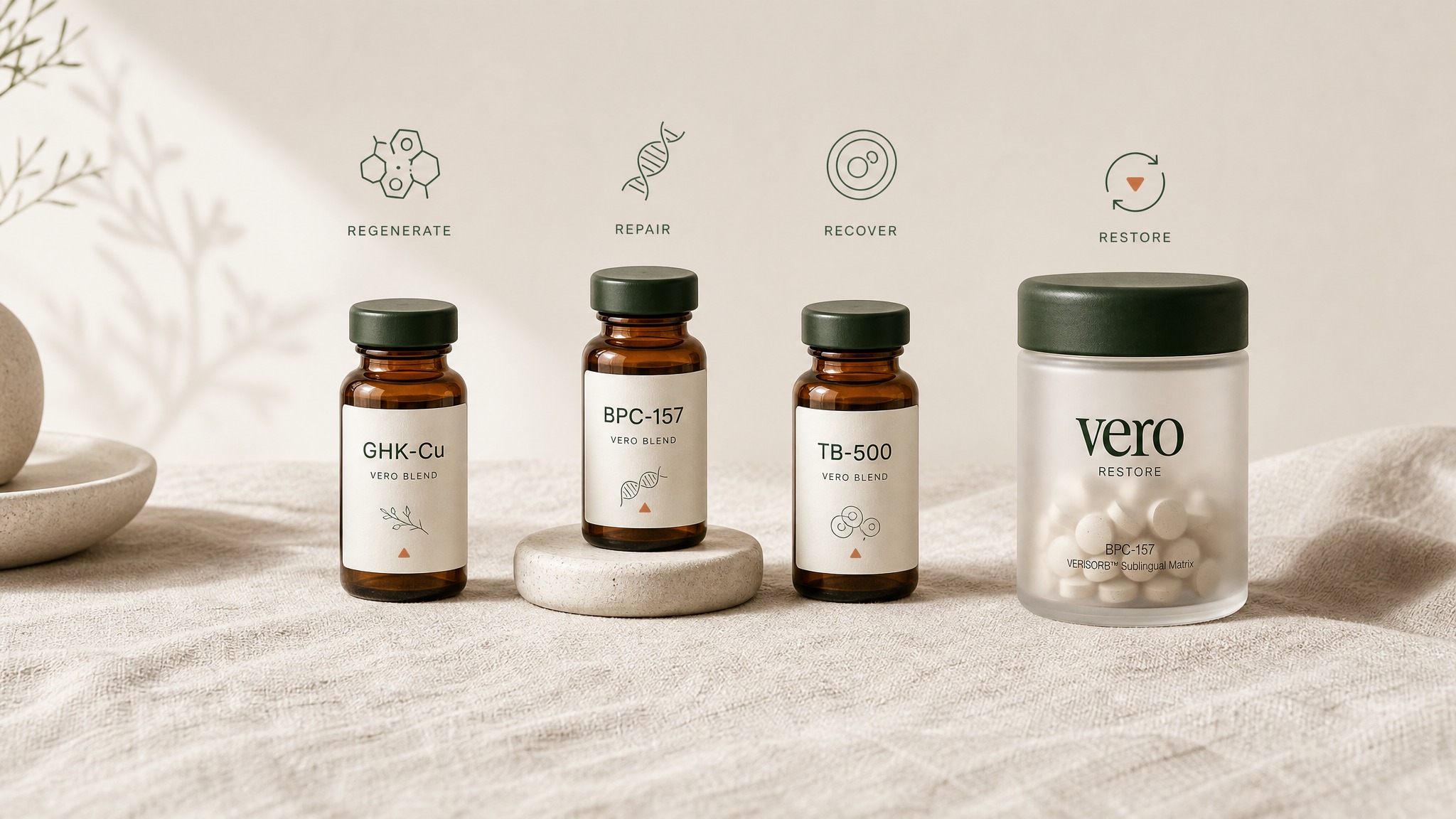
In practice, three names come up again and again in these blends:
What Is the "Glow Peptide," Really?
- GHK-Cu: a copper-binding peptide most studied for skin and collagen
- BPC-157: a synthetic peptide studied mostly in animal tissue-repair models
- TB-500: a fragment related to a natural protein called thymosin beta-4, studied for cell movement and blood-vessel formation in animals
Here's how the three parts compare on what they're studied for and how strong the evidence is:
| Peptide | What it's studied for | Strongest evidence tier |
|---|---|---|
| GHK-Cu | Skin and collagen | Human (placebo-controlled skin study) |
| BPC-157 | Connective-tissue and gut repair | Animal and cell-culture only |
| TB-500 (thymosin beta-4 fragment) | Cell migration and blood-vessel formation | Animal and cell-culture only |
The honest version most listings skip: the exact dose of each peptide varies by product, and there's no standardised "glow" formula anyone agrees on. That's why the label alone tells you almost nothing about what you're actually looking at. The useful question isn't "does the glow peptide work," it's "what does the research say about each of these three, and how strong is it?"
What Does GHK-Cu Do in the Glow Blend?
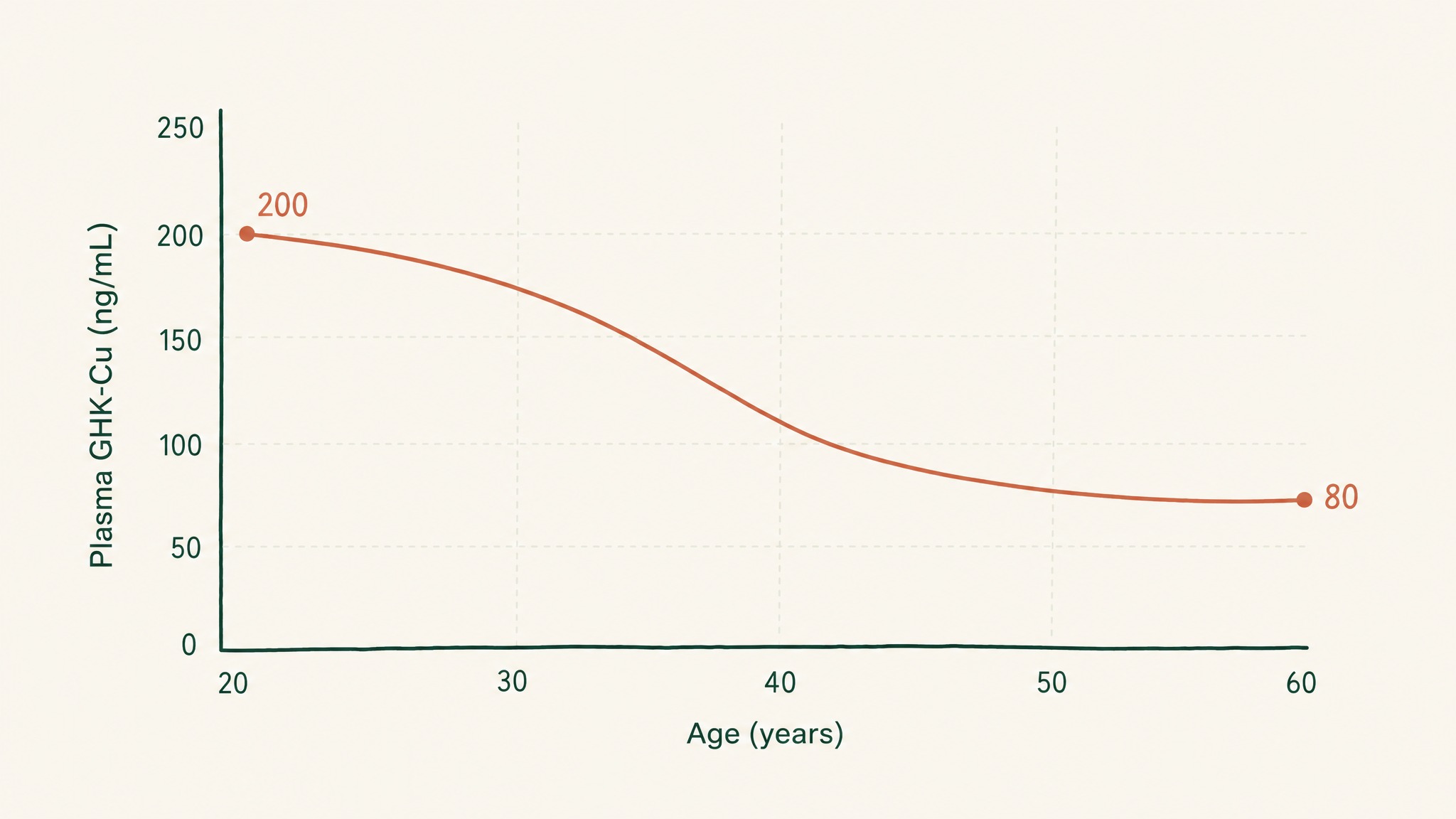
GHK-Cu is the piece of the glow blend with the clearest human research behind it. By the time you're 60, your body makes less than half the GHK-Cu it made in your twenties, and that drop lines up with when skin starts looking different. It's a tiny copper-binding peptide, three amino acids with a copper ion attached, like a small key with a copper tooth on the end.
The numbers are worth pinning down, with dates:
GHK-Cu peptide penetrating skin layers to reach collagen-producing cells in the dermis.
- Plasma GHK runs at roughly 200 nanograms per millilitre in your twenties and falls to around 80 by age 60, close to a 60% drop across four decades (Pickart & Margolina, 2018).
- In a placebo-controlled human study, a GHK-Cu cream was associated with measured collagen increases in 70% of the women tested over one month, versus 50% for vitamin C and 40% for retinoic acid under matched conditions (Pickart, Vasquez-Soltero & Margolina, 2015).
- A gene-expression analysis found GHK shifts expression by at least 50% in roughly a third of the human genes it was tested against, an unusually wide reach for one small molecule (Pickart & Margolina, 2018).
Almost a third of your genome, nudged by one small peptide your body already recognises as its own.
In our protocol design, the question we weigh most heavily here isn't dose, it's delivery. The strongest GHK-Cu findings came from creams and engineered carriers applied right to the tissue, so any protocol that ignores how the peptide actually reaches the skin is missing the part that made the research work. If you want the full breakdown, we cover it in our wider piece on peptides and skin care.
What Does BPC-157 Bring to a Glow Stack?
BPC-157 is the tissue-repair component of the glow blend, and its research is almost entirely preclinical. The name stands for "Body Protection Compound," and it's a synthetic string of amino acids based on a fragment found in stomach fluid. Most people meet it as a recovery peptide, not a skin one.
One part gets glossed over in glow-blend marketing: almost every BPC-157 finding comes from rats and cell cultures, not people.
What Does BPC-157 Bring to a Glow Stack?
- In preclinical animal research, BPC-157 has been studied for tendon, ligament, and bone-repair signalling, with the authors noting the human trial data simply isn't there yet (Gwyer, Wragg & Wilson, 2019).
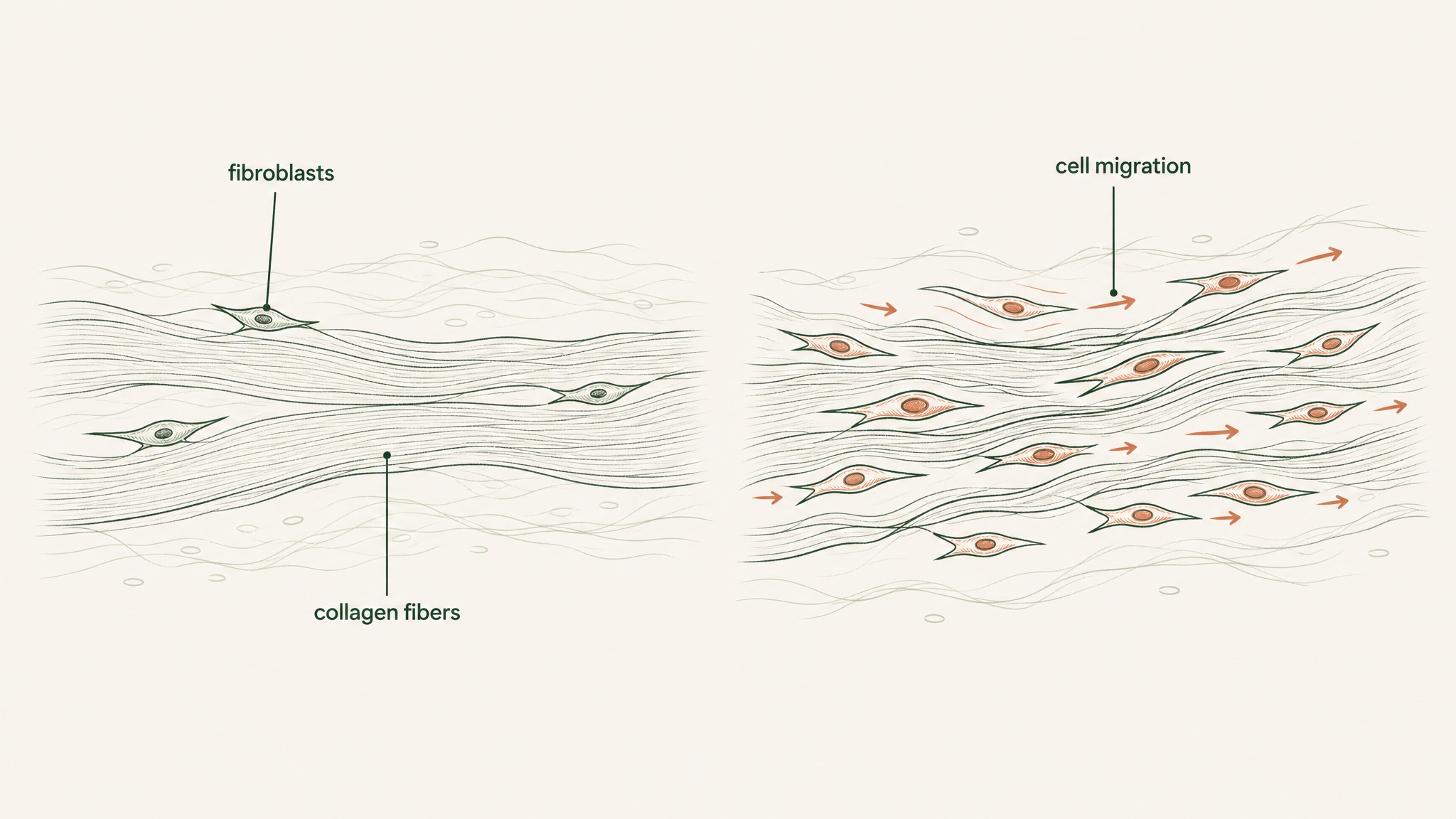
- In laboratory cell research, BPC-157 has been observed to increase the outgrowth of tendon fibroblasts, the cells that build tendon tissue, in a culture dish (Chang et al., 2011).
- A 2021 review pulled together the preclinical BPC-157 literature and flagged the same gap plainly: broad animal-model signals, no completed human efficacy trials (Seiwerth et al., 2021).
So why is it in a "glow" product at all? The pitch is that skin is a tissue too, and a repair-focused peptide might support the same rebuilding work. That's a reasonable hypothesis, but it's a hypothesis, not a finding. We keep the BPC-157 story separate in our BPC-157 benefits guide precisely so the animal-model line doesn't get blurred into a skin claim it hasn't earned.
What Is TB-500 Doing in the Blend?
TB-500 is in the glow blend for its role in cell movement and new blood-vessel formation, studied mostly in animals. What's actually in the vial is usually a fragment of a natural protein called thymosin beta-4, not the whole protein, a detail that quietly changes every claim made about it (Esposito et al., 2012).
The wound and skin data is the strongest part of its record, and it's still animal work:
Thymosin beta-4 fragments trigger new blood vessels and cell migration to close a skin wound.
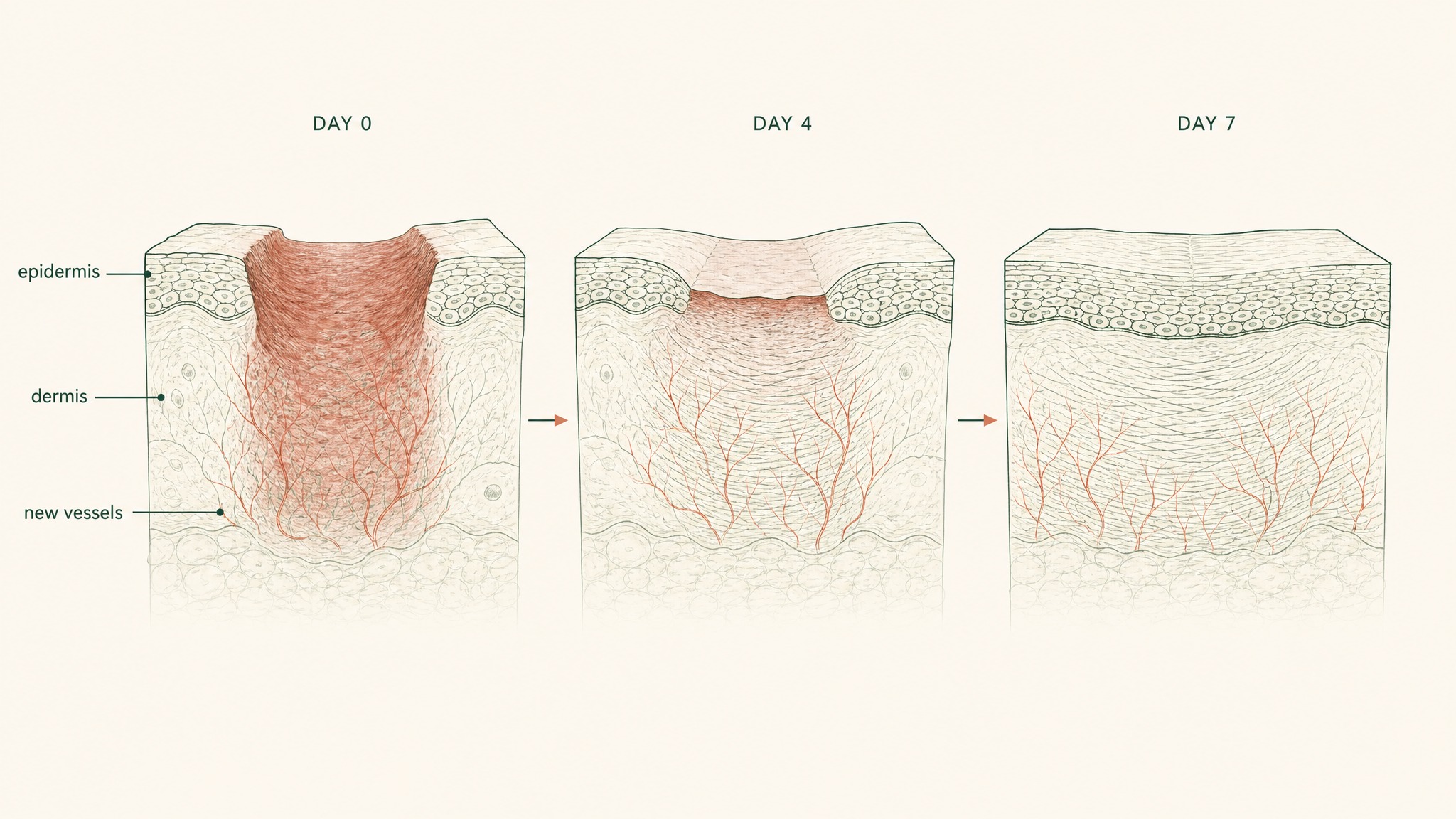
- In a rat wound model, thymosin beta-4 was linked to reepithelialization (the skin closing back over a raw area) measured 42% higher at day 4 and up to 61% higher at day 7 versus saline controls (Malinda et al., 1999).
- In an animal eye model, thymosin beta-4 was studied for corneal wound closure alongside a reduction in local inflammation signalling (Sosne et al., 2001).
- In a mouse heart-attack model, thymosin beta-4 was observed to activate two cell-survival signals inside cardiac cells, with better measured heart function afterward (Bock-Marquette et al., 2004).
Every one of those numbers came from an animal, not a person. That's the honest ceiling on the current evidence.
The glow-blend logic is that the same blood-vessel and cell-migration signals studied in those animal wound-repair models might also be relevant to how skin looks and how it recovers. Plausible, and worth researching, but the human data isn't there yet. We keep the full picture in what TB-500 actually is and the TB-500 benefits breakdown.
Why Doesn't Swallowing a Glow Peptide Pill Work?
Swallowing a peptide destroys most of it before it can do anything, which is why delivery format decides whether any glow-peptide research applies to you. Picture your gut as a security checkpoint built to break proteins down into scraps. A peptide is a protein, so it gets treated like lunch, not like a signal.
The research on oral peptide delivery is blunt about this:
Why swallowing peptides wastes most of them: the gut and liver destroy them before they reach your blood.
- Peptides taken by mouth face enzyme breakdown in the gut plus a "first-pass" filter through the liver, which together leave very little intact peptide reaching the bloodstream (Renukuntla et al., 2013).
- Because of that, researchers studying peptide absorption have looked hard at routes that skip the gut, including delivery under the tongue, to raise the fraction that survives (Patil & Devarajan, 2016).
This is the whole reason the strongest glow-component findings used injections, creams, or engineered carriers, never a plain capsule. It's also why VERO built the VERISORB sublingual matrix, a delivery system designed to move the peptide across the tissue under your tongue instead of sending it through the digestive gauntlet. Delivery isn't a footnote to the glow-peptide story. It's the plot. For the full version, see our guide to peptide pill bioavailability.
Is the Glow Peptide Legal or FDA-Approved?
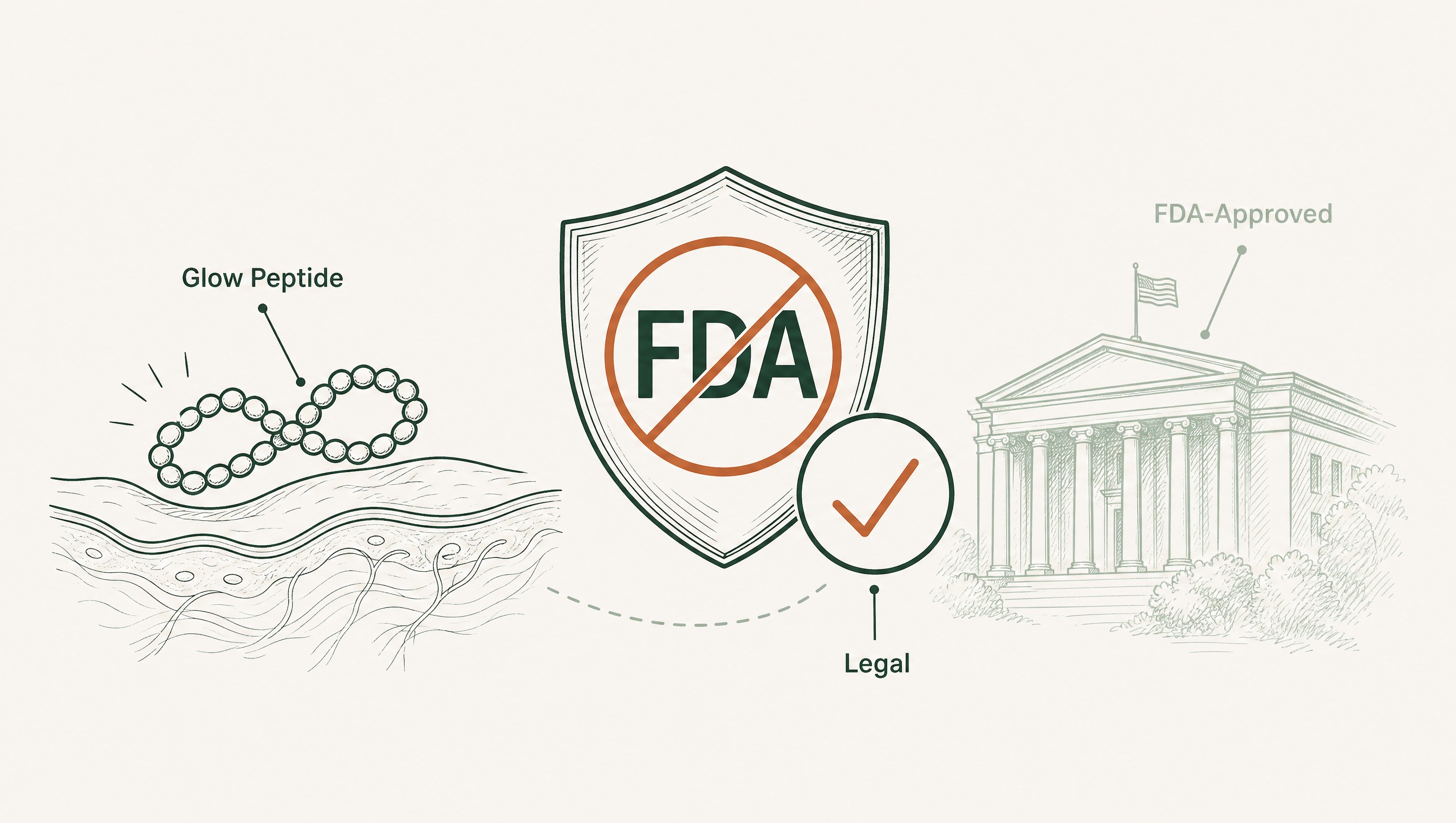
No component of the glow peptide is FDA-approved for use in humans, and all are supplied for research purposes only. This is the caveat most "glow stack" listings bury, and it's the single most important line in this article. Research suggests interesting things about these peptides in labs and animals, but "interesting in a lab" and "approved for you" are very different rungs on the ladder.
Where things stand today, with dates:
- In an April 16, 2026 Federal Register notice, the FDA moved BPC-157, TB-500, and ten other peptides into formal review by its Pharmacy Compounding Advisory Committee (U.S. FDA / Federal Register, 2026).
- "Under review" is not "approved." No completed Phase 1, 2, or 3 human efficacy trials exist for BPC-157, and the committee process is a recommendation stage, not a final decision.
What that means for you, plainly: these are research compounds. Anyone considering them should treat the label "research purposes only" as the literal truth it is, and talk to a qualified healthcare professional first. We track the moving regulatory picture in our BPC-157 FDA regulatory status guide.
How Do People Approach a Glow Protocol?
People who research a glow protocol tend to treat it as three separate research questions, not one product, and they lean on the timelines the actual studies used. Since there's no standardised formula, the sensible move is to understand each peptide's evidence on its own, then decide what a structured approach looks like.
A few things members experience as useful anchors when they read the research:
- Delivery first. The strongest findings for all three used a route that skips the gut, so format matters more than any single dose number.
- Skin changes are slow. The human GHK-Cu data measured collagen shifts over about four weeks, so week-by-week photos in steady lighting are a fairer proxy than a mirror check.
- Separate the evidence tiers. GHK-Cu has human skin data; BPC-157 and TB-500 are animal-model stories. Users report better expectations when they keep those apart.
If you're weighing which structured approach fits, our guide on how to choose a peptide protocol walks through the decision without the marketing gloss. None of this is a diagnostic tool. It's just the same categories the underlying research actually measured, translated into things you can observe.
Frequently Asked Questions
Is the glow peptide one peptide or a blend?
It's almost always a blend. "Glow peptide" is a marketing label, most often covering a mix of GHK-Cu, BPC-157, and TB-500 in a single vial, with the exact amounts varying by product. There's no single standardised "glow" molecule.
Which part of the glow blend has the most human research?
GHK-Cu, by a wide margin. It has placebo-controlled human skin data behind it, including a study where a GHK-Cu cream was linked to collagen increases in 70% of women tested (Pickart et al., 2015). BPC-157 and TB-500 research is overwhelmingly animal-model and cell-based.
Is the glow peptide FDA-approved?
No. None of the three common components is FDA-approved for human use, and all are supplied for research purposes only. In 2026 the FDA moved several of these peptides into a compounding review process, which is a recommendation stage, not an approval (U.S. FDA / Federal Register, 2026).
Why do glow peptides need injections or special delivery?
Because swallowed peptides are mostly destroyed in the gut and liver before reaching your bloodstream (Renukuntla et al., 2013). The research findings behind these peptides used routes that skip the gut, which is why delivery format matters as much as the peptide itself.
Does the glow peptide actually make your skin glow?
The honest answer is that the skin evidence is strongest for GHK-Cu and mostly preclinical for the other two. Research suggests plausible mechanisms, but "glow" is a marketing word, not a measured outcome, and anyone considering these compounds should speak with a qualified healthcare professional first.
References
- Pickart, L. & Margolina, A. (2018). GHK peptide and multiple cellular pathways in skin regeneration: a review. International Journal of Molecular Sciences. https://pmc.ncbi.nlm.nih.gov/articles/PMC6073405/. Retrieved 2026-08-25.
- Pickart, L., Vasquez-Soltero, J.M. & Margolina, A. (2015). GHK-Cu and skin remodeling: human and cellular findings. BioMed Research International. https://pmc.ncbi.nlm.nih.gov/articles/PMC4508379/. Retrieved 2026-08-25.
- Seiwerth, S. et al. (2021). Stable gastric pentadecapeptide BPC 157: preclinical research overview. Frontiers in Pharmacology. https://pubmed.ncbi.nlm.nih.gov/34267654/. Retrieved 2026-08-25.
- Gwyer, D., Wragg, N.M. & Wilson, S.L. (2019). BPC 157 in tendon, ligament and bone repair: a review of animal-model evidence. Cell and Tissue Research. https://pubmed.ncbi.nlm.nih.gov/30915550/. Retrieved 2026-08-25.
- Chang, C.H. et al. (2011). Pentadecapeptide BPC 157 and tendon fibroblast outgrowth in vitro. Journal of Applied Physiology. https://pubmed.ncbi.nlm.nih.gov/21030672/. Retrieved 2026-08-25.
- Malinda, K.M. et al. (1999). Thymosin beta-4 in dermal wound repair: a rat-model study. Journal of Investigative Dermatology. https://pubmed.ncbi.nlm.nih.gov/10469335/. Retrieved 2026-08-25.
- Sosne, G. et al. (2001). Thymosin beta-4 and corneal wound repair in vivo. Experimental Eye Research. https://pubmed.ncbi.nlm.nih.gov/11311052/. Retrieved 2026-08-25.
- Bock-Marquette, I. et al. (2004). Thymosin beta-4 and cardiac cell-survival signalling in a mouse model. Nature. https://pubmed.ncbi.nlm.nih.gov/15565145/. Retrieved 2026-08-25.
- Esposito, S. et al. (2012). Identification of the N-acetylated thymosin beta-4 fragment in commercial TB-500. Drug Testing and Analysis. https://pubmed.ncbi.nlm.nih.gov/22962027/. Retrieved 2026-08-25.
- Renukuntla, J. et al. (2013). Oral delivery approaches for therapeutic peptides and proteins. International Journal of Pharmaceutics. https://pmc.ncbi.nlm.nih.gov/articles/PMC3680128/. Retrieved 2026-08-25.
- Patil, S.B. & Devarajan, P.V. (2016). Sublingual delivery of peptides: absorption considerations. Drug Delivery. https://pubmed.ncbi.nlm.nih.gov/24901208/. Retrieved 2026-08-25.
- U.S. FDA / Federal Register (2026). Pharmacy Compounding Advisory Committee notice: BPC-157 and related peptides. https://www.federalregister.gov/documents/2026/04/16/2026-07361/pharmacy-compounding-advisory-committee-notice-of-meeting-establishment-of-a-public-docket-request. Retrieved 2026-08-25.
Clinical Context
Important Notice: VERO protocols are nutritional and systemic optimisation formats. They are not intended to diagnose, treat, cure, or prevent any medical condition. These statements have not been evaluated by the Food and Drug Administration.