
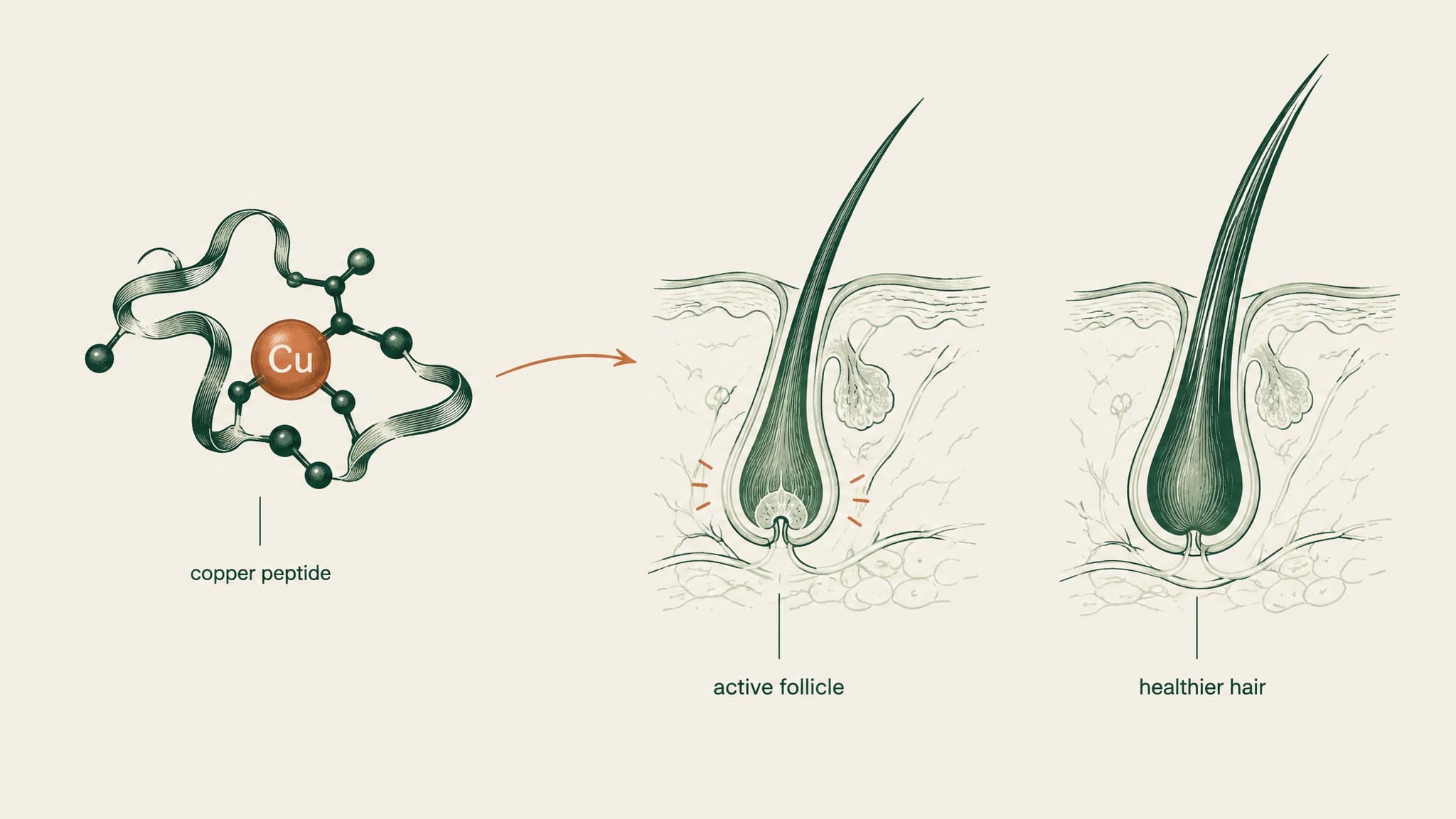
Copper peptide for hair loss is backed mostly by lab and ex-vivo research, not human trials. Here's what GHK-Cu studies really show, with real numbers.
Introduction
Copper peptide for hair loss is a research-stage idea backed mostly by laboratory and ex-vivo studies, not by large human trials. In plain terms: the lab signal is real and genuinely interesting, but nobody has yet proven that a copper peptide on its own regrows hair in people. This article is published for research purposes only, so read it as a map of the evidence rather than a set of instructions.
At VERO, copper-peptide science anchors the RADIANCE copper peptide protocol, our GHK-Cu formulation held in a sublingual matrix (a tablet that dissolves under your tongue instead of being swallowed whole). What follows is what the studies actually found, with real numbers you can check, plus an honest note on where the evidence stops. Copper peptides are worth understanding precisely because most of what's written about them online skips the part where the research runs out.
GHK-Cu is the copper peptide almost every hair-loss claim traces back to, so it gets most of the attention below.
Key Takeaways
- Copper peptide for hair loss centres on molecules like GHK-Cu, copper-binding compounds your body makes less of with age, with plasma levels near 200 ng/mL in your twenties falling to around 80 ng/mL by 60 (Pickart et al., 2015).
- In ex-vivo human hair-follicle cultures, a copper tripeptide was observed to lengthen follicles and raise dermal papilla cell activity at very low doses (Pyo et al., 2007).
- No published human trial shows a copper peptide on its own regrowing hair, and the strongest human data comes from a combination study that also included two known-active drugs (Kuceki et al., 2025).
- For honest comparison, minoxidil 5% added about 18.6 hairs per cm² over 48 weeks (Olsen et al., 2002) and finasteride added a net 138 hairs over two years (Kaufman et al., 1998).
- Two widely quoted copper-peptide hair stats, a "27% density increase" and a "512-participant safety review," have no traceable source and should be ignored.
This content is published for research and educational purposes only. It is not intended to diagnose, treat, cure, or prevent any disease, and it does not constitute medical advice. Readers should consult a qualified healthcare professional before making any decisions about their own health. Statements on this page have not been evaluated by the FDA. VERO's peptide products are supplied for research purposes only.
What Is a Copper Peptide, and Can It Help With Hair Loss?
A copper peptide is a tiny signalling molecule your own body already makes, and its supply quietly shrinks as you get older. That decline is why copper peptide for hair loss is even a research question, because thinning hair and slower follicle activity tend to show up in the same decades the decline does. The most studied one, GHK-Cu, is a chain of three amino acids (biology's molecular Lego bricks) clipped together with a copper ion, like a small key with a copper tooth on the end.
Here's the scale of the drop, which is the reason copper peptides come up in aging conversations at all:
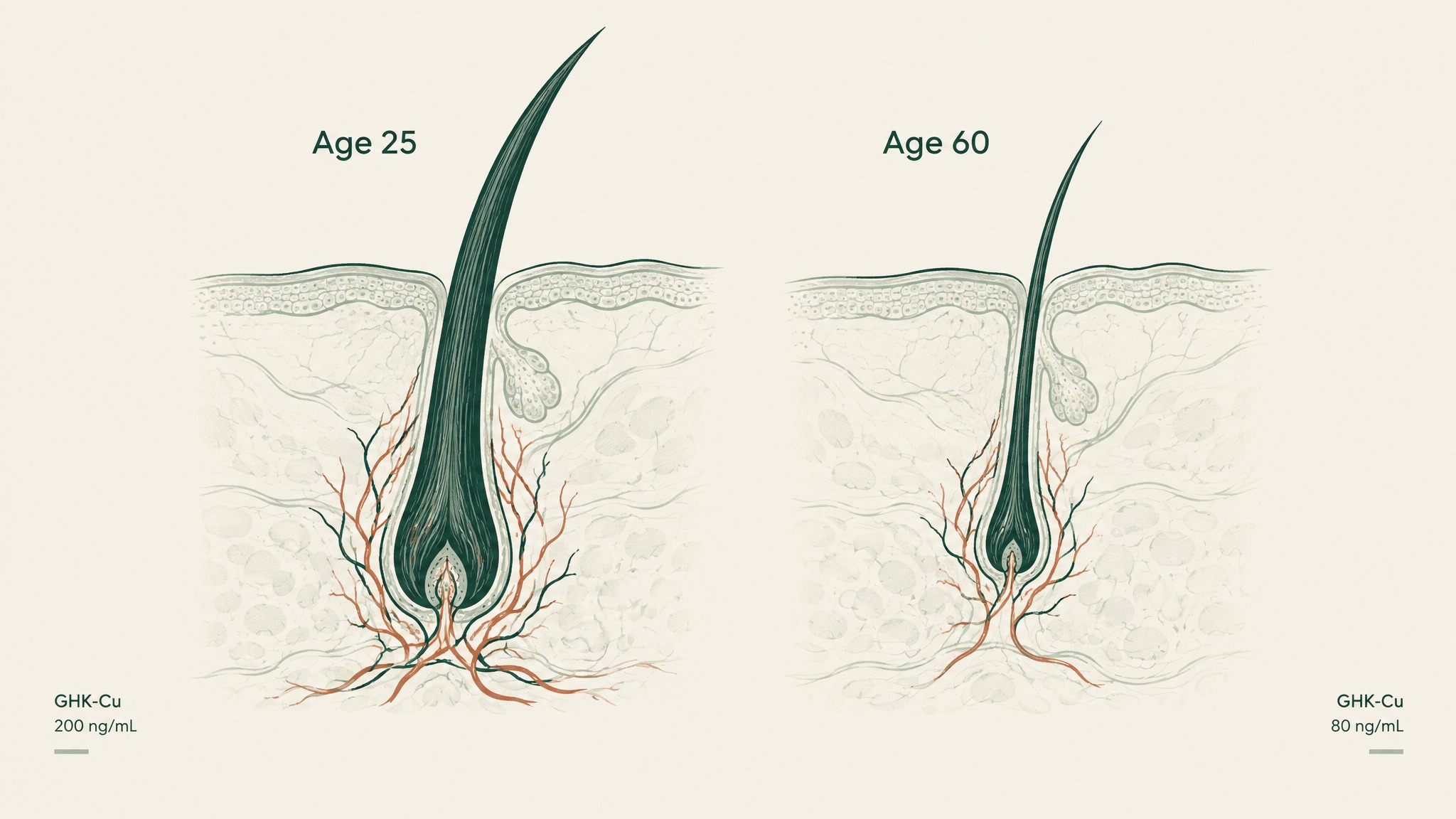
Hair follicles shrink and slow as GHK-Cu levels drop from your twenties to your sixties.
- Plasma GHK runs at roughly 200 nanograms per millilitre in your twenties and falls to around 80 by age 60, a decline of nearly 60% (Pickart et al., 2015).
- The same paper reports GHK can turn the activity of at least 4,000 human genes up or down, a wide reach for one small molecule (Pickart et al., 2015).
One honest caveat on those two figures: they come from the peptide's own discoverer re-analysing public gene data, not from an independently replicated trial, so read them as a starting point, not a verdict.
Hair loss itself is common enough that any credible option gets attention fast. A clinician-examined study of 1,005 men found androgenetic alopecia (the medical name for common pattern hair loss) in 58% of those aged 30 to 49, rising from 47.5% in the mid-thirties to 73.2% by the mid-forties (Krupa Shankar et al., 2009). A 2025 US records study of 266,612 people put diagnosed-alopecia rates lower, peaking near 29% in men in their thirties, because it only counts people who were formally diagnosed (Gupta et al., 2025). Either way, a lot of people are looking for answers, which is exactly why unverified copper-peptide claims spread so fast.
How Might Copper Peptides Signal a Hair Follicle?
The proposed mechanism behind copper peptide for hair loss centres on the blood supply and support cells around each follicle, not the hair shaft itself. Think of a hair follicle as a plant: the visible hair is the stem, but the growth happens down in the root, and the root needs a good blood supply and healthy soil cells around it. Copper-peptide research has focused on those roots and their surrounding "soil."
Two lab findings anchor this idea:
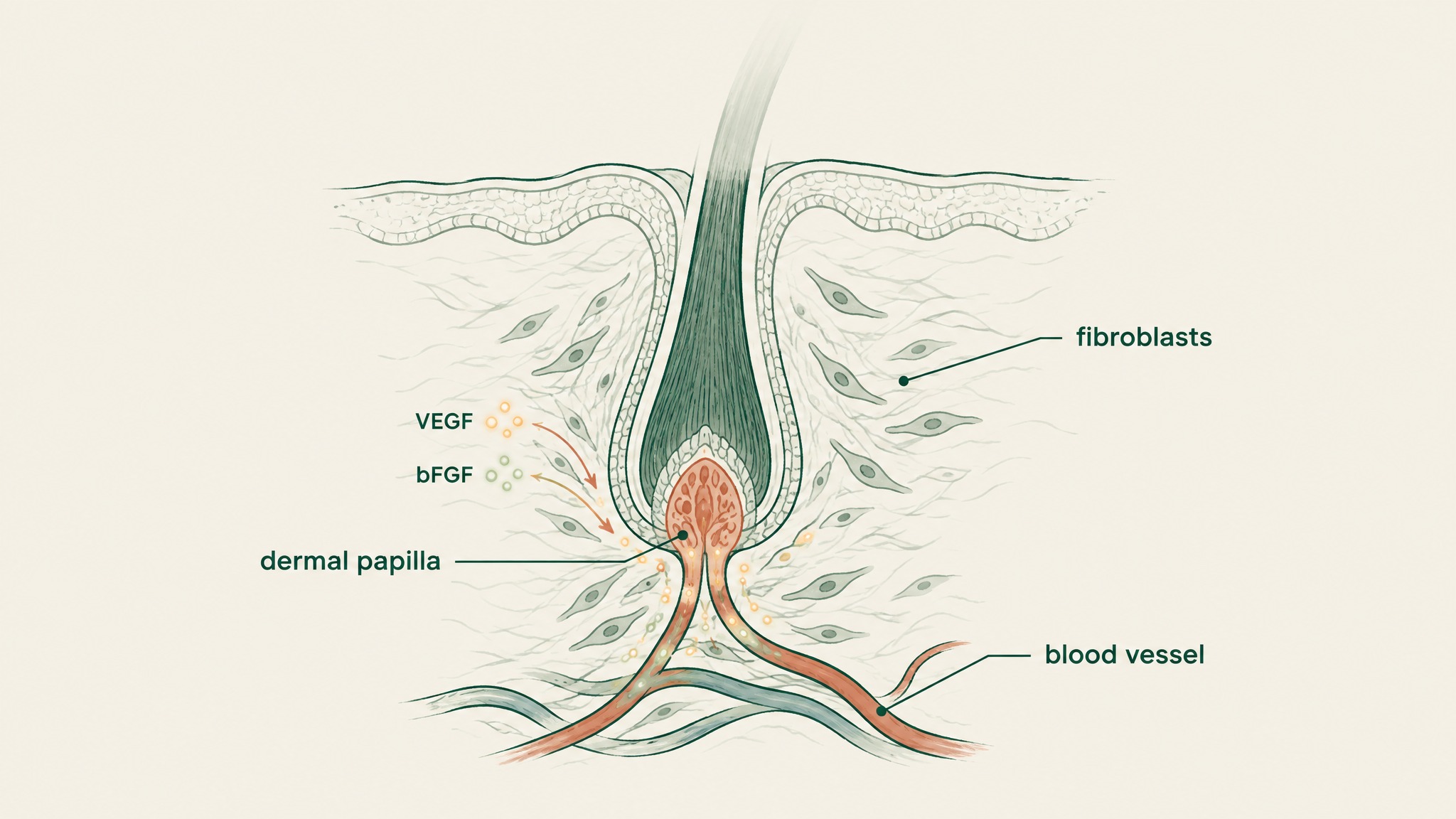
Blood vessels and support cells nourish the hair root where growth is controlled.
- In vitro, a copper tripeptide was observed to raise output of VEGF and bFGF (two growth-signal proteins that help build blood vessels) in human fibroblast cultures (Pollard et al., 2005).
- In ex-vivo human hair-follicle organ culture, a closely related copper tripeptide was observed at very low doses (around a trillionth to a billionth of a mole per litre) to lengthen follicles, increase proliferation of dermal papilla cells, raise VEGF, and lower TGF-beta1, a protein linked to follicle shutdown (Pyo et al., 2007).
Dermal papilla cells are the control-room cells at the base of a follicle that tell hair when to grow and when to rest.
That second study is the single most cited piece of "copper peptides for hair" evidence, so it's worth being precise about what it was. It used human follicle tissue kept alive in a dish and isolated cells in culture, which is a real and useful signal, but it is not the same as giving a copper peptide to a living person and counting hairs months later. Research suggests the pathway is plausible; the studies simply haven't followed it all the way into people yet.
What Does the Human Evidence Actually Show?
There is no published human trial showing a copper peptide, used on its own, regrowing hair by a measured amount. This is the part most articles quietly skip, and it's the honest centre of this whole topic. The lab work is encouraging, but the jump from a follicle in a dish to a head of hair on a person has not been made in a controlled standalone study.
The strongest human data actually involves a combination, not copper peptides alone:
What Does the Human Evidence Actually Show?
- A 2025 study delivered a mix of minoxidil, dutasteride, and copper peptides into the scalp across five monthly sessions.
- Severity scores improved over six months, judged by both AI analysis and blinded human reviewers (Kuceki et al., 2025).
- The catch: minoxidil and dutasteride are already proven active for hair, so the study cannot tell you how much, if anything, the copper peptides added.
That last point is not a technicality, it's the whole game. When three ingredients go in together and two of them already work, you can't credit the third for the result. Users report good outcomes from combination approaches all the time, but a good outcome from a stack is not evidence for one ingredient in it.
So the fair summary of copper peptide for hair loss is this: promising lab and ex-vivo signal, real but confounded combination data, and zero standalone human proof. That's a weaker claim than most sellers make, and it's the accurate one.
How Do Copper Peptides Compare to Minoxidil and Finasteride?
Minoxidil and finasteride have large human trials with hard hair-count numbers, and copper peptide for hair loss simply does not, which is the cleanest way to see where copper peptides sit today. Both drugs have been measured in hundreds to thousands of people over months and years. Copper peptides have been measured mostly in dishes.
| Approach | Best measured result | Study |
|---|---|---|
| Minoxidil 5% (topical) | +18.6 non-vellus hairs/cm² at 48 weeks vs +3.9 for placebo | Olsen et al., 2002 |
| Finasteride 1 mg (oral) | net +138 hairs at 2 years vs placebo | Kaufman et al., 1998 |
| Copper peptide (GHK-Cu) alone | no standalone human hair-count trial published | none to date |
| Copper peptide in a combination | severity scores improved, contribution can't be isolated | Kuceki et al., 2025 |
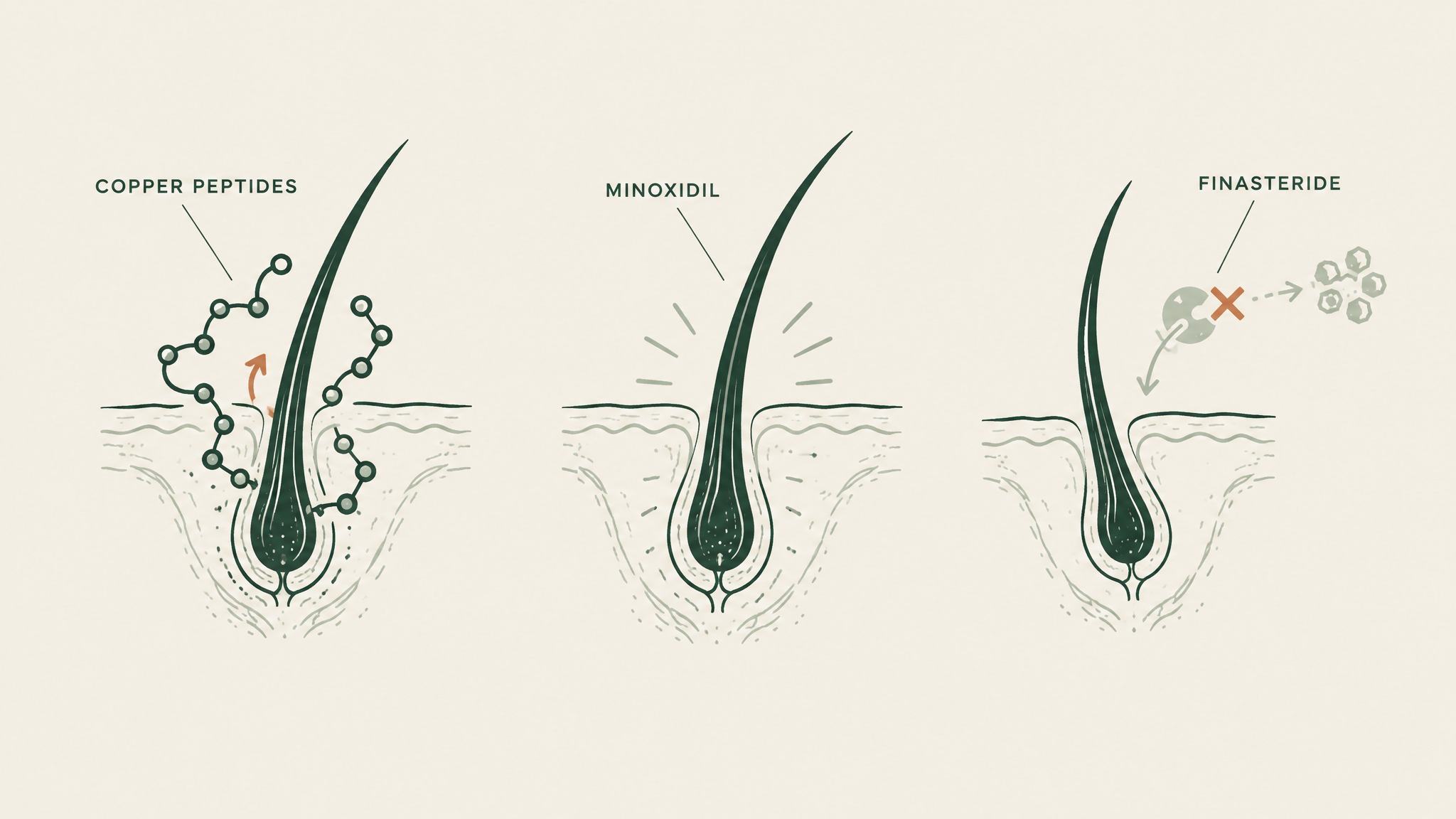
How Do Copper Peptides Compare to Minoxidil and Finasteride?
The two drug numbers come from serious trials. In a 48-week randomised study of 393 men, 60% of the 5% minoxidil group were rated improved on blinded photos versus 23% on placebo (Olsen et al., 2002). In two-year trials involving 1,553 men, finasteride produced a net gain of 138 hairs in a fixed scalp circle versus placebo (Kaufman et al., 1998).
None of that makes copper peptides useless, and it doesn't make them proven either. It means copper peptides are an early-research compound, and the honest move is to hold them to the same evidence bar you'd hold anything else to.
Are Copper Peptides Safe to Use on Your Scalp?
Topical copper peptides have a solid track record in cosmetics at the low concentrations normally used. This is the one area where the copper peptide for hair loss evidence is genuinely reassuring rather than just promising. The independent Cosmetic Ingredient Review panel looked at the safety data and reached a clear conclusion.
The specifics worth knowing:
- The panel judged tripeptide-1 (the peptide backbone of GHK-Cu) and related copper peptides safe as used in cosmetics, with typical use concentrations under 10 parts per million (Johnson et al., 2018).
- That conclusion covers topical cosmetic use, which is where the human safety record exists.
Safe as a cosmetic ingredient is not the same as proven effective for hair, and it's important not to blur the two.
One clear gap: the well-studied safety picture is for topical use at low doses. Other delivery routes and much higher doses do not have the same body of published human safety data behind them, so "it's a safe skincare ingredient" should not be stretched into "any form at any dose is fine." As always, anyone weighing a research protocol should talk to a qualified clinician first, and nothing here is medical advice.
Why Does Delivery Decide Whether Copper Peptides Do Anything?
Delivery format decides almost everything with copper peptide for hair loss, because a peptide that never reaches the follicle can't signal anything. A key with the perfect shape is useless if it never reaches the lock. This is the detail that separates a real copper-peptide approach from a hopeful label.
Short peptides are fragile. Swallow a raw copper peptide in an ordinary capsule and stomach acid plus digestive enzymes tend to break it apart before it gets anywhere useful, which is true of most short peptides, not just this one. That's exactly why the lab studies above didn't use plain capsules; they used engineered carriers, a cream for skin or a specialised fluid to push the peptide toward follicles.
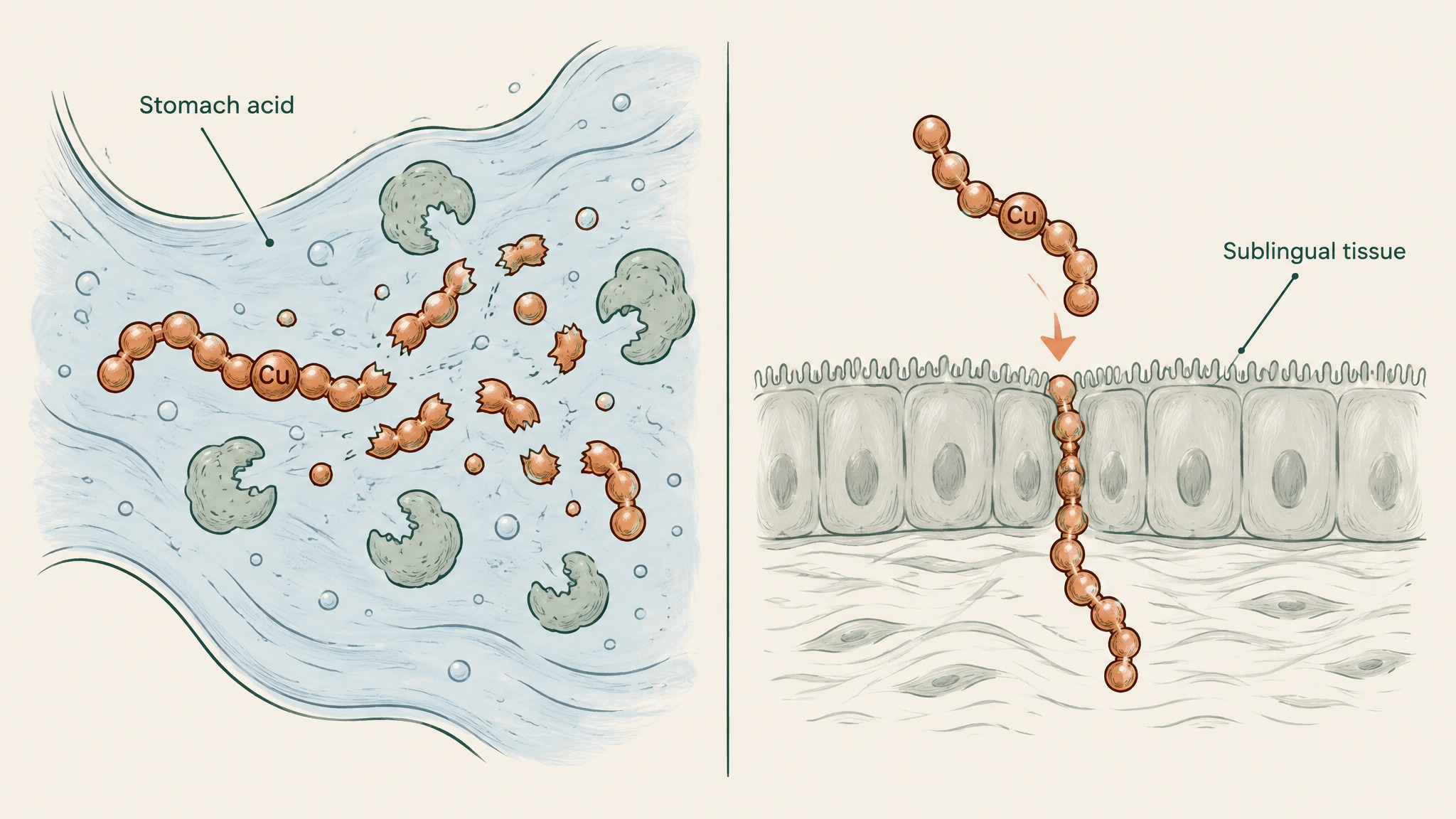
How stomach acid breaks down copper peptides, but sublingual delivery keeps them intact.
In our protocol design, the question we weigh most heavily is delivery: a copper peptide that degrades before it reaches its target can't do the thing the research describes, so we build the delivery route into the formula rather than bolting it on as an afterthought. That's the reasoning behind holding GHK-Cu in the VERISORB sublingual matrix used in the RADIANCE protocol: a route designed to move the intact peptide across the tissue under your tongue instead of leaving it to the stomach. For a fuller breakdown of the science, our GHK-Cu copper peptide protocol guide walks through the mechanism in more depth.
Which Copper-Peptide Hair Claims Should You Ignore?
Two specific copper peptide for hair loss statistics circulate everywhere online and neither has a real source behind it. Naming them matters, because they show up in AI answers and blog posts as if they were established fact. If you see either one, count the page repeating it as unreliable.
Here's what to strike from your mental list:
- A claimed "27% increase in hair density" over six months, usually attributed to a "Falla and Nagaraja" paper in the Journal of Cosmetic Dermatology. No such paper, authors, or journal record can be found. It only appears on marketing sites.
- A claimed "2023 pooled safety review of 12 human studies, 512 participants." No authors, journal, or DOI exist for it anywhere, and it's often cited to a copycat domain dressed up to look like a real news outlet.
A suspiciously round number with no checkable study behind it is the single clearest sign a copper-peptide page is repeating marketing, not research.
Members experience real frustration trying to separate signal from noise here, and this is why: the honest copper-peptide story (promising lab data, no standalone human proof) is less exciting than a fake "27% in six months," so the fake number spreads faster. Holding out for checkable numbers is the whole defence.
Frequently Asked Questions
Does copper peptide actually regrow hair? The lab evidence for copper peptide for hair loss is promising, but no published human trial shows a copper peptide regrowing hair on its own. In ex-vivo human follicle cultures a copper tripeptide was observed to lengthen follicles (Pyo et al., 2007), yet that is tissue in a dish, not people counted over time.
Is copper peptide better than minoxidil for hair loss? There's no fair way to say yes, because copper peptides have no standalone human hair-count trial while minoxidil 5% added about 18.6 hairs per cm² over 48 weeks in a randomised study (Olsen et al., 2002). You can't rank a compound with no human data above one with strong human data.
Are topical copper peptides safe? For cosmetic use at low concentrations, the independent safety review judged them safe as used, typically under 10 parts per million (Johnson et al., 2018). Higher doses and other delivery routes don't carry the same published human safety record.
Is GHK-Cu the same as the copper peptide in skincare serums? Often, but not always. "Copper peptide" on a label can mean GHK-Cu at various strengths or a different copper-binding blend, so the research here applies only to the specific peptides and doses each study used.
References
These are the sources behind every copper peptide for hair loss figure cited above.
- Pickart, L., Vasquez-Soltero, J. M., & Margolina, A. (2015). GHK peptide as a natural modulator of cellular pathways in skin regeneration. BioMed Research International. https://www.ncbi.nlm.nih.gov/pmc/articles/PMC4508379/. Retrieved 2026-09-25.
- Pollard, J. D., Quan, S., Kang, T., & Koch, R. J. (2005). Copper tripeptide and growth-factor expression in normal and irradiated fibroblasts. Archives of Facial Plastic Surgery. https://pubmed.ncbi.nlm.nih.gov/15655171/. Retrieved 2026-09-25.
- Pyo, H. K., Yoo, H. G., Won, C. H., et al. (2007). Tripeptide-copper complex and human hair-follicle growth in vitro. Archives of Pharmacal Research. https://pubmed.ncbi.nlm.nih.gov/17703734/. Retrieved 2026-09-25.
- Olsen, E. A., Dunlap, F. E., Funicella, T., et al. (2002). A randomized clinical trial of 5% versus 2% topical minoxidil and placebo in androgenetic alopecia in men. Journal of the American Academy of Dermatology. https://pubmed.ncbi.nlm.nih.gov/12196747/. Retrieved 2026-09-25.
- Kaufman, K. D., Olsen, E. A., Whiting, D., et al. (1998). Finasteride in men with androgenetic alopecia: a randomized trial. Journal of the American Academy of Dermatology. https://pubmed.ncbi.nlm.nih.gov/9777765/. Retrieved 2026-09-25.
- Johnson, W., Bergfeld, W. F., Belsito, D. V., et al. (2018). Safety assessment of tripeptide-1, hexapeptide-12, their metal salts, and related derivatives as used in cosmetics. International Journal of Toxicology. https://journals.sagepub.com/doi/10.1177/1091581818807863. Retrieved 2026-09-25.
- Krupa Shankar, D. S., Chakravarthi, M., & Shilpakar, R. (2009). Male androgenetic alopecia: a population-based study in 1,005 subjects. International Journal of Trichology. https://www.ncbi.nlm.nih.gov/pmc/articles/PMC2938575/. Retrieved 2026-09-25.
- Gupta, A. K., Wang, T., & Economopoulos, V. (2025). Epidemiological landscape of androgenetic alopecia in the US: an All of Us cross-sectional study. PLOS ONE. https://journals.plos.org/plosone/article?id=10.1371/journal.pone.0319040. Retrieved 2026-09-25.
- Kuceki, G., Coppinger, A. J., Ragi, S. D., et al. (2025). Minoxidil, dutasteride, and copper peptides in androgenetic alopecia: a combination-session study. JAAD International. https://www.ncbi.nlm.nih.gov/pmc/articles/PMC11992372/. Retrieved 2026-09-25.
Curious how copper-peptide research is built into a structured, delivery-first formulation? Explore the RADIANCE Protocol →
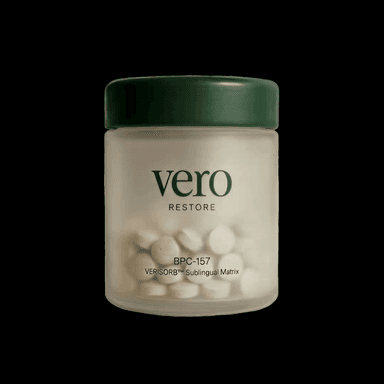
RADIANCE™
Coming SoonEngineered around 5mg GHK-Cu. Increases dermal thickness and systemic collagen synthesis
Clinical Context
Important Notice: VERO protocols are nutritional and systemic optimisation formats. They are not intended to diagnose, treat, cure, or prevent any medical condition. These statements have not been evaluated by the Food and Drug Administration.