

Most NAD plus supplements don't deliver what the label claims. What the bioavailability research shows about NMN, NR and direct NAD+, and how to choose.
Search for the right NAD plus supplement and you'll hit a wall of confident promises: more energy, slower ageing, sharper mornings. Almost none of those bottles mention the one thing that decides whether any of it matters, which is how much of the active ingredient actually reaches your bloodstream. The protocols that actually work all start from that single fact. This guide is for research purposes only, and it's built to answer the question the labels dodge.
Here's the honest starting point. "NAD+ supplement" almost never means NAD+ itself sitting in the bottle. It usually means a precursor, a building block your body rebuilds into NAD+, and the three main ones behave very differently the moment you swallow them.
Key takeaways:
- NAD+ is the cellular fuel your body uses for energy and repair, and research suggests it falls measurably as you age.
- Most products sold as an "NAD+ supplement" are precursors: nicotinamide riboside (NR) or nicotinamide mononucleotide (NMN), not NAD+ itself.
- The bioavailability problem is the part most brands skip. A big, charged molecule like NAD+ barely survives an oral capsule intact.
- Human trials cluster around NR at 250 to 500 mg and NMN at 250 to 900 mg daily, and several have measured a real rise in blood NAD+.
- Before you buy, check the form, the dose, a third-party Certificate of Analysis, and whether the brand is honest about delivery route.
What is an NAD plus supplement?
An NAD plus supplement is any product meant to raise the level of NAD+ in your cells, usually by feeding your body the raw materials to build more of it. The category name is a bit of a magic trick, though, because the bottle rarely contains NAD+ itself.
Think of NAD+ (nicotinamide adenine dinucleotide, a molecule every cell carries) as a rechargeable shuttle. It picks up energy from the food you eat and drops it where your cells need power. It also gets spent by your repair crews, the enzymes that fix DNA and run cellular housekeeping.
So a single molecule is pulling double duty. Here's what NAD+ actually does day to day:
- Carries electrons through the reactions that turn food into usable energy (ATP)
- Acts as fuel for sirtuins, a family of repair-and-maintenance proteins
- Gets consumed by PARP enzymes, the crews that patch damaged DNA
- Helps set your cells' daily rhythm, rising and falling with food and sleep
When NAD+ runs low, all of that slows at once. If you want the deeper biology, our explainer on how NAD+ drives sirtuin signalling and longevity walks through the full mechanism. For this guide, the point is simpler: an NAD plus supplement is a tool for topping up a fuel supply that research suggests drains over time.
Why do NAD+ levels fall as you age?
The reason an NAD plus supplement gets pitched as a longevity tool comes down to one observation: your NAD+ tank doesn't stay full. Research suggests the NAD+ in your tissues can fall by roughly half between your twenties and midlife (Massudi 2012; Verdin 2015).
Picture a sink with the tap running and the plug half-pulled. In your twenties, water pours in faster than it drains. As you age, the tap slows and the drain widens, so the level drops.
Three things drive that drop:
- The tap slows. The enzyme that rebuilds NAD+ (called NAMPT) becomes less productive with age, so you make less from scratch.
- The drain widens. An enzyme called CD38 ramps up as you get older and burns through NAD+ faster than your cells can replace it. Researchers have described CD38 as a primary driver of age-related NAD+ decline (Camacho-Pereira 2016).
- Wear and tear. Everyday oxidative stress and DNA damage call on NAD+-dependent repair crews, spending the molecule faster.
None of this means topping up NAD+ reverses ageing. It means the decline is measurable and consistent across studies, which is why the research keeps circling back to it. Members experience this differently depending on age and baseline health, so the same supplement won't read the same for everyone.
NMN vs NR vs direct NAD+: what does each form actually do?
This is where most buyers get lost, and where an NAD plus supplement decision is actually made. The three common forms all aim at the same target, raising NAD+, but they start from different distances and absorb differently.
The choice really comes down to two questions: how close to NAD+ does the molecule start, and how much of it survives the trip into your blood?
Nicotinamide riboside (NR)
NR is the form with the longest human safety record, which is why it shows up under brand names like Niagen and Tru Niagen. Your body converts NR into NMN, then into NAD+, so it's two steps back in the chain.
In a 2016 study, researchers reported that NR is "uniquely and orally bioavailable" and raised blood NAD+ in people after a single dose (Trammell 2016). A 2019 randomised, placebo-controlled trial in overweight adults found NR was well tolerated and raised whole-blood NAD+ in a clear dose-dependent way, by 22%, 51% and 142% at 100, 300 and 1,000 mg over eight weeks (Conze 2019).
Nicotinamide mononucleotide (NMN)
NMN sits one step closer to NAD+ than NR does, which is the main reason it gets marketed as the "upgrade." One research group has proposed that cells have a dedicated NMN transporter (called Slc12a8), though whether NMN is absorbed whole or first broken down to NR is still genuinely debated.
What's clearer is the human data. In a 2021 randomised trial, researchers observed that NMN improved muscle insulin sensitivity in prediabetic women over ten weeks (Yoshino 2021), and a 2023 dose-comparison trial measured a rise in blood NAD+ across 300, 600 and 900 mg daily groups (Yi 2023).
Direct NAD+
This is the form that sounds the most logical and works the least well in a capsule. The NAD+ molecule itself is large and carries an electrical charge, and that combination makes it a poor candidate for surviving your gut intact.
An IV drip skips the gut entirely, which is why clinics use it, but that's a clinical setting, not a daily habit. Sublingual delivery (under the tongue) is the practical at-home route people use when they want the molecule itself rather than a precursor.
Here's the comparison most product pages won't put in one place:
| Form | Molecular weight | Oral absorption | Relative cost | Best research use |
|---|---|---|---|---|
| NR (nicotinamide riboside) | ~255 Da | Good; human trials show a rise in blood NAD+ | Moderate | Longest human safety record |
| NMN (nicotinamide mononucleotide) | ~334 Da | Demonstrated in human trials | Higher | One step from NAD+; most studied for metabolic markers |
| Direct NAD+ (oral capsule) | ~663 Da | Poor as an intact molecule | Variable | Rarely the form trials actually measure |
| Direct NAD+ (IV) | ~663 Da | Bypasses the gut entirely | High, clinic only | Clinical and research settings |
| Direct NAD+ (sublingual) | ~663 Da | Bypasses gut and first liver pass | Moderate | The practical at-home route for the molecule itself |
Why don't NAD+ capsules deliver what the label says?
This is the section the bestselling brands quietly avoid, and it's the most important one. A bottle that says "1,000 mg" is telling you what went into the capsule, not what reaches your blood.
Picture your gut as an airport security line built to confiscate exactly this kind of cargo. Swallow an NAD plus supplement and it runs a three-stage gauntlet before any of it gets through:
- Stomach acid. The acidic environment starts breaking the molecule apart before it leaves your stomach.
- Gut enzymes. Your small intestine is lined with enzymes that slice these molecules into smaller pieces, and intact NAD+ is a prime target.
- The liver's first pass. Whatever survives goes straight to your liver, which converts much of it down to plain nicotinamide before it ever reaches the rest of your body.
That's why a big charged molecule like direct NAD+ makes such a weak oral capsule, and why the human trials that actually measured a rise in NAD+ used precursors like NR and NMN instead. It's the same wall that stops most peptides in their tracks. Our guide on why oral capsules lose most of their dose to digestion covers the underlying physiology, and the sublingual vs oral comparison shows what changes when you route around the gut.
In the research cycles we've run designing LEGACY, the absorption question, not the headline milligram number, is the one that separates a formulation that does something from one that just looks impressive on a label. That's a comment about delivery science and research framing, not a health claim.
Two routes bypass the gut gauntlet entirely. An IV puts NAD+ straight into circulation, but it's clinic-only. Sublingual delivery sends a molecule from under your tongue into the bloodstream without the stomach, the gut enzymes, or that first liver pass, which is the same logic behind VERISORB sublingual technology.
What the absorption science suggests is straightforward: route matters at least as much as dose.
What does the research actually show about NAD+ supplements?
Honest answer: the human evidence is real but still early, and it's strongest for raising NAD+ itself rather than for any specific outcome you can feel. Here's what the controlled trials have actually measured, by area.
The short version: solid for raising NAD+, much thinner for proving you'll actually feel it.
Cellular energy and mitochondrial function
In a 2018 randomised trial, researchers observed that NR raised blood NAD+ and was well tolerated over six weeks in healthy middle-aged and older adults (Martens 2018). The 2021 NMN trial measured improved muscle insulin sensitivity, a marker of how well cells take up energy (Yoshino 2021).
Cardiovascular markers
The same 2018 NR trial reported a signal worth noting: a trend toward lower systolic blood pressure and reduced aortic stiffness in some adults, though the authors framed it as preliminary rather than proven (Martens 2018). It's a hint, not a headline.
Cognitive and muscle endpoints
This is where the data thins out fastest. The 2023 NMN trial measured a modest improvement in six-minute walking distance across the NMN groups (Yi 2023), but research suggests cognitive and athletic outcomes in healthy adults remain early and inconsistent. The mechanism is well mapped; the felt benefits are not yet settled.
How much NAD plus supplement should you take?
Dosing for an NAD plus supplement is narrower than the marketing suggests, and it depends entirely on which form you're using. The trial-supported ranges are the safest reference point.
- NR: human trials have used roughly 100 to 500 mg daily, with 250 to 300 mg common in the safety studies (Conze 2019; Martens 2018).
- NMN: trials have tested 250 to 900 mg daily, and a 2023 study found 600 mg gave the best overall balance of NAD+ rise and performance markers (Yi 2023). An earlier human study found single oral doses up to 500 mg were well tolerated (Irie 2020).
- Sublingual direct NAD+: dosed in milligrams per tablet rather than the gram-scale numbers you see on capsules, because the delivery route, not the raw amount, does the work.
A few practical notes from the research. Most studies dose in the morning, often fasted, which fits the molecule's daily rhythm.
NAD+ precursors clear within hours, so split dosing hasn't been shown to beat a single daily dose in the published comparisons. More is not automatically better, since your body's own conversion enzymes become the bottleneck well before the label number does.
What are the side effects of NAD+ supplements?
For most healthy adults in the published trials, an NAD plus supplement has been well tolerated, but "well tolerated" is not the same as "risk-free." Knowing the common and the theoretical risks lets you read a label with clear eyes.
The commonly reported, usually mild effects:
- Nausea or general stomach upset
- Headache
- Flushing (more associated with high-dose niacin-type forms than with NR or NMN at trial doses)
- Fatigue or restlessness if taken late in the day
There's also a theoretical concern worth addressing directly rather than burying. Because cancer cells also use NAD+ to grow, some researchers have asked whether boosting NAD+ could feed existing tumours. The current human trials have not reported this as an observed outcome, but the question is open, which is exactly why anyone with a history of cancer should talk to a clinician first.
A few firm cautions: NAD+ precursors can interact with chemotherapy and certain immune-modulating drugs, and there's no safety data supporting use during pregnancy or breastfeeding. None of this is medical advice. If you take prescription medication or have a medical condition, the research-responsible move is to involve your doctor before starting.
How do you choose an NAD plus supplement?
By this point the buying decision is mostly about filtering out the noise. A good NAD plus supplement isn't the one with the biggest number on the front; it's the one that's honest about form, dose and delivery. Run any product through this six-point checklist before you spend a penny.
- Form matches your goal. NR for the longest human safety record, NMN if you want the precursor one step from NAD+, sublingual direct NAD+ if absorption of the molecule itself is the priority.
- A third-party Certificate of Analysis exists. This is a lab report from an independent testing house confirming the bottle contains what the label claims, at the stated purity. No CoA, no trust.
- The dose matches trial-supported ranges. Compare the per-serving amount to the NR and NMN ranges above. Wildly higher numbers are a marketing flag, not a quality signal.
- The delivery route is disclosed. If a brand won't tell you how the molecule is supposed to get into your blood, assume it mostly doesn't.
- No proprietary blends hiding the real dose. "Proprietary blend" often means the active is underdosed and padded with filler. You want each ingredient listed with its own amount.
- Sourcing and batch testing are transparent. A brand confident in its product will tell you where the raw material comes from and that each batch is tested.
As one example of the sublingual route in practice, VERO's LEGACY protocol is built around delivering NAD+ under the tongue rather than asking a capsule to survive the gut. Whatever you choose, the checklist matters more than the brand.
Disclosure: VERO produces LEGACY, a sublingual NAD+ protocol. We've kept the framing above research-oriented and form-agnostic on purpose, because the buying principles hold regardless of which brand you pick.
Frequently Asked Questions
Is NAD+ the same as an NAD plus supplement?
Not quite. NAD+ is the molecule your cells use for energy and repair. An NAD plus supplement is a product meant to raise that molecule's level, and it usually contains a precursor like NR or NMN rather than NAD+ itself, because the intact molecule absorbs poorly by mouth.
Do NAD+ supplements actually raise NAD levels?
For precursor forms, the controlled evidence says yes. A 2019 trial found NR raised whole-blood NAD+ dose-dependently, up to 142% at the highest dose (Conze 2019), and a 2023 trial measured a clear rise across NMN dose groups (Yi 2023). Whether that translates into outcomes you can feel is far less settled.
NMN, NR, or direct NAD+: which is best?
It depends on your priority. NR has the longest human safety record, NMN sits one step closer to NAD+ and has more metabolic trial data, and direct NAD+ only makes practical sense by IV or sublingual delivery because oral capsules of the intact molecule absorb poorly.
How long until you feel anything?
Honestly, you may not "feel" a clear change at all, and the research reflects that. Blood NAD+ can rise within days to weeks in trials, but measurable markers like insulin sensitivity were tracked over weeks to months. Consider felt effects a bonus, not a guarantee.
Can you take NAD+ with other longevity supplements?
Many people stack NAD+ precursors with compounds like resveratrol, pterostilbene or TMG, and users report doing so routinely. The combinations are popular in the longevity community, but rigorous human data on the stacks specifically is thin, so the combinations remain experimental rather than proven.
Is sublingual NAD+ better than capsules?
For the direct NAD+ molecule, the mechanical case for sublingual is strong, because it skips the stomach, gut enzymes and the liver's first pass that degrade an oral capsule. Whether a given sublingual product hits its target levels depends on the formulation, so the route is necessary but not automatically sufficient.
Can you raise NAD+ without a supplement?
To some degree, yes. Regular exercise, time-restricted eating and adequate sleep all support the body's natural NAD+ production. None of those replace a precursor dose if your goal is the large, measurable rise the trials report, but they're the baseline most supplement protocols sit on top of.
Is NAD+ safe to take every day?
For most healthy adults at trial-supported doses, yes, with the cautions above. The cancer-substrate question and the lack of pregnancy safety data are the firm reasons to involve a clinician if either applies to you.
Key Takeaways
- An NAD plus supplement is a tool for raising NAD+, the molecule your cells use for energy and repair, which research suggests declines measurably with age (Massudi 2012; Verdin 2015). One 2019 trial measured a whole-blood NAD+ rise of up to 142% on NR (Conze 2019).
- Most products labelled "NAD+ supplement" are precursors. NR is two steps from NAD+ with the longest safety record; NMN is one step closer with more metabolic trial data.
- Direct NAD+ is a large, charged molecule that survives an oral capsule poorly, which is why IV and sublingual routes exist for the molecule itself.
- The bioavailability gauntlet (stomach acid, gut enzymes, the liver's first pass) is why the trials that raised NAD+ used precursors, not intact NAD+ capsules.
- Trial-supported dosing sits around NR 100 to 500 mg and NMN 250 to 900 mg daily, with 600 mg NMN giving the best balance in one 2023 study (Yi 2023).
- Side effects are usually mild, but the cancer-substrate question, drug interactions and pregnancy mean a clinician conversation is the responsible first step.
- Choose on form, dose, a third-party Certificate of Analysis and an honest delivery route, not on the biggest milligram number on the label.
Curious where sublingual NAD+ delivery fits in a structured research protocol? Explore the LEGACY protocol → or browse all VERO protocols.
References
- Massudi H, Grant R, Braidy N, et al. Age-associated changes in oxidative stress and NAD+ metabolism in human tissue. PLoS One. 2012. https://pubmed.ncbi.nlm.nih.gov/22848760/. Retrieved 2026-05-29.
- Verdin E. NAD+ in aging, metabolism, and neurodegeneration. Science. 2015. https://pubmed.ncbi.nlm.nih.gov/26785480/. Retrieved 2026-05-29.
- Camacho-Pereira J, Tarragó MG, Chini CCS, et al. CD38 Dictates Age-Related NAD Decline and Mitochondrial Dysfunction through a SIRT3-Dependent Mechanism. Cell Metabolism. 2016. https://pubmed.ncbi.nlm.nih.gov/27304511/. Retrieved 2026-05-29.
- Trammell SAJ, Schmidt MS, Weidemann BJ, et al. Nicotinamide riboside is uniquely and orally bioavailable in mice and humans. Nature Communications. 2016. https://pubmed.ncbi.nlm.nih.gov/27721479/. Retrieved 2026-05-29.
- Martens CR, Denman BA, Mazzo MR, et al. Chronic nicotinamide riboside supplementation is well-tolerated and elevates NAD+ in healthy middle-aged and older adults. Nature Communications. 2018. https://pubmed.ncbi.nlm.nih.gov/29599478/. Retrieved 2026-05-29.
- Conze D, Brenner C, Kruger CL. Safety and Metabolism of Long-term Administration of NIAGEN (Nicotinamide Riboside Chloride) in a Randomized, Double-Blind, Placebo-Controlled Clinical Trial of Healthy Overweight Adults. Scientific Reports. 2019. https://pubmed.ncbi.nlm.nih.gov/31278280/. Retrieved 2026-05-29.
- Yoshino M, Yoshino J, Kayser BD, et al. Nicotinamide mononucleotide increases muscle insulin sensitivity in prediabetic women. Science. 2021. https://pubmed.ncbi.nlm.nih.gov/33888596/. Retrieved 2026-05-29.
- Yi L, Maier AB, Tao R, et al. The efficacy and safety of β-nicotinamide mononucleotide (NMN) supplementation in healthy middle-aged adults: a randomized, multicenter, double-blind, placebo-controlled, parallel-group, dose-dependent clinical trial. GeroScience. 2023. https://pubmed.ncbi.nlm.nih.gov/36482258/. Retrieved 2026-05-29.
- Irie J, Inagaki E, Fujita M, et al. Effect of oral administration of nicotinamide mononucleotide on clinical parameters and nicotinamide metabolite levels in healthy Japanese men. Endocrine Journal. 2020. https://pubmed.ncbi.nlm.nih.gov/31685720/. Retrieved 2026-05-29.
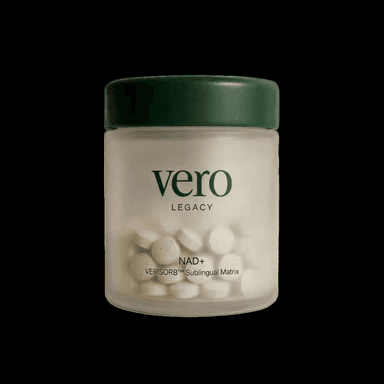
LEGACY™
NAD+Engineered around 300mg NAD+. Replenishes systemic NAD+ levels and drives mitochondrial function
Clinical Context
Important Notice: VERO protocols are nutritional and systemic optimisation formats. They are not intended to diagnose, treat, cure, or prevent any medical condition. These statements have not been evaluated by the Food and Drug Administration.